Recognition: unknown
Even a precessing clock is right twice per orbit -- The super-periods of eRO-QPE2 and challenges for quasi-periodic eruption orbital models
Pith reviewed 2026-05-10 16:19 UTC · model grok-4.3
The pith
The QPE timing of eRO-QPE2 matches apsidal precession for a specific EMRI configuration only when assuming one observed event per orbit.
A machine-rendered reading of the paper's core claim, the machinery that carries it, and where it could break.
Core claim
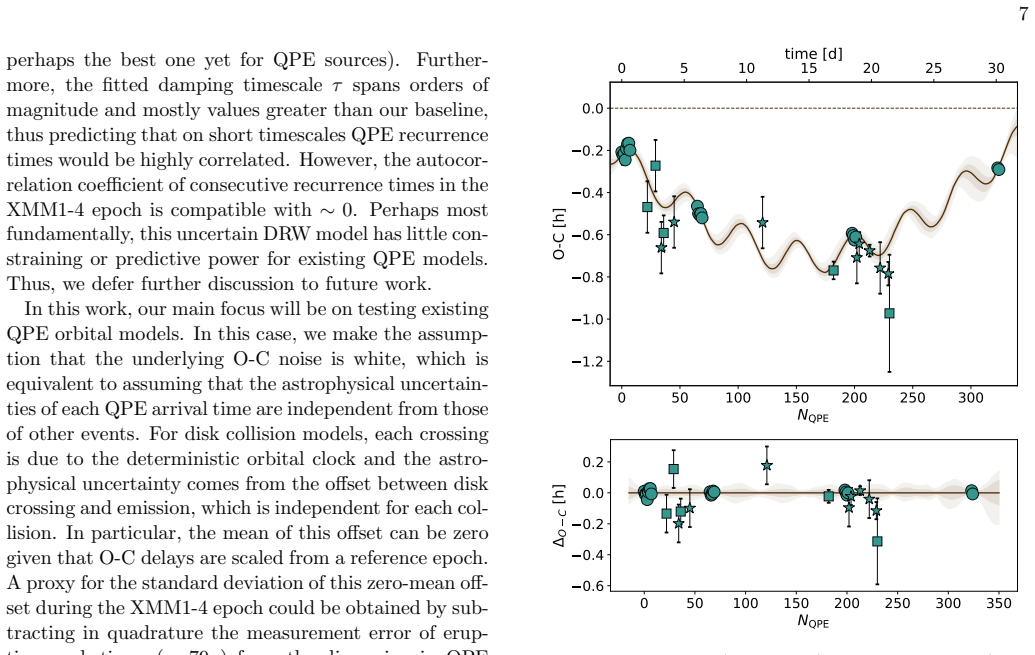
The central discovery is that the short super-period of 4.4 days in eRO-QPE2 is consistent with apsidal precession when the eruptions are interpreted as one per orbit, for parameters a ~ 140 R_g, e ~ 0.1, M_BH ~ 1.5e5 M_sun. The data show no measurable period derivative, disfavoring certain high-eccentricity or high-mass secondaries. The odd-even correlation in timing disfavors observing two crossings per orbit. No reliable fits are found with robust EMRI models.
What carries the argument
Hierarchical super-period analysis of the O-C residuals combined with model comparisons to apsidal precession, nodal precession, and full EMRI trajectories.
If this is right
- Absence of a measurable period derivative disfavors gravitational wave decay from high-eccentricity white dwarfs or massive eccentric intermediate-mass black holes as the QPE mechanism.
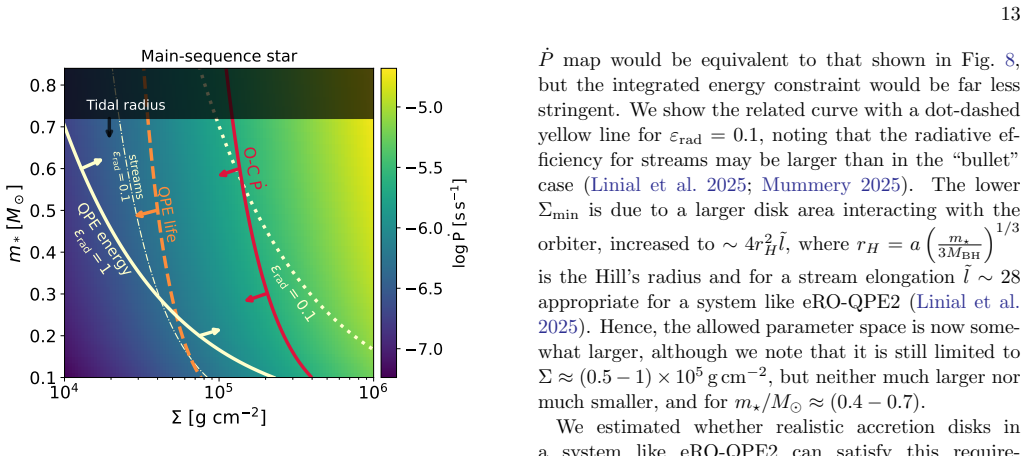
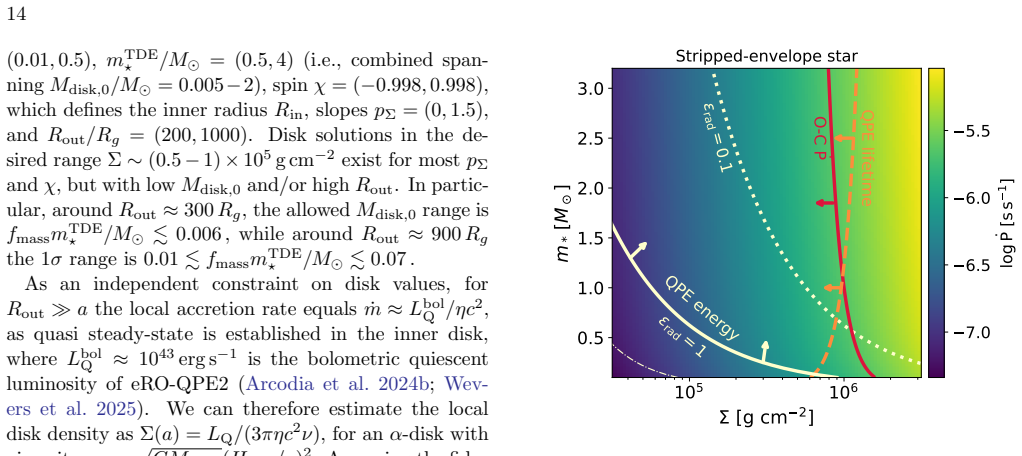
- Disk-collision models are constrained such that a main-sequence star secondary is unlikely without additional stellar debris, but stripped stars are still viable.
- The correlation between odd and even cycles in the O-C diagram indicates that not both per-orbit crossings are being observed.
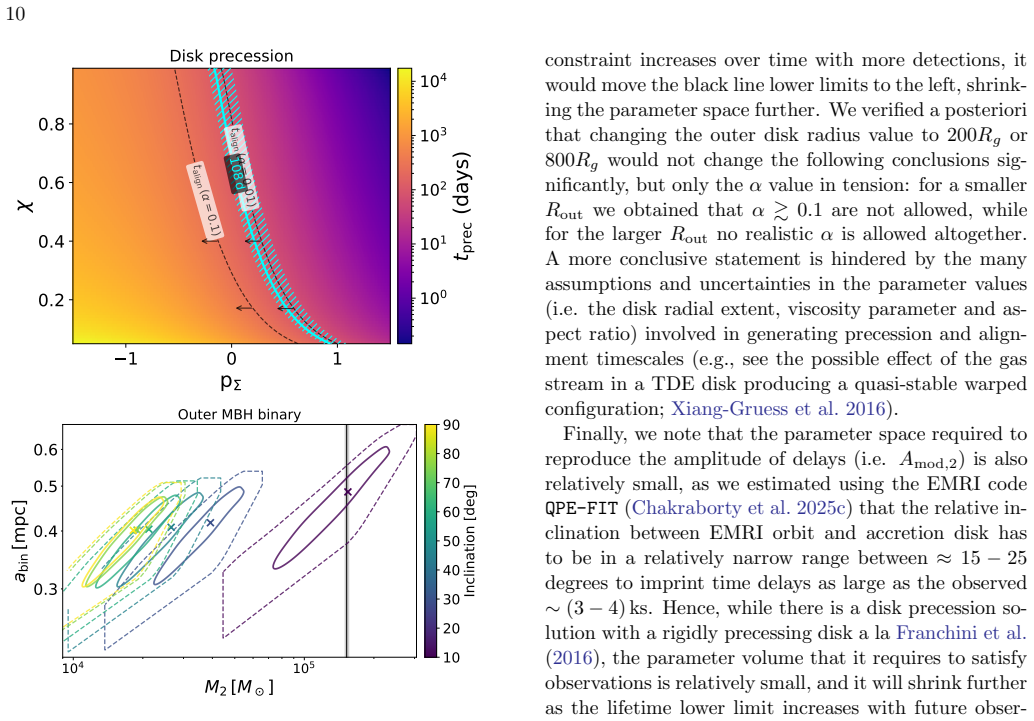
- The longer 95-day modulation allows for a possible hierarchical triple system with an outer black hole at 0.4 milliparsec, but is inconsistent with standard EMRI nodal precession.
Where Pith is reading between the lines
- If the orbital interpretation holds, future denser sampling could reveal whether the likelihood peaks broaden or if the model remains incompatible.
- Persistent failure of robust orbital models might point toward non-orbital origins for QPEs such as disk instabilities.
- Similar timing analyses on other QPE sources could determine if super-periodic behavior is a general feature or specific to eRO-QPE2.
Load-bearing premise
That the QPEs are driven by an underlying orbital clock with only one eruption observed per orbit rather than two crossings.
What would settle it
Detection of a negative period derivative at the level of 2 times 10 to the -6 s/s or successful convergence of EMRI trajectory models to a unique set of parameters with additional observations.
Figures




read the original abstract
We present O$-$C (``observed minus calculated'') timing analysis of the quasi-periodic eruption (QPE) source eRO-QPE2 with a multi-mission X-ray campaign, which includes 32 observed eruptions spanning a month (i.e. 325 QPE cycles). In relation to accretion (e.g. disk instability) models, the O-C is consistent with a damped random walk of the QPE recurrence, albeit with highly uncertain parameters. If instead an underlying orbital clock is present, eRO-QPE2 is consistent with a period of $P \sim 2.24$\,h and two hierarchical super-periodic modulations, with periods of $\sim 4.4$\,d ($\sim47$\,P) and $\approx 95$\,d ($\approx 1000$\,P). We found no negative period derivative, with $|\dot{P}| \lesssim 2 \times 10^{-6}$\,s/s at $3\sigma$. This disfavors high-eccentricity WDs and high-mass/eccentricity IMBHs via GW decay. For disk-collision models, where the $\dot{P}$ from gas drag and the QPE integrated energy provide bounds on the local disk density, a main-sequence star is disfavored as EMRI secondary unless stellar debris streams are present, while stripped stars remain allowed. The correlated odd/even O-C disfavors both disk crossings per orbit being observed. Interpreting the data with one \emph{observed} event per orbit, the short modulation is consistent with apsidal precession for $a \sim 140\,R_g$, $e \approx 0.1$, and $M_{\rm BH} \approx 1.5 \times 10^{5}\,M_\odot$. The longer modulation (much less constrained) is inconsistent with EMRI nodal precession and disk precession is allowed for a limited parameter volume, while there is a solution with a stable hierarchical triple system with an outer massive black hole at $\sim 0.4\,\mathrm{mpc}$ and mass $\sim(0.1-1) \times M_{\rm BH}$. However, no reliable solution can be found with more robust EMRI trajectory models, possibly due to narrow likelihood peaks in a multi-dimensional parameter space with sparse data.
Editorial analysis
A structured set of objections, weighed in public.
Referee Report
Summary. The manuscript reports O-C timing analysis of 32 QPE events from eRO-QPE2 spanning ~325 cycles. It finds the recurrence consistent with a damped random walk, or alternatively with an orbital period P ≈ 2.24 h modulated by super-periods of ~4.4 d and ~95 d. No negative P-dot is detected at 3σ, disfavoring high-eccentricity WDs and high-mass IMBHs. The odd/even O-C correlation disfavors two crossings per orbit. Under one observed event per orbit, the short super-period matches apsidal precession for a ≈ 140 R_g, e ≈ 0.1, M_BH ≈ 1.5×10^5 M_⊙. The long modulation allows a hierarchical triple solution but no reliable fits with robust EMRI models due to narrow likelihoods and sparse data.
Significance. The non-detection of period derivative provides a robust, data-driven constraint on EMRI evolutionary models. The multi-mission dataset is valuable for timing studies. If the orbital interpretation holds, it offers a potential mapping to GR precession effects, but the conditional nature due to model assumptions and lack of reliable robust-model solutions reduces the overall significance to suggestive constraints rather than firm conclusions.
major comments (2)
- Abstract: The statement that the correlated odd/even O-C disfavors both disk crossings per orbit being observed lacks a quantitative significance assessment or test against red-noise/sampling artifacts. With only 32 events, this correlation's robustness is critical for adopting the one-per-orbit assumption required to map the 4.4 d modulation to apsidal precession (a ~140 R_g, e~0.1, M_BH~1.5e5 M_⊙).
- Abstract: The manuscript explicitly states that no reliable solution can be found with more robust EMRI trajectory models due to narrow likelihood peaks and sparse data. This directly challenges the load-bearing claim of consistency with apsidal precession, indicating the inferred parameters may not be stable.
minor comments (2)
- The abstract is information-dense; separating the random-walk versus orbital-clock interpretations into distinct paragraphs would improve readability.
- Ensure consistent use of approximate symbols (∼ vs ≈) for periods and parameters throughout the text and figures.
Simulated Author's Rebuttal
We thank the referee for their detailed and constructive report. We address each major comment below and have revised the manuscript to incorporate quantitative tests and clearer caveats where the concerns are valid. Our responses aim to strengthen the presentation of the O-C analysis and its limitations without overstating the robustness of the orbital interpretation.
read point-by-point responses
-
Referee: Abstract: The statement that the correlated odd/even O-C disfavors both disk crossings per orbit being observed lacks a quantitative significance assessment or test against red-noise/sampling artifacts. With only 32 events, this correlation's robustness is critical for adopting the one-per-orbit assumption required to map the 4.4 d modulation to apsidal precession (a ~140 R_g, e~0.1, M_BH~1.5e5 M_⊙).
Authors: We agree that a formal statistical assessment is needed to quantify the odd/even correlation and rule out red-noise or sampling artifacts. In the revised manuscript we have added a Monte Carlo test that compares the observed odd/even O-C correlation against 10^4 realizations of a damped random walk with the same sampling and noise properties; the observed correlation is recovered in <0.5% of the simulations, corresponding to >3σ significance. We also explicitly state that this test supports (but does not prove) the one-event-per-orbit assumption, and we have updated the abstract and Section 3.3 accordingly. The limited event count remains a caveat, which we now emphasize more strongly. revision: yes
-
Referee: Abstract: The manuscript explicitly states that no reliable solution can be found with more robust EMRI trajectory models due to narrow likelihood peaks and sparse data. This directly challenges the load-bearing claim of consistency with apsidal precession, indicating the inferred parameters may not be stable.
Authors: The manuscript already flags this limitation in both the abstract and the discussion, presenting the apsidal-precession parameters only as a consistency check under simplified assumptions rather than a definitive solution. We have further revised the abstract and Section 4.2 to state explicitly that the (a, e, M_BH) values are illustrative and that the inability to obtain stable solutions with full EMRI trajectory models (due to narrow likelihood peaks and sparse sampling) precludes a robust orbital identification. The text now frames the short super-period as “suggestive of apsidal precession” and highlights the need for denser monitoring to break the degeneracies. revision: yes
Circularity Check
No significant circularity; data-driven fits interpreted via external GR formulas
full rationale
The paper extracts super-periods (~4.4 d and ~95 d) by direct fitting to the observed O-C residuals of 32 eruptions and then tests whether those fitted values are consistent with apsidal precession (or other mechanisms) by solving standard GR expressions for a, e, and M_BH. This is ordinary parameter estimation from data, not a reduction of the claimed result to the input by construction. The one-event-per-orbit assumption is stated explicitly as a conditional interpretation rather than derived or smuggled; no load-bearing self-citation, ansatz, or renaming of a known result occurs. The central numbers are therefore independent of the paper's own fitted quantities once the external GR formulas are accepted.
Axiom & Free-Parameter Ledger
free parameters (3)
- orbital period P
- short super-period
- long super-period
axioms (2)
- domain assumption An underlying orbital clock governs the QPE recurrence when the random-walk model is set aside.
- domain assumption Only one eruption is observed per orbit (not two disk crossings).
Reference graph
Works this paper leans on
-
[1]
M., Broggi, L., Sesana, A., & Bonetti, M
Allievi, C. M., Broggi, L., Sesana, A., & Bonetti, M. 2026, arXiv e-prints, arXiv:2603.02302, doi: 10.48550/arXiv.2603.02302
-
[2]
2021, Nature, 592, 704, doi: 10.1038/s41586-021-03394-6
Arcodia, R., Merloni, A., Nandra, K., et al. 2021, Nature, 592, 704, doi: 10.1038/s41586-021-03394-6
-
[3]
2022, A&A, 662, A49, doi: 10.1051/0004-6361/202243259
Arcodia, R., Miniutti, G., Ponti, G., et al. 2022, A&A, 662, A49, doi: 10.1051/0004-6361/202243259
-
[4]
2024a, A&A, 684, A64, doi: 10.1051/0004-6361/202348881
Arcodia, R., Liu, Z., Merloni, A., et al. 2024a, A&A, 684, A64, doi: 10.1051/0004-6361/202348881
-
[5]
2024b, A&A, 690, A80, doi: 10.1051/0004-6361/202451218
Arcodia, R., Linial, I., Miniutti, G., et al. 2024b, A&A, 690, A80, doi: 10.1051/0004-6361/202451218
-
[6]
2024c, A&A, 684, L14, doi: 10.1051/0004-6361/202348949
Arcodia, R., Merloni, A., Buchner, J., et al. 2024c, A&A, 684, L14, doi: 10.1051/0004-6361/202348949
-
[7]
2024d, A&A, 681, A97, doi: 10.1051/0004-6361/202347531
Arcodia, R., Merloni, A., Comparat, J., et al. 2024d, A&A, 681, A97, doi: 10.1051/0004-6361/202347531
-
[8]
2025, ApJ, 989, 13, doi: 10.3847/1538-4357/adec9b Astropy Collaboration, Price-Whelan, A
Arcodia, R., Baldini, P., Merloni, A., et al. 2025, ApJ, 989, 13, doi: 10.3847/1538-4357/adec9b Astropy Collaboration, Price-Whelan, A. M., Sip˝ ocz, B. M., et al. 2018, AJ, 156, 123, doi: 10.3847/1538-3881/aabc4f
-
[9]
2026, arXiv e-prints, arXiv:2602.03932, doi: 10.48550/arXiv.2602.03932
Baldini, P., Rau, A., Merloni, A., et al. 2026, arXiv e-prints, arXiv:2602.03932, doi: 10.48550/arXiv.2602.03932
-
[10]
2025, arXiv e-prints, arXiv:2512.13688, doi: 10.48550/arXiv.2512.13688
Bertassi, L., Charisi, M., Buscicchio, R., et al. 2025, arXiv e-prints, arXiv:2512.13688, doi: 10.48550/arXiv.2512.13688
-
[11]
Blanchet, L. 2014, Living Reviews in Relativity, 17, 2, doi: 10.12942/lrr-2014-2 Boh´ e, A., Marsat, S., & Blanchet, L. 2013, Classical and Quantum Gravity, 30, 135009, doi: 10.1088/0264-9381/30/13/135009
-
[12]
2019, PASP, 131, 108005, doi: 10.1088/1538-3873/aae7fc —
Buchner, J. 2019, PASP, 131, 108005, doi: 10.1088/1538-3873/aae7fc —. 2021, The Journal of Open Source Software, 6, 3001, doi: 10.21105/joss.03001
-
[13]
2024, arXiv e-prints, arXiv:2409.16908, doi: 10.48550/arXiv.2409.16908
Bykov, S., Gilfanov, M., Sunyaev, R., & Medvedev, P. 2024, arXiv e-prints, arXiv:2409.16908, doi: 10.48550/arXiv.2409.16908
-
[14]
2021, ApJL, 921, L40, doi: 10.3847/2041-8213/ac313b
Chakraborty, J., Kara, E., Masterson, M., et al. 2021, ApJL, 921, L40, doi: 10.3847/2041-8213/ac313b
-
[15]
2024, ApJ, 965, 12, doi: 10.3847/1538-4357/ad2941
Chakraborty, J., Arcodia, R., Kara, E., et al. 2024, ApJ, 965, 12, doi: 10.3847/1538-4357/ad2941
-
[16]
Chakraborty, J., Kara, E., Arcodia, R., et al. 2025a, arXiv e-prints, arXiv:2503.19013. https://arxiv.org/abs/2503.19013
-
[17]
2025b, arXiv e-prints, arXiv:2504.07167, doi: 10.48550/arXiv.2504.07167
Chakraborty, J., Kosec, P., Kara, E., et al. 2025b, arXiv e-prints, arXiv:2504.07167, doi: 10.48550/arXiv.2504.07167
-
[18]
Chakraborty, J., Drummond, L. V., Bonetti, M., et al. 2025c, ApJ, 992, 120, doi: 10.3847/1538-4357/ae003b 35
-
[19]
Chakraborty, J., Rappaport, S. A., Arcodia, R., et al. 2026, arXiv e-prints, arXiv:2602.16776. https://arxiv.org/abs/2602.16776
-
[20]
2023, ApJ, 947, 32, doi: 10.3847/1538-4357/acbfb6
Chen, J.-H., Shen, R.-F., & Liu, S.-F. 2023, ApJ, 947, 32, doi: 10.3847/1538-4357/acbfb6
-
[21]
Colpi, M., Danzmann, K., Hewitson, M., et al. 2024, arXiv e-prints, arXiv:2402.07571, doi: 10.48550/arXiv.2402.07571
work page internal anchor Pith review doi:10.48550/arxiv.2402.07571 2024
-
[22]
Dodd, S. A., Huang, X., Davis, S. W., & Ramirez-Ruiz, E. 2025, arXiv e-prints, arXiv:2506.19900, doi: 10.48550/arXiv.2506.19900 D’Orazio, D. J., Tiede, C., Zwick, L., Hayasaki, K., &
-
[23]
2025, arXiv e-prints, arXiv:2501.10509, doi: 10.48550/arXiv.2501.10509
Mayer, L. 2025, arXiv e-prints, arXiv:2501.10509, doi: 10.48550/arXiv.2501.10509
-
[24]
Evans, P. A., Beardmore, A. P., Page, K. L., et al. 2007, A&A, 469, 379, doi: 10.1051/0004-6361:20077530 —. 2009a, MNRAS, 397, 1177, doi: 10.1111/j.1365-2966.2009.14913.x —. 2009b, MNRAS, 397, 1177, doi: 10.1111/j.1365-2966.2009.14913.x
-
[25]
2016, MNRAS, 455, 1946, doi: 10.1093/mnras/stv2417
Franchini, A., Lodato, G., & Facchini, S. 2016, MNRAS, 455, 1946, doi: 10.1093/mnras/stv2417
-
[26]
2023, A&A, 675, A100, doi: 10.1051/0004-6361/202346565
Franchini, A., Bonetti, M., Lupi, A., et al. 2023, A&A, 675, A100, doi: 10.1051/0004-6361/202346565
-
[27]
Frank, J., King, A., & Raine, D. J. 2002, Accretion Power in Astrophysics: Third Edition
2002
-
[28]
2009, Classical and Quantum Gravity, 26, 135002, doi: 10.1088/0264-9381/26/13/135002
Fujita, R., & Hikida, W. 2009, Classical and Quantum Gravity, 26, 135002, doi: 10.1088/0264-9381/26/13/135002
-
[29]
Giustini, M., Miniutti, G., & Saxton, R. D. 2020, A&A, 636, L2, doi: 10.1051/0004-6361/202037610 G¨ otberg, Y., de Mink, S. E., Groh, J. H., et al. 2018, A&A, 615, A78, doi: 10.1051/0004-6361/201732274
-
[30]
2025, arXiv e-prints, arXiv:2504.12762, doi: 10.48550/arXiv.2504.12762
Guo, W., & Shen, R.-F. 2025, arXiv e-prints, arXiv:2504.12762, doi: 10.48550/arXiv.2504.12762
-
[31]
2025, arXiv e-prints, arXiv:2504.20148
Guolo, M., Mummery, A., Ingram, A., et al. 2025a, arXiv e-prints, arXiv:2504.20148. https://arxiv.org/abs/2504.20148
-
[32]
2025b, arXiv e-prints, arXiv:2501.03333, doi: 10.48550/arXiv.2501.03333
Guolo, M., Mummery, A., Wevers, T., et al. 2025b, arXiv e-prints, arXiv:2501.03333, doi: 10.48550/arXiv.2501.03333
-
[33]
Hajdu, G., Catelan, M., Jurcsik, J., et al. 2015, MNRAS, 449, L113, doi: 10.1093/mnrasl/slv024 Hern´ andez-Garc´ ıa, L., Chakraborty, J., S´ anchez-S´ aez, P., et al. 2025, arXiv e-prints, arXiv:2504.07169, doi: 10.48550/arXiv.2504.07169
-
[34]
2025, ApJ, 993, 186, doi: 10.3847/1538-4357/ae07ca
Huang, X., Linial, I., & Jiang, Y.-F. 2025, ApJ, 993, 186, doi: 10.3847/1538-4357/ae07ca
-
[35]
E., Aigrain, S., & Karastergiou, A
Ingram, A., Motta, S. E., Aigrain, S., & Karastergiou, A. 2021, MNRAS, 503, 1703, doi: 10.1093/mnras/stab609 Jankoviˇ c, T., Bonnerot, C., Karpov, S., & Jurca, A. 2026, arXiv e-prints, arXiv:2602.02656, doi: 10.48550/arXiv.2602.02656
-
[36]
2001, A&A, 365, L1, doi: 10.1051/0004-6361:20000036 Jos´ e, J., & Hernanz, M
Jansen, F., Lumb, D., Altieri, B., et al. 2001, A&A, 365, L1, doi: 10.1051/0004-6361:20000036
-
[37]
2025, ApJL, 983, L18, doi: 10.3847/2041-8213/adc456
Jiang, N., & Pan, Z. 2025, ApJL, 983, L18, doi: 10.3847/2041-8213/adc456
-
[38]
Kaur, K., Stone, N. C., & Gilbaum, S. 2023, MNRAS, 524, 1269, doi: 10.1093/mnras/stad1894
-
[39]
2020, MNRAS, 493, L120, doi: 10.1093/mnrasl/slaa020
King, A. 2020, MNRAS, 493, L120, doi: 10.1093/mnrasl/slaa020
-
[40]
Koen, C. 2006, MNRAS, 365, 489, doi: 10.1111/j.1365-2966.2005.09719.x
-
[41]
T.-L., Shibata, M., Kawaguchi, K., & Pelle, J
Lam, A. T.-L., Shibata, M., Kawaguchi, K., & Pelle, J. 2025, PhRvD, 112, 083006, doi: 10.1103/m2tv-l3z8
-
[42]
Linial, I., & Metzger, B. D. 2023, ApJ, 957, 34, doi: 10.3847/1538-4357/acf65b
-
[43]
Linial, I., Metzger, B. D., & Quataert, E. 2025, arXiv e-prints, arXiv:2506.10096, doi: 10.48550/arXiv.2506.10096
-
[44]
2024, Monthly Notice of the Royal Astronomical Society, 527, 4317, doi: 10.1093/mnras/stad3470
Linial, I., & Quataert, E. 2024, MNRAS, 527, 4317, doi: 10.1093/mnras/stad3470
-
[45]
2023, ApJ, 945, 86, doi: 10.3847/1538-4357/acbd3d
Linial, I., & Sari, R. 2023, ApJ, 945, 86, doi: 10.3847/1538-4357/acbd3d
-
[46]
2023, MNRAS, 524, 6247, doi: 10.1093/mnras/stad2203
Lu, W., & Quataert, E. 2023, MNRAS, 524, 6247, doi: 10.1093/mnras/stad2203
-
[47]
Classical and Quantum Gravity33(3), 035010 (2016) https://doi.org/ 10.1088/0264-9381/33/3/035010
Luo, J., Chen, L.-S., Duan, H.-Z., et al. 2016, Classical and Quantum Gravity, 33, 035010, doi: 10.1088/0264-9381/33/3/035010
-
[48]
Mardling, R. A., & Aarseth, S. J. 2001, MNRAS, 321, 398, doi: 10.1046/j.1365-8711.2001.03974.x
-
[49]
Middleton, M., G´ urpide, A., Kwan, T. M., et al. 2025, MNRAS, 537, 1688, doi: 10.1093/mnras/staf052
-
[50]
2023a, A&A, 674, L1, doi: 10.1051/0004-6361/202346653 —
Miniutti, G., Giustini, M., Arcodia, R., et al. 2023a, A&A, 674, L1, doi: 10.1051/0004-6361/202346653 —. 2023b, A&A, 670, A93, doi: 10.1051/0004-6361/202244512
-
[51]
Miniutti, G., Saxton, R. D., Giustini, M., et al. 2019, Nature, 573, 381, doi: 10.1038/s41586-019-1556-x
-
[52]
2025, A&A, 693, A179, doi: 10.1051/0004-6361/202452400
Miniutti, G., Franchini, A., Bonetti, M., et al. 2025, A&A, 693, A179, doi: 10.1051/0004-6361/202452400
-
[53]
2025, arXiv e-prints, arXiv:2504.21456
Mummery, A. 2025, arXiv e-prints, arXiv:2504.21456. https://arxiv.org/abs/2504.21456
-
[54]
2016, ARA&A, 54, 441, doi: 10.1146/annurev-astro-081915-023315
Naoz, S. 2016, ARA&A, 54, 441, doi: 10.1146/annurev-astro-081915-023315
-
[55]
Nicholl, M., Pasham, D. R., Mummery, A., et al. 2024, Nature, 634, 804, doi: 10.1038/s41586-024-08023-6
-
[56]
2023, ApJ, 952, 32, doi: 10.3847/1538-4357/acd180 36
Pan, X., Li, S.-L., & Cao, X. 2023, ApJ, 952, 32, doi: 10.3847/1538-4357/acd180 36
-
[57]
2024, arXiv e-prints, arXiv:2411.00289, doi: 10.48550/arXiv.2411.00289
Pasham, D., Kejriwal, S., Coughlin, E., et al. 2024, arXiv e-prints, arXiv:2411.00289, doi: 10.48550/arXiv.2411.00289
-
[58]
Payne, A. V., Shappee, B. J., Hinkle, J. T., et al. 2021, ApJ, 910, 125, doi: 10.3847/1538-4357/abe38d
-
[59]
Peters, P. C. 1964, Phys. Rev., 136, B1224, doi: 10.1103/PhysRev.136.B1224
-
[60]
Quintin, E., Webb, N. A., Guillot, S., et al. 2023, A&A, 675, A152, doi: 10.1051/0004-6361/202346440
-
[61]
Raj, A., & Nixon, C. J. 2021, ApJ, 909, 82, doi: 10.3847/1538-4357/abdc25
-
[62]
2021, Experimental Astronomy, 51, 1333, doi: 10.1007/s10686-021-09709-9
Sesana, A., Korsakova, N., Arca Sedda, M., et al. 2021, Experimental Astronomy, 51, 1333, doi: 10.1007/s10686-021-09709-9
-
[63]
2005, in Astronomical Society of the Pacific Conference Series, Vol
Sterken, C. 2005, in Astronomical Society of the Pacific Conference Series, Vol. 335, The Light-Time Effect in Astrophysics: Causes and cures of the O-C diagram, ed. C. Sterken, 3
2005
-
[64]
2012, PhRvL, 108, 061302, doi: 10.1103/PhysRevLett.108.061302
Stone, N., & Loeb, A. 2012, PhRvL, 108, 061302, doi: 10.1103/PhysRevLett.108.061302
-
[65]
2026, PASJ, 78, 185, doi: 10.1093/pasj/psaf132
Suzuguchi, T., Omiya, H., & Takeda, H. 2026, PASJ, 78, 185, doi: 10.1093/pasj/psaf132
-
[66]
2023, MNRAS, 526, 69, doi: 10.1093/mnras/stad2616 van de Meent, M
Tagawa, H., & Haiman, Z. 2023, MNRAS, 526, 69, doi: 10.1093/mnras/stad2616 van de Meent, M. 2020, Classical and Quantum Gravity, 37, 145007, doi: 10.1088/1361-6382/ab79d5
-
[67]
Vurm, I., Linial, I., & Metzger, B. D. 2025, ApJ, 983, 40, doi: 10.3847/1538-4357/adb74d
-
[68]
2022, ApJ, 933, 225, doi: 10.3847/1538-4357/ac75e6
Wang, M., Yin, J., Ma, Y., & Wu, Q. 2022, ApJ, 933, 225, doi: 10.3847/1538-4357/ac75e6
-
[69]
2025, ApJL, 980, L1, doi: 10.3847/2041-8213/adace9
Wevers, T., Guolo, M., Lockwood, S., et al. 2025, ApJL, 980, L1, doi: 10.3847/2041-8213/adace9
-
[70]
Wevers, T., French, K. D., Zabludoff, A. I., et al. 2024, ApJL, 970, L23, doi: 10.3847/2041-8213/ad5f1b
-
[71]
and Veitch, John and Messenger, Chris
Williams, M. J., Veitch, J., & Messenger, C. 2021, PhRvD, 103, 103006, doi: 10.1103/PhysRevD.103.103006
-
[72]
2025, ApJ, 987, 171, doi: 10.3847/1538-4357/add72d
Xian, J., Zhang, F., Dou, L., & Chen, Z. 2025, ApJ, 987, 171, doi: 10.3847/1538-4357/add72d
-
[73]
2021, ApJL, 921, L32, doi: 10.3847/2041-8213/ac31aa
Xian, J., Zhang, F., Dou, L., He, J., & Shu, X. 2021, ApJL, 921, L32, doi: 10.3847/2041-8213/ac31aa
-
[74]
Xiang-Gruess, M., Ivanov, P. B., & Papaloizou, J. C. B. 2016, MNRAS, 463, 2242, doi: 10.1093/mnras/stw2130
-
[75]
Z., Quataert, E., Jiang, Y.-F., Lu, W., & White, C
Yao, P. Z., Quataert, E., Jiang, Y.-F., Lu, W., & White, C. J. 2025, ApJ, 978, 91, doi: 10.3847/1538-4357/ad8911
-
[76]
2009, NewA, 14, 121, doi: 10.1016/j.newast.2008.06.002
Zasche, P., Liakos, A., Niarchos, P., et al. 2009, NewA, 14, 121, doi: 10.1016/j.newast.2008.06.002
-
[77]
Zeng, Y., & Pan, Z. 2026, arXiv e-prints, arXiv:2601.11925, doi: 10.48550/arXiv.2601.11925
-
[78]
2026, ApJ, 997, 134, doi: 10.3847/1538-4357/ae2600
Zhan, Y., Wang, D., Yi, S.-X., & Wang, F.-Y. 2026, ApJ, 997, 134, doi: 10.3847/1538-4357/ae2600
-
[79]
2024, PhRvD, 109, 103031, doi: 10.1103/PhysRevD.109.103031
Zhou, C., Huang, L., Guo, K., Li, Y.-P., & Pan, Z. 2024, PhRvD, 109, 103031, doi: 10.1103/PhysRevD.109.103031
-
[80]
2025a, MNRAS, 543, 1816, doi: 10.1093/mnras/staf1580
Zhou, C., Pan, Z., Jiang, N., & Zhao, W. 2025a, MNRAS, 543, 1816, doi: 10.1093/mnras/staf1580
discussion (0)
Sign in with ORCID, Apple, or X to comment. Anyone can read and Pith papers without signing in.