Recognition: 1 theorem link
· Lean TheoremParticle transformers for identifying Lorentz-boosted Higgs bosons decaying to a pair of W bosons
Pith reviewed 2026-05-10 16:12 UTC · model grok-4.3
The pith
PaRT tags boosted Higgs-to-WW jets at over 50 percent efficiency with 1 percent background while staying independent of jet mass.
A machine-rendered reading of the paper's core claim, the machinery that carries it, and where it could break.
Core claim
PaRT, a particle transformer that uses self-attention to weigh the contributions of individual particles inside a jet, identifies boosted Higgs bosons decaying to WW with tagging efficiency above 50 percent at a background efficiency of 1 percent while remaining decorrelated from the jet mass; data-to-simulation efficiency scale factors measured in 138 fb^{-1} of 13 TeV collisions fall between 0.9 and 1.0.
What carries the argument
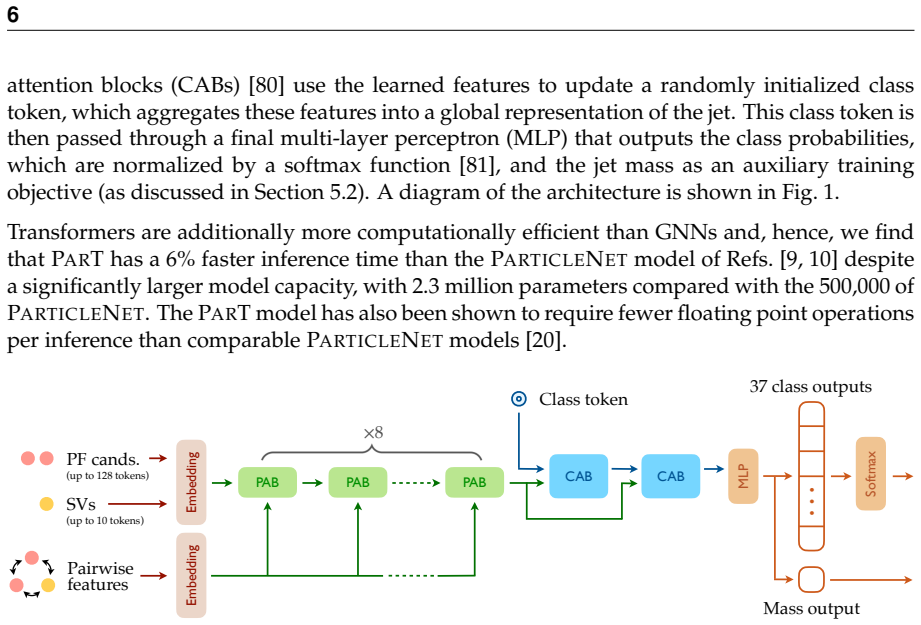
The PaRT classifier, a self-attention network that assigns importance weights to the particles reconstructed inside each jet to discriminate multipronged signal jets from background.
If this is right
- Standard-model measurements of diboson production gain sensitivity through improved signal selection.
- Searches for beyond-standard-model resonances decaying to hadronic dibosons can exploit the higher tagging efficiency.
- The mass-decorrelated output allows the jet mass to be used as an independent variable in fits or limits.
Where Pith is reading between the lines
- The same architecture could be retrained on other boosted resonances such as Z or top quarks with minimal changes to the input representation.
- Because the model operates on particle lists rather than fixed images, it may generalize to jets with variable numbers of constituents more readily than convolutional approaches.
- Combining PaRT scores with existing substructure variables could further reduce background in analyses that already use jet mass.
Load-bearing premise
Simulated events used for training capture the particle distributions and detector responses that actually occur in proton-proton collisions.
What would settle it
A tag-and-probe measurement of the signal efficiency in a data control sample, such as a sideband or a known resonance, that deviates significantly from the predicted value after all corrections.
Figures


read the original abstract
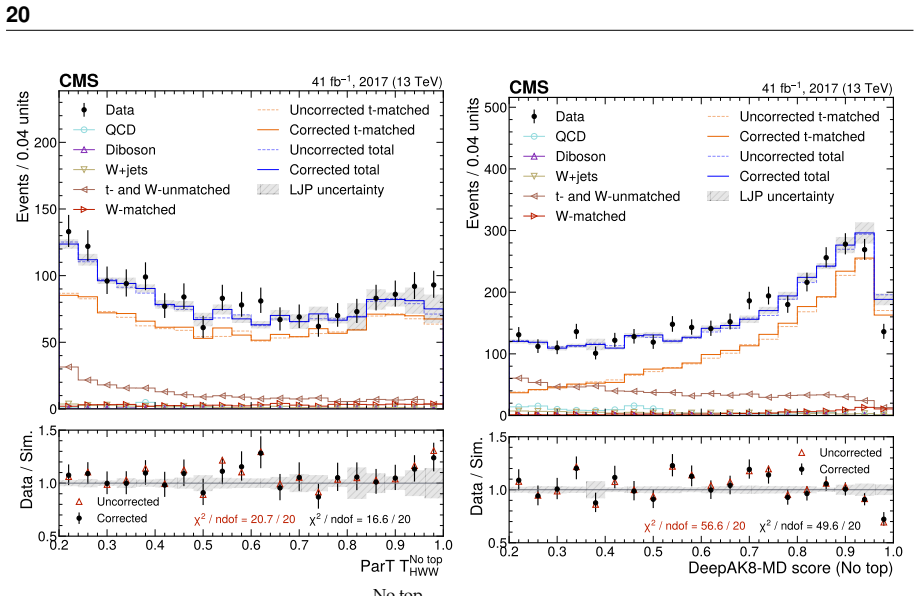
A novel deep neural network classifier, a ``Particle transformer'' (PaRT), is introduced for the identification of highly Lorentz-boosted resonances reconstructed as single, multipronged jets in measurements and searches performed by the CMS Collaboration at the CERN LHC. Based on a self-attention mechanism that allows the model to weigh the importance of different particles, PaRT is trained on a wide variety of topologies, notably demonstrating strong performance for the first time on jets originating from boosted Higgs boson decays to W bosons. The PaRT algorithm achieves a tagging efficiency of more than 50\% for such jets at a background efficiency of 1%, while maintaining decorrelation from the jet mass. A calibration is performed in proton-proton collision data collected by CMS at a center-of-mass energy of 13 TeV, with a data set corresponding to a total luminosity of 138 fb$^{-1}$. Data-to-simulation selection efficiency scale factors are measured to be in the 0.9$-$1.0 range, with relative uncertainties between 7 and 23%. The tagging capability of PaRT enhances the sensitivity of standard model measurements and searches for beyond-the-standard-model resonances decaying to hadronic diboson systems.
Editorial analysis
A structured set of objections, weighed in public.
Referee Report
Summary. The manuscript introduces a Particle Transformer (PaRT) deep neural network for identifying Lorentz-boosted Higgs bosons decaying to WW pairs, reconstructed as single multipronged jets. It reports a tagging efficiency exceeding 50% at 1% background efficiency while maintaining decorrelation from jet mass, trained on diverse simulated topologies, and provides a data calibration in 138 fb^{-1} of 13 TeV CMS collision data yielding scale factors of 0.9-1.0 with relative uncertainties of 7-23%. The work aims to enhance sensitivity for SM diboson measurements and BSM resonance searches.
Significance. If the reported performance and calibration hold, this provides a new tool for tagging boosted H->WW jets that could improve sensitivity in hadronic diboson analyses. The transformer architecture with self-attention on particle constituents represents a timely application to a difficult topology, and the explicit data-driven calibration step with scale factors near unity is a positive feature that mitigates simulation-to-data discrepancies.
minor comments (3)
- The abstract states the efficiency claim without referencing the specific pT or mass range over which it applies; this should be clarified in the results section with supporting figures.
- The data calibration section reports scale factors in the 0.9-1.0 range; it would strengthen the paper to include a table or plot showing the scale factors as a function of jet pT or mass, along with the breakdown of uncertainty sources.
- The claim of 'strong performance for the first time' on boosted H->WW should be supported by a direct comparison to existing taggers (e.g., DeepAK8 or ParticleNet) in the same topology, including efficiency curves.
Simulated Author's Rebuttal
We thank the referee for their positive assessment of our manuscript on the Particle Transformer (PaRT) algorithm and for recommending minor revision. We appreciate the recognition of the reported tagging performance for boosted H->WW jets, the decorrelation from jet mass, and the data-driven calibration yielding scale factors near unity. No specific major comments were provided in the report, so we have reviewed the manuscript for minor improvements in clarity and presentation while maintaining the core results.
Circularity Check
No significant circularity in the derivation chain
full rationale
The paper trains PaRT on simulated topologies, reports tagging efficiencies (>50% signal at 1% background with mass decorrelation) on held-out simulation, and derives data-to-simulation scale factors (0.9-1.0) from independent 13 TeV collision data (138 fb^{-1}). No equation or claim reduces by construction to a fitted parameter from the same inputs, no self-definitional loop exists, and no load-bearing self-citation or ansatz smuggling is invoked for the central performance metrics. The separation of training, evaluation, and calibration datasets keeps the reported results independent of the inputs used to generate them.
Axiom & Free-Parameter Ledger
axioms (1)
- domain assumption Simulated events accurately model the detector response, particle fragmentation, and underlying event for boosted diboson jets.
Lean theorems connected to this paper
-
IndisputableMonolith/Foundation/RealityFromDistinction.leanreality_from_one_distinction unclear?
unclearRelation between the paper passage and the cited Recognition theorem.
A novel deep neural network classifier, a 'Particle transformer' (PaRT), is introduced... self-attention mechanism... log-cosh loss... primary Lund jet plane calibration
What do these tags mean?
- matches
- The paper's claim is directly supported by a theorem in the formal canon.
- supports
- The theorem supports part of the paper's argument, but the paper may add assumptions or extra steps.
- extends
- The paper goes beyond the formal theorem; the theorem is a base layer rather than the whole result.
- uses
- The paper appears to rely on the theorem as machinery.
- contradicts
- The paper's claim conflicts with a theorem or certificate in the canon.
- unclear
- Pith found a possible connection, but the passage is too broad, indirect, or ambiguous to say the theorem truly supports the claim.
Forward citations
Cited by 1 Pith paper
-
Improved results on Higgs boson pair production in the 4b final state
CMS sets an observed upper limit of 4.4 on the HH signal strength μ_HH in the 4b final state at 13.6 TeV, improving prior LHC results by more than a factor of two in the resolved topology.
Reference graph
Works this paper leans on
-
[1]
CMS Collaboration, “Observation of a new boson at a mass of 125 GeV with the CMS experiment at the LHC”,Phys. Lett. B716(2012) 30, References 23 doi:10.1016/j.physletb.2012.08.021,arXiv:1207.7235
-
[2]
Observation of a new boson with mass near 125 GeV in pp collisions at √s=7 and 8 TeV
CMS Collaboration, “Observation of a new boson with mass near 125 GeV in pp collisions at √s=7 and 8 TeV”,JHEP06(2013) 081, doi:10.1007/JHEP06(2013)081,arXiv:1303.4571
-
[3]
ATLAS Collaboration, “Observation of a new particle in the search for the standard model Higgs boson with the ATLAS detector at the LHC”,Phys. Lett. B716(2012) 1, doi:10.1016/j.physletb.2012.08.020,arXiv:1207.7214
work page internal anchor Pith review doi:10.1016/j.physletb.2012.08.020 2012
-
[4]
CMS Collaboration, “Identification of heavy, energetic, hadronically decaying particles using machine-learning techniques”,JINST15(2020) P06005, doi:10.1088/1748-0221/15/06/P06005,arXiv:2004.08262
-
[5]
Performance of the mass-decorrelated DEEPDOUBLEX classifier for double-b and double-c large-radius jets with the CMS detector
CMS Collaboration, “Performance of the mass-decorrelated DEEPDOUBLEX classifier for double-b and double-c large-radius jets with the CMS detector”, CMS Detector Performance Summary CMS-DP-2022-041, 2022
2022
-
[6]
JEDI-net: a jet identification algorithm based on interaction networks
E. A. Moreno et al., “JEDI-net: a jet identification algorithm based on interaction networks”,Eur. Phys. J. C80(2020) 58,doi:10.1140/epjc/s10052-020-7608-4, arXiv:1908.05318
-
[7]
Interaction networks for the identification of boosted H→b b decays
E. A. Moreno et al., “Interaction networks for the identification of boosted H→b b decays”,Phys. Rev. D102(2020) 012010,doi:10.1103/PhysRevD.102.012010, arXiv:1909.12285
-
[8]
H. Qu and L. Gouskos, “PARTICLENET: Jet tagging via particle clouds”,Phys. Rev. D101 (2020) 056019,doi:10.1103/PhysRevD.101.056019,arXiv:1902.08570
-
[9]
Identification of highly Lorentz-boosted heavy particles using graph neural networks and new mass decorrelation techniques
CMS Collaboration, “Identification of highly Lorentz-boosted heavy particles using graph neural networks and new mass decorrelation techniques”, CMS Detector Performance Summary CMS-DP-2020-002, 2020
2020
-
[10]
Mass regression of highly-boosted jets using graph neural networks
CMS Collaboration, “Mass regression of highly-boosted jets using graph neural networks”, CMS Detector Performance Summary CMS-DP-2021-017, 2021
2021
-
[11]
CMS Collaboration, “Measurement of boosted Higgs bosons produced via vector boson fusion or gluon fusion in the H→b b decay mode using LHC proton-proton collision data at √s=13 TeV”,JHEP12(2024) 035,doi:10.1007/JHEP12(2024)035, arXiv:2407.08012
-
[12]
CMS Collaboration, “Search for Higgs boson decay to a charm quark-antiquark pair in proton-proton collisions at √s=13 TeV”,Phys. Rev. Lett.131(2023) 061801, doi:10.1103/PhysRevLett.131.061801,arXiv:2205.05550
-
[13]
Search for nonresonant pair production of highly energetic Higgs bosons decaying to bottom quarks
CMS Collaboration, “Search for nonresonant pair production of highly energetic Higgs bosons decaying to bottom quarks”,Phys. Rev. Lett.131(2023) 041803, doi:10.1103/PhysRevLett.131.041803,arXiv:2205.06667
-
[14]
CMS Collaboration, “Search for a massive scalar resonance decaying to a light scalar and a Higgs boson in the four b quarks final state with boosted topology”,Phys. Lett. B842 (2023) 137392,doi:10.1016/j.physletb.2022.137392,arXiv:2204.12413. 24
-
[15]
CMS Collaboration, “Search for resonant pair production of Higgs bosons in the b bb b final state using large-area jets in proton-proton collisions at √s=13 TeV”,JHEP02 (2025) 040,doi:10.1007/JHEP02(2025)040,arXiv:2407.13872
-
[16]
CMS Collaboration, “Search for heavy resonances decaying to a pair of Lorentz-boosted Higgs bosons in final states with leptons and a bottom quark pair at √s=13 TeV”,JHEP 05(2022) 005,doi:10.1007/JHEP05(2022)005,arXiv:2112.03161
-
[17]
CMS Collaboration, “Search for resonances decaying to three W bosons in the hadronic final state in proton-proton collisions at √s=13 TeV”,Phys. Rev. D106(2022) 012002, doi:10.1103/PhysRevD.106.012002,arXiv:2112.13090
-
[18]
Search for resonances decaying to three W bosons in proton-proton collisions at √s=13 TeV
CMS Collaboration, “Search for resonances decaying to three W bosons in proton-proton collisions at √s=13 TeV”,Phys. Rev. Lett.129(2022) 021802, doi:10.1103/PhysRevLett.129.021802,arXiv:2201.08476
-
[19]
A. J. Larkoski, I. Moult, and B. Nachman, “Jet substructure at the Large Hadron Collider: A review of recent advances in theory and machine learning”,Phys. Rept.841(2020) 1, doi:10.1016/j.physrep.2019.11.001,arXiv:1709.04464
-
[20]
Particle Transformer for Jet Tagging
H. Qu, C. Li, and S. Qian, “Particle transformer for jet tagging”, inProc. 39th Int. Conf. on Machine Learning, volume 162, p. 18281. 2022.arXiv:2202.03772
-
[21]
CMS Collaboration, “Search for a massive resonance decaying into a Higgs boson and a W or Z boson in hadronic final states in proton-proton collisions at √s=8 TeV”,JHEP 02(2016) 145,doi:10.1007/JHEP02(2016)145,arXiv:1506.01443
-
[22]
Theory and phenomenology of two-Higgs-doublet models
G. C. Branco et al., “Theory and phenomenology of two-Higgs-doublet models”,Phys. Rept.516(2012) 1,doi:10.1016/j.physrep.2012.02.002,arXiv:1106.0034
-
[23]
Searching for signs of the second Higgs doublet
N. Craig, J. Galloway, and S. Thomas, “Searching for signs of the second Higgs doublet”, 2013.arXiv:1305.2424
-
[24]
About the bosonic decays of heavy Higgs states in the (N)MSSM
F. Domingo and S. Paßehr, “About the bosonic decays of heavy Higgs states in the (N)MSSM”,Eur. Phys. J. C82(2022) 962, doi:10.1140/epjc/s10052-022-10919-4,arXiv:2207.05776
-
[25]
LHC signals from cascade decays of warped vector resonances
K. S. Agashe et al., “LHC signals from cascade decays of warped vector resonances”, JHEP05(2017) 078,doi:10.1007/JHEP05(2017)078,arXiv:1612.00047
-
[26]
Dedicated strategies for triboson signals from cascade decays of vector resonances
K. Agashe et al., “Dedicated strategies for triboson signals from cascade decays of vector resonances”,Phys. Rev. D99(2019) 075016,doi:10.1103/PhysRevD.99.075016, arXiv:1711.09920
-
[27]
Model-independent probe of anomalous heavy neutral Higgs bosons at the LHC
H.-Y. Ren, L.-H. Xia, and Y.-P . Kuang, “Model-independent probe of anomalous heavy neutral Higgs bosons at the LHC”,Phys. Rev. D90(2014) 115002, doi:10.1103/PhysRevD.90.115002,arXiv:1404.6367
-
[28]
Further investigation of the model-independent probe of heavy neutral Higgs bosons at LHC Run 2
Y.-P . Kuang, H.-Y. Ren, and L.-H. Xia, “Further investigation of the model-independent probe of heavy neutral Higgs bosons at LHC Run 2”,Chin. Phys. C40(2016) 023101, doi:10.1088/1674-1137/40/2/023101,arXiv:1506.08007
-
[29]
F. A. Dreyer, G. P . Salam, and G. Soyez, “The Lund jet plane”,JHEP12(2018) 064, doi:10.1007/JHEP12(2018)064,arXiv:1807.04758. References 25
-
[30]
A method for correcting the substructure of multiprong jets using the Lund jet plane
CMS Collaboration, “A method for correcting the substructure of multiprong jets using the Lund jet plane”,JHEP11(2025) 038,doi:10.1007/JHEP11(2025)038, arXiv:2507.07775
-
[31]
CMS Collaboration, “Combination of searches for nonresonant Higgs boson pair production in proton-proton collisions at √s=13 TeV”, 2025.arXiv:2510.07527. Submitted toJ. Phys. G
-
[32]
The CMS experiment at the CERN LHC
CMS Collaboration, “The CMS experiment at the CERN LHC”,JINST3(2008) S08004, doi:10.1088/1748-0221/3/08/S08004
-
[33]
Development of the CMS detector for the CERN LHC Run 3
CMS Collaboration, “Development of the CMS detector for the CERN LHC Run 3”, JINST19(2024) P05064,doi:10.1088/1748-0221/19/05/P05064, arXiv:2309.05466
-
[34]
Performance of the CMS Level-1 trigger in proton-proton collisions at √s=13 TeV
CMS Collaboration, “Performance of the CMS Level-1 trigger in proton-proton collisions at √s=13 TeV”,JINST15(2020) P10017, doi:10.1088/1748-0221/15/10/P10017,arXiv:2006.10165
-
[35]
CMS Collaboration, “The CMS trigger system”,JINST12(2017) P01020, doi:10.1088/1748-0221/12/01/P01020,arXiv:1609.02366
-
[36]
Performance of the CMS high-level trigger during LHC Run 2
CMS Collaboration, “Performance of the CMS high-level trigger during LHC Run 2”, JINST19(2024) P11021,doi:10.1088/1748-0221/19/11/P11021, arXiv:2410.17038
-
[37]
Electron and photon reconstruction and identification with the CMS experiment at the CERN LHC
CMS Collaboration, “Electron and photon reconstruction and identification with the CMS experiment at the CERN LHC”,JINST16(2021) P05014, doi:10.1088/1748-0221/16/05/P05014,arXiv:2012.06888
-
[38]
CMS Collaboration, “Performance of the CMS muon detector and muon reconstruction with proton-proton collisions at √s=13 TeV”,JINST13(2018) P06015, doi:10.1088/1748-0221/13/06/P06015,arXiv:1804.04528
work page internal anchor Pith review Pith/arXiv arXiv doi:10.1088/1748-0221/13/06/p06015 2018
-
[39]
Description and performance of track and primary-vertex reconstruction with the CMS tracker
CMS Collaboration, “Description and performance of track and primary-vertex reconstruction with the CMS tracker”,JINST9(2014) P10009, doi:10.1088/1748-0221/9/10/P10009,arXiv:1405.6569
-
[40]
The CMS phase-1 pixel detector upgrade
CMS Tracker Group, “The CMS phase-1 pixel detector upgrade”,JINST16(2021) P02027,doi:10.1088/1748-0221/16/02/P02027,arXiv:2012.14304
-
[41]
Track impact parameter resolution for the full pseudo rapidity coverage in the 2017 dataset with the CMS phase-1 pixel detector
CMS Collaboration, “Track impact parameter resolution for the full pseudo rapidity coverage in the 2017 dataset with the CMS phase-1 pixel detector”, CMS Detector Performance Summary CMS-DP-2020-049, 2020
2017
-
[42]
2017 tracking performance plots
CMS Collaboration, “2017 tracking performance plots”, CMS Detector Performance Summary CMS-DP-2017-015, 2017
2017
-
[43]
Particle-flow reconstruction and global event description with the CMS detector
CMS Collaboration, “Particle-flow reconstruction and global event description with the CMS detector”,JINST12(2017) P10003,doi:10.1088/1748-0221/12/10/P10003, arXiv:1706.04965
work page internal anchor Pith review Pith/arXiv arXiv doi:10.1088/1748-0221/12/10/p10003 2017
-
[44]
Technical proposal for the Phase-II upgrade of the Compact Muon Solenoid
CMS Collaboration, “Technical proposal for the Phase-II upgrade of the Compact Muon Solenoid”, CMS Technical Proposal CERN-LHCC-2015-010, CMS-TDR-15-02, 2015. 26
2015
-
[45]
Offline secondary vertex reconstruction in the CMS detector
CMS Collaboration, “Offline secondary vertex reconstruction in the CMS detector”,PoS LHCP2024(2025) 236,doi:10.22323/1.478.0236
-
[46]
M. Cacciari, G. P . Salam, and G. Soyez, “The anti-kT jet clustering algorithm”,JHEP04 (2008) 063,doi:10.1088/1126-6708/2008/04/063,arXiv:0802.1189
-
[47]
M. Cacciari, G. P . Salam, and G. Soyez, “FastJet user manual”,Eur. Phys. J. C72(2012) 1896,doi:10.1140/epjc/s10052-012-1896-2,arXiv:1111.6097
-
[48]
Pileup removal algorithms
CMS Collaboration, “Pileup removal algorithms”, CMS Physics Analysis Summary CMS-PAS-JME-14-001, 2014
2014
-
[49]
Pileup per particle identification
D. Bertolini, P . Harris, M. Low, and N. Tran, “Pileup per particle identification”,JHEP10 (2014) 059,doi:10.1007/JHEP10(2014)059,arXiv:1407.6013
-
[50]
Pileup mitigation at CMS in 13 TeV data
CMS Collaboration, “Pileup mitigation at CMS in 13 TeV data”,JINST15(2020) P09018, doi:10.1088/1748-0221/15/09/P09018,arXiv:2003.00503
-
[51]
Jet energy scale and resolution in the CMS experiment in pp collisions at 8 TeV
CMS Collaboration, “Jet energy scale and resolution in the CMS experiment in pp collisions at 8 TeV”,JINST12(2017) P02014, doi:10.1088/1748-0221/12/02/P02014,arXiv:1607.03663
-
[52]
S. Catani, Y. L. Dokshitzer, M. H. Seymour, and B. R. Webber, “Longitudinally invariant kT clustering algorithms for hadron hadron collisions”,Nucl. Phys. B406(1993) 187, doi:10.1016/0550-3213(93)90166-M
-
[53]
Successive combination jet algorithm for hadron collisions
S. D. Ellis and D. E. Soper, “Successive combination jet algorithm for hadron collisions”, Phys. Rev. D48(1993) 3160,doi:10.1103/PhysRevD.48.3160, arXiv:hep-ph/9305266
-
[54]
Better jet clustering algorithms
Y. L. Dokshitzer, G. D. Leder, S. Moretti, and B. R. Webber, “Better jet clustering algorithms”,JHEP08(1997) 001,doi:10.1088/1126-6708/1997/08/001, arXiv:hep-ph/9707323
-
[55]
M. Wobisch and T. Wengler, “Hadronization corrections to jet cross-sections in deep inelastic scattering”, inProc. Workshop on Monte Carlo Generators for HERA Physics, p. 270. 1998.arXiv:hep-ph/9907280
work page internal anchor Pith review arXiv 1998
-
[56]
A. J. Larkoski, S. Marzani, G. Soyez, and J. Thaler, “Soft drop”,JHEP05(2014) 146, doi:10.1007/JHEP05(2014)146,arXiv:1402.2657
-
[57]
Jet flavour classification using DeepJet
E. Bols et al., “Jet flavour classification using DeepJet”,JINST15(2020) P12012, doi:10.1088/1748-0221/15/12/P12012,arXiv:2008.10519
-
[58]
CMS Collaboration, “Performance of missing transverse momentum reconstruction in proton-proton collisions at √s=13 TeV using the CMS detector”,JINST14(2019) P07004,doi:10.1088/1748-0221/14/07/P07004,arXiv:1903.06078
-
[59]
J. Alwall et al., “The automated computation of tree-level and next-to-leading order differential cross sections, and their matching to parton shower simulations”,JHEP07 (2014) 079,doi:10.1007/JHEP07(2014)079,arXiv:1405.0301
-
[60]
On the spin and parity of a single-produced resonance at the LHC
S. Bolognesi et al., “On the spin and parity of a single-produced resonance at the LHC”, Phys. Rev. D86(2012) 095031,doi:10.1103/PhysRevD.86.095031, arXiv:1208.4018. References 27
-
[61]
Particle Data Group, “Review of particle physics”,Phys. Rev. D110(2024) 030001, doi:10.1103/PhysRevD.110.030001
-
[62]
T. Sj ¨ostrand et al., “An introduction toPYTHIA8.2”,Comput. Phys. Commun.191(2015) 159,doi:10.1016/j.cpc.2015.01.024,arXiv:1410.3012
-
[63]
Pileup subtraction using jet areas
M. Cacciari and G. P . Salam, “Pileup subtraction using jet areas”,Phys. Lett. B659(2008) 119,doi:10.1016/j.physletb.2007.09.077,arXiv:0707.1378
-
[64]
A New Method for Combining NLO QCD with Shower Monte Carlo Algorithms
P . Nason, “A new method for combining NLO QCD with shower Monte Carlo algorithms”,JHEP11(2004) 040,doi:10.1088/1126-6708/2004/11/040, arXiv:hep-ph/0409146
work page internal anchor Pith review doi:10.1088/1126-6708/2004/11/040 2004
-
[65]
Matching NLO QCD computations with Parton Shower simulations: the POWHEG method
S. Frixione, P . Nason, and C. Oleari, “Matching NLO QCD computations with parton shower simulations: thePOWHEGmethod”,JHEP11(2007) 070, doi:10.1088/1126-6708/2007/11/070,arXiv:0709.2092
work page internal anchor Pith review doi:10.1088/1126-6708/2007/11/070 2007
-
[66]
A general framework for implementing NLO calculations in shower Monte Carlo programs: the POWHEG BOX
S. Alioli, P . Nason, C. Oleari, and E. Re, “A general framework for implementing NLO calculations in shower Monte Carlo programs: thePOWHEGbox”,JHEP06(2010) 043, doi:10.1007/JHEP06(2010)043,arXiv:1002.2581
work page internal anchor Pith review doi:10.1007/jhep06(2010)043 2010
-
[67]
Higgs production via gluon fusion in thePOWHEGapproach in the SM and in the MSSM
E. Bagnaschi, G. Degrassi, P . Slavich, and A. Vicini, “Higgs production via gluon fusion in thePOWHEGapproach in the SM and in the MSSM”,JHEP02(2012) 088, doi:10.1007/JHEP02(2012)088,arXiv:1111.2854
-
[68]
Higgs boson pair production at NNLO with top quark mass effects
M. Grazzini et al., “Higgs boson pair production at NNLO with top quark mass effects”, JHEP05(2018) 059,doi:10.1007/JHEP05(2018)059,arXiv:1803.02463
-
[69]
Neutral Higgs boson pair production at hadron colliders: QCD corrections
S. Dawson, S. Dittmaier, and M. Spira, “Neutral Higgs boson pair production at hadron colliders: QCD corrections”,Phys. Rev. D58(1998) 115012, doi:10.1103/PhysRevD.58.115012,arXiv:hep-ph/9805244
-
[70]
Higgs boson pair production at next-to-next-to-leading order in QCD
D. de Florian and J. Mazzitelli, “Higgs boson pair production at next-to-next-to-leading order in QCD”,Phys. Rev. Lett.111(2013) 201801, doi:10.1103/PhysRevLett.111.201801,arXiv:1309.6594
-
[71]
Higgs pair production at next-to-next-to-leading logarithmic accuracy at the LHC
D. de Florian and J. Mazzitelli, “Higgs pair production at next-to-next-to-leading logarithmic accuracy at the LHC”,JHEP09(2015) 053, doi:10.1007/JHEP09(2015)053,arXiv:1505.07122
-
[72]
Gluon fusion into Higgs pairs at NLO QCD and the top mass scheme
J. Baglio et al., “Gluon fusion into Higgs pairs at NLO QCD and the top mass scheme”, Eur. Phys. J. C79(2019) 459,doi:10.1140/epjc/s10052-019-6973-3, arXiv:1811.05692
-
[73]
S. Borowka et al., “Higgs boson pair production in gluon fusion at next-to-leading order with full top-quark mass dependence”,Phys. Rev. Lett.117(2016) 012001, doi:10.1103/PhysRevLett.117.012001,arXiv:1604.06447. [Erratum: doi:10.1103/PhysRevLett.117.079901]
-
[74]
Threshold resummation effects in Higgs boson pair production at the LHC
D. Y. Shao, C. S. Li, H. T. Li, and J. Wang, “Threshold resummation effects in Higgs boson pair production at the LHC”,JHEP07(2013) 169,doi:10.1007/JHEP07(2013)169, arXiv:1301.1245. 28
-
[75]
Extraction and validation of a new set of CMS PYTHIA8 tunes from underlying-event measurements
CMS Collaboration, “Extraction and validation of a new set of CMSPYTHIA8 tunes from underlying-event measurements”,Eur. Phys. J. C80(2020) 4, doi:10.1140/epjc/s10052-019-7499-4,arXiv:1903.12179
-
[76]
Ball, et al., JHEP04, 040 (2015)
NNPDF Collaboration, “Parton distributions for the LHC Run II”,JHEP04(2015) 040, doi:10.1007/JHEP04(2015)040,arXiv:1410.8849
-
[77]
Parton distributions from high-precision collider data
NNPDF Collaboration, “Parton distributions from high-precision collider data”,Eur. Phys. J. C77(2017) 663,doi:10.1140/epjc/s10052-017-5199-5, arXiv:1706.00428
work page internal anchor Pith review Pith/arXiv arXiv doi:10.1140/epjc/s10052-017-5199-5 2017
-
[78]
GEANT4 Collaboration, “GEANT4—a simulation toolkit”,Nucl. Instrum. Meth. A506 (2003) 250,doi:10.1016/S0168-9002(03)01368-8
-
[79]
A. Vaswani et al., “Attention is all you need”, inProc. 31st Int. Conf. on Neural Information Processing Systems, NIPS’17, p. 6000. Curran Associates Inc., Red Hook, NY, USA, 2017. arXiv:1706.03762
work page internal anchor Pith review Pith/arXiv arXiv 2017
-
[80]
Multiscale Vision Transformers , isbn =
H. Touvron et al., “Going deeper with image transformers”, inProc. IEEE/CVF Int. Conf. on Computer Vision (ICCV), p. 32. 2021.arXiv:2103.17239. doi:10.1109/ICCV48922.2021.00010
discussion (0)
Sign in with ORCID, Apple, or X to comment. Anyone can read and Pith papers without signing in.