Agentic Workflows for Resolving Conflict Over Shared Resources: A Power Grid Application
Pith reviewed 2026-05-10 17:09 UTC · model grok-4.3
The pith
A framework coordinates LLM agents by resolving conflicts over shared power grid resources through negotiation, mediation, and deterministic rules.
A machine-rendered reading of the paper's core claim, the machinery that carries it, and where it could break.
Core claim
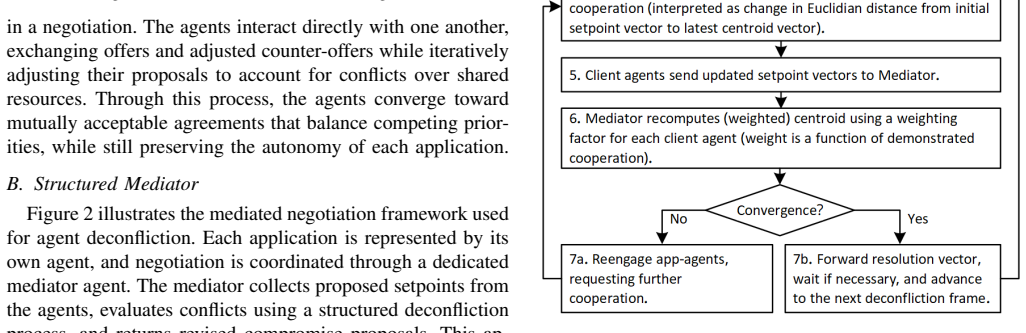
The authors establish that conflicts among actions proposed by formally encapsulated LLM client agents over shared resources can be resolved through a domain-agnostic framework that uses bilateral negotiation, structured mediation, and procedural deconfliction, supported by chain-of-thought reasoning in the agents and an iterative weighted-consensus mechanism that avoids optimization requirements on the applications. This is shown in a power grid demonstration coordinating advanced distribution management system applications for cost optimization and resilience.
What carries the argument
The three-mode deconfliction framework consisting of bilateral negotiation, structured mediation, and procedural (deterministic) deconfliction, together with chain-of-thought client agent reasoning and an iterative weighted-consensus mechanism.
If this is right
- Cost optimization and resilience applications can coordinate their use of shared generators and storage without each solving a joint optimization.
- Both numeric decisions such as power setpoints and non-numeric decisions can be handled within the same structure.
- The framework remains domain agnostic and does not require redesign of the individual applications.
- An iterative consensus step can aggregate proposals from multiple agents while preserving individual application logic.
Where Pith is reading between the lines
- The same negotiation-plus-consensus pattern could be applied to other shared-resource settings such as traffic signal control or cloud resource allocation.
- If the modes prove reliable at scale, distributed energy systems might operate with lighter central oversight than traditional centralized optimization.
- Additional validation could involve measuring how often the procedural mode is invoked versus negotiation in larger agent populations.
Load-bearing premise
LLM-based client agents that use chain-of-thought reasoning will generate proposals consistent enough for the three deconfliction modes and weighted consensus to produce reliable outcomes without the applications themselves solving optimization problems.
What would settle it
A simulation run in the power distribution use case where the weighted-consensus mechanism fails to yield a feasible schedule for the diesel generators and battery systems when the agents propose conflicting actions.
Figures

read the original abstract
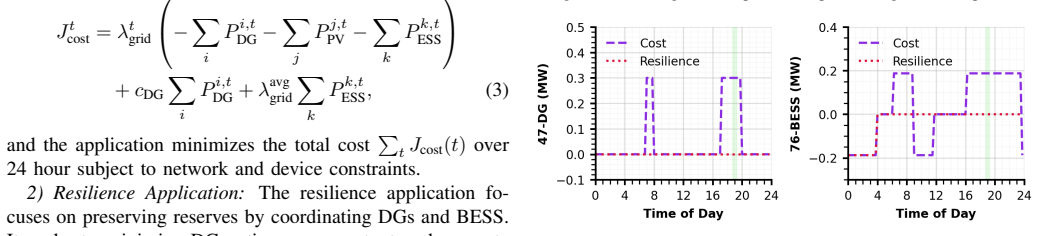
The increasing use of LLM-based agents to support decision-making and control across diverse domains motivates the need for systematic deconfliction of their proposed actions. We present a deconfliction framework for coordinating multiple agents that formally encapsulate individual applications, each proposing potentially conflicting actions over shared resources. Conflicts are resolved through three deconfliction modes: bilateral negotiation, structured mediation, and procedural (deterministic) deconfliction. We define design principles for large language model-based client agents, including a chain-of-thought style reasoning process, and introduce an iterative weighted-consensus mechanism that does not require the applications themselves to solve optimization problems. The framework is domain agnostic and supports both numeric and non-numeric decisions. Its performance is demonstrated on a power distribution use case with conflicting advanced distribution management system applications for cost optimization and resilience, coordinating diesel generators and battery energy storage systems.
Editorial analysis
A structured set of objections, weighed in public.
Referee Report
Summary. The manuscript presents a deconfliction framework for coordinating multiple LLM-based agents that encapsulate individual applications proposing potentially conflicting actions over shared resources. Conflicts are resolved using three modes—bilateral negotiation, structured mediation, and procedural (deterministic) deconfliction—supported by chain-of-thought reasoning design principles for the agents and an iterative weighted-consensus mechanism that avoids requiring the applications to solve optimization problems. The framework is domain-agnostic and is demonstrated on a power-distribution use case coordinating cost-optimization and resilience applications over diesel generators and battery energy storage systems.
Significance. If the central claims hold, the work offers a lightweight, optimization-free approach to multi-agent coordination that could enable scalable deployment of heterogeneous LLM agents in critical infrastructure domains such as power systems. The explicit separation of application logic from deconfliction and the support for both numeric and non-numeric decisions are strengths that distinguish it from traditional centralized solvers.
major comments (2)
- [Power-grid use-case section] Power-grid use-case section: the three deconfliction modes and weighted-consensus procedure contain no projection step onto the feasible set defined by the nonlinear AC power-flow equations, voltage limits, line capacities, or device ratings. Because any admissible action vector must satisfy Kirchhoff’s laws and operational constraints, the absence of such a mechanism is load-bearing for the claim that the framework successfully coordinates the applications.
- [Demonstration section] Demonstration section: the manuscript supplies no quantitative results (e.g., feasibility rate, cost or resilience improvement, convergence iterations, or comparison against a centralized OPF baseline), so it is impossible to verify whether the deconflicted actions are physically realizable or outperform existing methods.
minor comments (1)
- [Abstract] The abstract states that performance is “demonstrated” but does not report any outcome metrics; adding a single sentence summarizing key indicators would improve readability.
Simulated Author's Rebuttal
We thank the referee for their constructive and detailed comments. We address each major comment point-by-point below, providing clarifications on the framework's scope and indicating revisions where appropriate to strengthen the manuscript.
read point-by-point responses
-
Referee: [Power-grid use-case section] Power-grid use-case section: the three deconfliction modes and weighted-consensus procedure contain no projection step onto the feasible set defined by the nonlinear AC power-flow equations, voltage limits, line capacities, or device ratings. Because any admissible action vector must satisfy Kirchhoff’s laws and operational constraints, the absence of such a mechanism is load-bearing for the claim that the framework successfully coordinates the applications.
Authors: We acknowledge that the deconfliction modes and weighted-consensus procedure do not incorporate an explicit projection onto the feasible set defined by AC power-flow equations, voltage limits, line capacities, or device ratings. The framework is deliberately designed as a high-level, domain-agnostic coordination layer that resolves conflicts among LLM agents without requiring any agent to solve optimization problems, including power-flow optimizations. In the power-grid use case, each application agent is assumed to propose actions that respect local device ratings and constraints; the deconfliction then ensures cross-agent consistency via negotiation, mediation, or procedural rules. Network-level feasibility (Kirchhoff’s laws and global constraints) is intended to be handled by a subsequent low-level controller or OPF solver after deconfliction, which aligns with the separation of application logic from deconfliction emphasized in the manuscript. We will revise the use-case section to explicitly articulate this architectural boundary, discuss integration points with power-flow tools, and note that physical realizability is not claimed to be guaranteed solely by the deconfliction process. revision: partial
-
Referee: [Demonstration section] Demonstration section: the manuscript supplies no quantitative results (e.g., feasibility rate, cost or resilience improvement, convergence iterations, or comparison against a centralized OPF baseline), so it is impossible to verify whether the deconflicted actions are physically realizable or outperform existing methods.
Authors: The demonstration section is currently illustrative, using a concrete power-distribution scenario to show how bilateral negotiation, structured mediation, procedural deconfliction, and the iterative weighted-consensus mechanism operate on conflicting proposals from cost-optimization and resilience applications. We agree that quantitative metrics would strengthen the evaluation. In the revised manuscript we will expand this section to report convergence iterations, conflict-resolution success rate across example runs, and outcome values for cost and resilience metrics. Physical realizability will be addressed by confirming that example actions remain within device ratings and by noting that downstream feasibility enforcement is assumed. A direct comparison to a centralized OPF baseline is not straightforward given our optimization-free design, but we will include a baseline comparison against simple priority-based or random conflict resolution to quantify coordination benefits. revision: yes
Circularity Check
No circularity: framework is definitional and demonstrated empirically without reducing predictions to inputs
full rationale
The manuscript presents a conceptual deconfliction framework consisting of three modes (bilateral negotiation, structured mediation, procedural deconfliction) plus an iterative weighted-consensus mechanism for LLM agents using chain-of-thought reasoning. No equations, optimization formulations, fitted parameters, or first-principles derivations appear in the provided text. The power-grid use case is described as a demonstration rather than a quantitative prediction that could collapse to a fit. No self-citation chains, uniqueness theorems, or ansatzes are invoked as load-bearing mathematical steps. The central claim—that the modes resolve conflicts without applications solving optimization problems—remains an architectural assertion whose validity is left to empirical testing, not enforced by construction from the inputs.
Axiom & Free-Parameter Ledger
Reference graph
Works this paper leans on
-
[1]
A survey on multi agent system and its applications in power system engineering,
M. W. Y . Donget al., “A survey on multi agent system and its applications in power system engineering,”Journal of Computational Intelligence in Materials Science, vol. 1, pp. 001–011, 2023
work page 2023
-
[2]
Application of large language models in power system operation and control,
Y . Zhang, “Application of large language models in power system operation and control,”J. Comput. Electron. Inf. Manage., vol. 15, no. 3, pp. 79–83, 2024
work page 2024
-
[3]
S. Mathes,et al., “Collaborative framework on responsible ai in llm- driven cdss for precision oncology leveraging real-world patient data,” npj Precision Oncology, 2025
work page 2025
-
[4]
F. Aghaee and H. R. Shaker, “Rb-llm control: An intelligent con- trol framework with rule-based largelanguage model decision-making,” Aerospace Science and Technology, p. 111259, 2025
work page 2025
-
[5]
A review on enhancing agricul- tural intelligence with large language models,
H. Li, H. Wu, Q. Li, and C. Zhao, “A review on enhancing agricul- tural intelligence with large language models,”Artificial Intelligence in Agriculture, vol. 15, no. 4, pp. 671–685, 2025
work page 2025
-
[6]
A. P. Reiman, S. Poudel, M. Mukherjee, A. A. Anderson, O. Vasios, T. E. Slay, G. D. Black, A. Dubey, and J. P. Ogle, “App deconfliction: Orchestrating distributed, multi-agent, multi-objective operations for power systems,”IEEE Access, vol. 11, pp. 40314–40327, 2023
work page 2023
-
[7]
Ai agents vs. agentic ai: A conceptual taxonomy, applications and challenges,
R. Sapkota, K. I. Roumeliotis, and M. Karkee, “Ai agents vs. agentic ai: A conceptual taxonomy, applications and challenges,”Information Fusion, p. 103599, 2025
work page 2025
-
[8]
Decentralized cooperative conflict resolution among multiple autonomous mobile agents,
L. Pallottino, V . G. Scordio, and A. Bicchi, “Decentralized cooperative conflict resolution among multiple autonomous mobile agents,” in2004 43rd IEEE Conference on Decision and Control (CDC)(IEEE Cat. No. 04CH37601), vol. 5, pp. 4758–4763, IEEE, 2004
work page 2004
-
[9]
Decision making in multiagent systems: A survey,
Y . Rizk, M. Awad, and E. W. Tunstel, “Decision making in multiagent systems: A survey,”IEEE Transactions on Cognitive and Developmental Systems, vol. 10, no. 3, pp. 514–529, 2018
work page 2018
-
[10]
Consensus problems in networks of agents with switching topology and time-delays,
R. Olfati-Saber and R. M. Murray, “Consensus problems in networks of agents with switching topology and time-delays,”IEEE Transactions on automatic control, vol. 49, no. 9, pp. 1520–1533, 2004
work page 2004
-
[11]
Game theoretic orchestration for cooperation among power distribution system appli- cations,
A. P. Reiman, R. Sadnan, T. Slay, and M. Mukherjee, “Game theoretic orchestration for cooperation among power distribution system appli- cations,” in2024 IEEE Green Technologies Conference (GreenTech), pp. 232–236, 2024
work page 2024
-
[12]
S. Poudel, M. Mukherjee, R. Sadnan, and A. P. Reiman, “Fairness- aware distributed energy coordination for voltage regulation in power distribution systems,”IEEE Transactions on Sustainable Energy, vol. 14, no. 3, pp. 1866–1880, 2023
work page 2023
discussion (0)
Sign in with ORCID, Apple, or X to comment. Anyone can read and Pith papers without signing in.