Recognition: unknown
Coupling Designs for Randomized Experiments with Complex Treatments
Pith reviewed 2026-05-10 15:39 UTC · model grok-4.3
The pith
Assigning highly dissimilar treatments to similar units improves estimation efficiency in randomized experiments with complex treatments.
A machine-rendered reading of the paper's core claim, the machinery that carries it, and where it could break.
Core claim
Coupling designs match experimental units into homogeneous groups and then apply Monte Carlo coupling to assign within-group treatments that are highly dispersed over the treatment space. This produces efficiency gains proportional to the product of dispersion (spread of assignments relative to independent randomization) and match quality, with a spectral analysis revealing that the gains depend on alignment between the estimator's influence function and the coupling's principal directions.
What carries the argument
Coupling design: first match units into homogeneous groups, then use Monte Carlo coupling to assign highly dispersed treatments within each group.
If this is right
- Efficiency gains increase with greater dispersion of within-group treatment assignments.
- Higher match quality in group formation directly multiplies the efficiency improvement.
- The design applies to continuous, constrained multivariate, text, and image treatment spaces.
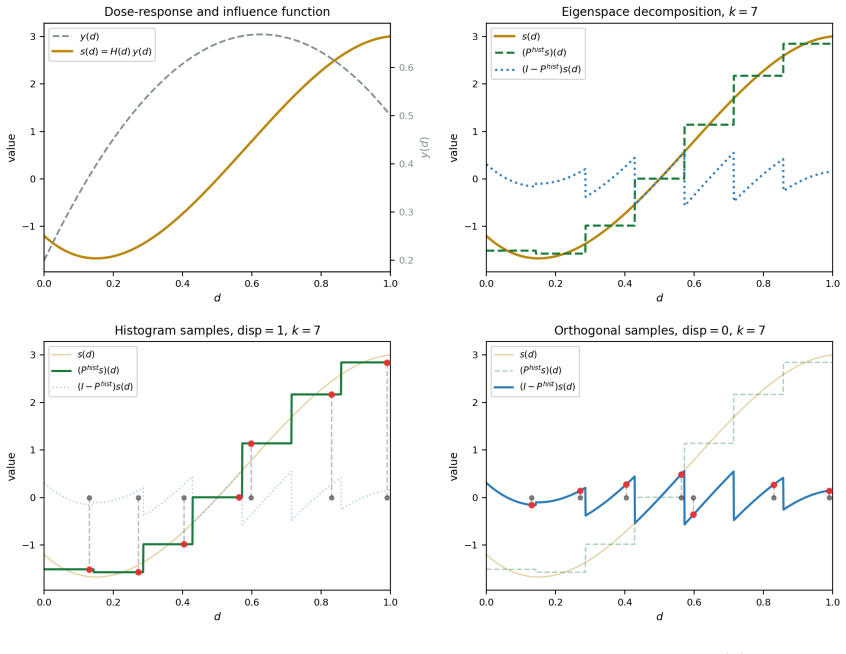
- Spectral analysis shows efficiency varies with how the influence function's smoothness aligns with coupling directions.
- The approach is demonstrated in a cash transfer experiment and a discrete-choice marketplace experiment.
Where Pith is reading between the lines
- This method could reduce the sample size needed to achieve a target precision when treatments are high-dimensional or irregular.
- It suggests a general principle that deliberate within-group contrast can improve power in any design that already uses matching.
- Computational scaling of the Monte Carlo step may limit applicability to very large experiments unless faster approximations are developed.
- The same dispersion-matching logic might be testable in observational data by reweighting matched pairs to mimic the coupling.
Load-bearing premise
It is possible to form homogeneous groups with high match quality even for complex high-dimensional covariates while Monte Carlo coupling achieves substantial dispersion without breaking the validity of the randomization.
What would settle it
A simulation or real experiment in which the variance of the estimator under a coupling design is no smaller than under independent randomization when match quality is held high.
Figures



read the original abstract
We describe a new family of coupling designs, extending the basic principle of stratified randomization to experiments with continuous, constrained multivariate, text/image and other irregular treatment spaces. Our approach is to first match units into homogeneous groups, then use Monte Carlo coupling techniques to assign within-group treatments that are highly dispersed over the treatment space. We show that ensuring similar experimental units receive highly dissimilar treatments generically improves estimation efficiency. In particular, the efficiency gains from a coupling design are proportional to the product of dispersion and match quality, where dispersion measures how spread out the treatment assignments are under a given coupling relative to independent randomization. We develop a new spectral analysis, revealing how efficiency depends on a match between the smoothness and shape of the estimator's influence function and the principal directions of a given coupling. We illustrate how coupling designs work in practice using a cash transfer experiment in development economics and a discrete-choice experiment in two-sided marketplaces.
Editorial analysis
A structured set of objections, weighed in public.
Referee Report
Summary. The manuscript proposes a new family of coupling designs for randomized experiments with complex treatment spaces (continuous, constrained multivariate, text/image). Units are matched into homogeneous groups on covariates, after which Monte Carlo coupling assigns within-group treatments that are highly dispersed relative to independent randomization. The central claim is that this generically improves estimation efficiency, with gains proportional to the product of a dispersion measure and match quality; a new spectral analysis shows that efficiency further depends on alignment between the smoothness/shape of the estimator's influence function and the principal directions induced by the coupling. The approach is illustrated on a cash-transfer experiment and a discrete-choice experiment.
Significance. If the proportionality result and spectral characterization hold under the stated conditions, the work would meaningfully extend stratified randomization to irregular treatment spaces common in modern economics experiments. It offers a principled way to improve efficiency without enlarging samples or imposing strong parametric assumptions on the outcome model. The two empirical illustrations provide concrete evidence of implementability, and the absence of free parameters in the core design is a strength.
major comments (2)
- [§4 (Spectral Analysis) and main efficiency theorem] §4 (Spectral Analysis) and the main efficiency theorem: the claim that gains are 'generic' and proportional to dispersion × match quality assumes that the coupling's principal directions align with the relevant smoothness of the influence function. For high-dimensional or irregular treatments the Monte Carlo procedure defines those directions from covariate dispersion within groups; nothing in the argument guarantees that this aligns with the function space of an arbitrary estimator. The cash-transfer and discrete-choice illustrations do not contain misalignment cases, so the generic claim rests on an untested alignment that can cause the gain term to vanish or reverse.
- [§3.2 (Match Quality and Group Formation)] §3.2 (Match Quality and Group Formation): the efficiency result treats match quality as achievable at high levels even for complex, high-dimensional covariates. The manuscript supplies no general bound or simulation evidence on the rate at which match quality degrades with dimension or with irregular treatment constraints, which is load-bearing for the proportionality statement.
minor comments (2)
- [Abstract] The abstract states the efficiency claim but does not report the magnitude of gains observed in the two illustrations; adding a one-sentence summary of those gains would improve readability.
- [Notation and §4] Notation for the dispersion measure and the spectral inner product should be introduced once and used consistently; occasional re-definition in later sections is distracting.
Simulated Author's Rebuttal
We thank the referee for the constructive and detailed report. The comments raise important points about the scope of our efficiency results and the practical limits of match quality. We respond to each major comment below and describe the revisions we will make to strengthen the manuscript.
read point-by-point responses
-
Referee: The claim that gains are 'generic' and proportional to dispersion × match quality assumes that the coupling's principal directions align with the relevant smoothness of the influence function. For high-dimensional or irregular treatments the Monte Carlo procedure defines those directions from covariate dispersion within groups; nothing in the argument guarantees that this aligns with the function space of an arbitrary estimator. The cash-transfer and discrete-choice illustrations do not contain misalignment cases, so the generic claim rests on an untested alignment that can cause the gain term to vanish or reverse.
Authors: We appreciate the referee's close attention to the spectral analysis. The main efficiency theorem establishes proportionality to dispersion × match quality under the maintained condition that the estimator's influence function is sufficiently smooth in the covariates. Section 4 then decomposes the realized gain via the inner product between the influence function and the principal directions of the coupling; this decomposition makes the role of alignment explicit rather than assuming it away. We interpret 'generic' as applying to the class of estimators standard in empirical work, where influence functions vary smoothly with covariates and therefore align with the within-group covariate dispersion directions produced by Monte Carlo coupling. We nevertheless agree that the illustrations do not probe misalignment and that highly irregular estimators could attenuate or reverse the gain. In revision we will add an explicit discussion of the alignment condition together with a short simulated example of misalignment to show when the gain term approaches zero. revision: yes
-
Referee: The efficiency result treats match quality as achievable at high levels even for complex, high-dimensional covariates. The manuscript supplies no general bound or simulation evidence on the rate at which match quality degrades with dimension or with irregular treatment constraints, which is load-bearing for the proportionality statement.
Authors: We agree that the rate at which match quality degrades is practically important for the applicability of the proportionality result. The theoretical statements are conditional on the realized match quality (the within-group reduction in covariate variance), so they remain valid for any level attained by the matching step. To provide users with guidance on when high match quality is attainable, we will add simulation studies in the revision that trace match quality as a function of covariate dimension, sample size, and treatment-space constraints, calibrated to the cash-transfer and discrete-choice examples already in the paper. revision: yes
Circularity Check
No circularity: efficiency proportionality derived from design properties via spectral analysis
full rationale
The paper defines coupling designs via unit matching followed by Monte Carlo assignment to achieve within-group dispersion, then derives (via new spectral analysis) that efficiency gains are proportional to the product of that dispersion and match quality. This is presented as a mathematical result relating the influence function's smoothness to the coupling's principal directions, not as a tautology or redefinition. No self-citations are load-bearing for the central claim, no fitted parameters are relabeled as predictions, and the proportionality is not equivalent to the inputs by construction. The derivation chain remains self-contained against external benchmarks.
Axiom & Free-Parameter Ledger
Reference graph
Works this paper leans on
-
[1]
and Imbens, G
Athey, S. and Imbens, G. W. (2017). The econometrics of randomized experiments. Handbook of Economic Field Experiments
2017
-
[2]
Bai, Y. (2022). Optimality of matched-pair designs in randomized controlled trials. American Economic Review
2022
-
[3]
Bai, Y., Liu, J., Shaikh, A. M., and Tabord-Meehan, M. (2023). On the efficiency of finely stratified experiments. arXiv preprint arXiv:2307.15181
-
[4]
Bai, Y., Liu, J., and Tabord-Meehan, M. (2024). Inference for matched tuples and fully blocked factorial designs.Quantitative Economics, 15(2):279–330
2024
-
[5]
P., and Shaikh, A
Bai, Y., Romano, J. P., and Shaikh, A. M. (2021). Inference in experiments with matched pairs.Journal of the American Statistical Association
2021
-
[6]
Bai, Y., Shaikh, A. M., and Tabord-Meehan, M. (2025). A primer on the analysis of randomized experiments and a survey of some recent advances. arXiv:2405.03910
-
[7]
and Mullainathan, S
Bertrand, M. and Mullainathan, S. (2004). Are Emily and Greg more employable than Lakisha and Jamal? A field experiment on labor market discrimination. American Economic Review, 94(4):991–1013
2004
-
[8]
Polarfactorizationandmonotonerearrangementofvector-valued functions.Communications on Pure and Applied Mathematics, 44(4):375–417
Brenier, Y.(1991). Polarfactorizationandmonotonerearrangementofvector-valued functions.Communications on Pure and Applied Mathematics, 44(4):375–417
1991
-
[9]
and McKenzie, D
Bruhn, M. and McKenzie, D. (2009). In pursuit of balance: Randomization in practice in development field experiments.American Economic Journal: Applied Economics, pages 200–232
2009
-
[10]
A., Canay, I
Bugni, F. A., Canay, I. A., and Shaikh, A. M. (2018). Inference under covariate- adaptive randomization.Journal of the American Statistical Association
2018
-
[11]
A., Canay, I
Bugni, F. A., Canay, I. A., and Shaikh, A. M. (2019). Inference under covariate- adaptive randomization with multiple treatments.Quantitative Economics. 61
2019
-
[12]
and Rafi, A
Cai, Y. and Rafi, A. (2024). On the performance of the neyman allocation with small pilots.Journal of Econometrics, 242(1)
2024
-
[13]
Carlier, G., Galichon, A., and Santambrogio, F. (2010). From Knothe’s transport to Brenier’s map and a continuation method for optimal transport.SIAM Journal on Mathematical Analysis, 41(6):2554–2576
2010
-
[14]
Chernozhukov, V., Galichon, A., Hallin, M., and Henry, M. (2017). Monge– Kantorovich depth, quantiles, ranks and signs.The Annals of Statistics, 45(1):223–256
2017
-
[15]
Cochran, W. G. and Cox, G. M. (1957).Experimental Designs. John Wiley & Sons, New York, 2nd edition
1957
-
[16]
and Patterson, T
Cranley, R. and Patterson, T. N. L. (1976). Randomization of number theo- retic methods for multiple integration.SIAM Journal on Numerical Analysis, 13(6):904–914
1976
-
[17]
Cytrynbaum, M. (2021). The optimal design for a fixed estimator. Working Paper
2021
- [18]
-
[19]
Efron, B. (1971). Forcing a sequential experiment to be balanced.Biometrika, 58(3):403–417
1971
-
[20]
Fisher, R. A. (1926). The arrangement of field experiments.Journal of the Ministry of Agriculture of Great Britain, 33:503–513
1926
-
[21]
Fisher, R. A. (1935).The Design of Experiments. Oliver and Boyd, Edinburgh
1935
-
[22]
Fishman, G. S. and Huang, B. D. (1983). Antithetic variates revisited.Communi- cations of the ACM, 26(11):964–971
1983
-
[23]
Fogarty, C. B. (2018). On mitigating the analytical limitations of finely stratified experiments.Journal of the Royal Statistical Society: Series B, 80(5)
2018
-
[24]
H., and Rosenbaum, P
Greevy, R., Lu, B., Silber, J. H., and Rosenbaum, P. (2004). Optimal multivariate matching before randomization.Biostatistics, 5(2):263–275
2004
-
[25]
Hammersley, J. M. and Morton, K. W. (1956). A new Monte Carlo technique: Antithetic variates.Mathematical Proceedings of the Cambridge Philosophical Society, 52(3):449–475
1956
-
[26]
H., Hurwitz, W
Hansen, M. H., Hurwitz, W. N., and Madow, W. G. (1953).Sample Survey Methods and Theory. Wiley
1953
-
[27]
Harshaw, C., Sävje, F., Eisenstat, D., Mirrokni, V., and Pouget-Abadie, J. (2023). Design and analysis of bipartite experiments under a linear exposure-response model.Electronic Journal of Statistics, 17(2):4528–4572
2023
-
[28]
A., and Zhang, P
Harshaw, C., Sävje, F., Spielman, D. A., and Zhang, P. (2024). Balancing covariates in randomized experiments with the Gram–Schmidt walk design.Journal of the American Statistical Association, 119(548):2934–2946
2024
- [29]
-
[30]
J., Sävje, F., and Sekhon, J
Higgins, M. J., Sävje, F., and Sekhon, J. S. (2015). Improving massive experiments with threshold blocking.Proceedings of the National Academy of Sciences
2015
-
[31]
Hoeffding, W. (1940). Masstabinvariante Korrelationstheorie.Schriften des Mathe- matischen Instituts und des Instituts für Angewandte Mathematik der Universität Berlin, 5:179–233
1940
-
[32]
Imai, K. (2008). Variance identification and efficiency analysis in randomized ex- periments under the matched-pair design.Statistics in Medicine, 27:4857–4873. 62
2008
-
[33]
Imai, K., King, G., and Nall, C. (2009). The essential role of pair matching in cluster-randomized experiments, with application to the mexican universal health insurance evaluation.Statistical Science
2009
-
[34]
Kallus, N. (2017). Optimal a priori balance in the design of controlled experiments. Journal of the Royal Statistical Society: Series B
2017
-
[35]
Kasy, M. (2016). Why experimenters might not always want to randomize, and what they could do instead.Political Analysis, pages 1–15
2016
-
[36]
Kempthorne, O. (1956). The efficiency factor of an incomplete block design.Annals of Mathematical Statistics, 27:846–849
1956
-
[37]
and Pashley, N
Koo, T. and Pashley, N. E. (2026). Design-based causal inference for incomplete block designs.Biometrika
2026
-
[38]
Kuo, F. Y. (2003). Component-by-component constructions achieve the optimal rate of convergence for multivariate integration in weighted Korobov and Sobolev spaces.Journal of Complexity, 19(3):301–320. L’Ecuyer, P. and Lemieux, C. (2000). Variance reduction via lattice rules.Manage- ment Science, 46(9):1214–1235
2003
-
[39]
Li, X., Ding, P., and Rubin, D. B. (2018). Asymptotic theory of rerandomization in treatment–control experiments.Proceedings of the National Academy of Sciences
2018
-
[40]
D., Beckman, R
McKay, M. D., Beckman, R. J., and Conover, W. J. (1979). A comparison of three methods for selecting values of input variables in the analysis of output from a computer code.Technometrics, 21(2):239–245
1979
-
[41]
Mehler, F. G. (1866). Ueber die Entwicklung einer Function von beliebig vielen Variablen nach Laplaceschen Functionen höherer Ordnung.Journal für die reine und angewandte Mathematik, 66:161–176. Mérigot, Q. (2011). A multiscale approach to optimal transport.Computer Graphics Forum, 30(5):1583–1592
2011
-
[42]
Morgan, K. L. and Rubin, D. B. (2012). Rerandomization to improve covariate balance in experiments.Annals of Statistics, 40(2)
2012
-
[43]
Owen, A. B. (1992). Orthogonal arrays for computer experiments, integration and visualization.Statistica Sinica, 2(2):439–452
1992
-
[44]
Owen, A. B. (1995). Randomly permuted(t, m, s)-nets and(t, s)-sequences. In
1995
-
[45]
Owen, A. B. (2013).Monte Carlo theory, methods and examples.https://artowen. su.domains/mc/
2013
-
[46]
Pashley, N. E. and Miratrix, L. W. (2021). Insights on variance estimation for blocked and matched pairs designs.Journal of Educational and Behavioral Statis- tics
2021
-
[47]
Asymptoticsforleastabsolutedeviationestimators.Econometric Theory, 7(2):186–199
Pollard, D.(1991). Asymptoticsforleastabsolutedeviationestimators.Econometric Theory, 7(2):186–199
1991
-
[48]
Robert, C. P. and Casella, G. (2004).Monte Carlo Statistical Methods. Springer- Verlag
2004
-
[49]
Shirley, P. (1991). Discrepancy as a quality measure for sample distributions. In Proceedings of Eurographics, pages 183–193
1991
-
[50]
Sloan, I. H. and Joe, S. (1994).Lattice Methods for Multiple Integration. Clarendon
1994
-
[51]
Tang, B. (1993). Orthogonal array-based Latin hypercubes.Journal of the American Statistical Association, 88(424):1392–1397
1993
-
[52]
(1993).Lectures on Hermite and Laguerre Expansions, volume 42 ofMathematical Notes
Thangavelu, S. (1993).Lectures on Hermite and Laguerre Expansions, volume 42 ofMathematical Notes. Princeton University Press
1993
-
[53]
Yates, F. (1936). Incomplete randomized blocks.Annals of Eugenics, 7(2):121–140
1936
-
[54]
Yitzhaki, S. (1996). On using linear regressions in welfare economics.Journal of Business & Economic Statistics, 14(4):478–486. Also available via JSTOR stable 1392256. 64
1996
discussion (0)
Sign in with ORCID, Apple, or X to comment. Anyone can read and Pith papers without signing in.