Recognition: unknown
Galactic Archaeology with the Subaru `\=Onohi`ula Prime Focus Spectrograph Strategic Program
Pith reviewed 2026-05-10 16:51 UTC · model grok-4.3
The pith
A Subaru PFS survey will model density profiles of six dwarf galaxies using 18,000 stars to test if they show cold dark matter cusps or alternative cores.
A machine-rendered reading of the paper's core claim, the machinery that carries it, and where it could break.
Core claim
The program will deduce the mass density profiles of six dwarf galaxies as a function of radius from modeling of the full line-of-sight velocity and abundance distributions for 18,000 member stars to beyond the nominal tidal radius of each system, testing consistency with cusps expected for cold dark matter or cores expected from alternative dark matter theories or baryonic feedback. Complementary measurements of the [alpha/Fe] ratio in 30,000 M31 halo and outer disk stars will reveal differences in assembly history with the Milky Way, while velocities and metallicities for Milky Way main-sequence stars to 30 kpc will show responses to accretion events such as Gaia-Sausage Enceladus and the,
What carries the argument
Modeling full line-of-sight velocity and abundance distributions from PFS multi-fiber spectra to derive radial mass density profiles beyond tidal radii in dwarf galaxies.
Load-bearing premise
That the planned samples of 18,000 dwarf galaxy members and 30,000 M31 halo stars will be sufficient to reliably model full line-of-sight velocity and abundance distributions beyond tidal radii without significant contamination or selection biases.
What would settle it
If the modeled central density slope for the dwarf galaxies is measured to be near -1 rather than near zero, this would favor cold dark matter cusps over cores.
Figures








read the original abstract
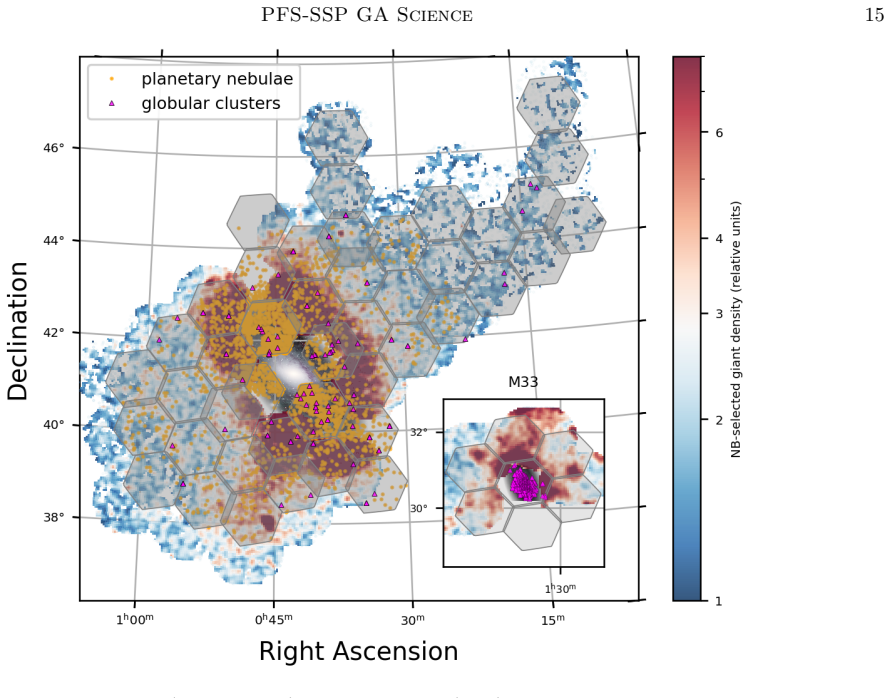
The recently commissioned Subaru `\=Onohi`ula Prime Focus Spectrograph (PFS) will obtain spectra from nearly 2,400 fibers that cover 1.24 square degrees. The 360 night Subaru Strategic Program for PFS is dedicating approximately one-third of its allocation (130 nights) to study the structure and evolution of galaxies in the Local Group. This Galactic Archaeological survey has three pillars. (1) We will determine whether the mass density profiles of dwarf galaxies are consistent with cusps, as expected for cold dark matter, or cores, as expected from alternative dark matter theories or baryonic feedback. We will deduce the density profiles as a function of radius from modeling of the full line-of-sight velocity and abundance distributions for six dwarf galaxies. Our total sample will consist of 18,000 member stars to beyond the nominal tidal radius of each system. (2) From measurements of the [alpha/Fe] abundance ratio, we will learn the difference in assembly history of the two most massive galaxies in the Local Group: M31 and the Milky Way. We will observe 30,000 member stars over 45 square degrees of M31's halo and outer disk. (3) We will uncover how the most fragile (outer) part of the Milky Way responded to accretion events both in the distant past (such as Gaia-Sausage Enceladus) and in more recent history (such as the Sagittarius dwarf spheroidal galaxy). To support this study, PFS will provide velocities and metallicities--from which, in combination with photometry, we will deduce ages--for tens of thousands of main-sequence stars out to a Galactocentric distance of ~30 kpc.
Editorial analysis
A structured set of objections, weighed in public.
Referee Report
Summary. The manuscript outlines the design of the Galactic Archaeology component of the Subaru PFS Strategic Program, which dedicates 130 nights to Local Group studies. It presents three science pillars: (1) constraining mass density profiles in six dwarf galaxies via full line-of-sight velocity and abundance modeling of 18,000 member stars to test cuspy CDM profiles against cored alternatives or baryonic feedback; (2) comparing [alpha/Fe] ratios in 30,000 M31 halo and outer-disk stars over 45 square degrees to differentiate assembly histories from the Milky Way; (3) tracing the outer Milky Way's response to accretion events (e.g., Gaia-Sausage Enceladus, Sagittarius) using velocities, metallicities, and photometrically derived ages for tens of thousands of main-sequence stars to ~30 kpc.
Significance. If successfully executed, the program would deliver the largest homogeneous spectroscopic samples yet for Local Group archaeology, enabling statistically robust tests of dark matter density profiles and galaxy assembly timelines that are currently limited by sample size and coverage. The explicit target numbers, wide areal coverage, and use of PFS multiplex advantage constitute clear strengths for a proposal of this scope.
minor comments (2)
- [Abstract] Abstract: the statement that ages will be 'deduced' from velocities, metallicities, and photometry lacks a brief description of the method (e.g., isochrone fitting or Bayesian age estimation) or reference to expected precision.
- [Science pillars description] The manuscript would benefit from a short paragraph on the adopted membership criteria and expected contamination rates for the dwarf-galaxy and M31-halo samples, as these directly affect the reliability of the density-profile and abundance analyses.
Simulated Author's Rebuttal
We thank the referee for their positive summary of the manuscript and for recommending minor revision. The description accurately captures the three science pillars of the PFS Galactic Archaeology survey, including the target samples, areal coverage, and scientific goals for testing dark matter profiles, comparing assembly histories, and tracing Milky Way accretion responses.
Circularity Check
No significant circularity; proposal describes future observations without derivations or fits
full rationale
The manuscript is a Subaru Strategic Program proposal outlining planned PFS observations and science goals for Local Group galactic archaeology. It states prospective aims such as modeling density profiles from future samples of 18,000 dwarf galaxy stars and 30,000 M31 halo stars, but contains no equations, models, fits, predictions, or derivations that could reduce to inputs by construction. All claims are forward-looking plans contingent on data yet to be collected, with no self-citations, ansatzes, or uniqueness theorems invoked as load-bearing steps. This is the expected non-finding for an observational proposal lacking executed analysis.
Axiom & Free-Parameter Ledger
axioms (1)
- domain assumption Standard assumptions in galactic dynamics and stellar spectroscopy allow reliable identification of member stars and modeling of velocity and abundance distributions from line-of-sight data.
Reference graph
Works this paper leans on
-
[1]
Aihara, H., Arimoto, N., Armstrong, R., et al. 2018, PASJ, 70, S4, doi: 10.1093/pasj/psx066
-
[2]
Aihara, H., AlSayyad, Y., Ando, M., et al. 2022, PASJ, 74, 247, doi: 10.1093/pasj/psab122
-
[3]
Allard, F., Homeier, D., & Freytag, B. 2011, in Cool Stars 16, Vol. 448, 91, doi: 10.48550/arXiv.1011.5405
-
[4]
Alvarado, E., Gerasimov, R., Burgasser, A. J., et al. 2024, Research Notes of the American Astronomical Society, 8, 134, doi: 10.3847/2515-5172/ad4bd7
-
[5]
Amorisco, N. C., Agnello, A., & Evans, N. W. 2013, MNRAS, 429, L89, doi: 10.1093/mnrasl/sls031
-
[6]
, archivePrefix = "arXiv", eprint =
Amorisco, N. C., & Evans, N. W. 2012, MNRAS, 419, 184, doi: 10.1111/j.1365-2966.2011.19684.x
-
[7]
2022, arXiv e-prints, arXiv:2203.06781
Ando, S., Baum, S., Boylan-Kolchin, M., et al. 2022, arXiv e-prints, arXiv:2203.06781. https://arxiv.org/abs/2203.06781
-
[8]
Antoja, T., Helmi, A., Romero-G´ omez, M., et al. 2018, Nature, 561, 360, doi: 10.1038/s41586-018-0510-7
-
[9]
Arentsen, A., Starkenburg, E., Shetrone, M. D., et al. 2019, A&A, 621, A108, doi: 10.1051/0004-6361/201834146
-
[10]
Arnaboldi, M., Aguerri, J. A. L., Napolitano, N. R., et al. 2002, AJ, 123, 760, doi: 10.1086/338313
-
[11]
2022, A&A, 666, A109, doi: 10.1051/0004-6361/202244258
Arnaboldi, M., Bhattacharya, S., Gerhard, O., et al. 2022, A&A, 666, A109, doi: 10.1051/0004-6361/202244258
-
[12]
1995, ApJL, 451, L49, doi: 10.1086/309687
Audouze, J., & Silk, J. 1995, ApJL, 451, L49, doi: 10.1086/309687
-
[13]
2008, ApJL, 681, L13, doi: 10.1086/590179
Battaglia, G., Helmi, A., Tolstoy, E., et al. 2008, ApJL, 681, L13, doi: 10.1086/590179
-
[14]
A., San Roman, I., Gallart, C., Sarajedini, A., & Aparicio, A
Beasley, M. A., San Roman, I., Gallart, C., Sarajedini, A., & Aparicio, A. 2015, MNRAS, 451, 3400, doi: 10.1093/mnras/stv943
-
[15]
, year = 2005, month = sep, volume =
Beers, T. C., & Christlieb, N. 2005, ARA&A, 43, 531, doi: 10.1146/annurev.astro.42.053102.134057
-
[16]
2020, ApJ, 903, 10, doi: 10.3847/1538-4357/abb5f4
Belland, B., Kirby, E., Boylan-Kolchin, M., & Wheeler, C. 2020, ApJ, 903, 10, doi: 10.3847/1538-4357/abb5f4
-
[17]
Deason, A. J. 2018, MNRAS, 478, 611, doi: 10.1093/mnras/sty982
-
[18]
Belokurov, V., Sanders, J. L., Fattahi, A., et al. 2020, MNRAS, 494, 3880, doi: 10.1093/mnras/staa876
-
[19]
Belokurov, V., Vasiliev, E., Deason, A. J., et al. 2023, MNRAS, 518, 6200, doi: 10.1093/mnras/stac3436
-
[20]
Belokurov, V., Zucker, D. B., Evans, N. W., et al. 2006, ApJL, 642, L137, doi: 10.1086/504797
-
[21]
Bensby, T., Feltzing, S., & Lundstr¨ om, I. 2003, A&A, 410, 527, doi: 10.1051/0004-6361:20031213
-
[22]
Bernard, E. J., Ferguson, A. M. N., Schlafly, E. F., et al. 2016, MNRAS, 463, 1759, doi: 10.1093/mnras/stw2134
-
[23]
2024, A&A, 686, A92, doi: 10.1051/0004-6361/202348410
Bernet, M., Ramos, P., Antoja, T., Monari, G., & Famaey, B. 2024, A&A, 686, A92, doi: 10.1051/0004-6361/202348410
-
[24]
Besla, G., Kallivayalil, N., Hernquist, L., et al. 2012, MNRAS, 421, 2109, doi: 10.1111/j.1365-2966.2012.20466.x
-
[25]
2025a, ApJL, 983, L30, doi: 10.3847/2041-8213/adc735
Bhattacharya, S., Arnaboldi, M., Gerhard, O., Kobayashi, C., & Saha, K. 2025a, ApJL, 983, L30, doi: 10.3847/2041-8213/adc735
-
[26]
2021, A&A, 647, A130, doi: 10.1051/0004-6361/202038366
Bhattacharya, S., Arnaboldi, M., Gerhard, O., et al. 2021, A&A, 647, A130, doi: 10.1051/0004-6361/202038366
-
[27]
2023, MNRAS, 522, 6010, doi: 10.1093/mnras/stad1378
Bhattacharya, S., Arnaboldi, M., Hammer, F., et al. 2023, MNRAS, 522, 6010, doi: 10.1093/mnras/stad1378
-
[28]
2019a, A&A, 624, A132, doi: 10.1051/0004-6361/201834579
Bhattacharya, S., Arnaboldi, M., Hartke, J., et al. 2019a, A&A, 624, A132, doi: 10.1051/0004-6361/201834579
-
[29]
Bhattacharya, S., Arnaboldi, M., Kobayashi, C., Gerhard, O., & Saha, K. 2025b, arXiv e-prints, arXiv:2505.01896, doi: 10.48550/arXiv.2505.01896
work page internal anchor Pith review Pith/arXiv arXiv doi:10.48550/arxiv.2505.01896
-
[30]
2019b, A&A, 631, A56, doi: 10.1051/0004-6361/201935898
Bhattacharya, S., Arnaboldi, M., Caldwell, N., et al. 2019b, A&A, 631, A56, doi: 10.1051/0004-6361/201935898
-
[31]
2022, MNRAS, 517, 2343, doi: 10.1093/mnras/stac2703
Bhattacharya, S., Arnaboldi, M., Caldwell, N., et al. 2022, MNRAS, 517, 2343, doi: 10.1093/mnras/stac2703
-
[32]
Bird, J. C., Loebman, S. R., Weinberg, D. H., et al. 2021, MNRAS, 503, 1815, doi: 10.1093/mnras/stab289
-
[34]
2021b, MNRAS, 504, 3168, doi: 10.1093/mnras/stab704
Bland-Hawthorn, J., & Tepper-Garc´ ıa, T. 2021b, MNRAS, 504, 3168, doi: 10.1093/mnras/stab704
-
[35]
C., M´ esz´ aros, S., Fleming, S
Bohlin, R. C., M´ esz´ aros, S., Fleming, S. W., et al. 2017, AJ, 153, 234, doi: 10.3847/1538-3881/aa6ba9
-
[36]
2012, ApJL, 760, L6, doi: 10.1088/2041-8205/760/1/L6
Bonaca, A., Geha, M., & Kallivayalil, N. 2012, ApJL, 760, L6, doi: 10.1088/2041-8205/760/1/L6
-
[37]
Bonaca, A., & Hogg, D. W. 2018, ApJ, 867, 101, doi: 10.3847/1538-4357/aae4da PFS-SSP GA Science39
-
[38]
Bonaca, A., & Price-Whelan, A. M. 2025, New Astronomy Reviews, 100, 101713, doi: https://doi.org/10.1016/j.newar.2024.101713
-
[39]
Bonaca, A., Conroy, C., Cargile, P. A., et al. 2020, ApJL, 897, L18, doi: 10.3847/2041-8213/ab9caa
-
[40]
2021, A&A, 651, A79, doi: 10.1051/0004-6361/202140816
Bonifacio, P., Monaco, L., Salvadori, S., et al. 2021, A&A, 651, A79, doi: 10.1051/0004-6361/202140816
-
[41]
2018, PASJ, 70, S5, doi: 10.1093/pasj/psx080
Bosch, J., Armstrong, R., Bickerton, S., et al. 2018, PASJ, 70, S5, doi: 10.1093/pasj/psx080
-
[42]
Breddels, M. A., & Helmi, A. 2014, ApJL, 791, L3, doi: 10.1088/2041-8205/791/1/L3
-
[43]
Bromm, V., & Larson, R. B. 2004, ARA&A, 42, 79, doi: 10.1146/annurev.astro.42.053102.134034
-
[44]
2024, The BONES Archive, Zenodo, doi: 10.5281/zenodo.12668258
Brooks, H. 2024, The BONES Archive, Zenodo, doi: 10.5281/zenodo.12668258
-
[45]
2021, MNRAS, 506, 150, doi: 10.1093/mnras/stab1242
Buder, S., Sharma, S., Kos, J., et al. 2021, MNRAS, 506, 150, doi: 10.1093/mnras/stab1242
-
[46]
Bullock, J. S., & Boylan-Kolchin, M. 2017, ARA&A, 55, 343, doi: 10.1146/annurev-astro-091916-055313
-
[47]
Bullock, J. S., & Johnston, K. V. 2005, ApJ, 635, 931, doi: 10.1086/497422
-
[48]
Burgasser, A. J., Cruz, K. L., & Kirkpatrick, J. D. 2007, ApJ, 657, 494, doi: 10.1086/510148
-
[49]
Buttry, R., Pace, A. B., Koposov, S. E., et al. 2022, MNRAS, 514, 1706, doi: 10.1093/mnras/stac1441
-
[50]
2011, Nature, 477, 67, doi: 10.1038/nature10377
Caffau, E., Bonifacio, P., Fran¸ cois, P., et al. 2011, Nature, 477, 67, doi: 10.1038/nature10377
-
[51]
Caldwell, N., & Romanowsky, A. J. 2016, ApJ, 824, 42, doi: 10.3847/0004-637X/824/1/42
-
[52]
2011, AJ, 141, 61, doi: 10.1088/0004-6256/141/2/61
Harding, P. 2011, AJ, 141, 61, doi: 10.1088/0004-6256/141/2/61
-
[53]
Cannon, J. M., O’Leary, E. M., Weisz, D. R., et al. 2012, ApJ, 747, 122, doi: 10.1088/0004-637X/747/2/122
-
[54]
Carlberg, R. G. 2012, ApJ, 748, 20, doi: 10.1088/0004-637X/748/1/20
-
[55]
Carlberg, R. G., Jenkins, A., Frenk, C. S., & Cooper, A. P. 2024, ApJ, 975, 135, doi: 10.3847/1538-4357/ad7b35
-
[56]
Chabrier, G. 2003, PASP, 115, 763, doi: 10.1086/376392
work page internal anchor Pith review doi:10.1086/376392 2003
-
[57]
Chambers, K. C., Magnier, E. A., Metcalfe, N., et al. 2016, arXiv, arXiv:1612.05560, doi: 10.48550/arXiv.1612.05560
work page internal anchor Pith review Pith/arXiv arXiv doi:10.48550/arxiv.1612.05560 2016
-
[58]
Chiba, M. 2022, MNRAS, 511, 943, doi: 10.1093/mnras/stac063
-
[59]
Chandra, V., Semenov, V. A., Rix, H.-W., et al. 2024, ApJ, 972, 112, doi: 10.3847/1538-4357/ad5b60
-
[60]
Chandra, V., Naidu, R. P., Conroy, C., et al. 2025, ApJ, 988, 156, doi: 10.3847/1538-4357/addab6
-
[61]
Chang, L. J., & Necib, L. 2021, MNRAS, 507, 4715, doi: 10.1093/mnras/stab2440
-
[62]
Chapman, S. C., Ibata, R., Lewis, G. F., et al. 2006, ApJ, 653, 255, doi: 10.1086/508599
-
[63]
Q., Liu, X
Chen, B. Q., Liu, X. W., Xiang, M. S., et al. 2015, VizieR Online Data Catalog (other), 0400, J/other/RAA/15
2015
-
[64]
2015, Research in Astronomy and Astrophysics, 15, 1392, doi: 10.1088/1674-4527/15/8/020
Chen, B.-Q., Liu, X.-W., Xiang, M.-S., et al. 2015, Research in Astronomy and Astrophysics, 15, 1392, doi: 10.1088/1674-4527/15/8/020
-
[65]
Chen, Y. Q., Zhao, G., & Zhao, J. K. 2009, ApJ, 702, 1336, doi: 10.1088/0004-637X/702/2/1336
-
[66]
2001, ApJ, 554, 1044, doi: 10.1086/321427
Chiappini, C., Matteucci, F., & Romano, D. 2001, ApJ, 554, 1044, doi: 10.1086/321427
-
[67]
Chiba, M., & Beers, T. C. 2000, AJ, 119, 2843, doi: 10.1086/301409
-
[68]
Chiti, A., Frebel, A., Mardini, M. K., et al. 2021, ApJS, 254, 31, doi: 10.3847/1538-4365/abf73d
-
[69]
2008, A&A, 484, 721, doi: 10.1051/0004-6361:20078748 Ciuc˘ a, I., Kawata, D., Miglio, A., Davies, G
Christlieb, N., Sch¨ orck, T., Frebel, A., et al. 2008, A&A, 484, 721, doi: 10.1051/0004-6361:20078748 Ciuc˘ a, I., Kawata, D., Miglio, A., Davies, G. R., & Grand, R. J. J. 2021, MNRAS, 503, 2814, doi: 10.1093/mnras/stab639
-
[70]
Conn, A. R., McMonigal, B., Bate, N. F., et al. 2016, MNRAS, 458, 3282, doi: 10.1093/mnras/stw513
-
[71]
Conroy, C., Weinberg, D. H., Naidu, R. P., et al. 2022, arXiv e-prints, arXiv:2204.02989, doi: 10.48550/arXiv.2204.02989
-
[72]
Cooper, A. P., Cole, S., Frenk, C. S., et al. 2010, MNRAS, 406, 744, doi: 10.1111/j.1365-2966.2010.16740.x
-
[73]
Cooper, A. P., Koposov, S. E., Allende Prieto, C., et al. 2023, ApJ, 947, 37, doi: 10.3847/1538-4357/acb3c0 Correa Magnus, L., & Vasiliev, E. 2022, MNRAS, 511, 2610, doi: 10.1093/mnras/stab3726 Da Costa, G. S., Bessell, M. S., Mackey, A. D., et al. 2019, MNRAS, 489, 5900, doi: 10.1093/mnras/stz2550 de Blok, W. J. G., McGaugh, S. S., Bosma, A., & Rubin, V....
-
[75]
Shen, K. J. 2020b, ApJ, 891, 85, doi: 10.3847/1538-4357/ab736f De Silva, G. M., Freeman, K. C., Bland-Hawthorn, J., et al. 2015, MNRAS, 449, 2604, doi: 10.1093/mnras/stv327 40PFS-SSP GA Working group
-
[76]
2014, ApJ, 794, 115, doi: 10.1088/0004-637X/794/2/115
Deason, A., Wetzel, A., & Garrison-Kimmel, S. 2014, ApJ, 794, 115, doi: 10.1088/0004-637X/794/2/115
-
[77]
Deason, A. J., Belokurov, V., Koposov, S. E., & Lancaster, L. 2018, ApJL, 862, L1, doi: 10.3847/2041-8213/aad0ee
-
[78]
Deason, A. J., Fattahi, A., Frenk, C. S., et al. 2020, MNRAS, 496, 3929, doi: 10.1093/mnras/staa1711
-
[79]
Dey, A., Najita, J. R., Koposov, S. E., et al. 2023, ApJ, 944, 1, doi: 10.3847/1538-4357/aca5f8
-
[80]
Diaz, J. D., & Bekki, K. 2012, ApJ, 750, 36, doi: 10.1088/0004-637X/750/1/36
-
[81]
Ding, J., Rockosi, C., Li, T. S., et al. 2025, ApJ, 994, 134, doi: 10.3847/1538-4357/ae0a37
-
[82]
Ding, K., Filion, C., Wyse, R. F. G., et al. 2025, AJ, 170, 327, doi: 10.3847/1538-3881/ae10a7
discussion (0)
Sign in with ORCID, Apple, or X to comment. Anyone can read and Pith papers without signing in.