Recognition: unknown
Impacts of Multidimensional Progenitor Perturbations on Core-Collapse Supernova Explosions
Pith reviewed 2026-05-10 16:34 UTC · model grok-4.3
The pith
Simulations of 15-solar-mass stars show that differences in pre-collapse progenitor structure and composition do not alter the timing or development of core-collapse supernova explosions.
A machine-rendered reading of the paper's core claim, the machinery that carries it, and where it could break.
Core claim
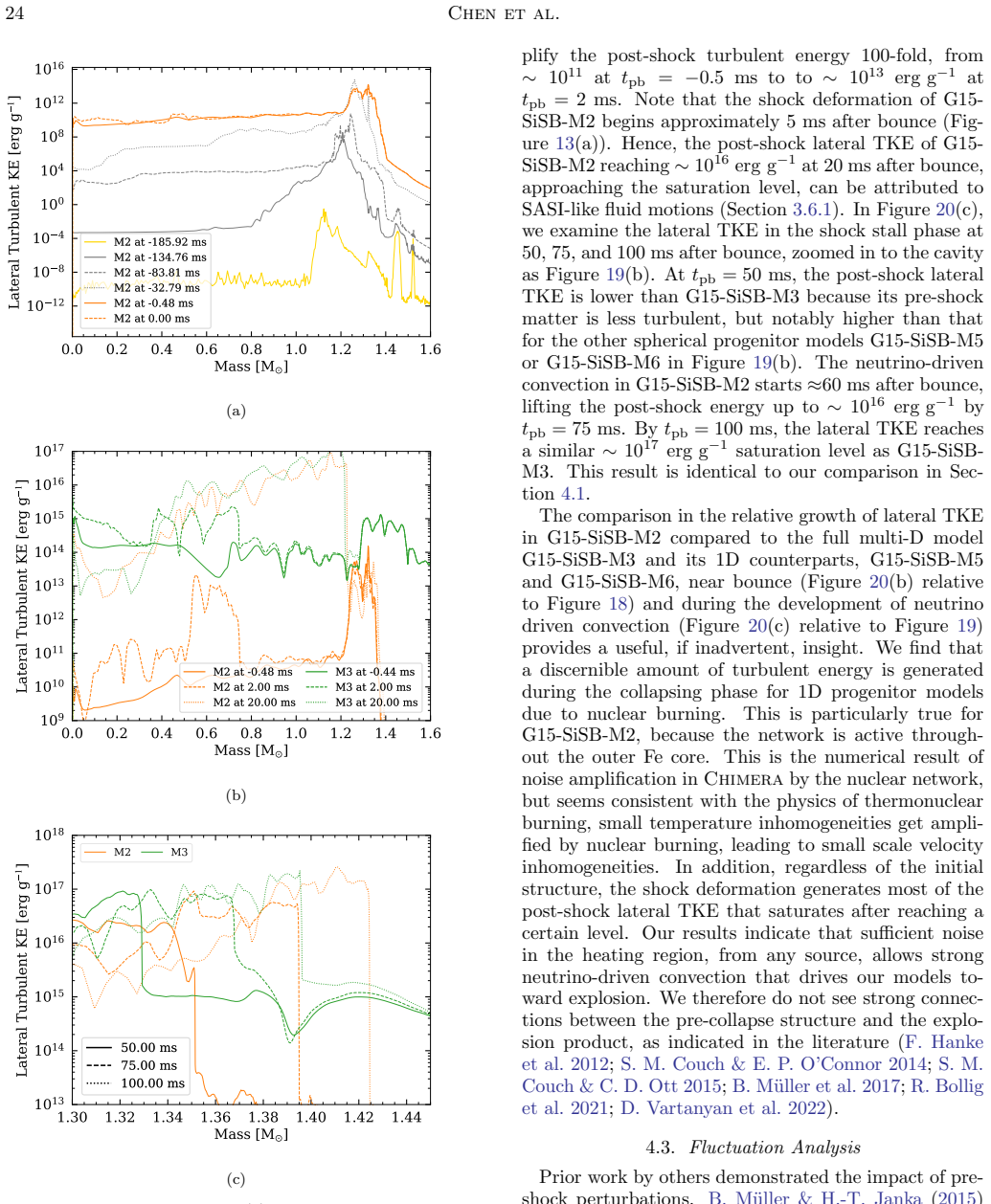
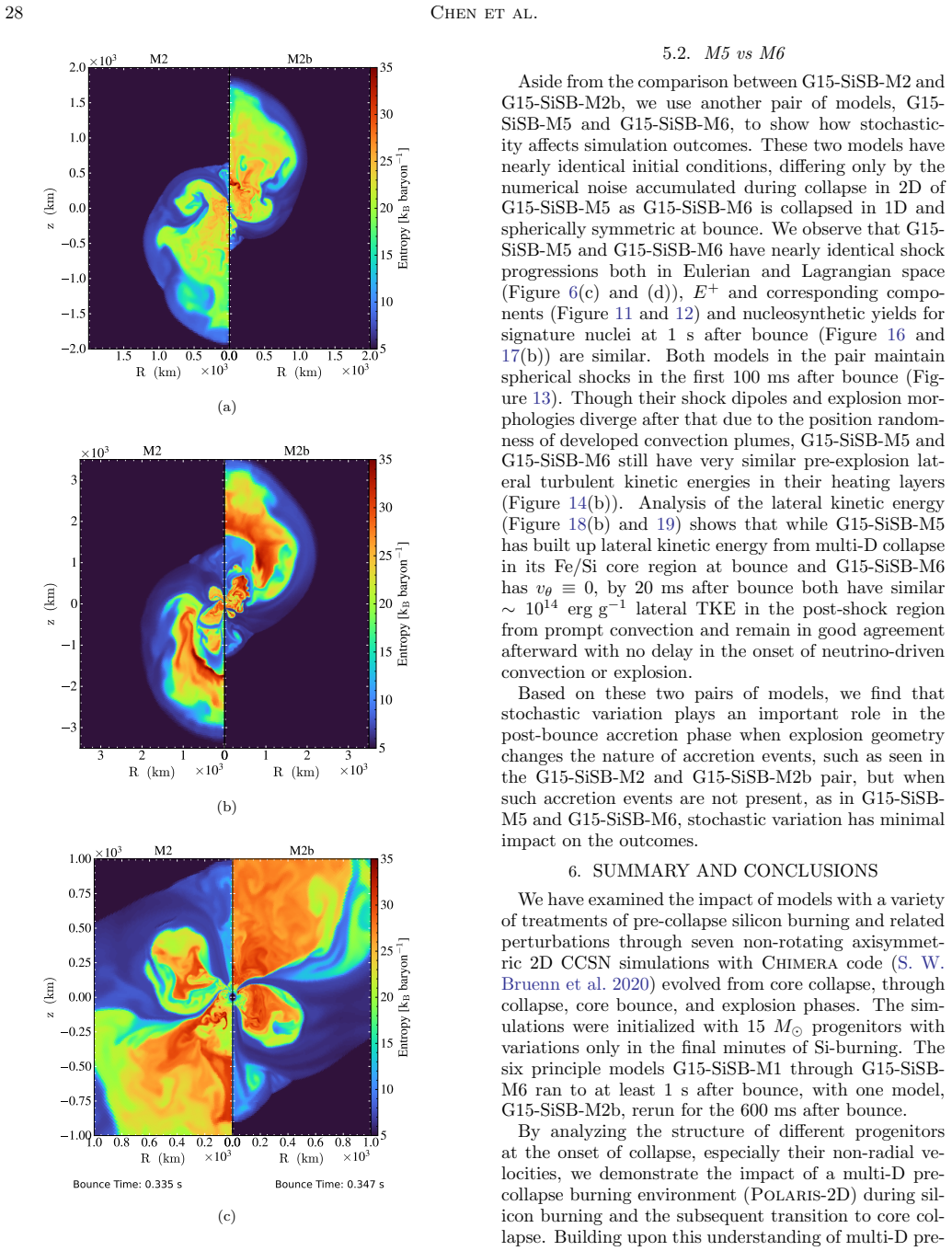
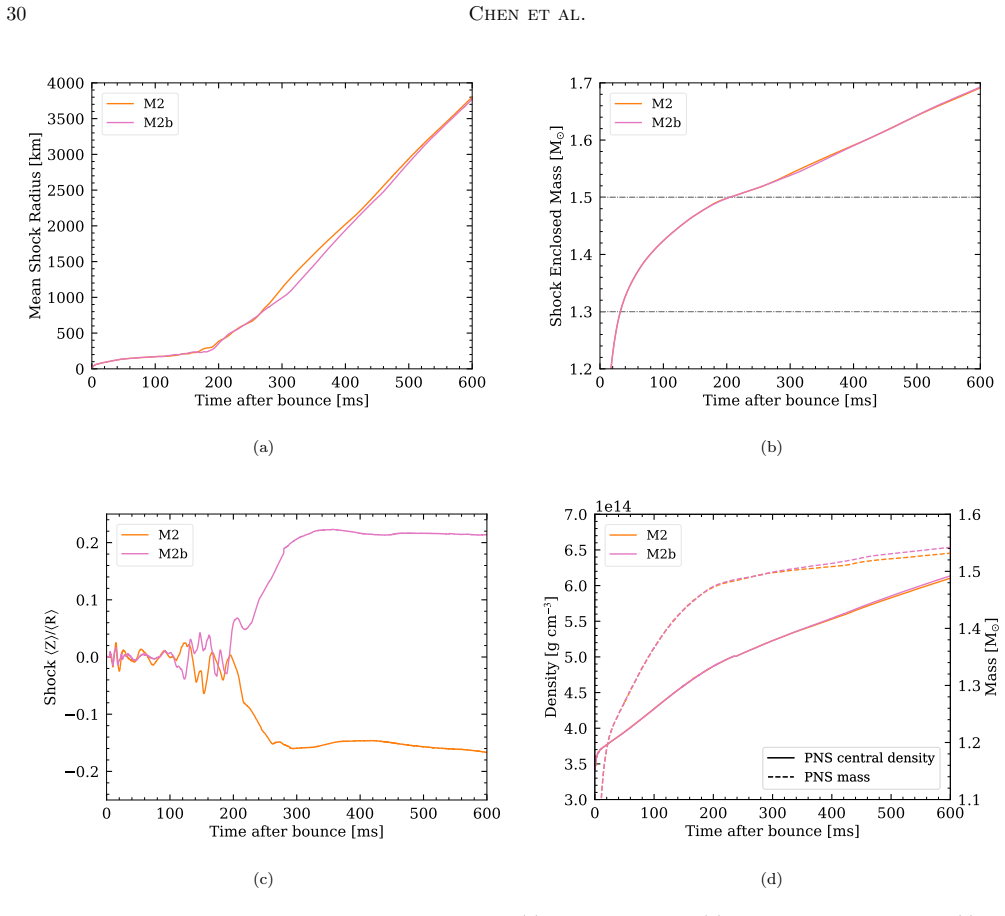
Contrary to results reported by other groups, we observe similar shock revival times and explosion development in our simulations despite differences in initial compositions and structures. We find no discernible impact from turbulent energy introduced by the multi-D structures in the progenitor as the models evolve from the stalled shock to explosion. We attribute this to the turbulence generated in the post-shock region by shock deformation and standing accretion shock instability reaching a saturation level before the neutrino-driven convection dominates the post-shock dynamics. An examination of model stochasticity shows that any prior expected impacts on explosive outcome due to convect
What carries the argument
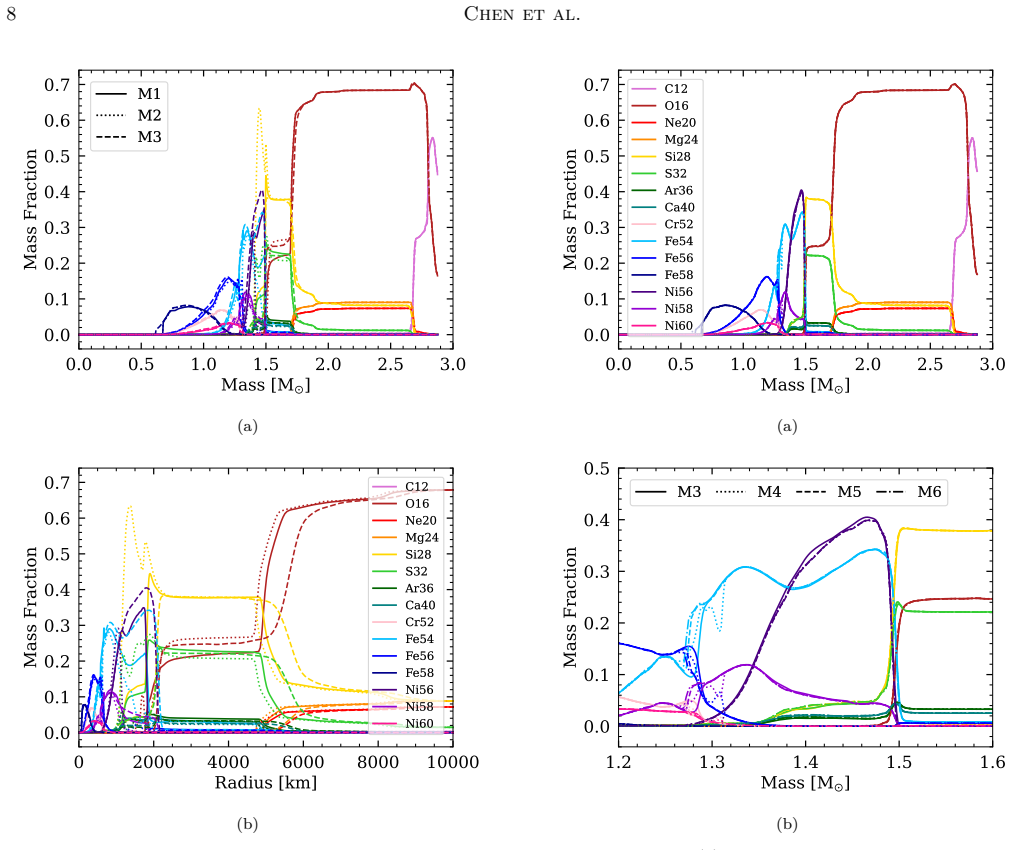
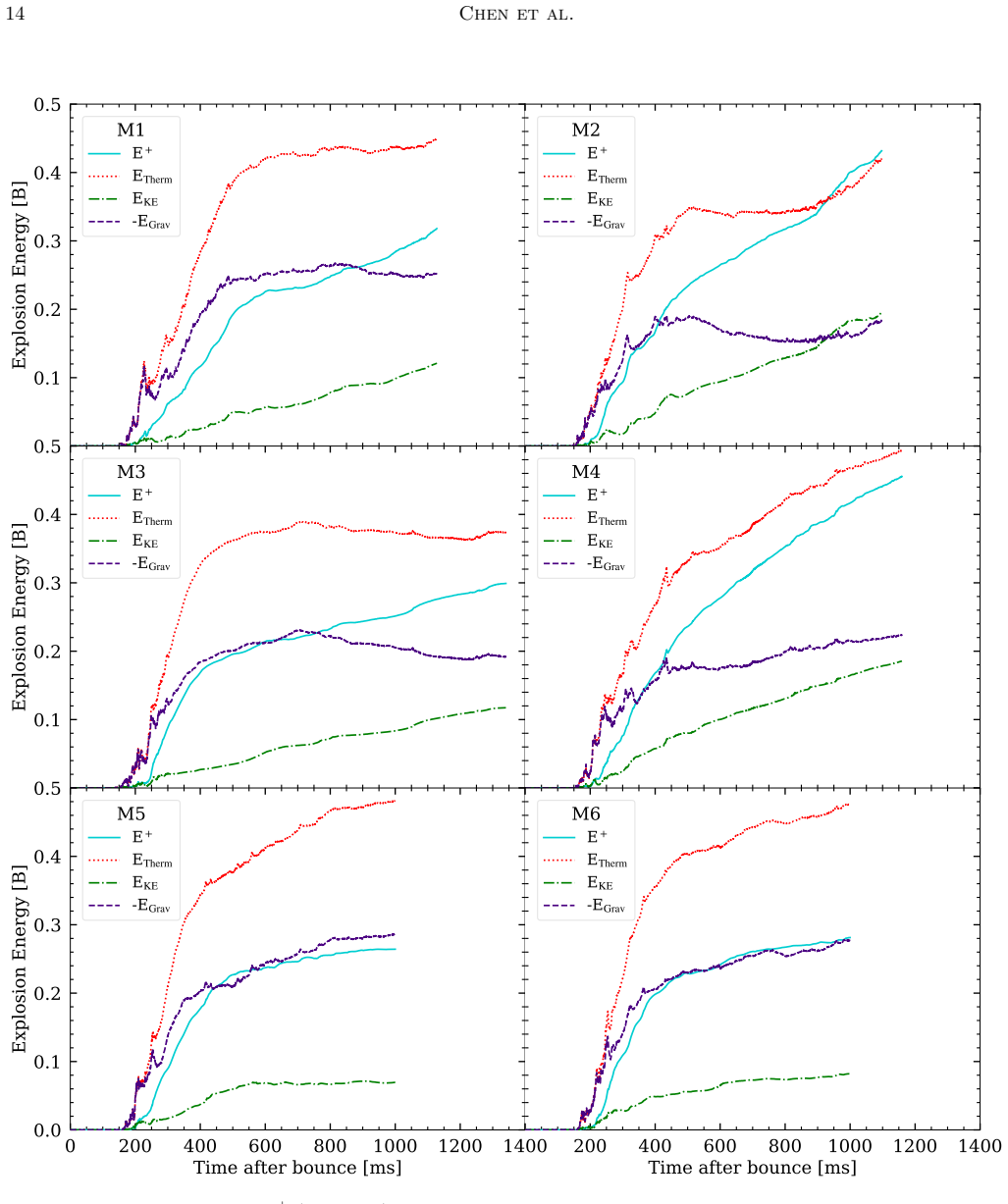
Comparison of 2D CHIMERA neutrino radiation hydrodynamics simulations of 15 solar mass progenitors with varying 1D and 2D pre-collapse structures, tracking shock dynamics, diagnostic energy, neutrino heating, accretion, explosion geometry, nuclear abundances, and turbulent convection to isolate the role of initial multi-dimensional perturbations.
If this is right
- Shock revival times and explosion development proceed similarly across progenitors with and without multi-dimensional structures from pre-collapse evolution.
- Turbulent energy supplied by the progenitor becomes irrelevant once post-shock motions from shock deformation and SASI reach saturation.
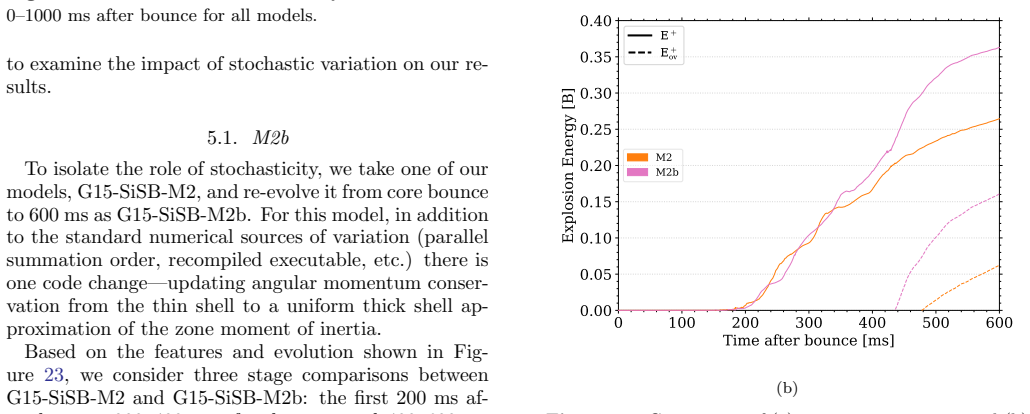
- Effects from convection-related perturbations in the progenitor lie below the level of numerical stochasticity in these models.
- Explosion outcomes remain insensitive to differences in initial compositions and structures introduced by different stellar evolution environments.
Where Pith is reading between the lines
- If post-shock saturation always precedes neutrino-driven convection, then full 3D modeling of pre-collapse convection may not be required to predict 2D explosion outcomes.
- The same progenitors run in three dimensions could test whether SASI behaves differently and allows progenitor perturbations to matter.
- Neighboring studies reporting impacts from multi-D progenitors may need to verify that those effects survive changes in numerical resolution or neutrino transport.
- The result implies that variability in supernova models is more often set by neutrino heating details or grid resolution than by stellar-evolution perturbations.
Load-bearing premise
That turbulence generated in the post-shock region by shock deformation and standing accretion shock instability reaches a saturation level before neutrino-driven convection dominates, rendering any progenitor-supplied turbulent energy irrelevant to the explosion outcome.
What would settle it
A simulation in which progenitor turbulence is strong enough to measurably shift shock revival time or change explosion development before post-shock SASI turbulence saturates.
Figures










read the original abstract
Numerical studies of core-collapse supernovae have demonstrated the importance of non-radial motions in pre-collapse progenitors on the explosion outcome. We use the CHIMERA neutrino radiation hydrodynamics code running seven two-dimensional simulations of 15 solar mass progenitors with different progenitor structures introduced by different one and two-dimensional pre-collapse stellar evolution environments to examine the impacts of stellar structure and non-spherical motion in the pre-collapse progenitor on the development of explosions in 2D core-collapse supernova simulations. We compare the explosion evolution of these models in terms of shock dynamics, diagnostic energy, neutrino heating, accretion, explosion geometry, nuclear abundances, and turbulent convection. We also analyze how stochasticity impacts our simulations. Contrary to results reported by other groups examining the impacts of multi-dimensional progenitors, we observe similar shock revival times and explosion development in our simulations despite differences in initial compositions and structures. We find no discernible impact from turbulent energy introduced by the multi-D structures in the progenitor as the models evolve from the stalled shock to explosion. We attribute this to the turbulence generated in the post-shock region by shock deformation and standing accretion shock instability to a saturation level before the neutrino-driven convection dominates the post-shock dynamics. An examination of model stochasticity shows that any prior expected impacts on explosive outcome due to convection-related perturbations lie below the detectable threshold of numerical variation.
Editorial analysis
A structured set of objections, weighed in public.
Referee Report
Summary. The manuscript reports results from seven 2D CHIMERA neutrino radiation hydrodynamics simulations of 15 solar mass core-collapse supernovae. Progenitors are initialized with structures and perturbations drawn from both 1D and 2D pre-collapse stellar evolution calculations. The authors compare shock revival times, diagnostic energies, neutrino heating, accretion rates, explosion geometry, nuclear abundances, and turbulent convection across the set. They report similar revival times and explosion development despite initial differences, conclude that progenitor-supplied turbulent energy has no discernible effect once the stalled shock phase begins, and attribute this to saturation of post-shock turbulence by shock deformation and SASI before neutrino-driven convection dominates. A stochasticity analysis is presented to argue that any convection-related effects fall below numerical variation thresholds.
Significance. If the central observational result of similar revival times holds after the requested diagnostics are supplied, the work would indicate that, at least in 2D, post-shock hydrodynamic processes rapidly erase memory of pre-collapse multi-dimensional structure. This would stand in contrast to reports from other groups and would underscore the importance of quantifying stochasticity and resolution convergence in the field. The use of an ensemble of seven models with explicit stochasticity analysis is a constructive step toward placing bounds on variability.
major comments (2)
- [Abstract] Abstract: the attribution that 'turbulence generated in the post-shock region by shock deformation and standing accretion shock instability [reaches] a saturation level before the neutrino-driven convection dominates' is load-bearing for the claim of no discernible progenitor impact, yet the manuscript supplies no supporting quantitative evidence such as time series of turbulent kinetic energy decomposed by source (progenitor vs. gain-region generation), velocity power spectra at key epochs, or direct comparison of fluctuation amplitudes traceable to the initial multi-D structures.
- [Abstract] Abstract and stochasticity analysis: the statement that 'any prior expected impacts on explosive outcome due to convection-related perturbations lie below the detectable threshold of numerical variation' is not accompanied by resolution studies, quantitative error bars on shock revival times or diagnostic energies, or explicit criteria for data exclusion. Without these, the assertion that progenitor effects are negligible relative to numerical noise cannot be evaluated.
Simulated Author's Rebuttal
We thank the referee for the constructive and detailed report. The comments highlight areas where additional quantitative support would strengthen the manuscript. We address each point below and indicate revisions to be incorporated in the revised version.
read point-by-point responses
-
Referee: [Abstract] Abstract: the attribution that 'turbulence generated in the post-shock region by shock deformation and standing accretion shock instability [reaches] a saturation level before the neutrino-driven convection dominates' is load-bearing for the claim of no discernible progenitor impact, yet the manuscript supplies no supporting quantitative evidence such as time series of turbulent kinetic energy decomposed by source (progenitor vs. gain-region generation), velocity power spectra at key epochs, or direct comparison of fluctuation amplitudes traceable to the initial multi-D structures.
Authors: We agree that the manuscript would benefit from explicit quantitative diagnostics supporting the attribution of turbulence saturation. While the similar shock revival times, diagnostic energies, and post-shock flow properties across the seven models with differing initial perturbations provide indirect evidence that post-shock processes dominate, we will add time series of turbulent kinetic energy in the gain region (with decomposition where feasible from the available data) and velocity power spectra at representative epochs (e.g., at shock stall and near revival) for selected models. These additions will allow direct comparison of fluctuation amplitudes and their evolution independent of the initial progenitor structure. revision: yes
-
Referee: [Abstract] Abstract and stochasticity analysis: the statement that 'any prior expected impacts on explosive outcome due to convection-related perturbations lie below the detectable threshold of numerical variation' is not accompanied by resolution studies, quantitative error bars on shock revival times or diagnostic energies, or explicit criteria for data exclusion. Without these, the assertion that progenitor effects are negligible relative to numerical noise cannot be evaluated.
Authors: The stochasticity analysis in the manuscript uses the spread across the seven-member ensemble to quantify variation in revival times, diagnostic energies, and other quantities, with all models included and no data exclusion applied. We will add explicit error bars derived from the standard deviation of these quantities across the ensemble and state the inclusion criterion (all seven simulations are retained). While dedicated resolution convergence studies were not performed for this specific progenitor set, we will expand the discussion to place the observed ensemble variation in the context of prior CHIMERA resolution tests reported in the literature. This will clarify that the progenitor-induced differences fall within the quantified numerical variation. revision: partial
Circularity Check
No circularity: direct numerical comparison of distinct initial conditions
full rationale
The paper reports results from seven 2D CHIMERA simulations initialized with different 15 solar-mass progenitor structures and compositions. The central claims of similar shock revival times, explosion development, and no discernible impact from progenitor-supplied turbulent energy are presented as direct outcomes of evolving those distinct initial conditions to the stalled-shock and explosion phases. No equations, fitted parameters, or derivations are shown that reduce the reported outcomes to self-referential definitions or inputs called predictions. The post-hoc attribution to post-shock turbulence reaching saturation before neutrino-driven convection dominates is an interpretive statement, not a load-bearing step that constructs the main results by construction. No self-citation chains, uniqueness theorems, or ansatzes imported from prior work are invoked to force the conclusions. The study is therefore self-contained as a comparative simulation exercise.
Axiom & Free-Parameter Ledger
axioms (1)
- domain assumption The CHIMERA code accurately captures neutrino-driven convection and standing accretion shock instability in 2D.
Forward citations
Cited by 1 Pith paper
-
The jet-shaped pipe morphology in planetary nebulae and core-collapse supernova remnants
Morphological similarity between pipe structures in planetary nebulae and supernova remnants, plus a jet simulation, indicates that jittering jets shaped both.
Reference graph
Works this paper leans on
-
[1]
, " * write output.state after.block = add.period write newline
ENTRY address archivePrefix author booktitle chapter doi edition editor eprint howpublished institution journal key month number organization pages publisher school series title misctitle type volume year version url label extra.label sort.label short.list INTEGERS output.state before.all mid.sentence after.sentence after.block FUNCTION init.state.consts ...
-
[2]
write newline
" write newline "" before.all 'output.state := FUNCTION format.url url empty "" new.block "" url * "" * if FUNCTION format.eprint eprint empty "" archivePrefix empty "" archivePrefix "arXiv" = new.block " " eprint * " " * new.block " " eprint * " " * if if if FUNCTION format.doi doi empty "" " " doi * " " * if FUNCTION format.pid doi empty eprint empty ur...
-
[3]
Or2v q2I W0l* q A.>| 0lKu &-(f 4 R
thebibliography [1] 20pt to REFERENCES 6pt =0pt \@twocolumntrue 12pt -12pt 10pt plus 3pt =0pt =0pt =1pt plus 1pt =0pt =0pt -12pt =13pt plus 1pt =20pt =13pt plus 1pt \@M =10000 =-1.0em =0pt =0pt 0pt =0pt =1.0em @enumiv\@empty 10000 10000 `\.\@m \@noitemerr \@latex@warning Empty `thebibliography' environment \@ifnextchar \@reference \@latexerr Missing key o...
2017
-
[4]
2003, title Stability of Standing Accretion Shocks, with an Eye toward Core-Collapse Supernovae , , 584, 971
Blondin, J., Mezzacappa, A., & DeMarino, C. 2003, title Stability of Standing Accretion Shocks, with an Eye toward Core-Collapse Supernovae , , 584, 971
2003
-
[5]
Blondin , J. M., & Mezzacappa , A. 2006, title The Spherical Accretion Shock Instability in the Linear Regime , , 642, 401, 10.1086/500817
-
[6]
Bodansky , D., Clayton , D. D., & Fowler , W. A. 1968, title Nuclear Quasi-Equilibrium during Silicon Burning , , 16, 299, 10.1086/190176
-
[7]
Bollig , R., Yadav , N., Kresse , D., et al. 2021, title Self-consistent 3D Supernova Models From -7 Minutes to +7 s: A 1-bethe Explosion of a 19 M _ Progenitor , , 915, 28, 10.3847/1538-4357/abf82e
-
[8]
Bruenn , S. W., Lentz , E. J., Hix , W. R., et al. 2016, title The Development of Explosions in Axisymmetric Ab Initio Core-Collapse Supernova Simulations of 12-25 M_ Stars , , 818, 123, 10.3847/0004-637X/818/2/123
-
[9]
Bruenn , S. W., Blondin , J. M., Hix , W. R., et al. 2020, title CHIMERA: A Massively Parallel Code for Core-collapse Supernova Simulations , , 248, 11, 10.3847/1538-4365/ab7aff
-
[10]
W., Sieverding , A., Lentz , E
Bruenn , S. W., Sieverding , A., Lentz , E. J., et al. 2023, title Comparison of the Core-collapse Evolution of Two Nearly Equal-mass Progenitors , , 947, 35, 10.3847/1538-4357/acbb65
-
[11]
T., Raffelt , G
Buras , R., Janka , H., Keil , M. T., Raffelt , G. G., & Rampp , M. 2003, title Electron Neutrino Pair Annihilation: A New Source for Muon and Tau Neutrinos in Supernovae , , 587, 320
2003
-
[12]
Cardall , C. Y., & Budiardja , R. D. 2015, title Stochasticity and Efficiency in Simplified Models of Core-collapse Supernova Explosions , , 813, L6, 10.1088/2041-8205/813/1/L6
-
[13]
Chertkow , M. A. 2012, title Advancements in Modeling Self-Consistent Core-Collapse Supernovae with CHIMERA, PhD thesis, University of Tennessee, Knoxville
2012
-
[14]
A., Messer , O
Chertkow , M. A., Messer , O. E. B., Hix , W. R., et al. 2012, title Advancements in modeling self-consistent core collapse supernovae with CHIMERA , J. Phys.: Conf. Ser., 402, 012025
2012
-
[15]
M., Chatzopoulos , E., Arnett , W
Couch , S. M., Chatzopoulos , E., Arnett , W. D., & Timmes , F. X. 2015, title The Three-dimensional Evolution to Core Collapse of a Massive Star , , 808, L21, 10.1088/2041-8205/808/1/L21
-
[16]
Couch , S. M., & O'Connor , E. P. 2014, title High-resolution Three-dimensional Simulations of Core-collapse Supernovae in Multiple Progenitors , , 785, 123, 10.1088/0004-637X/785/2/123
-
[17]
Couch , S. M., & Ott , C. D. 2013, title Revival of the Stalled Core-collapse Supernova Shock Triggered by Precollapse Asphericity in the Progenitor Star , , 778, L7, 10.1088/2041-8205/778/1/L7
-
[18]
Couch , S. M., & Ott , C. D. 2015, title The Role of Turbulence in Neutrino-driven Core-collapse Supernova Explosions , , 799, 5, 10.1088/0004-637X/799/1/5
-
[19]
Cyburt , R. H., Amthor , A. M., Ferguson , R., et al. 2010, title The JINA REACLIB Database: Its Recent Updates and Impact on Type-I X-ray Bursts , , 189, 240, 10.1088/0067-0049/189/1/240
- [20]
-
[21]
Fields , C. E., & Couch , S. M. 2020, title On the Development of Multidimensional Progenitor Models for Core-collapse Supernovae , , 901, 33, 10.3847/1538-4357/abada7
-
[22]
M., Fowler , W
Fuller , G. M., Fowler , W. A., & Newman , M. J. 1985, title Stellar weak interaction rates for intermediate-mass nuclei. IV - Interpolation procedures for rapidly varying lepton capture rates using effective log (ft)-values , , 293, 1
1985
-
[23]
2014, title Toward Connecting Core-collapse Supernova Theory with Observations
Handy , T., Plewa , T., & Odrzywo ek , A. 2014, title Toward Connecting Core-collapse Supernova Theory with Observations. I. Shock Revival in a 15 M _ Blue Supergiant Progenitor with SN 1987A Energetics , , 783, 125, 10.1088/0004-637X/783/2/125
-
[24]
Hanke , F., Marek , A., Mueller , B., & Janka , H.-T. 2012, title Is Strong SASI Activity the Key to Successful Neutrino-Driven Supernova Explosions? , , 755, 138, 10.1088/0004-637X/755/2/138
-
[25]
Harris , J. A., Hix , W. R., Chertkow , M. A., et al. 2017, title Implications for Post-processing Nucleosynthesis of Core-collapse Supernova Models with Lagrangian Particles , , 843, 2, 10.3847/1538-4357/aa76de
-
[26]
R., Messer , O
Hix , W. R., Messer , O. E. B., Mezzacappa , A., et al. 2003, title Consequences of Nuclear Electron Capture in Core Collapse Supernovae , , 91, 201102
2003
-
[27]
R., & Thielemann , F
Hix , W. R., & Thielemann , F. 1999, title Computational methods for nucleosynthesis and nuclear energy generation. , J. Comp. Appl. Math, 109, 321
1999
-
[28]
Hix , W. R., Lentz , E. J., Endeve , E., et al. 2014, title Essential ingredients in core-collapse supernovae , AIP Advances, 4, 041013, 10.1063/1.4870009
-
[29]
Hunter , J. D. 2007, title Matplotlib: A 2D Graphics Environment , Computing in Science and Engineering, 9, 90, 10.1109/MCSE.2007.55
-
[30]
1996, title Neutrino Energy Loss in Stellar Interiors
Itoh , N., Hayashi , H., Nishikawa , A., & Kohyama , Y. 1996, title Neutrino Energy Loss in Stellar Interiors. VII. Pair, Photo-, Plasma, Bremsstrahlung, and Recombination Neutrino Processes , , 102, 411, 10.1086/192264
-
[31]
Janka,Explosion Mechanisms of Core-Collapse Supernovae,Ann
Janka , H.-T. 2012, title Explosion Mechanisms of Core-Collapse Supernovae , Annu. Rev. Nucl. Part. Sci., 62, 407. 1206.2503
-
[32]
Landfield , R. E. 2018, title Sensitivity of neutrino-driven core-collapse supernova models to the microphysical equation of state , PhD thesis, University of Tennessee, Knoxville, United States
2018
-
[33]
2000, title Shell-model calculations of stellar weak interaction rates: II
Langanke , K., & Mart \' nez-Pinedo , G. 2000, title Shell-model calculations of stellar weak interaction rates: II. Weak rates for nuclei in the mass range A=45-65 in supernovae environments , , 673, 481
2000
-
[34]
M., et al
Langanke , K., Mart \' nez-Pinedo , G., Sampaio , J. M., et al. 2003, title Electron Capture Rates on Nuclei and Implications for Stellar Core Collapse , , 90, 241102
2003
-
[35]
J., Keeling Sandoval , C., Hix , W
Lentz , E. J., Keeling Sandoval , C., Hix , W. R., et al. 2026, title Multidimensional Late Stage Stellar Evolution of a 15 \ Star , , in prep
2026
-
[36]
Mezzacappa , A. 2005, title Ascertaining The Core Collapse Supernova Mechanism: The State of the Art and the Road Ahead , Annu. Rev. Nucl. Part. Sci., 55, 467, 10.1146/annurev.nucl.55.090704.151608PDF: http://arjournals.annualreviews.org/doi/pdf/10.1146/annurev.nucl.55.090704.151608
work page doi:10.1146/annurev.nucl.55.090704.151608pdf: 2005
-
[37]
M \"u ller , B., & Janka , H.-T. 2015, title Non-radial instabilities and progenitor asphericities in core-collapse supernovae , , 448, 2141, 10.1093/mnras/stv101
-
[38]
M \"u ller , B., Melson , T., Heger , A., & Janka , H.-T. 2017, title Supernova simulations from a 3D progenitor model - Impact of perturbations and evolution of explosion properties , , 472, 491, 10.1093/mnras/stx1962
-
[39]
M \"u ller , B., Tauris , T. M., Heger , A., et al. 2019, title Three-dimensional simulations of neutrino-driven core-collapse supernovae from low-mass single and binary star progenitors , , 484, 3307, 10.1093/mnras/stz216
-
[40]
Murphy , J. W., Dolence , J. C., & Burrows , A. 2013, title The Dominance of Neutrino-driven Convection in Core-collapse Supernovae , , 771, 52, 10.1088/0004-637X/771/1/52
-
[41]
R., et al
Neopane , S., Sandoval , M., Hix , W. R., et al. 2026, title Core-collapse Evolution to One Year , , in prep
2026
-
[42]
1994, title Rate Tables for the Weak Processes of sd-Shell Nuclei in Stellar Matter , At
Oda , T., Hino , M., Muto , K., Takahara , M., & Sato , K. 1994, title Rate Tables for the Weak Processes of sd-Shell Nuclei in Stellar Matter , At. Data Nuc. Data Tab., 56, 231
1994
-
[43]
2011, ApJS, 192, 3, doi: 10.1088/0067-0049/192/1/3
Paxton , B., Bildsten , L., Dotter , A., et al. 2011, title Modules for Experiments in Stellar Astrophysics (MESA) , , 192, 3, 10.1088/0067-0049/192/1/3
-
[44]
2013, ApJS, 208, 4, doi: 10.1088/0067-0049/208/1/4 Modeling Procyon13
Paxton , B., Cantiello , M., Arras , P., et al. 2013, title Modules for Experiments in Stellar Astrophysics (MESA): Planets, Oscillations, Rotation, and Massive Stars , , 208, 4, 10.1088/0067-0049/208/1/4
work page internal anchor Pith review doi:10.1088/0067-0049/208/1/4 2013
-
[45]
2015, ApJS, 220, 15, doi: 10.1088/0067-0049/220/1/15
Paxton , B., Marchant , P., Schwab , J., et al. 2015, title Modules for Experiments in Stellar Astrophysics (MESA): Binaries, Pulsations, and Explosions , , 220, 15, 10.1088/0067-0049/220/1/15
work page internal anchor Pith review doi:10.1088/0067-0049/220/1/15 2015
-
[46]
Sandoval , M. A., Hix , W. R., Messer , O. E. B., Lentz , E. J., & Harris , J. A. 2021, title Three-dimensional Core-collapse Supernova Simulations with 160 Isotopic Species Evolved to Shock Breakout , , 921, 113, 10.3847/1538-4357/ac1d49
-
[47]
Skinner , M. A., Dolence , J. C., Burrows , A., Radice , D., & Vartanyan , D. 2019, title FORNAX: A Flexible Code for Multiphysics Astrophysical Simulations , , 241, 7, 10.3847/1538-4365/ab007f
-
[48]
W., Hempel , M., & Fischer , T
Steiner , A. W., Hempel , M., & Fischer , T. 2013, title Core-collapse Supernova Equations of State Based on Neutron Star Observations , , 774, 17, 10.1088/0004-637X/774/1/17
-
[49]
Takiwaki , T., Kotake , K., & Suwa , Y. 2014, title A Comparison of Two- and Three-dimensional Neutrino-hydrodynamics Simulations of Core-collapse Supernovae , , 786, 83, 10.1088/0004-637X/786/2/83
-
[50]
Timmes , F. X., & Swesty , F. D. 2000, title The Accuracy, Consistency, and Speed of an Electron-Positron Equation of State Based on Table Interpolation of the Helmholtz Free Energy , , 126, 501, 10.1086/313304
-
[51]
1966, title The Approach to Nuclear Statistical Equilibrium , Can
Truran, J., Cameron, A., & Gilbert, A. 1966, title The Approach to Nuclear Statistical Equilibrium , Can. J. Phys., 44, 563
1966
-
[52]
Vartanyan , D., Coleman , M. S. B., & Burrows , A. 2022, title The collapse and three-dimensional explosion of three-dimensional massive-star supernova progenitor models , , 510, 4689, 10.1093/mnras/stab3702
-
[53]
Vartanyan , D., Laplace , E., Renzo , M., et al. 2021, title Binary-stripped Stars as Core-collapse Supernovae Progenitors , , 916, L5, 10.3847/2041-8213/ac0b42
-
[54]
Wang , T., & Burrows , A. 2024, title Insights into the Production of ^ 44 Ti and Nickel Isotopes in Core-collapse Supernovae , , 974, 39, 10.3847/1538-4357/ad6983
-
[55]
Wongwathanarat , A., Janka , H.-T., & M \"u ller , E. 2013, title Three-dimensional neutrino-driven supernovae: Neutron star kicks, spins, and asymmetric ejection of nucleosynthesis products , A&A, 552, A126, 10.1051/0004-6361/201220636
-
[56]
The evolution and explosion of massive stars.Rev
Woosley , S. E., Heger , A., & Weaver , T. A. 2002, title The evolution and explosion of massive stars , Rev. Mod. Phys., 74, 1015, 10.1103/RevModPhys.74.1015
discussion (0)
Sign in with ORCID, Apple, or X to comment. Anyone can read and Pith papers without signing in.