Compact single-shot ranging and near-far imaging using metasurfaces
Pith reviewed 2026-05-10 16:16 UTC · model grok-4.3
The pith
A metasurface creates a 15 mm camera that records two close focal planes and one far plane on one sensor to enable passive millimeter ranging.
A machine-rendered reading of the paper's core claim, the machinery that carries it, and where it could break.
Core claim
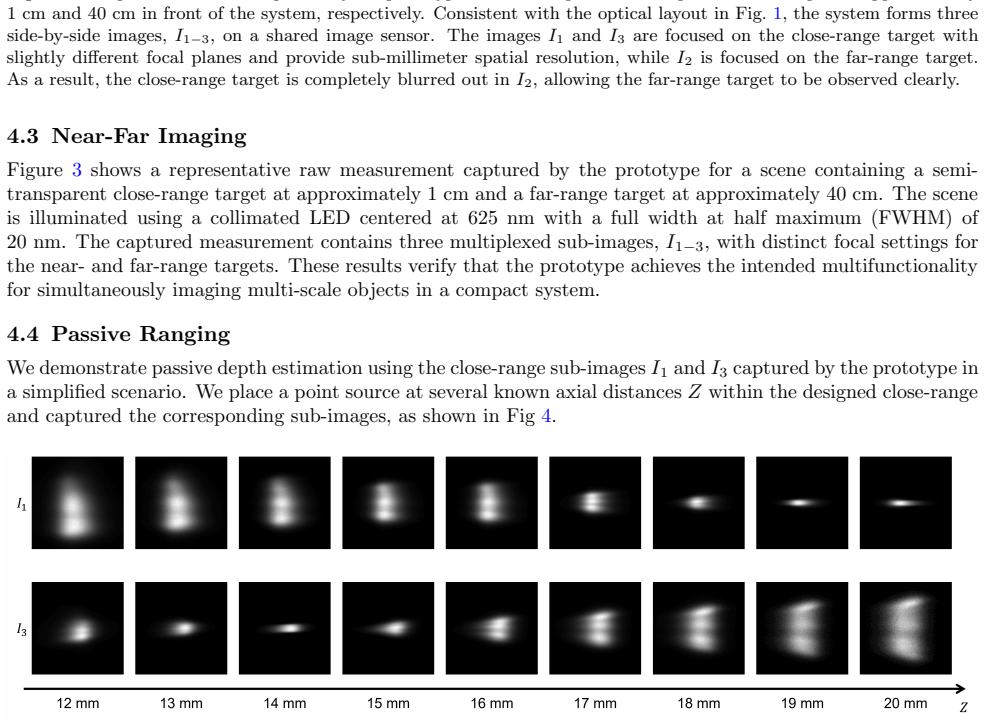
The metasurface imaging system captures two images at close range (1-2 cm) and an additional image at long range (about 40 cm) on a shared photosensor. The close-range image pair focuses at 1.4 cm and 2.0 cm, respectively, which forms a focal stack, enabling passive ranging with an accuracy of ±1 mm from 12 mm to 20 mm through a computationally efficient depth-from-defocus algorithm for a simplified scenario. The entire system is compact, with a total track length of 15 mm.
What carries the argument
A metasurface optic that imposes three distinct focal lengths on incoming light to produce a focal stack plus a far image on a single shared photosensor, supporting depth-from-defocus ranging.
Load-bearing premise
The depth-from-defocus algorithm reaches the stated millimeter accuracy only when the metasurface actually delivers the claimed focal lengths with usable image quality on the shared sensor.
What would settle it
Place test objects at known distances between 12 mm and 20 mm and run the depth-from-defocus algorithm on the captured focal stack; the claim fails if the average absolute error exceeds 1 mm.
Figures



read the original abstract
We present a metasurface imaging system capable of simultaneously capturing two images at close range (1-2~cm) and an additional image at long range (about 40~cm) on a shared photosensor. The close-range image pair focuses at 1.4~cm and 2.0~cm, respectively, which forms a focal stack, enabling passive ranging with an accuracy of $\pm$1~mm from 12~mm to 20~mm through a computationally efficient depth-from-defocus algorithm for a simplified scenario. The entire system is compact, with a total track length of 15~mm, making it suitable for seamless integration into edge platforms for defense and other resource-constrained applications.
Editorial analysis
A structured set of objections, weighed in public.
Referee Report
Summary. The manuscript presents a metasurface imaging system that simultaneously captures two close-range images (focusing at 1.4 cm and 2.0 cm) and one long-range image (~40 cm) on a shared photosensor with a 15 mm track length. It claims this focal stack enables passive ranging with ±1 mm accuracy over 12–20 mm via a computationally efficient depth-from-defocus algorithm in a simplified scenario, targeting compact integration for edge and defense applications.
Significance. If experimentally validated with the claimed image quality and algorithm performance, the approach could advance compact single-shot near-far imaging and ranging systems by leveraging metasurfaces for multi-focal capture on a single sensor. This would be relevant for resource-constrained platforms, though the absence of design equations, fabrication details, or validation data limits assessment of its practical impact.
major comments (1)
- [Abstract] Abstract: The central claim of ±1 mm ranging accuracy from 12 mm to 20 mm is stated without any experimental validation data, error analysis, metasurface phase profile equations, or description of the 'simplified scenario' assumptions for the depth-from-defocus algorithm. This is load-bearing, as the feasibility depends on whether the 1.4 cm / 2.0 cm focal stack on a 15 mm track produces distinguishable defocus cues without excessive crosstalk or aberrations.
Simulated Author's Rebuttal
We thank the referee for their detailed and constructive review. We address the major comment below and have revised the manuscript to improve clarity and qualification of our claims.
read point-by-point responses
-
Referee: [Abstract] Abstract: The central claim of ±1 mm ranging accuracy from 12 mm to 20 mm is stated without any experimental validation data, error analysis, metasurface phase profile equations, or description of the 'simplified scenario' assumptions for the depth-from-defocus algorithm. This is load-bearing, as the feasibility depends on whether the 1.4 cm / 2.0 cm focal stack on a 15 mm track produces distinguishable defocus cues without excessive crosstalk or aberrations.
Authors: We agree that the abstract is a high-level summary and does not embed the supporting details. The full manuscript presents the metasurface phase profile equations, the depth-from-defocus algorithm with its simplified-scenario assumptions (paraxial approximation, negligible aberrations, and minimal crosstalk between the three focal planes), and simulation results that include error analysis demonstrating the ±1 mm accuracy over 12–20 mm. We acknowledge that the work is simulation-based and contains no experimental validation data. In the revised version we have updated the abstract to explicitly qualify the ranging claim as simulation-derived under the stated assumptions, and we have expanded the methods and discussion sections to provide the phase-profile equations, algorithm details, and an analysis of crosstalk and aberration sensitivity. revision: yes
Circularity Check
No circularity; abstract presents empirical claims without derivations or self-referential steps
full rationale
The provided abstract and context contain no equations, parameter fits, derivations, or citations. The ranging accuracy of ±1 mm is stated as an outcome of the metasurface focal stack and depth-from-defocus algorithm in a simplified scenario, without any reduction of that accuracy figure to fitted inputs or prior self-citations by construction. No load-bearing step equates a prediction to its own definition or renames a known result. The derivation chain is therefore self-contained against external benchmarks such as the actual metasurface fabrication and algorithm performance on real data.
Axiom & Free-Parameter Ledger
Reference graph
Works this paper leans on
-
[1]
Advancements in the field of autonomous underwater vehicle,
Sahoo, A., Dwivedy, S. K., and Robi, P., “Advancements in the field of autonomous underwater vehicle,” Ocean Engineering181, 145–160 (2019)
work page 2019
-
[2]
Li, Z., An, P., Wu, K., Liu, Q., and Yang, Y., “Mvmfcam: an all-in-focus optical synthetic aperture imaging system based on multi-view multi-focus computational imaging,”Optics Express33(10), 20496– 20515 (2025)
work page 2025
-
[3]
Multifocus camera optics with 5x extending the depth of field,
Laskin, A., Laskin, V., and Ostrun, A., “Multifocus camera optics with 5x extending the depth of field,” in [Optics, Photonics, and Digital Technologies for Imaging Applications VIII],12998, 69–79, SPIE (2024)
work page 2024
-
[4]
Focal track: Depth and accommodation with oscillating lens deformation,
Guo, Q., Alexander, E., and Zickler, T., “Focal track: Depth and accommodation with oscillating lens deformation,” in [Proceedings of the IEEE international conference on computer vision], 966–974 (2017)
work page 2017
-
[5]
Balthasar Mueller, J., Rubin, N. A., Devlin, R. C., Groever, B., and Capasso, F., “Metasurface polar- ization optics: independent phase control of arbitrary orthogonal states of polarization,”Physical review letters118(11), 113901 (2017)
work page 2017
-
[6]
Aluminum plasmonic multicolor meta-hologram,
Huang, Y.-W., Chen, W. T., Tsai, W.-Y., Wu, P. C., Wang, C.-M., Sun, G., and Tsai, D. P., “Aluminum plasmonic multicolor meta-hologram,”Nano letters15(5), 3122–3127 (2015)
work page 2015
-
[7]
Kamali, S. M., Arbabi, E., Arbabi, A., Horie, Y., Faraji-Dana, M., and Faraon, A., “Angle-multiplexed metasurfaces: encoding independent wavefronts in a single metasurface under different illumination angles,” Physical Review X7(4), 041056 (2017)
work page 2017
-
[8]
Composite functional metasurfaces for multispectral achromatic optics,
Avayu, O., Almeida, E., Prior, Y., and Ellenbogen, T., “Composite functional metasurfaces for multispectral achromatic optics,”Nature communications8(1), 14992 (2017)
work page 2017
-
[9]
Multispectral chiral imaging with a metalens,
Khorasaninejad, M., Chen, W., Zhu, A., Oh, J., Devlin, R., Rousso, D., and Capasso, F., “Multispectral chiral imaging with a metalens,”Nano letters16(7), 4595–4600 (2016)
work page 2016
-
[10]
Compact single- shot metalens depth sensors inspired by eyes of jumping spiders,
Guo, Q., Shi, Z., Huang, Y.-W., Alexander, E., Qiu, C.-W., Capasso, F., and Zickler, T., “Compact single- shot metalens depth sensors inspired by eyes of jumping spiders,”Proceedings of the National Academy of Sciences116(46), 22959–22965 (2019)
work page 2019
-
[11]
Matrix fourier optics enables a compact full-stokes polarization camera,
Rubin, N. A., D’Aversa, G., Chevalier, P., Shi, Z., Chen, W. T., and Capasso, F., “Matrix fourier optics enables a compact full-stokes polarization camera,”Science365(6448), eaax1839 (2019)
work page 2019
-
[12]
Meta-optics achieves rgb-achromatic focusing for virtual reality,
Li, Z., Lin, P., Huang, Y.-W., Park, J.-S., Chen, W. T., Shi, Z., Qiu, C.-W., Cheng, J.-X., and Capasso, F., “Meta-optics achieves rgb-achromatic focusing for virtual reality,”Science Advances7(5), eabe4458 (2021)
work page 2021
-
[13]
Polarization multi-image synthesis with birefringent metasurfaces,
Hazineh, D., Lim, S. W. D., Guo, Q., Capasso, F., and Zickler, T., “Polarization multi-image synthesis with birefringent metasurfaces,” in [2023 IEEE International Conference on Computational Photography (ICCP)], 1–12, IEEE (2023)
work page 2023
-
[14]
Metahdr: single shot high-dynamic range imaging and sensing using a multifunctional metasurface,
Brookshire, C., Liu, Y., Chen, Y., Chen, W. T., and Guo, Q., “Metahdr: single shot high-dynamic range imaging and sensing using a multifunctional metasurface,”Optics Express32(15), 26690–26707 (2024)
work page 2024
-
[15]
Inverse-designed metasurfaces for multifunctional spatial fre- quency filtering,
Pearson, P., Roberts, G., and Faraon, A., “Inverse-designed metasurfaces for multifunctional spatial fre- quency filtering,”Optica12(7), 1090–1099 (2025)
work page 2025
-
[16]
Metah2: A snapshot metasurface hdr hyperspectral camera,
Liu, Y. and Guo, Q., “Metah2: A snapshot metasurface hdr hyperspectral camera,” in [2025 IEEE Inter- national Conference on Image Processing (ICIP)], 1918–1923, IEEE (2025)
work page 2025
-
[17]
Metaspectra+: A compact broadband metasurface camera for snapshot hyperspectral+ imaging,
Liu, Y., Xu, W., and Guo, Q., “Metaspectra+: A compact broadband metasurface camera for snapshot hyperspectral+ imaging,”arXiv preprint arXiv:2603.09116(2026)
-
[18]
Alexander, E., [A theory of depth from differential defocus], Harvard University (2019)
work page 2019
-
[19]
Guo, Q., [Efficient passive ranging with computational optics], Harvard University (2022)
work page 2022
-
[20]
Depth from coupled optical differentiation: J. luo et al.,
Luo, J., Liu, Y., Alexander, E., and Guo, Q., “Depth from coupled optical differentiation: J. luo et al.,” International Journal of Computer Vision133(11), 8109–8126 (2025)
work page 2025
-
[21]
Rotheneder, S.,Performance analysis of a stereo matching implementation in OpenCL, PhD thesis, Tech- nische Universit¨ at Wien (2018)
work page 2018
-
[22]
Focal split: Untethered snapshot depth from differential defocus,
Luo, J., Mamish, J., Fu, A., Concannon, T., Hester, J., Alexander, E., and Guo, Q., “Focal split: Untethered snapshot depth from differential defocus,” in [Proceedings of the Computer Vision and Pattern Recognition Conference], 26965–26974 (2025)
work page 2025
-
[23]
Super-dispersive off-axis meta-lenses for compact high resolution spectroscopy,
Khorasaninejad, M., Chen, W.-T., Oh, J., and Capasso, F., “Super-dispersive off-axis meta-lenses for compact high resolution spectroscopy,”Nano letters16(6), 3732–3737 (2016)
work page 2016
-
[24]
Polarization-insensitive metalenses at visible wavelengths,
Khorasaninejad, M., Zhu, A. Y., Roques-Carmes, C., Chen, W. T., Oh, J., Mishra, I., Devlin, R. C., and Capasso, F., “Polarization-insensitive metalenses at visible wavelengths,”Nano letters16(11), 7229–7234 (2016)
work page 2016
-
[25]
Alumina etch masks for fabrication of high-aspect- ratio silicon micropillars and nanopillars,
Henry, M., Walavalkar, S., Homyk, A., and Scherer, A., “Alumina etch masks for fabrication of high-aspect- ratio silicon micropillars and nanopillars,”Nanotechnology20(25), 255305 (2009)
work page 2009
discussion (0)
Sign in with ORCID, Apple, or X to comment. Anyone can read and Pith papers without signing in.