Recognition: 2 theorem links
· Lean TheoremGeneral control of linear cellular automata
Pith reviewed 2026-05-10 16:26 UTC · model grok-4.3
The pith
Controllability of linear cellular automata holds exactly when a controllability matrix is invertible.
A machine-rendered reading of the paper's core claim, the machinery that carries it, and where it could break.
Core claim
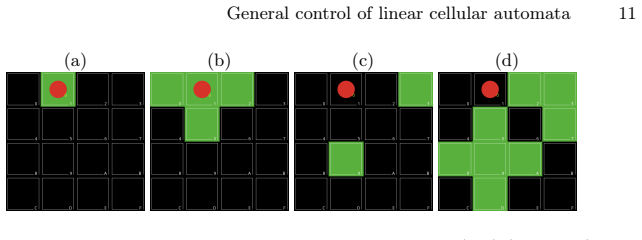
We develop a general theory for linear (and affine) cellular automata, and apply it to examples of one-dimensional and two-dimensional Boolean cases. We introduce the concept of controllability matrix and show that controllability holds if and only if the controllability matrix is invertible.
What carries the argument
The controllability matrix, formed by stacking the effects of control inputs across successive time steps according to the linear evolution rule, whose invertibility certifies that every state is reachable from every other state.
If this is right
- Controllability reduces to a single matrix inversion or rank computation rather than exhaustive search of state trajectories.
- The same matrix test applies unchanged to both one-dimensional rings and two-dimensional grids when the rules remain linear.
- Affine updates, which include constant terms, are covered by the same construction after a shift of coordinates.
- Once the matrix is known to be invertible, explicit sequences of control inputs can be recovered by solving the corresponding linear system.
Where Pith is reading between the lines
- The matrix criterion could be used to select minimal sets of control sites that still render a given cellular-automaton rule fully controllable.
- For large grids the test may be approximated by examining the rank of truncated controllability matrices whose size grows only with the number of control steps rather than the full state space.
- The approach suggests a route for extending reachability analysis to other discrete dynamical systems whose evolution is linear over finite alphabets, such as certain finite-state transducers or linear feedback shift registers.
Load-bearing premise
The cellular automata must follow linear or affine update rules that can be expressed with matrix multiplication over a suitable algebraic structure such as a finite field.
What would settle it
Exhibit a linear cellular automaton whose controllability matrix is singular yet every configuration is still reachable from every other in finite time, or whose matrix is invertible yet some target state cannot be reached from a given initial state.
Figures




read the original abstract
In mathematics and engineering, control theory is concerned with the analysis of dynamical systems through the application of suitable control inputs. One of the prominent problems in control theory is controllability which concerns the ability to determine whether there exists a control input that can steer a dynamical system from an initial state to a desired final state within a finite time horizon. There is a general theory for controlling linear or linearizable system, but it cannot be applied to discrete systems like cellular automata, which is the problem of that we address in this paper. We develop a general theory for linear (and affine) cellular automata, and apply it to examples of one-dimensional and two-dimensional Boolean cases. We introduce the concept of controllability matrix and show that controllability holds if and only if the controllability matrix is invertible.
Editorial analysis
A structured set of objections, weighed in public.
Referee Report
Summary. The manuscript develops a general theory for controllability of linear and affine cellular automata. It defines a controllability matrix and proves that controllability holds if and only if this matrix is invertible. The approach is illustrated with explicit constructions and verification on one-dimensional and two-dimensional Boolean cellular automata.
Significance. If the derivations hold, the work supplies a direct, matrix-based test for controllability in linear cellular automata by constructing the global state-transition matrix A and input matrix B from the local CA rule, thereby recovering the classical Kalman rank condition in this discrete setting. The Boolean examples provide concrete verification that the resulting controllability matrix is invertible for the chosen control configurations. This adaptation may be useful for analyzing steering problems in finite-grid discrete systems, though the core equivalence is a standard result once the linear representation is established.
minor comments (3)
- The abstract states the main theorem but supplies no proof outline or key assumptions on the state space and control action; a one-sentence indication of the linear representation x_{t+1}=A x_t + B u_t would improve clarity for readers outside control theory.
- The manuscript should explicitly reference the classical Kalman controllability criterion and the rank condition to situate the contribution and avoid any appearance of reinventing the linear-algebraic test.
- Notation for the controllability matrix (e.g., its explicit block form in terms of A and B) should be introduced with a numbered equation in the main text rather than only in the examples.
Simulated Author's Rebuttal
We thank the referee for their positive summary, significance assessment, and recommendation of minor revision. No specific major comments were provided in the report, so we have no point-by-point responses to address. We are pleased that the adaptation of the controllability test to cellular automata is viewed as potentially useful.
Circularity Check
No circularity: standard Kalman condition applied after explicit (A,B) construction from CA rules
full rationale
The paper maps linear/affine CA rules to a global linear system x_{t+1}=A x_t + B u_t over a finite vector space, then defines the controllability matrix in the classical form and states the equivalence to controllability. This equivalence is the known Kalman rank condition for finite-dimensional linear systems, which the abstract treats as pre-existing general theory rather than deriving it from the paper's own data, parameters, or self-citations. No self-definitional loop, fitted-input-as-prediction, or load-bearing self-citation appears; the contribution is the CA-specific (A,B) construction and example verification, which remains independent of the controllability theorem itself.
Axiom & Free-Parameter Ledger
axioms (1)
- domain assumption Linear cellular automata can be represented as linear transformations over appropriate algebraic structures such as finite fields.
invented entities (1)
-
Controllability matrix for cellular automata
no independent evidence
Lean theorems connected to this paper
-
IndisputableMonolith/Foundation/AbsoluteFloorClosure.leanbool_absolute_floor echoes?
echoesECHOES: this paper passage has the same mathematical shape or conceptual pattern as the Recognition theorem, but is not a direct formal dependency.
The Jacobian Jij = ∂s′i/∂sj … in case of linear rules ∂si(T)/∂sj(0)=(J^T)ij
What do these tags mean?
- matches
- The paper's claim is directly supported by a theorem in the formal canon.
- supports
- The theorem supports part of the paper's argument, but the paper may add assumptions or extra steps.
- extends
- The paper goes beyond the formal theorem; the theorem is a base layer rather than the whole result.
- uses
- The paper appears to rely on the theorem as machinery.
- contradicts
- The paper's claim conflicts with a theorem or certificate in the canon.
- unclear
- Pith found a possible connection, but the passage is too broad, indirect, or ambiguous to say the theorem truly supports the claim.
Reference graph
Works this paper leans on
-
[1]
Jacques Louis Lions.Optimal control of systems governed by partial dif- ferential equations. Vol. 170. Springer, 1971
1971
-
[2]
Exact Controllability, Stabilization and Perturbations for Dis- tributed Systems
J. L. Lions. “Exact Controllability, Stabilization and Perturbations for Dis- tributed Systems”. In:SIAM Review30.1 (Mar. 1988), pp. 1–68.issn: 1095-7200.doi:10.1137/1030001.url:http://dx.doi.org/10.1137/ 1030001
work page doi:10.1137/1030001.url:http://dx.doi.org/10.1137/ 1988
-
[3]
Eduardo D Sontag.Mathematical Control Theory: Deterministic Finite Dimensional Systems. Vol. 6. New York, USA: Springer Science & Business Media, 2013.doi:10.1007/978-1-4612-0577-7
-
[4]
A New Approach to Linear Filtering and Prediction Prob- lems
R. E. Kalman. “A New Approach to Linear Filtering and Prediction Prob- lems”. In:Journal of Basic Engineering82.1 (Mar. 1960), pp. 35–45.issn: 0021-9223.doi:10 . 1115 / 1 . 3662552.url:http : / / dx . doi . org / 10 . 1115/1.3662552
1960
-
[5]
Markov Chains Ap- proach for Regional Controllability of Deterministic Cellular Automata, via Boundary Actions
Sara Dridi, Franco Bagnoli, and Samira El Yacoubi. “Markov Chains Ap- proach for Regional Controllability of Deterministic Cellular Automata, via Boundary Actions.” In:Journal of Cellular Automata14 (2019)
2019
-
[6]
Recent advances in regional controllability of cellular au- tomata
Sara Dridi. “Recent advances in regional controllability of cellular au- tomata”. PhD thesis. Perpignan, 2019
2019
-
[7]
A graph theory approach for regional controllability of Boolean cellular automata
Sara Dridi et al. “A graph theory approach for regional controllability of Boolean cellular automata”. In:International Journal of Parallel, Emer- gent and Distributed Systems(2019), pp. 1–15.doi:10.1080/17445760. 2019.1608442. General control of linear cellular automata 15
-
[8]
Kalman Condition and New Algorithm Approach for Regional Controllability of Peripherally- linear Elementary Cellular Automata via Boundary Actions
Sara Dridi, Samira El Yacoubi, and Franco Bagnoli. “Kalman Condition and New Algorithm Approach for Regional Controllability of Peripherally- linear Elementary Cellular Automata via Boundary Actions.” In:J. Cell. Autom.16.3-4 (2022), pp. 173–195
2022
-
[9]
Towardabound- ary regional control problem for Boolean cellular automata
FrancoBagnoli,SamiraElYacoubi,andRaúlRechtman.“Towardabound- ary regional control problem for Boolean cellular automata”. In:Natural Computing17.3 (2018), pp. 479–486.doi:10.1007/s11047-017-9626-1
-
[10]
Regional control of probabilistic cellular automata
Franco Bagnoli et al. “Regional control of probabilistic cellular automata”. In:International Conference on Cellular Automata. Springer. New York, USA, 2018, pp. 243–254.doi:10.1007/978-3-319-99813-8_22
-
[11]
Optimal and suboptimal regional control of prob- abilistic cellular automata
Franco Bagnoli et al. “Optimal and suboptimal regional control of prob- abilistic cellular automata”. In:Natural Computing18.4 (2019), pp. 845– 853.doi:10.1007/s11047-019-09763-5
-
[12]
Franco Bagnoli, Michele Baia, and Tommaso Matteuzzi. “Effects of a Van- ishing Noise on Elementary Cellular Automata Phase-Space Structure”. In:Cellular Automata. New York, USA: Springer Nature, 2024, pp. 45– 57.isbn: 9783031715525.doi:10.1007/978- 3- 031- 71552- 5_5.url: http://dx.doi.org/10.1007/978-3-031-71552-5_5
-
[13]
Boundary regional controllability of linear boolean cellular automata using markov chain
Sara Dridi, Samira El Yacoubi, and Franco Bagnoli. “Boundary regional controllability of linear boolean cellular automata using markov chain”. In:Recent advances in modeling, analysis and systems control: theoretical aspects and applications. Springer, 2019, pp. 37–48
2019
-
[14]
Con- trolled cellular automata
Achilles Beros, Monique Chyba, and Oleksandr Markovichenko. “Con- trolled cellular automata”. In:Networks and Heterogeneous Media14.1 (2019), pp. 1–22. [15]ACRI: International Conference on Cellular Automata for Research and Industry. Lecture Notes in Computer Science LNCS 2493, 3305, 4173, 5191, 6350, 7495, 8751, 9863, 11115, 12599, 13402, 14978,https://...
2019
-
[15]
Phys Nonlinear Phenom 65(1-2):117-134
Gérard Y. Vichniac. “Boolean derivatives on cellular automata”. In:Phys- ica D: Nonlinear Phenomena45.1–3 (1990), pp. 63–74.issn: 0167-2789. doi:10.1016/0167- 2789(90)90174- n.url:http://dx.doi.org/10. 1016/0167-2789(90)90174-N
-
[16]
Booleanderivativesandcomputationofcellularautomata
FrancoBagnoli.“Booleanderivativesandcomputationofcellularautomata”. In:International Journal of Modern Physics C3.02 (1992), pp. 307–320. doi:10.1142/S0129183192000257
discussion (0)
Sign in with ORCID, Apple, or X to comment. Anyone can read and Pith papers without signing in.