Recognition: unknown
Semantic Manipulation Localization
Pith reviewed 2026-05-10 15:27 UTC · model grok-4.3
The pith
TRACE localizes subtle semantic edits in images by anchoring meaning, sensing frequency perturbations, and jointly reasoning over content and scope.
A machine-rendered reading of the paper's core claim, the machinery that carries it, and where it could break.
Core claim
By identifying semantically meaningful regions, injecting frequency-based perturbation cues to capture subtle changes under visual consistency, and verifying candidates through joint reasoning over semantic content and scope, the TRACE framework localizes meaning-altering manipulations that lack obvious low-level artifacts and outperforms existing IML methods on the new SML benchmark with more complete and semantically coherent results.
What carries the argument
The TRACE framework, which models semantic sensitivity through the three progressively coupled components of semantic anchoring, semantic perturbation sensing, and semantic-constrained reasoning.
If this is right
- Image forensics must move beyond artifact detection to handle modern generative edits that preserve visual consistency.
- The semantics-driven benchmark provides a standard for evaluating localization of meaning changes rather than pixel inconsistencies.
- TRACE's three-stage coupling produces localization that is more complete, compact, and aligned with human interpretation of the edit.
- Semantic anchoring first isolates regions critical to image understanding before perturbation analysis is applied.
- Joint reasoning over content and scope reduces false positives in areas that look edited but do not alter overall meaning.
Where Pith is reading between the lines
- The same anchoring-plus-reasoning structure could be tested on video sequences to localize temporal semantic changes across frames.
- If the perturbation-sensing stage proves robust, it might extend to other modalities like audio or text where subtle meaning shifts occur without surface artifacts.
- Forensic tools could incorporate TRACE-style semantic scope checks to distinguish intentional edits from natural variations in scene content.
Load-bearing premise
That semantic sensitivity captured by coupling anchoring, frequency perturbation sensing, and joint reasoning can reliably identify edits that alter meaning while staying visually consistent with surrounding content.
What would settle it
A new test set of images containing seamless semantic edits (such as altered object attributes that change scene interpretation) where TRACE produces localization maps that are no more accurate or coherent than those from standard artifact-based IML methods.
Figures





read the original abstract
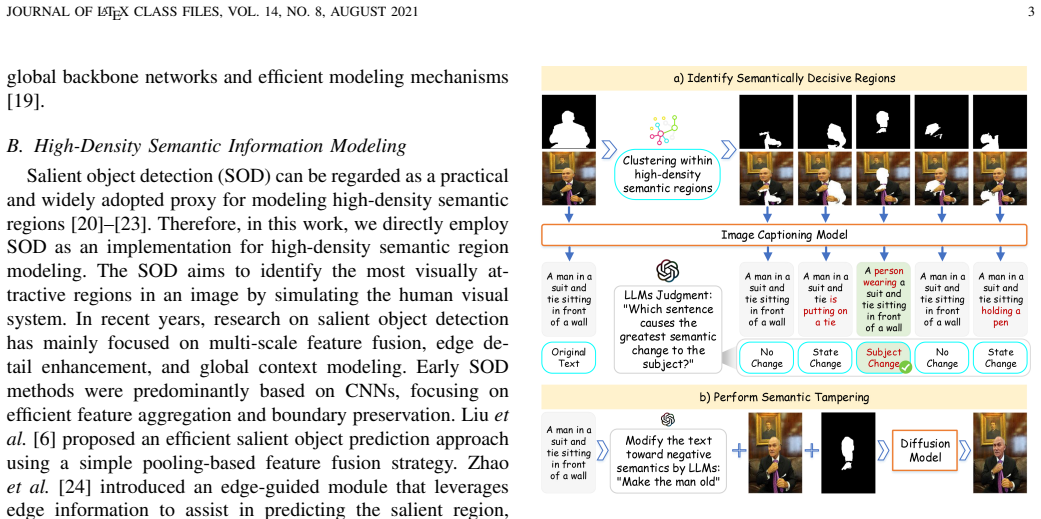
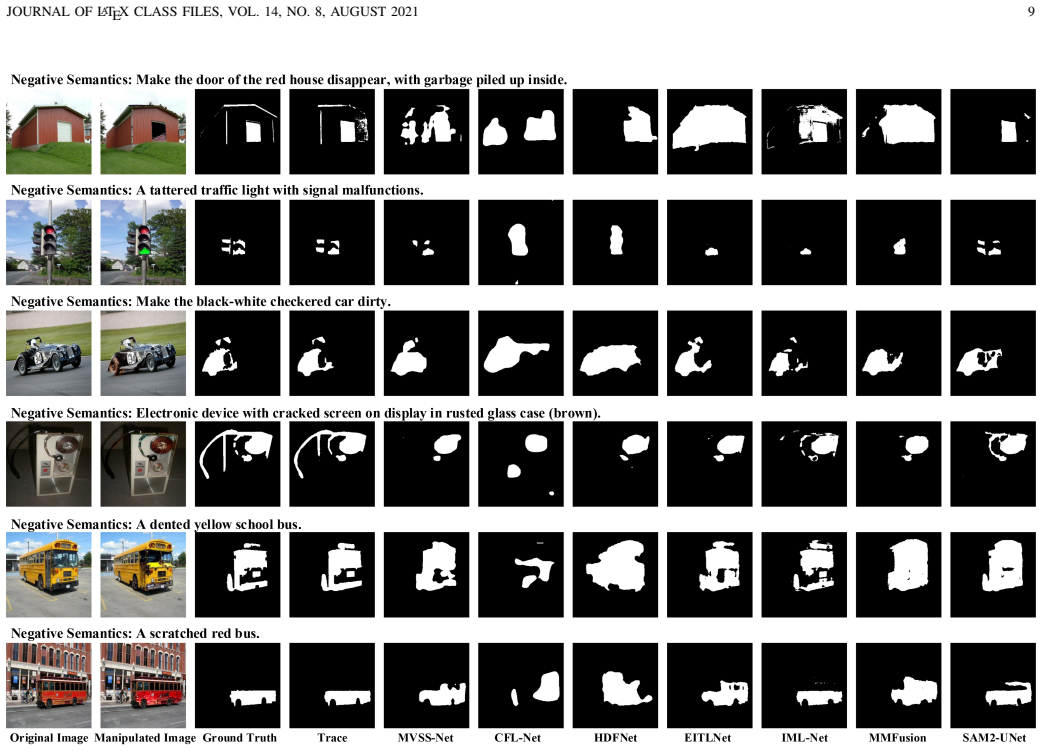
Image Manipulation Localization (IML) aims to identify edited regions in an image. However, with the increasing use of modern image editing and generative models, many manipulations no longer exhibit obvious low-level artifacts. Instead, they often involve subtle but meaning-altering edits to an object's attributes, state, or relationships while remaining highly consistent with the surrounding content. This makes conventional IML methods less effective because they mainly rely on artifact detection rather than semantic sensitivity. To address this issue, we introduce Semantic Manipulation Localization (SML), a new task that focuses on localizing subtle semantic edits that significantly change image interpretation. We further construct a dedicated fine-grained benchmark for SML using a semantics-driven manipulation pipeline with pixel-level annotations. Based on this task, we propose TRACE (Targeted Reasoning of Attributed Cognitive Edits), an end-to-end framework that models semantic sensitivity through three progressively coupled components: semantic anchoring, semantic perturbation sensing, and semantic-constrained reasoning. Specifically, TRACE first identifies semantically meaningful regions that support image understanding, then injects perturbation-sensitive frequency cues to capture subtle edits under strong visual consistency, and finally verifies candidate regions through joint reasoning over semantic content and semantic scope. Extensive experiments show that TRACE consistently outperforms existing IML methods on our benchmark and produces more complete, compact, and semantically coherent localization results. These results demonstrate the necessity of moving beyond artifact-based localization and provide a new direction for image forensics in complex semantic editing scenarios.
Editorial analysis
A structured set of objections, weighed in public.
Referee Report
Summary. The manuscript introduces Semantic Manipulation Localization (SML) as a new task focused on identifying subtle semantic edits (attributes, states, relationships) that alter image meaning while remaining visually consistent with surrounding content. It constructs a fine-grained benchmark via a semantics-driven manipulation pipeline that supplies pixel-level annotations, and proposes the TRACE end-to-end framework whose three progressively coupled components (semantic anchoring, perturbation-sensitive frequency injection, and semantic-constrained reasoning) are intended to model semantic sensitivity. The central claim is that TRACE outperforms prior IML methods on this benchmark and yields more complete, compact, and semantically coherent localization maps.
Significance. If the central claim holds under external validation, the work would be significant for shifting IML research from low-level artifact detection toward semantic understanding, a timely direction given modern generative editing tools. The introduction of a dedicated SML benchmark and the explicit coupling of the three TRACE components constitute a coherent technical contribution. Credit is due for targeting a problem that conventional IML methods are acknowledged to handle poorly and for supplying pixel-level annotations.
major comments (2)
- [Benchmark construction and evaluation sections] Benchmark construction and evaluation sections: the benchmark is generated exclusively by the authors' own semantics-driven manipulation pipeline, and all reported performance (including the claim that TRACE 'consistently outperforms existing IML methods') is measured only on this self-generated data. Because the three TRACE components are themselves designed to target precisely the same class of semantic edits, outperformance may reflect alignment between the generation process and the model's inductive biases rather than robustness to arbitrary visually consistent semantic changes. An external test set or cross-pipeline comparison is required to break this potential circularity.
- [Experiments section] Experiments section: the abstract asserts outperformance and 'more complete, compact, and semantically coherent' results, yet supplies no quantitative metrics (e.g., IoU, F1, precision-recall), baseline details, ablation studies on the three components, or error analysis. Without these, the central claim that semantic sensitivity modeled via the coupled components reliably localizes edits lacking low-level artifacts cannot be assessed.
minor comments (1)
- [Abstract] Abstract: the description of the second component alternates between 'semantic perturbation sensing' and 'perturbation-sensitive frequency injection'; consistent terminology would improve clarity.
Simulated Author's Rebuttal
We thank the referee for the detailed and constructive comments on our manuscript. We address each of the major comments below and outline the revisions we plan to make to strengthen the paper.
read point-by-point responses
-
Referee: Benchmark construction and evaluation sections: the benchmark is generated exclusively by the authors' own semantics-driven manipulation pipeline, and all reported performance (including the claim that TRACE 'consistently outperforms existing IML methods') is measured only on this self-generated data. Because the three TRACE components are themselves designed to target precisely the same class of semantic edits, outperformance may reflect alignment between the generation process and the model's inductive biases rather than robustness to arbitrary visually consistent semantic changes. An external test set or cross-pipeline comparison is required to break this potential circularity.
Authors: We acknowledge the potential issue of circularity raised by the referee. The benchmark was constructed using a semantics-driven pipeline to specifically target subtle semantic manipulations that do not produce obvious artifacts, which is the essence of the new SML task. This allows us to demonstrate that TRACE, with its focus on semantic anchoring, perturbation sensing, and constrained reasoning, can localize such edits more effectively than traditional IML approaches. We agree that this setup could benefit from additional validation. In the revised manuscript, we will include a more thorough discussion of the benchmark's design and its relation to real-world semantic edits, as well as qualitative evaluations on a variety of edited images to support broader applicability. revision: partial
-
Referee: Experiments section: the abstract asserts outperformance and 'more complete, compact, and semantically coherent' results, yet supplies no quantitative metrics (e.g., IoU, F1, precision-recall), baseline details, ablation studies on the three components, or error analysis. Without these, the central claim that semantic sensitivity modeled via the coupled components reliably localizes edits lacking low-level artifacts cannot be assessed.
Authors: We appreciate the referee's observation regarding the presentation of experimental results. The current manuscript's experiments section does include comparisons with IML methods and describes the TRACE components, but we agree that more explicit quantitative metrics, ablation studies, and error analysis would strengthen the paper. We will revise the experiments section to include detailed quantitative results (such as IoU and F1 scores), baseline details, ablations on the three components, and error analysis to better substantiate the claims about semantic sensitivity and localization performance. revision: yes
- The need for an external test set or cross-pipeline comparison, as we currently lack such independent data and it would require substantial new data collection efforts.
Circularity Check
Self-generated semantics-driven benchmark creates circular validation for TRACE outperformance
specific steps
-
fitted input called prediction
[Abstract]
"We further construct a dedicated fine-grained benchmark for SML using a semantics-driven manipulation pipeline with pixel-level annotations. ... TRACE ... models semantic sensitivity through three progressively coupled components: semantic anchoring, semantic perturbation sensing, and semantic-constrained reasoning. ... Extensive experiments show that TRACE consistently outperforms existing IML methods on our benchmark and produces more complete, compact, and semantically coherent localization results."
The benchmark inputs are produced by the authors' own semantics-driven pipeline targeting subtle meaning-altering edits. TRACE's core is defined to model exactly those semantic sensitivities via its three components. Claiming superior localization on this benchmark therefore reduces to testing alignment between the generation process and the model's inductive biases, with no independent external data to break the loop.
full rationale
The paper introduces SML as a new task focused on subtle semantic edits and constructs its benchmark exclusively via an authors' semantics-driven manipulation pipeline that generates pixel-level annotations for attribute/state/relationship changes. TRACE is then defined with three coupled components explicitly targeting semantic sensitivity to the same edit class. Outperformance is claimed only on this internally generated benchmark with no external test sets or cross-pipeline comparisons referenced, making the superiority result statistically aligned with the construction process rather than independently verified.
Axiom & Free-Parameter Ledger
Reference graph
Works this paper leans on
-
[1]
Exploring multi-view pixel contrast for general and robust image forgery localization,
Z. Lou, G. Cao, K. Guo, L. Yu, and S. Weng, “Exploring multi-view pixel contrast for general and robust image forgery localization,”IEEE Transactions on Information Forensics and Security, 2025
2025
-
[2]
A forensic framework with diverse data generation for generalizable forgery localization,
Y . Huang, W. Luo, X. Cao, and J. Huang, “A forensic framework with diverse data generation for generalizable forgery localization,”IEEE Transactions on Information Forensics and Security, 2025
2025
-
[3]
Reloc: A restoration-assisted framework for robust image tampering localization,
P. Zhuang, H. Li, R. Yang, and J. Huang, “Reloc: A restoration-assisted framework for robust image tampering localization,”IEEE Transactions on Information Forensics and Security, vol. 18, pp. 5243–5257, 2023
2023
-
[4]
M2sformer: Multi-spectral and multi-scale attention with edge-aware difficulty guidance for image forgery localization,
J.-H. Nam, D.-H. Moon, and S.-C. Lee, “M2sformer: Multi-spectral and multi-scale attention with edge-aware difficulty guidance for image forgery localization,” inProceedings of the IEEE/CVF International Conference on Computer Vision, 2025, pp. 15 927–15 938
2025
-
[5]
Coverage—a novel database for copy-move forgery detection,
B. Wen, Y . Zhu, R. Subramanian, T.-T. Ng, X. Shen, and S. Winkler, “Coverage—a novel database for copy-move forgery detection,” in2016 IEEE international conference on image processing (ICIP). IEEE, 2016, pp. 161–165
2016
-
[6]
A simple pooling- based design for real-time salient object detection,
J.-J. Liu, Q. Hou, M.-M. Cheng, J. Feng, and J. Jiang, “A simple pooling- based design for real-time salient object detection,” inProceedings of the IEEE/CVF conference on computer vision and pattern recognition, 2019, pp. 3917–3926
2019
-
[7]
Depth scale balance saliency detection with connective feature pyramid and edge guidance,
Z. Tan and X. Gu, “Depth scale balance saliency detection with connective feature pyramid and edge guidance,”Applied Intelligence, vol. 51, no. 8, pp. 5775–5792, 2021
2021
-
[8]
Mvss-net: Multi- view multi-scale supervised networks for image manipulation detec- tion,
C. Dong, X. Chen, R. Hu, J. Cao, and X. Li, “Mvss-net: Multi- view multi-scale supervised networks for image manipulation detec- tion,”IEEE Transactions on Pattern Analysis and Machine Intelligence, vol. 45, no. 3, pp. 3539–3553, 2022
2022
-
[9]
Cfl-net: Image forgery localization using contrastive learning,
F. F. Niloy, K. K. Bhaumik, and S. S. Woo, “Cfl-net: Image forgery localization using contrastive learning,” inProceedings of the IEEE/CVF winter conference on applications of computer vision, 2023, pp. 4642– 4651
2023
-
[10]
Making deepfakes more spurious: evading deep face forgery detection via trace removal attack,
C. Liu, H. Chen, T. Zhu, J. Zhang, and W. Zhou, “Making deepfakes more spurious: evading deep face forgery detection via trace removal attack,”IEEE Transactions on Dependable and Secure Computing, vol. 20, no. 6, pp. 5182–5196, 2023
2023
-
[11]
Hdf-net: Capturing homogeny difference features to localize the tampered im- age,
R. Han, X. Wang, N. Bai, Y . Wang, J. Hou, and J. Xue, “Hdf-net: Capturing homogeny difference features to localize the tampered im- age,”IEEE Transactions on Pattern Analysis and Machine Intelligence, vol. 46, no. 12, pp. 10 005–10 020, 2024
2024
-
[12]
arXiv preprint arXiv:2505.11003 , year=
B. Du, X. Zhu, X. Ma, C. Qu, K. Feng, Z. Yang, C.-M. Pun, J. Liu, and J.-Z. Zhou, “Forensichub: A unified benchmark & codebase for all-domain fake image detection and localization,”arXiv preprint arXiv:2505.11003, 2025
-
[13]
Boosting adversarial transferability of vision transformers,
Y . Wang, C. Zhang, H. Zhou, Z. Ying, Z. Xiong, W. Zhou, and L. Zhu, “Boosting adversarial transferability of vision transformers,” IEEE Transactions on Dependable and Secure Computing, 2025
2025
-
[14]
Mmfusion: Combining image forensic filters for visual manipulation detection and localization,
K. Triaridis, K. Tsigos, and V . Mezaris, “Mmfusion: Combining image forensic filters for visual manipulation detection and localization,”arXiv preprint arXiv:2312.01790, 2023
-
[15]
arXiv preprint arXiv:2307.14863 , year=
X. Ma, B. Du, Z. Jiang, A. Y . A. Hammadi, and J. Zhou, “Iml-vit: Benchmarking image manipulation localization by vision transformer,” arXiv preprint arXiv:2307.14863, 2023. JOURNAL OF LATEX CLASS FILES, VOL. 14, NO. 8, AUGUST 2021 14
-
[16]
Effective image tampering localization via enhanced transformer and co-attention fusion,
K. Guo, H. Zhu, and G. Cao, “Effective image tampering localization via enhanced transformer and co-attention fusion,” inIcassp 2024-2024 ieee international conference on acoustics, speech and signal processing (icassp). IEEE, 2024, pp. 4895–4899
2024
-
[17]
Trufor: Leveraging all-round clues for trustworthy image forgery detection and localization,
F. Guillaro, D. Cozzolino, A. Sud, N. Dufour, and L. Verdoliva, “Trufor: Leveraging all-round clues for trustworthy image forgery detection and localization,” inProceedings of the IEEE/CVF conference on computer vision and pattern recognition, 2023, pp. 20 606–20 615
2023
-
[18]
Rethinking image forgery detection via soft contrastive learning and unsupervised clustering,
H. Wu, Y . Chen, J. Zhou, and Y . Li, “Rethinking image forgery detection via soft contrastive learning and unsupervised clustering,” IEEE Transactions on Dependable and Secure Computing, 2025
2025
-
[19]
Safire: Segment any forged image region,
M.-J. Kwon, W. Lee, S.-H. Nam, M. Son, and C. Kim, “Safire: Segment any forged image region,” inProceedings of the AAAI conference on artificial intelligence, vol. 39, no. 4, 2025, pp. 4437–4445
2025
-
[20]
Co-saliency detection with two-stage co- attention mining and individual calibration,
Z. Tan, X. Gu, and Q. Cheng, “Co-saliency detection with two-stage co- attention mining and individual calibration,”Engineering Applications of Artificial Intelligence, vol. 127, p. 107201, 2024
2024
-
[21]
Bridging feature complementarity gap between encoder and decoder for salient object detection,
Z. Tan and X. Gu, “Bridging feature complementarity gap between encoder and decoder for salient object detection,”Digital Signal Pro- cessing, vol. 133, p. 103841, 2023
2023
-
[22]
Utc: A unified transformer with inter-task contrastive learning for visual dialog,
C. Chen, Z. Tan, Q. Cheng, X. Jiang, Q. Liu, Y . Zhu, and X. Gu, “Utc: A unified transformer with inter-task contrastive learning for visual dialog,” inProceedings of the IEEE/CVF Conference on computer vision and pattern recognition, 2022, pp. 18 103–18 112
2022
-
[23]
Bridging spatiotem- poral feature gap for video salient object detection,
Z. Tan, C. Chen, K. Wen, Q. Cheng, and Z. Fu, “Bridging spatiotem- poral feature gap for video salient object detection,”Knowledge-Based Systems, vol. 304, p. 112505, 2024
2024
-
[24]
Eg- net: Edge guidance network for salient object detection,
J.-X. Zhao, J.-J. Liu, D.-P. Fan, Y . Cao, J. Yang, and M.-M. Cheng, “Eg- net: Edge guidance network for salient object detection,” inProceedings of the IEEE/CVF international conference on computer vision, 2019, pp. 8779–8788
2019
-
[25]
Dual swin-transformer based mutual interactive network for rgb-d salient object detection,
C. Zeng, S. Kwong, and H. Ip, “Dual swin-transformer based mutual interactive network for rgb-d salient object detection,”Neurocomputing, vol. 559, p. 126779, 2023
2023
-
[26]
Sam2-unet: Segment anything 2 makes strong encoder for natural and medical image segmentation,
X. Xiong, Z. Wu, S. Tan, W. Li, F. Tang, Y . Chen, S. Li, J. Ma, and G. Li, “Sam2-unet: Segment anything 2 makes strong encoder for natural and medical image segmentation,”Visual Intelligence, vol. 4, no. 1, p. 2, 2026
2026
-
[27]
Samba: A unified mamba-based framework for general salient object detection,
J. He, K. Fu, X. Liu, and Q. Zhao, “Samba: A unified mamba-based framework for general salient object detection,” inProceedings of the Computer Vision and Pattern Recognition Conference, 2025, pp. 25 314– 25 324
2025
-
[28]
Unifying global- local representations in salient object detection with transformers,
S. Ren, N. Zhao, Q. Wen, G. Han, and S. He, “Unifying global- local representations in salient object detection with transformers,”IEEE Transactions on Emerging Topics in Computational Intelligence, vol. 8, no. 4, pp. 2870–2879, 2024
2024
-
[29]
Uncertainty guided refinement for fine-grained salient object detection,
Y . Yuan, P. Gao, Q. Dai, J. Qin, and W. Xiang, “Uncertainty guided refinement for fine-grained salient object detection,”IEEE Transactions on Image Processing, 2025
2025
-
[30]
Conda: Condensed deep association learning for co- salient object detection,
L. Li, N. Liu, D. Zhang, Z. Li, S. Khan, R. Anwer, H. Cholakkal, J. Han, and F. S. Khan, “Conda: Condensed deep association learning for co- salient object detection,” inEuropean Conference on Computer Vision. Springer, 2024, pp. 287–303
2024
-
[31]
Co-saliency detection with intra-group two-stage group semantics propagation and inter-group contrastive learning,
Z. Tan and X. Gu, “Co-saliency detection with intra-group two-stage group semantics propagation and inter-group contrastive learning,” Knowledge-Based Systems, vol. 252, p. 109356, 2022
2022
-
[32]
arXiv preprint arXiv:2111.09734 , year=
R. Mokady, A. Hertz, and A. H. Bermano, “Clipcap: Clip prefix for image captioning,”arXiv preprint arXiv:2111.09734, 2021
-
[33]
Instructpix2pix: Learning to follow image editing instructions,
T. Brooks, A. Holynski, and A. A. Efros, “Instructpix2pix: Learning to follow image editing instructions,” inProceedings of the IEEE/CVF conference on computer vision and pattern recognition, 2023, pp. 18 392–18 402
2023
-
[34]
Mat: Mask- aware transformer for large hole image inpainting,
W. Li, Z. Lin, K. Zhou, L. Qi, Y . Wang, and J. Jia, “Mat: Mask- aware transformer for large hole image inpainting,” inProceedings of the IEEE/CVF conference on computer vision and pattern recognition, 2022, pp. 10 758–10 768
2022
-
[35]
High- resolution image synthesis with latent diffusion models,
R. Rombach, A. Blattmann, D. Lorenz, P. Esser, and B. Ommer, “High- resolution image synthesis with latent diffusion models,” inProceedings of the IEEE/CVF conference on computer vision and pattern recognition, 2022, pp. 10 684–10 695
2022
-
[36]
Casia image tampering detection evaluation database,
J. Dong, W. Wang, and T. Tan, “Casia image tampering detection evaluation database,” in2013 IEEE China summit and international conference on signal and information processing. IEEE, 2013, pp. 422–426
2013
-
[37]
Copy-move forgery detection based on patchmatch,
D. Cozzolino, G. Poggi, and L. Verdoliva, “Copy-move forgery detection based on patchmatch,” in2014 IEEE international conference on image processing (ICIP). IEEE, 2014, pp. 5312–5316
2014
-
[38]
Multi-scale analysis strategies in prnu-based tampering localization,
P. Korus and J. Huang, “Multi-scale analysis strategies in prnu-based tampering localization,”IEEE Transactions on Information Forensics and Security, vol. 12, no. 4, pp. 809–824, 2016
2016
-
[39]
Imd2020: A large-scale annotated dataset tailored for detecting manipulated images,
A. Novozamsky, B. Mahdian, and S. Saic, “Imd2020: A large-scale annotated dataset tailored for detecting manipulated images,” inProceed- ings of the IEEE/CVF winter conference on applications of computer vision workshops, 2020, pp. 71–80
2020
-
[40]
Detection of co-salient objects by looking deep and wide,
D. Zhang, J. Han, C. Li, J. Wang, and X. Li, “Detection of co-salient objects by looking deep and wide,”International Journal of Computer Vision, vol. 120, no. 2, pp. 215–232, 2016
2016
-
[41]
Learning to detect salient objects with image-level supervision,
L. Wang, H. Lu, Y . Wang, M. Feng, D. Wang, B. Yin, and X. Ruan, “Learning to detect salient objects with image-level supervision,” in Proceedings of the IEEE conference on computer vision and pattern recognition, 2017, pp. 136–145
2017
-
[42]
Hierarchical image saliency detection on extended cssd,
J. Shi, Q. Yan, L. Xu, and J. Jia, “Hierarchical image saliency detection on extended cssd,”IEEE transactions on pattern analysis and machine intelligence, vol. 38, no. 4, pp. 717–729, 2015
2015
-
[43]
Visual saliency based on multiscale deep features,
G. Li and Y . Yu, “Visual saliency based on multiscale deep features,” inProceedings of the IEEE conference on computer vision and pattern recognition, 2015, pp. 5455–5463
2015
-
[44]
Design and perceptual validation of performance measures for salient object segmentation,
V . Movahedi and J. H. Elder, “Design and perceptual validation of performance measures for salient object segmentation,” in2010 IEEE computer society conference on computer vision and pattern recognition- workshops. IEEE, 2010, pp. 49–56
2010
-
[45]
Saliency detection via graph-based manifold ranking,
C. Yang, L. Zhang, H. Lu, X. Ruan, and M.-H. Yang, “Saliency detection via graph-based manifold ranking,” inProceedings of the IEEE conference on computer vision and pattern recognition, 2013, pp. 3166– 3173
2013
-
[46]
Salient object detection: A discriminative regional feature integration approach,
H. Jiang, J. Wang, Z. Yuan, Y . Wu, N. Zheng, and S. Li, “Salient object detection: A discriminative regional feature integration approach,” in Proceedings of the IEEE conference on computer vision and pattern recognition, 2013, pp. 2083–2090
2013
-
[47]
SAM 3: Segment Anything with Concepts
N. Carion, L. Gustafson, Y .-T. Hu, S. Debnath, R. Hu, D. Suris, C. Ryali, K. V . Alwala, H. Khedr, A. Huanget al., “Sam 3: Segment anything with concepts,”arXiv preprint arXiv:2511.16719, 2025
work page internal anchor Pith review Pith/arXiv arXiv 2025
-
[48]
T. Chen, R. Cao, X. Yu, L. Zhu, C. Ding, D. Ji, C. Chen, Q. Zhu, C. Xu, P. Maoet al., “Sam3-adapter: Efficient adaptation of segment anything 3 for camouflage object segmentation, shadow detection, and medical image segmentation,”arXiv preprint arXiv:2511.19425, 2025
-
[49]
Adversarial examples detection with enhanced image difference features based on local histogram equalization,
Z. Yin, S. Zhu, H. Su, J. Peng, W. Lyu, and B. Luo, “Adversarial examples detection with enhanced image difference features based on local histogram equalization,”IEEE Transactions on Dependable and Secure Computing, 2025
2025
-
[50]
Frequency bias matters: Diving into robust and generalized deep image forgery detection,
C. Liu, T. Zhu, W. Zhou, and W. Zhao, “Frequency bias matters: Diving into robust and generalized deep image forgery detection,”IEEE Transactions on Dependable and Secure Computing, 2025
2025
discussion (0)
Sign in with ORCID, Apple, or X to comment. Anyone can read and Pith papers without signing in.