Recognition: unknown
PoreDiT: A Scalable Generative Model for Large-Scale Digital Rock Reconstruction
Pith reviewed 2026-05-10 16:17 UTC · model grok-4.3
The pith
PoreDiT generates 1024-cubed digital rock models on consumer hardware by directly predicting binary pore probability fields.
A machine-rendered reading of the paper's core claim, the machinery that carries it, and where it could break.
Core claim
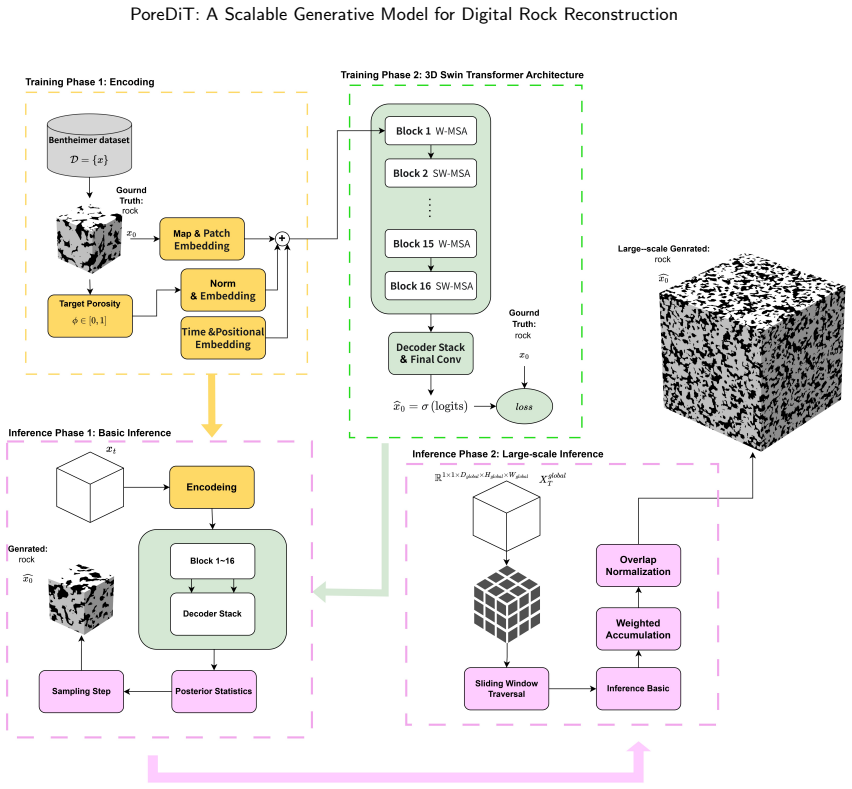
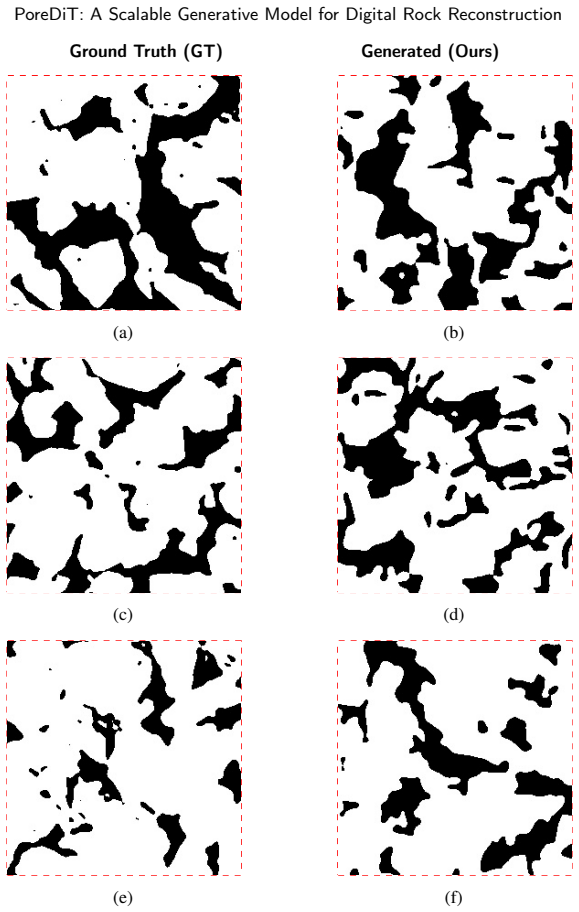
PoreDiT is a generative model built on a three-dimensional Swin Transformer that reconstructs digital rocks at gigavoxel scales. By directly predicting the binary probability field of pore spaces rather than grayscale intensities, the model preserves key topological features required for pore-scale fluid flow and transport simulations. It produces 1024 cubed voxel samples efficiently on consumer-grade hardware while matching prior state-of-the-art methods in porosity, pore-scale permeability, and Euler characteristics.
What carries the argument
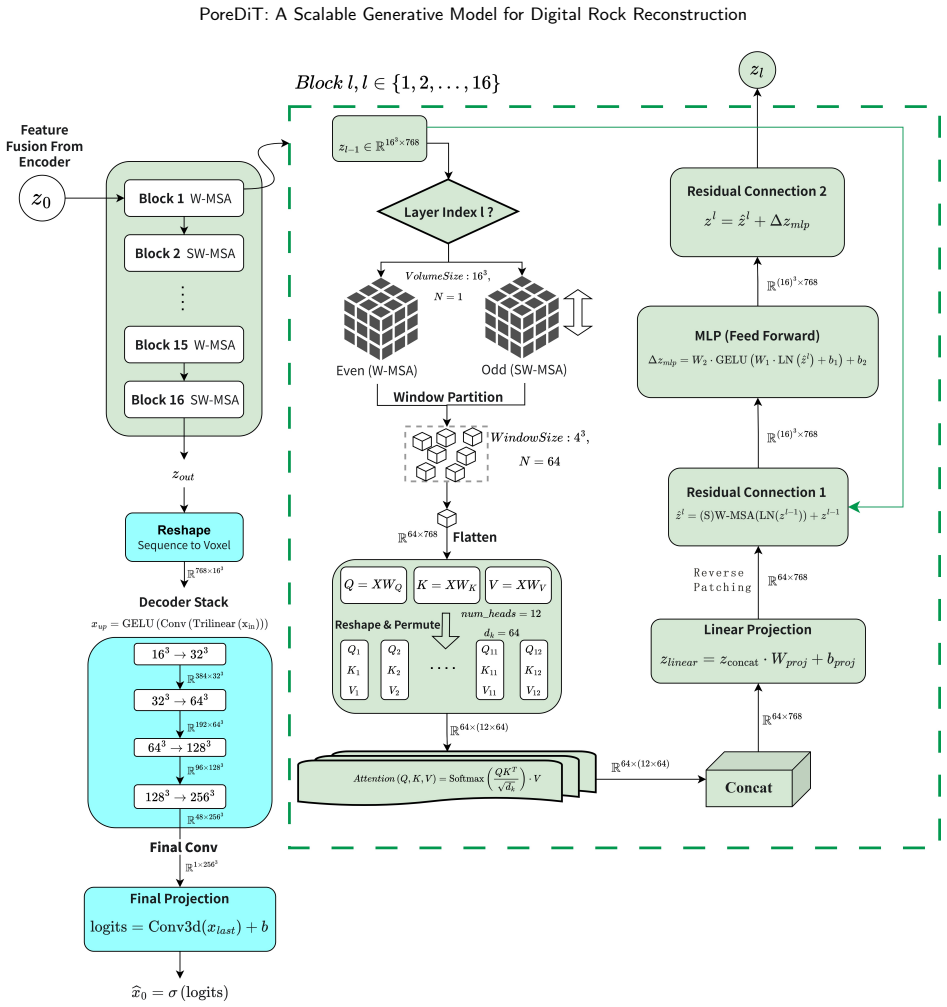
The 3D Swin Transformer architecture that predicts binary pore probability fields instead of grayscale intensities to preserve topological accuracy during large-scale reconstruction.
If this is right
- Ultra-large 1024 cubed voxel digital rock samples can be generated on consumer-grade hardware.
- Topological features critical for fluid flow and transport remain intact through binary probability prediction.
- Physical fidelity matches earlier state-of-the-art methods for porosity, permeability, and Euler characteristics.
- Large-domain hydrodynamic simulations become practical for pore-scale fluid mechanics applications.
Where Pith is reading between the lines
- The efficiency of binary field prediction could extend to other three-dimensional generative tasks involving segmented porous structures.
- Integration with real-time simulation workflows might accelerate studies in reservoir characterization and carbon sequestration.
- Further scaling to multi-gigavoxel domains or hybrid physics-informed training could build directly on the demonstrated computational savings.
Load-bearing premise
Predicting binary pore probability fields rather than grayscale intensities preserves the topological features needed for accurate pore-scale fluid flow and transport simulations without losing essential details.
What would settle it
A comparison in which fluid flow or transport simulations on PoreDiT-generated samples produce permeability, Euler characteristics, or other physical properties that differ substantially from those obtained on real CT-scanned rocks or on reconstructions from prior high-fidelity methods.
Figures





read the original abstract
This manuscript presents PoreDiT, a novel generative model designed for high-efficiency digital rock reconstruction at gigavoxel scales. Addressing the significant challenges in digital rock physics (DRP), particularly the trade-off between resolution and field-of-view (FOV), and the computational bottlenecks associated with traditional deep learning architectures, PoreDiT leverages a three-dimensional (3D) Swin Transformer to break through these limitations. By directly predicting the binary probability field of pore spaces instead of grayscale intensities, the model preserves key topological features critical for pore-scale fluid flow and transport simulations. This approach enhances computational efficiency, enabling the generation of ultra-large-scale ($1024^3$ voxels) digital rock samples on consumer-grade hardware. Furthermore, PoreDiT achieves physical fidelity comparable to previous state-of-the-art methods, including accurate porosity, pore-scale permeability, and Euler characteristics. The model's ability to scale efficiently opens new avenues for large-domain hydrodynamic simulations and provides practical solutions for researchers in pore-scale fluid mechanics, reservoir characterization, and carbon sequestration.
Editorial analysis
A structured set of objections, weighed in public.
Referee Report
Summary. The manuscript introduces PoreDiT, a 3D Swin Transformer generative model for digital rock reconstruction that directly predicts binary pore probability fields rather than grayscale intensities. This is claimed to preserve topological features for fluid flow simulations, enable generation of 1024^3 voxel samples on consumer hardware, and achieve physical fidelity comparable to prior state-of-the-art methods in porosity, pore-scale permeability, and Euler characteristics.
Significance. If validated, the approach could meaningfully advance digital rock physics by relaxing the resolution-FOV trade-off and supporting larger-domain hydrodynamic simulations relevant to reservoir characterization and carbon sequestration. The binary-output design for efficiency is a clear architectural contribution, though its physical accuracy must be demonstrated quantitatively.
major comments (2)
- Abstract: the assertion that PoreDiT 'achieves physical fidelity comparable to previous state-of-the-art methods, including accurate porosity, pore-scale permeability, and Euler characteristics' supplies no quantitative metrics, baseline comparisons, error bars, validation protocols, or training details, rendering the central performance claim unverifiable from the text.
- Abstract (binary probability field prediction): the claim that directly regressing the binary pore-probability field 'preserves key topological features critical for pore-scale fluid flow' is load-bearing yet unsupported by any analysis of post-hoc thresholding (e.g., at 0.5), loss-function details, ablation on threshold sensitivity, or quantitative comparison of lattice-Boltzmann permeability and Euler numbers between thresholded outputs and ground-truth segmentations.
Simulated Author's Rebuttal
We thank the referee for their detailed and constructive review. The comments highlight opportunities to strengthen the abstract's verifiability, and we will revise the manuscript accordingly while clarifying the support already present in the full text. Our point-by-point responses follow.
read point-by-point responses
-
Referee: Abstract: the assertion that PoreDiT 'achieves physical fidelity comparable to previous state-of-the-art methods, including accurate porosity, pore-scale permeability, and Euler characteristics' supplies no quantitative metrics, baseline comparisons, error bars, validation protocols, or training details, rendering the central performance claim unverifiable from the text.
Authors: We agree that the abstract would be strengthened by explicit quantitative highlights. The full manuscript (Results section and supplementary material) contains the requested elements: Table 2 reports mean porosity, permeability, and Euler characteristic values with standard deviations across 10 generated samples per method; direct comparisons to prior SOTA (e.g., 3D GAN baselines) are shown with relative errors; lattice-Boltzmann validation protocols and training hyperparameters are detailed in Sections 4.2 and 3.3. In the revision we will condense these key metrics and protocol references into the abstract for immediate verifiability. revision: yes
-
Referee: Abstract (binary probability field prediction): the claim that directly regressing the binary pore-probability field 'preserves key topological features critical for pore-scale fluid flow' is load-bearing yet unsupported by any analysis of post-hoc thresholding (e.g., at 0.5), loss-function details, ablation on threshold sensitivity, or quantitative comparison of lattice-Boltzmann permeability and Euler numbers between thresholded outputs and ground-truth segmentations.
Authors: The manuscript already specifies binary cross-entropy loss (Section 3.2) and standard 0.5 thresholding for final binary fields. Quantitative fidelity after thresholding is demonstrated via lattice-Boltzmann permeability and Euler-number matches to ground truth in the Results (Table 2 and Figure 4). However, we acknowledge that an explicit threshold-sensitivity ablation would further bolster the claim. We will add a short paragraph with sensitivity results (varying threshold from 0.4–0.6) and corresponding permeability/Euler deviations in the revised Methods or Results section. revision: partial
Circularity Check
No circularity detected; architectural claims rest on independent design choices evaluated against external physical benchmarks
full rationale
The paper introduces PoreDiT as a 3D Swin Transformer architecture that directly outputs a binary pore-probability field rather than grayscale intensities. This is presented as an explicit modeling decision whose benefits (topology preservation, scalability to 1024^3 voxels, and physical fidelity in porosity/permeability/Euler number) are asserted to follow from the architecture and are to be verified by comparison to prior SOTA methods and ground-truth segmentations. No equations, loss functions, or parameter-fitting steps are shown in the provided text that would reduce the central claims to self-definition, renamed fits, or self-citation chains. The derivation chain therefore remains self-contained with independent content; the binary-output choice is an ansatz whose validity is left to empirical checks rather than being forced by construction.
Axiom & Free-Parameter Ledger
free parameters (1)
- model hyperparameters and training settings
axioms (1)
- domain assumption Predicting binary pore probability fields preserves topological features critical for fluid flow simulations
Reference graph
Works this paper leans on
-
[1]
M.J.Blunt,B.Bijeljic,H.Dong,O.Gharbi,S.Iglauer,P.Mostaghimi,A.Paluszny,C.Pentland,Pore-scaleimagingandmodelling,Advances in Water resources 51 (2013) 197–216
2013
-
[2]
Bear, Dynamics of fluids in porous media, Courier Corporation, 2013
J. Bear, Dynamics of fluids in porous media, Courier Corporation, 2013
2013
-
[3]
Y. Hu, Y. Xu, K. Dong, G. Huang, M. Cai, Q. Wang, Z. Gu, J. Su, Pore-scale simulation of counter-current spontaneous imbibition in natural fractured porous media, Physics of Fluids 37 (8) (2025)
2025
-
[4]
D.Liu,X.Yang,D.Zhang,S.Huang,R.Jiang,J.Rong,Z.Wang,B.Shi,C.-Z.Qin,Thepore-network-continuumhybridmodelingofnonlinear shale gas flow in digital rocks of organic matter, Physics of Fluids 37 (6) (2025)
2025
-
[5]
P.C.F.Lopes,F.Semeraro,A.M.B.Pereira,R.Leiderman,Enablingfem-basedabsolutepermeabilityestimationingiga-voxelporousmedia with a single gpu, Computer Methods in Applied Mechanics and Engineering 434 (2025) 117559
2025
-
[6]
Y.Zhu,J.Brigham,A.Fascetti,Data-drivenmultiscalelatticediscreteparticlemodelfordigitaltwinmodelingofconcretestructures,Computer Methods in Applied Mechanics and Engineering 445 (2025) 118183
2025
-
[7]
T.Bultreys,W.DeBoever,V.Cnudde,Imagingandimage-basedfluidtransportmodelingattheporescaleingeologicalmaterials:Apractical introduction to the current state-of-the-art, Earth-Science Reviews 155 (2016) 93–128
2016
-
[8]
X. Ge, L. Wang, L. J. Garcia, S. Zhong, B. Chen, C. Li, 3d microstructure reconstruction of heterogeneous material from slice descriptors using explicit neural network, Computer Methods in Applied Mechanics and Engineering 448 (2026) 118469
2026
-
[9]
B. Chen, D. Li, L. Wang, X. Ge, C. Li, A novel data-driven digital reconstruction method for polycrystalline microstructures, Computer Methods in Applied Mechanics and Engineering 441 (2025) 117980
2025
-
[10]
Torquato, B
S. Torquato, B. Lu, Chord-length distribution function for two-phase random media, Physical Review E 47 (4) (1993) 2950
1993
-
[11]
R.Hazlett,Statisticalcharacterizationandstochasticmodelingofporenetworksinrelationtofluidflow,MathematicalGeology29(6)(1997) 801–822
1997
-
[12]
L. Zhu, C. Zhang, C. Zhang, X. Zhou, Z. Zhang, X. Nie, W. Liu, B. Zhu, Challenges and prospects of digital core-reconstruction research, Geofluids 2019 (1) (2019) 7814180
2019
-
[13]
L.Mosser,O.Dubrule,M.J.Blunt,Reconstructionofthree-dimensionalporousmediausinggenerativeadversarialneuralnetworks,Physical Review E 96 (4) (2017) 043309
2017
-
[14]
W.Zha,X.Li,Y.Xing,L.He,D.Li,Reconstructionofshaleimagebasedonwassersteingenerativeadversarialnetworkswithgradientpenalty, Advances in Geo-Energy Research 4 (1) (2020) 107–114
2020
-
[15]
N. You, Y. E. Li, A. Cheng, 3d carbonate digital rock reconstruction using progressive growing gan, Journal of Geophysical Research: Solid Earth 126 (5) (2021) e2021JB021687
2021
-
[16]
Zheng, D
Q. Zheng, D. Zhang, Rockgpt: reconstructing three-dimensional digital rocks from single two-dimensional slice with deep learning, Computational Geosciences 26 (3) (2022) 677–696
2022
-
[17]
L. Zhu, B. Bijeljic, M. J. Blunt, Generation of pore-space images using improved pyramid wasserstein generative adversarial networks, Advances in Water Resources 190 (2024) 104748
2024
-
[18]
An Image is Worth 16x16 Words: Transformers for Image Recognition at Scale
A. Dosovitskiy, An image is worth 16x16 words: Transformers for image recognition at scale, arXiv preprint arXiv:2010.11929 (2020)
work page internal anchor Pith review Pith/arXiv arXiv 2010
-
[19]
Z. Ma, S. Sun, B. Yan, H. Kwak, J. Gao, Enhancing the resolution of micro-ct images of rock samples via unsupervised machine learning based on a diffusion model, in: SPE Annual Technical Conference and Exhibition, SPE, 2023, p. D021S028R005
2023
-
[20]
N. N. Vlassis, W. Sun, Denoising diffusion algorithm for inverse design of microstructures with fine-tuned nonlinear material properties, Computer Methods in Applied Mechanics and Engineering 413 (2023) 116126
2023
-
[21]
J. Park, A. P. S. Gill, S. M. Moosavi, J. Kim, Inverse design of porous materials: a diffusion model approach, Journal of Materials Chemistry A 12 (11) (2024) 6507–6514
2024
- [22]
-
[23]
T. Li, K. He, Back to basics: Let denoising generative models denoise, arXiv preprint arXiv:2511.13720 (2025)
work page internal anchor Pith review arXiv 2025
-
[24]
8162–8171
A.Q.Nichol,P.Dhariwal,Improveddenoisingdiffusionprobabilisticmodels,in:Internationalconferenceonmachinelearning,PMLR,2021, pp. 8162–8171
2021
-
[25]
J.Ho,A.Jain,P.Abbeel,Denoisingdiffusionprobabilisticmodels,Advancesinneuralinformationprocessingsystems33(2020)6840–6851
2020
-
[26]
J. Ho, T. Salimans, Classifier-free diffusion guidance, arXiv preprint arXiv:2207.12598 (2022)
work page internal anchor Pith review Pith/arXiv arXiv 2022
-
[27]
Peebles, S
W. Peebles, S. Xie, Scalable diffusion models with transformers, in: Proceedings of the IEEE/CVF international conference on computer vision, 2023, pp. 4195–4205
2023
-
[28]
10012–10022
Z.Liu,Y.Lin,Y.Cao,H.Hu,Y.Wei,Z.Zhang,S.Lin,B.Guo,Swintransformer:Hierarchicalvisiontransformerusingshiftedwindows,in: Proceedings of the IEEE/CVF international conference on computer vision, 2021, pp. 10012–10022
2021
-
[29]
Z. Liu, J. Ning, Y. Cao, Y. Wei, Z. Zhang, S. Lin, H. Hu, Video swin transformer, in: Proceedings of the IEEE/CVF conference on computer vision and pattern recognition, 2022, pp. 3202–3211
2022
-
[30]
K. He, X. Chen, S. Xie, Y. Li, P. Dollár, R. Girshick, Masked autoencoders are scalable vision learners, in: Proceedings of the IEEE/CVF conference on computer vision and pattern recognition, 2022, pp. 16000–16009
2022
-
[31]
Torquato, et al., Random heterogeneous materials: microstructure and macroscopic properties, Vol
S. Torquato, et al., Random heterogeneous materials: microstructure and macroscopic properties, Vol. 16, Springer, 2002
2002
-
[32]
R. Neumann, M. Andreeta, E. Lucas-Oliveira, 11 Sandstones: raw, filtered and segmented data, project DRP-317 (2020).doi:10.17612/ F4H1-W124. URLhttps://doi.org/10.17612/F4H1-W124
-
[33]
Succi, The lattice Boltzmann equation: for fluid dynamics and beyond, Oxford university press, 2001
S. Succi, The lattice Boltzmann equation: for fluid dynamics and beyond, Oxford university press, 2001
2001
-
[34]
K.-H.Lee,G.J.Yun,Microstructurereconstructionusingdiffusion-basedgenerativemodels,MechanicsofAdvancedMaterialsandStructures 31 (18) (2024) 4443–4461
2024
-
[35]
C. L. Yeong, S. Torquato, Reconstructing random media, Physical review E 57 (1) (1998) 495. Yizhuo Huang et al.:Preprint submitted to ElsevierPage 32 of 33 PoreDiT: A Scalable Generative Model for Digital Rock Reconstruction
1998
-
[36]
Imperial College London, Micro-ct images and networks,https://www.imperial.ac.uk/earth-science/research/ research-groups/pore-scale-modelling/micro-ct-images-and-networks/, accessed: 2026-01-23 (2015)
2026
-
[37]
H. Dong, M. J. Blunt, Pore-network extraction from micro-computerized-tomography images, Physical Review E 80 (3) (2009) 036307
2009
-
[38]
J. T. Gostick, Z. A. Khan, T. G. Tranter, M. D. Kok, M. Agnaou, M. Sadeghi, R. Jervis, Porespy: A python toolkit for quantitative analysis of porous media images, Journal of Open Source Software 4 (37) (2019) 1296
2019
-
[39]
Cnudde, M
V. Cnudde, M. N. Boone, High-resolution x-ray computed tomography in geosciences: A review of the current technology and applications, Earth-Science Reviews 123 (2013) 1–17
2013
-
[40]
P. L. Bhatnagar, E. P. Gross, M. Krook, A model for collision processes in gases. i. small amplitude processes in charged and neutral one- component systems, Physical review 94 (3) (1954) 511
1954
-
[41]
Y. H. Qian, D. d’Humières, P. Lallemand, Lattice bgk models for navier-stokes equation, Europhysics Letters 17 (6) (1992) 479–484
1992
-
[42]
A. J. Ladd, Numerical simulations of particulate suspensions via a discretized boltzmann equation. part 1. theoretical foundation, Journal of fluid mechanics 271 (1994) 285–309
1994
-
[43]
Q. Zou, X. He, On pressure and velocity boundary conditions for the lattice boltzmann bgk model, Physics of fluids 9 (6) (1997) 1591–1598. Yizhuo Huang et al.:Preprint submitted to ElsevierPage 33 of 33
1997
discussion (0)
Sign in with ORCID, Apple, or X to comment. Anyone can read and Pith papers without signing in.