Recognition: unknown
On the non-uniqueness of continuous solutions to differential equations with a discrete state-dependent delay
Pith reviewed 2026-05-10 15:18 UTC · model grok-4.3
The pith
Differential equations with discrete state-dependent delays admit multiple continuous solutions from continuous initial data.
A machine-rendered reading of the paper's core claim, the machinery that carries it, and where it could break.
Core claim
The central claim is that for differential equations containing a discrete state-dependent delay, continuous initial functions do not guarantee a unique continuous solution; explicit examples demonstrate this non-uniqueness, and the distinct solutions can be partially classified by means of three colors and their simple combinations.
What carries the argument
The discrete state-dependent delay that selects past times according to the present value of the solution, thereby opening multiple continuous extensions of the same initial function.
If this is right
- Non-uniqueness occurs in simple, verifiable examples without requiring discontinuous data.
- The number of distinct continuous solutions can be finite and organized by color combinations.
- The classification distinguishes solution types by intuitive color groupings rather than exhaustive case analysis.
- Further research is required to determine whether the three-color scheme covers all instances of non-uniqueness.
Where Pith is reading between the lines
- Standard uniqueness results for delay equations may require additional conditions on the delay function when dependence on the state is discrete.
- In applied models the existence of multiple paths could produce qualitatively different long-term outcomes from identical starts.
- The color-labeling approach might be checked against numerical integrations of specific state-dependent delay equations to test its utility.
Load-bearing premise
The delay must remain discrete and state-dependent while the initial function stays continuous, without further restrictions that would force uniqueness.
What would settle it
A concrete differential equation with discrete state-dependent delay together with a proof that exactly one continuous solution exists for every continuous initial function on the initial interval.
Figures


read the original abstract
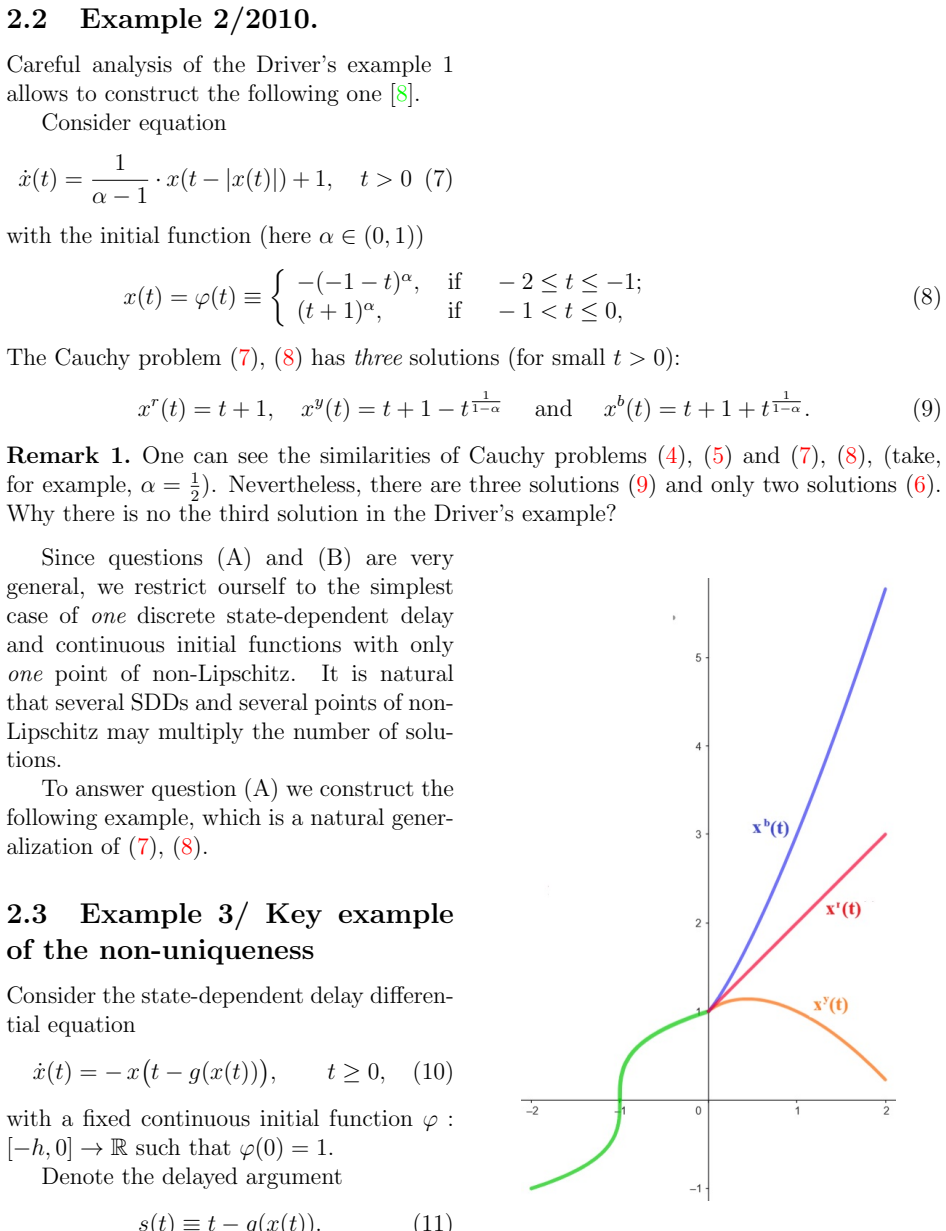
We discuss the non-uniqueness of continuous solutions to differential equations with a {\it discrete } state-dependent delay and continuous initial functions. We are interested not only in the fact (conditions) of non-uniqueness, but in additional information on the number of non-unique solutions and discuss an approach to classify them. We provide a few explicit (easy to verify) examples of the non-uniqueness of continuous solutions and propose an approach to their classification. This partial classification may be illustrated by using just three collors and their simple and intuitive combination. We recognize that this initial classification is not exhaustive, and further study is necessary to build a complete picture.
Editorial analysis
A structured set of objections, weighed in public.
Referee Report
Summary. The manuscript discusses non-uniqueness of continuous solutions to differential equations with discrete state-dependent delays under continuous initial functions. It supplies a few explicit examples to demonstrate the phenomenon, provides additional information on the number of such solutions, and proposes a partial classification approach illustrated via combinations of three colors, while explicitly noting that the classification is not exhaustive and requires further study.
Significance. If the claimed explicit examples can be directly verified against the differential equations as stated, the work offers concrete illustrations of non-uniqueness in a class of equations where uniqueness is not guaranteed in general. This is useful for the theory of functional differential equations, particularly state-dependent delays, and the intuitive three-color classification provides a starting framework for organizing solution multiplicity, even if partial. The focus on verifiable instances rather than a general theorem aligns with the paper's scope and could inform numerical or modeling work, though broader impact depends on the rigor and completeness of the derivations in the full text.
major comments (1)
- The abstract asserts that the examples are 'explicit (easy to verify)' and support the non-uniqueness claim, but the provided text contains no specific equations, derivations, or verification steps. This makes it impossible to confirm that the solutions satisfy the equation and initial conditions without additional material, which is load-bearing for the central claim.
minor comments (1)
- The classification is described as 'partial' and 'not exhaustive'; the manuscript should clarify in the relevant section what criteria (e.g., number of delay switches or solution branches) the three-color scheme captures and what cases remain unclassified.
Simulated Author's Rebuttal
We thank the referee for their careful review and for recognizing the utility of explicit examples and the three-color classification framework in our work on non-uniqueness for state-dependent delay equations. We address the single major comment below and will revise the manuscript to strengthen the verifiability of the central examples.
read point-by-point responses
-
Referee: The abstract asserts that the examples are 'explicit (easy to verify)' and support the non-uniqueness claim, but the provided text contains no specific equations, derivations, or verification steps. This makes it impossible to confirm that the solutions satisfy the equation and initial conditions without additional material, which is load-bearing for the central claim.
Authors: We agree that the presentation of the examples can be made more immediately verifiable. The manuscript does contain specific functional forms for the right-hand side, the state-dependent delay, continuous initial functions, and candidate continuous solutions in the body text (following the abstract), but we acknowledge that explicit equation statements, initial conditions, and substitution verifications are not laid out in a single, self-contained block. In the revised version we will add a dedicated subsection that states each example in full (equation, initial data, proposed solutions) and performs the direct substitution checks step by step, confirming that each solution satisfies both the differential equation and the initial condition. This will make the non-uniqueness claim transparent without requiring the reader to assemble the pieces. revision: yes
Circularity Check
No significant circularity: claims rest on explicit verifiable examples
full rationale
The paper centers on concrete, directly verifiable examples of non-uniqueness for continuous solutions of state-dependent delay equations, together with an explicitly partial and non-exhaustive classification scheme illustrated by color combinations. No equations, parameters, or uniqueness theorems are fitted or derived in a way that reduces the stated non-uniqueness back to the inputs by construction. Any self-citations to prior work by the same author are not load-bearing for the central claims, which are supported by the supplied instances that can be checked independently against the differential equation and initial data.
Axiom & Free-Parameter Ledger
axioms (1)
- domain assumption Continuous initial functions and discrete state-dependent delay are admissible for the equation class under study
Reference graph
Works this paper leans on
-
[1]
Diekmann, S
O. Diekmann, S. van Gils and S. Verduyn Lunel, S. A. Gils, H.-O. Walther,Delay Equations: Functional, Complex, and Nonlinear Analysis, Springer-Verlag, New York,
-
[2]
DOI: https://doi.org/10.1007/978-1-4612-4206-2
-
[3]
R. D. Driver, A two-body problem of classical electrodynamics: The one-dimensional case, Ann. of Phys. (N. Y.) 21 (1963), 122-142
1963
-
[4]
R. D. Driver, M. J. Norris, Note on uniqueness for a one-dimensional two-body problem of classical electrodynamics Annals of Physics Volume 42, Issue 2, April 1967, Pages 347-351. DOI: https://doi.org/10.1016/0003-4916(67)90076-0 10
-
[5]
J. K. Hale,Theory of Functional Differential Equations, Springer, Berlin- Heidelberg- New York, 1977
1977
-
[6]
F. Hartung, T. Krisztin, H.-O. Walther, J. Wu, Functional Differential Equations with State-Dependent Delays: Theory and Applications,in”Handbook of Differential Equa- tions: Ordinary Differential Equations, Volume 3” (A. Canada, P. Drabek, A. Fonda eds.), Elsevier B.V., 2006.DOI: https://doi.org/10.1016/S1874-5725(06)80009-X
-
[7]
Mallet-Paret, R
J. Mallet-Paret, R. D. Nussbaum, P. Paraskevopoulos, Periodic solutions for functional- differential equations with multiple state-dependent time lags,Topol. Methods Nonlinear Anal.3(1), (1994), 101–162
1994
-
[8]
A.V. Rezounenko, Differential equations with discrete state-dependent delay: unique- ness and well-posedness in the space of continuous functions,Nonlinear Analysis Se- ries A: Theory, Methods and Applications,70(2009), Issue 11, 3978-3986. DOI: https://doi.org/10.1016/j.na.2008.08.006
-
[9]
Rezounenko, Elementary properties of differential equations with a state- dependent delay
A.V. Rezounenko, Elementary properties of differential equations with a state- dependent delay. Lecture Notes. Kharkiv University Press. Kharkiv. 2010. 44 p
2010
-
[10]
A. Rezounenko. A condition on delay for differential equations with discrete state-dependent delay. J. Math. Anal. Appl., 385 (1) (2012), pp. 506-516, DOI: https://doi.org/10.1016/j.jmaa.2011.06.070
-
[11]
H.-O. Walther, The solution manifold and C1-smoothness for differential equations with state-dependent delay. Journal of Differential Equations Volume 195, Issue 1, 20 Novem- ber 2003, pp. 46-65. DOI: https://doi.org/10.1016/j.jde.2003.07.001
-
[12]
Winston, Uniqueness of the zero solution for delay differential equations with state dependence, J
E. Winston, Uniqueness of the zero solution for delay differential equations with state dependence, J. Differential Equations, 7 (1970), pp. 395-405. DOI: https://doi.org/10.1016/0022-0396(70)90118-X
-
[13]
Winston, Uniqueness of solutions of state dependent delay differential equations
E. Winston, Uniqueness of solutions of state dependent delay differential equations. Journal of Mathematical Analysis and Applications, Vol. 47, Issue 3, 1974, P. 620-625. DOI: https://doi.org/10.1016/0022-247X(74)90013-4 Submitted March 30, 2026 Kharkiv, Ukraine 11
discussion (0)
Sign in with ORCID, Apple, or X to comment. Anyone can read and Pith papers without signing in.