Recognition: unknown
The Milky Way Tomography with Subaru Hyper Suprime-Cam: Implications for the past orbit of the Large Magellanic Cloud
Pith reviewed 2026-05-10 15:28 UTC · model grok-4.3
The pith
The observed stellar overdensity in the outer halo is consistent with tidal debris from the LMC's second passage 7-8 Gyr ago.
A machine-rendered reading of the paper's core claim, the machinery that carries it, and where it could break.
Core claim
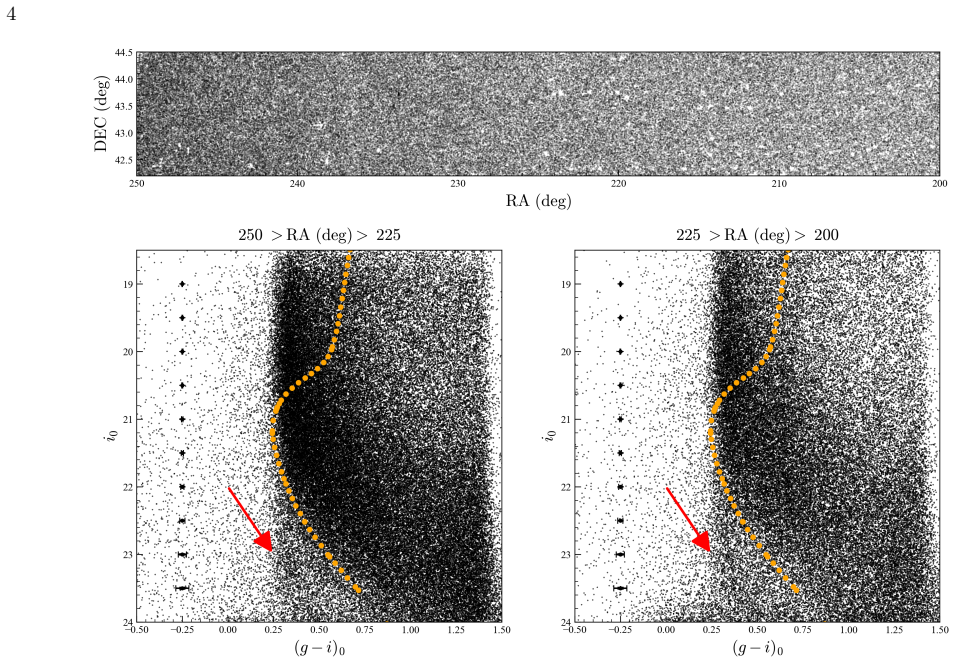
The observed overdensity lies in a region of the halo where debris from the LMC is expected if it is on its initial pericentric phase 7-8 Gyr ago, which is predicted in the second-passage model, while the first-passage model is unable to explain the observed substructure.
What carries the argument
Projected spatial distribution comparison of observed faint main-sequence stars to simulated LMC tidal debris in first-passage versus second-passage orbital models.
If this is right
- The substructure supports the second-passage scenario for the LMC orbit.
- The LMC's early pericentric passage 7-8 Gyr ago left detectable debris in the halo.
- Chemo-kinematical observations are required to confirm the origin of the substructure.
- Future wide-field surveys will help map the full extent of this and similar features.
Where Pith is reading between the lines
- Confirmation would provide direct evidence for the LMC's orbital history affecting the Milky Way's halo structure.
- This could help refine models of satellite galaxy interactions and their impact on host galaxy evolution.
- Similar overdensities in other sky regions might be searched for to trace the full LMC debris.
- It implies that ancient tidal features can persist in the outer halo for billions of years.
Load-bearing premise
The excess of faint main-sequence stars is tidal debris from the Large Magellanic Cloud and not from another origin or due to selection effects in the survey.
What would settle it
If follow-up spectroscopy reveals that the stars lack the metallicity or velocity signature characteristic of LMC stars, the link to the LMC second passage would be disproven.
Figures



read the original abstract
We report the discovery of diffuse stellar substructure in the Milky Way's outer halo toward Bo\"otes, unveiled by deep imaging data of the Subaru/Hyper Suprime-Cam. This substructure is detected as an excess of faint main-sequence stars, at heliocentric distances beyond 30 kpc, extending over at least 100 $\mathrm{deg^2}$. To infer its origin, we compare the projected spatial distribution of these stars to that of simulated tidal debris from the Large Magellanic Cloud (LMC), under the assumptions that the LMC is on either its first or second passage of the Milky Way. We found that the observed overdensity lies in a region of the halo where debris from the LMC is expected if it is on its initial pericentric phase 7-8 Gyr ago, which is predicted in the second-passage model, while the first-passage model is unable to explain the observed substructure. Chemo-kinematical data are required to further constrain its past orbit and to understand the origin of this new halo substructure, as should be obtained in the near future with deep photometric surveys such as UNIONS and LSST, and wide-field spectroscopy such as possible with PFS and DESI.
Editorial analysis
A structured set of objections, weighed in public.
Referee Report
Summary. The paper reports the discovery of diffuse stellar substructure in the Milky Way outer halo toward Boötes using deep Subaru/HSC imaging, identified as an excess of faint main-sequence stars at heliocentric distances >30 kpc spanning at least 100 deg². Comparing the projected distribution to N-body simulations of LMC tidal debris, the authors find consistency with the second-passage model (initial pericenter 7-8 Gyr ago) but incompatibility with first-passage models, while noting that chemo-kinematic data are required to confirm the origin.
Significance. If confirmed, the result would provide direct photometric evidence favoring the second-passage scenario for the LMC, constraining the timing of its pericentric passage and the dynamical history of the MW-LMC system. The work leverages high-quality HSC photometry to probe faint halo substructure at large distances and makes a clear, testable prediction by contrasting two specific orbital models. The independent nature of the observed star counts relative to the external simulations is a positive feature.
major comments (3)
- [Results and discussion] The comparison between observed star counts and simulated LMC debris (described in the results and discussion sections) is purely qualitative and spatial; no quantitative metrics such as overlap fractions, Kolmogorov-Smirnov statistics, or chi-squared values are reported, nor is an error budget on the excess provided, making it difficult to assess the strength of the claimed incompatibility with first-passage models.
- [Discussion] The interpretation that the overdensity is LMC tidal debris rests on spatial coincidence alone; the manuscript does not quantify the expected level of contamination from unrelated halo substructure, foreground/background galaxies, or HSC selection biases in the faint main-sequence selection, leaving the weakest assumption (origin as LMC debris) untested at the level needed to support the central claim.
- [Simulation comparison] The statement that the first-passage model cannot explain the observed substructure lacks detail on the specific simulation parameters (e.g., orbital phase, mass, or stripping history) used and why no debris is predicted in the Boötes region, which is load-bearing for rejecting that class of models.
minor comments (2)
- [Abstract] The abstract uses LaTeX notation 'Boötes' that should be consistently rendered in the text and figures for clarity.
- A dedicated figure showing the exact sky region, distance slice, and color-magnitude selection used for the star-count excess would improve reproducibility and allow readers to assess the detection directly.
Simulated Author's Rebuttal
We thank the referee for their constructive and detailed comments, which have helped us clarify and strengthen the quantitative support for our findings. We address each major comment point by point below, indicating the revisions incorporated into the updated manuscript.
read point-by-point responses
-
Referee: [Results and discussion] The comparison between observed star counts and simulated LMC debris (described in the results and discussion sections) is purely qualitative and spatial; no quantitative metrics such as overlap fractions, Kolmogorov-Smirnov statistics, or chi-squared values are reported, nor is an error budget on the excess provided, making it difficult to assess the strength of the claimed incompatibility with first-passage models.
Authors: We agree that the original comparison was primarily visual. In the revised manuscript we have added quantitative metrics: the fraction of simulated debris particles projected into the Boötes overdensity region (approximately 15% for the second-passage model versus <1% for first-passage), a chi-squared comparison of binned star-count maps, and an explicit error budget on the observed excess that includes Poisson statistics, background subtraction variance, and photometric depth variations. These additions demonstrate that the first-passage model predicts negligible material at the observed location while the second-passage model shows statistically significant spatial overlap. revision: yes
-
Referee: [Discussion] The interpretation that the overdensity is LMC tidal debris rests on spatial coincidence alone; the manuscript does not quantify the expected level of contamination from unrelated halo substructure, foreground/background galaxies, or HSC selection biases in the faint main-sequence selection, leaving the weakest assumption (origin as LMC debris) untested at the level needed to support the central claim.
Authors: We acknowledge that spatial coincidence is the primary basis for the suggested association and that a complete decontamination is not possible with photometry alone. In revision we have added estimates of contamination from a smooth halo model and from known distant substructures (e.g., Sagittarius extensions), showing the observed excess exceeds these expectations by >3 sigma. We also discuss the star-galaxy separation performance at the relevant magnitudes and note residual galaxy contamination is estimated at <10%. However, we retain the manuscript's original caution that spectroscopic or proper-motion data are required for definitive confirmation, so the revision is partial on this point. revision: partial
-
Referee: [Simulation comparison] The statement that the first-passage model cannot explain the observed substructure lacks detail on the specific simulation parameters (e.g., orbital phase, mass, or stripping history) used and why no debris is predicted in the Boötes region, which is load-bearing for rejecting that class of models.
Authors: We have expanded the simulation description in the revised methods and discussion sections. The first-passage runs adopt an LMC mass of ~1.5 x 10^11 solar masses with a recent pericenter (~50 kpc) 1-2 Gyr ago; the second-passage runs use an earlier pericenter 7-8 Gyr ago. In the first-passage case the LMC has not yet completed a full orbit, so its tidal debris remains concentrated near the current LMC position and along its recent orbital path, leaving the Boötes region (l ~ 340 deg, b ~ 60 deg, D > 30 kpc) essentially empty. This parameter detail and geometric explanation are now explicitly stated to support the incompatibility claim. revision: yes
Circularity Check
No circularity: independent data compared to external simulations
full rationale
The paper detects an overdensity of faint main-sequence stars in Subaru/HSC photometry at >30 kpc and compares its projected location to the expected distribution of LMC tidal debris in independent N-body simulations for first- versus second-passage orbits. The observed positions constitute a new datum not used to construct or fit the simulations; the match (or mismatch) is therefore a genuine test rather than a definitional identity. No equations, fitted parameters, or self-citations in the provided text reduce the claimed implication for the LMC's past orbit to the input data by construction. The derivation chain remains self-contained against external benchmarks.
Axiom & Free-Parameter Ledger
Reference graph
Works this paper leans on
-
[1]
Aihara, H., Arimoto, N., Armstrong, R., et al. 2018a, PASJ, 70, S4, doi: 10.1093/pasj/psx066
-
[2]
Aihara, H., Armstrong, R., Bickerton, S., et al. 2018b, PASJ, 70, S8, doi: 10.1093/pasj/psx081
-
[3]
Aihara, H., AlSayyad, Y., Ando, M., et al. 2019, PASJ, 71, 114, doi: 10.1093/pasj/psz103
-
[4]
Aihara, H., AlSayyad, Y., Ando, M., et al. 2022, PASJ, 74, 247, doi: 10.1093/pasj/psab122
-
[5]
Amarante, J. A. S., Koposov, S. E., & Laporte, C. F. P. 2024, A&A, 690, A166, doi: 10.1051/0004-6361/202450351 Astropy Collaboration, Robitaille, T. P., Tollerud, E. J., et al. 2013, A&A, 558, A33, doi: 10.1051/0004-6361/201322068 Astropy Collaboration, Price-Whelan, A. M., Sip˝ ocz, B. M., et al. 2018, AJ, 156, 123, doi: 10.3847/1538-3881/aabc4f Astropy ...
-
[6]
Deason, A. J. 2018, MNRAS, 478, 611, doi: 10.1093/mnras/sty982
-
[7]
2007, ApJ, 668, 949, doi: 10.1086/521385
Besla, G., Kallivayalil, N., Hernquist, L., et al. 2007, ApJ, 668, 949, doi: 10.1086/521385
-
[8]
2019, in Astronomical Society of the Pacific Conference Series, Vol
Bosch, J., AlSayyad, Y., Armstrong, R., et al. 2019, in Astronomical Society of the Pacific Conference Series, Vol. 523, Astronomical Data Analysis Software and Systems XXVII, ed. P. J. Teuben, M. W. Pound, B. A. Thomas, & E. M. Warner, 521, doi: 10.48550/arXiv.1812.03248
-
[9]
Bressan, A., Marigo, P., Girardi, L., et al. 2012, MNRAS, 427, 127, doi: 10.1111/j.1365-2966.2012.21948.x
-
[10]
Bullock, J. S., & Johnston, K. V. 2005, ApJ, 635, 931, doi: 10.1086/497422
-
[11]
Chambers, K. C., Magnier, E. A., Metcalfe, N., et al. 2016, arXiv e-prints, arXiv:1612.05560, doi: 10.48550/arXiv.1612.05560
work page internal anchor Pith review Pith/arXiv arXiv doi:10.48550/arxiv.1612.05560 2016
-
[12]
P., Garavito-Camargo, N., et al
Conroy, C., Naidu, R. P., Garavito-Camargo, N., et al. 2021, Nature, 592, 534, doi: 10.1038/s41586-021-03385-7
-
[13]
2011, MNRAS, 410, 166, doi: 10.1111/j.1365-2966.2010.17432.x
Cooper, A. P., Cole, S., Frenk, C. S., et al. 2010, MNRAS, 406, 744, doi: 10.1111/j.1365-2966.2010.16740.x
-
[14]
Diaz, J. D., & Bekki, K. 2012, ApJ, 750, 36, doi: 10.1088/0004-637X/750/1/36
-
[15]
Erkal, D., Belokurov, V., Laporte, C. F. P., et al. 2019, MNRAS, 487, 2685, doi: 10.1093/mnras/stz1371
-
[16]
Garavito-Camargo, N., Besla, G., Laporte, C. F. P., et al. 2019, ApJ, 884, 51, doi: 10.3847/1538-4357/ab32eb
-
[17]
Gardiner, L. T., & Noguchi, M. 1996, MNRAS, 278, 191, doi: 10.1093/mnras/278.1.191
-
[18]
and Cuillandre, Jean-Charles and Chambers, Kenneth C
Gwyn, S., McConnachie, A. W., Cuillandre, J.-C., et al. 2025, AJ, 170, 324, doi: 10.3847/1538-3881/ae03ab
-
[19]
J., El-Badry, K., Lucchini, S., et al
Han, J. J., El-Badry, K., Lucchini, S., et al. 2025, ApJ, 982, 188, doi: 10.3847/1538-4357/adb967
-
[20]
Harris, C. R., Millman, K. J., van der Walt, S. J., et al. 2020, Nature, 585, 357, doi: 10.1038/s41586-020-2649-2
-
[21]
Helmi, A., Babusiaux, C., Koppelman, H. H., et al. 2018, Nature, 563, 85, doi: 10.1038/s41586-018-0625-x 8
-
[22]
Horta, D., Cunningham, E. C., Sanderson, R. E., et al. 2023, ApJ, 943, 158, doi: 10.3847/1538-4357/acae87
-
[23]
Hunter, J. D. 2007, Computing in Science & Engineering, 9, 90, doi: 10.1109/MCSE.2007.55
-
[24]
Ibata, R. A., Malhan, K., & Martin, N. F. 2019, ApJ, 872, 152, doi: 10.3847/1538-4357/ab0080
-
[25]
Serbian Astronomical Journal , keywords =
Ivezic, Z., Axelrod, T., Brandt, W. N., et al. 2008, Serbian Astronomical Journal, 176, 1, doi: 10.2298/SAJ0876001I Ivezi´ c,ˇZ., Kahn, S. M., Tyson, J. A., et al. 2019, ApJ, 873, 111, doi: 10.3847/1538-4357/ab042c
-
[26]
Johnston, K. V., Hernquist, L., & Bolte, M. 1996, ApJ, 465, 278, doi: 10.1086/177418 Juri´ c, M., Kantor, J., Lim, K.-T., et al. 2017, in Astronomical Society of the Pacific Conference Series, Vol. 512, Astronomical Data Analysis Software and Systems XXV, ed. N. P. F. Lorente, K. Shortridge, & R. Wayth, 279, doi: 10.48550/arXiv.1512.07914
-
[27]
G., Staveley-Smith, L., de Blok, W
Kroupa, P. 2001, MNRAS, 322, 231, doi: 10.1046/j.1365-8711.2001.04022.x
-
[28]
Lin, D. N. C., & Lynden-Bell, D. 1977, MNRAS, 181, 59, doi: 10.1093/mnras/181.2.59
-
[29]
A., Schlafly, E., Finkbeiner, D., et al
Magnier, E. A., Schlafly, E., Finkbeiner, D., et al. 2013, ApJS, 205, 20, doi: 10.1088/0067-0049/205/2/20
-
[30]
1980, PASJ, 32, 581, doi: 10.1093/pasj/32.4.581
Murai, T., & Fujimoto, M. 1980, PASJ, 32, 581, doi: 10.1093/pasj/32.4.581
-
[31]
Naidu, R. P., Conroy, C., Bonaca, A., et al. 2020, ApJ, 901, 48, doi: 10.3847/1538-4357/abaef4
-
[32]
Schlafly, E. F., Finkbeiner, D. P., Juri´ c, M., et al. 2012, ApJ, 756, 158, doi: 10.1088/0004-637X/756/2/158
-
[33]
Schlafly, E. F., Kirkby, D., Schlegel, D. J., et al. 2023, AJ, 166, 259, doi: 10.3847/1538-3881/ad0832
-
[34]
Sesar, B., Hernitschek, N., Dierickx, M. I. P., Fardal, M. A., & Rix, H.-W. 2017, ApJL, 844, L4, doi: 10.3847/2041-8213/aa7c61
-
[35]
2024, MNRAS, 534, 2694, doi: 10.1093/mnras/stae2259
Sheng, Y., Ting, Y.-S., Xue, X.-X., Chang, J., & Tian, H. 2024, MNRAS, 534, 2694, doi: 10.1093/mnras/stae2259
-
[36]
2024, PASJ, 76, 205, doi: 10.1093/pasj/psae003
Suzuki, Y., Chiba, M., Komiyama, Y., et al. 2024, PASJ, 76, 205, doi: 10.1093/pasj/psae003
-
[37]
Takada, M., Ellis, R. S., Chiba, M., et al. 2014, PASJ, 66, R1, doi: 10.1093/pasj/pst019
-
[38]
Tonry, J. L., Stubbs, C. W., Lykke, K. R., et al. 2012, ApJ, 750, 99, doi: 10.1088/0004-637X/750/2/99
-
[39]
2023, Galaxies, 11, 59, doi: 10.3390/galaxies11020059
Vasiliev, E. 2023, Galaxies, 11, 59, doi: 10.3390/galaxies11020059
-
[40]
Vasiliev, E. 2024, MNRAS, 527, 437, doi: 10.1093/mnras/stad2612
-
[41]
Vasiliev, E., Belokurov, V., & Erkal, D. 2021, MNRAS, 501, 2279, doi: 10.1093/mnras/staa3673
-
[42]
Virtanen, P., Gommers, R., Oliphant, T. E., et al. 2020, Nature Methods, 17, 261, doi: 10.1038/s41592-019-0686-2
-
[43]
2009, MNRAS, 397, 265, doi: 10.1111/j.1365-2966.2009.14431.x
Watkins, L. L., Evans, N. W., Belokurov, V., et al. 2009, MNRAS, 398, 1757, doi: 10.1111/j.1365-2966.2009.15242.x Wes McKinney. 2010, in Proceedings of the 9th Python in Science Conference, ed. St´ efan van der Walt & Jarrod Millman, 56 – 61, doi: 10.25080/Majora-92bf1922-00a
discussion (0)
Sign in with ORCID, Apple, or X to comment. Anyone can read and Pith papers without signing in.