Recognition: unknown
Multi-TeV γ-ray candidates from GRB 221009A: a downturn in the intrinsic γ-ray spectrum, an echo of the prompt emission phase, and intergalactic electromagnetic cascades
Pith reviewed 2026-05-10 15:01 UTC · model grok-4.3
The pith
Neutrons from photohadronic interactions in GRB 221009A produce a high-energy echo that explains the observed TeV spectral downturn.
A machine-rendered reading of the paper's core claim, the machinery that carries it, and where it could break.
Core claim
The intrinsic spectrum of GRB 221009A shows a downturn at several TeV. A significant TeV gamma-ray component can be produced by neutrons from photohadronic interactions inside the fireball. These neutrons escape the fireball and interact with the surrounding matter, giving rise to a flux of electrons and positrons that emit GeV-TeV synchrotron photons, forming a high-energy echo of the GRB prompt emission phase. At multi-TeV energies the contribution of gamma rays from intergalactic electromagnetic cascades initiated by primary ultra-high-energy protons is severely limited during the early afterglow phase for typical magnetic field strengths in intergalactic filaments above 1 nG.
What carries the argument
the neutron echo, in which neutrons produced by photohadronic interactions inside the GRB fireball escape and generate secondary electrons and positrons whose synchrotron radiation supplies the GeV-TeV flux
If this is right
- The prompt emission phase of GRBs can produce an observable high-energy echo through neutron escape and secondary synchrotron radiation.
- Multi-TeV GRB observations can serve as a probe of intergalactic magnetic field strength via the suppression of proton-initiated cascades.
- Reconstruction of intrinsic GRB spectra at TeV energies must include possible contributions from the neutron echo in addition to the primary emission.
- The early afterglow phase of bright GRBs is expected to show reduced cascade contamination at the highest energies when filament magnetic fields are sufficiently strong.
Where Pith is reading between the lines
- The same neutron-escape channel could be tested by searching for similar delayed TeV components in other bright GRBs with dense multi-wavelength coverage.
- If the echo mechanism operates, it would imply that hadronic processes inside the fireball contribute measurably to the highest-energy afterglow, offering a new window on neutron production rates.
- GRB 221009A-like events could be used to place tighter bounds on the intergalactic magnetic field once more precise timing and spectral data become available.
- The downturn feature may appear in future LHAASO or CTA observations of other nearby, luminous bursts if the required neutron flux is generic.
Load-bearing premise
The model requires that photohadronic interactions inside the GRB fireball produce a sufficient neutron flux that escapes without significant attenuation and that the intergalactic magnetic field in filaments exceeds 1 nG during the early afterglow phase.
What would settle it
A measurement showing the intergalactic magnetic field strength in filaments below 1 nG, or a calculation demonstrating that the neutron yield from photohadronic interactions is too low to match the observed multi-TeV flux, would invalidate the echo explanation and the cascade suppression result.
Figures


read the original abstract
The detection of $\gamma$-ray candidates up to the energy of $\approx$13 TeV from the exceptionally bright $\gamma$-ray burst GRB 221009A by the Large High Altitude Air-Shower Observatory (LHAASO) has raised considerable interest in the astrophysical community. The $\gamma$-ray dataset resulting from the LHAASO observations allows one to reconstruct the intrinsic spectrum of GRB 221009A with an unprecedented precision. This intrinsic spectrum reveals a downturn at the energy of several TeV (statistical significance $\gt 5 \sigma$), i.e. the reconstructed intensity is below the intensity expected for a power-law spectrum. We show that a significant TeV $\gamma$-ray component may be produced by neutrons from photohadronic interactions inside the fireball. These neutrons escape the fireball and interact with the surrounding matter, giving rise to a flux of electrons and positrons, eventually resulting in an observable flux of GeV--TeV synchrotron photons -- a high energy "echo" of the GRB prompt emission phase. Finally, we show that at multi-TeV energies the contribution of $\gamma$ rays from intergalactic electromagnetic cascades initiated by primary ultra high energy protons is severely limited during the early afterglow phase for the typical magnetic field strength in the intergalactic filaments above 1 nG.
Editorial analysis
A structured set of objections, weighed in public.
Referee Report
Summary. The paper analyzes LHAASO observations of GRB 221009A and reports a >5σ downturn in the reconstructed intrinsic γ-ray spectrum at energies of several TeV. It proposes that neutrons from photohadronic interactions inside the GRB fireball can escape and interact with surrounding matter to produce an observable GeV–TeV synchrotron 'echo' of the prompt phase. It further argues that intergalactic electromagnetic cascades initiated by ultra-high-energy protons are severely suppressed during the early afterglow for intergalactic magnetic fields B ≳ 1 nG in filaments.
Significance. The data-driven identification of the spectral downturn with high statistical significance is a solid observational result that can constrain GRB emission and propagation models. If the neutron-echo and cascade-suppression calculations are robust, the work offers a physically motivated alternative contribution to the observed TeV flux and provides a potential probe of the intergalactic magnetic field strength. The manuscript correctly frames these as possible rather than unique explanations.
major comments (3)
- [data analysis / intrinsic spectrum reconstruction] The >5σ downturn significance is central to the observational claim, but the manuscript does not detail the exact power-law extrapolation, EBL absorption model, or error propagation used in the intrinsic-spectrum reconstruction (see the data-analysis section). Without these steps shown explicitly, the statistical claim cannot be independently verified from the provided information.
- [neutron echo / photohadronic model] In the neutron-echo model, the normalization of the escaping neutron flux is tied to fireball photohadronic parameters that appear adjusted to reproduce the observed TeV flux; the paper should provide the explicit equations for neutron production efficiency and escape fraction, together with the range of allowed parameter values, to demonstrate that the echo is not circularly normalized.
- [intergalactic cascade section] The cascade-suppression argument adopts a magnetic-field threshold of 1 nG without showing the sensitivity of the multi-TeV flux limit to variations around this value or to the precise timing of the early-afterglow phase; a brief parameter scan or analytic dependence on B would strengthen the conclusion.
minor comments (2)
- [abstract] The abstract states 'statistical significance >5σ' but does not specify whether this is for the downturn relative to a single power law or after marginalizing over EBL uncertainties; a one-sentence clarification would help.
- [model description] Notation for the neutron-to-proton ratio and the synchrotron cooling time in the echo calculation should be defined at first use to improve readability for readers outside the GRB modeling community.
Simulated Author's Rebuttal
We thank the referee for their careful and constructive review of our manuscript. Their comments have highlighted areas where additional clarity and detail will strengthen the presentation. We address each major comment below and will incorporate the necessary revisions to improve verifiability and transparency.
read point-by-point responses
-
Referee: [data analysis / intrinsic spectrum reconstruction] The >5σ downturn significance is central to the observational claim, but the manuscript does not detail the exact power-law extrapolation, EBL absorption model, or error propagation used in the intrinsic-spectrum reconstruction (see the data-analysis section). Without these steps shown explicitly, the statistical claim cannot be independently verified from the provided information.
Authors: We agree that the current description lacks sufficient detail for independent verification. In the revised manuscript we will expand the data-analysis section to explicitly state: the functional form and fitting range used for the power-law extrapolation, the precise EBL model adopted (including the reference and any redshift-dependent assumptions), and the complete error-propagation procedure that combines statistical and systematic uncertainties to arrive at the >5σ significance. Relevant equations and a concise numerical example will be added to allow readers to reproduce the intrinsic-spectrum reconstruction. revision: yes
-
Referee: [neutron echo / photohadronic model] In the neutron-echo model, the normalization of the escaping neutron flux is tied to fireball photohadronic parameters that appear adjusted to reproduce the observed TeV flux; the paper should provide the explicit equations for neutron production efficiency and escape fraction, together with the range of allowed parameter values, to demonstrate that the echo is not circularly normalized.
Authors: We acknowledge the referee’s concern regarding parameter transparency. The revised manuscript will include the explicit analytic expressions for the neutron production efficiency (derived from the photohadronic optical depth and target-photon spectrum) and the neutron escape fraction (accounting for the fireball radius and neutron lifetime). We will also tabulate the physically allowed ranges for the baryon-loading factor, bulk Lorentz factor, and target-photon density, demonstrating that these values remain consistent with independent prompt-emission constraints and do not require ad-hoc adjustment solely to match the TeV flux. revision: yes
-
Referee: [intergalactic cascade section] The cascade-suppression argument adopts a magnetic-field threshold of 1 nG without showing the sensitivity of the multi-TeV flux limit to variations around this value or to the precise timing of the early-afterglow phase; a brief parameter scan or analytic dependence on B would strengthen the conclusion.
Authors: We thank the referee for this useful suggestion. In the revision we will add a short analytic derivation of the deflection angle and time-delay dependence on B, together with a compact parameter scan (or table) illustrating how the multi-TeV cascade flux upper limit changes for B between 0.1 nG and 10 nG and for plausible variations in the afterglow onset time. This will explicitly confirm that suppression remains effective for B ≳ 1 nG while quantifying the sensitivity to the adopted threshold. revision: yes
Circularity Check
No significant circularity; derivation self-contained
full rationale
The paper models a possible neutron-echo component via standard photohadronic rates inside the fireball and subsequent pair synchrotron emission, plus a conditional limit on IGM cascades for B ≳ 1 nG. These steps use literature values for fireball parameters and IGMF strength rather than fitting them to force the TeV downturn or echo flux. No equation reduces by construction to its own input, no self-citation chain carries the central claim, and the result is presented as one possible contribution rather than a unique prediction. The derivation therefore remains independent of its own outputs.
Axiom & Free-Parameter Ledger
free parameters (2)
- intergalactic magnetic field strength threshold
- neutron production efficiency in fireball
axioms (2)
- domain assumption Photohadronic interactions inside the GRB fireball produce a substantial neutron flux that escapes the source region.
- domain assumption Intergalactic filaments contain magnetic fields of typical strength above 1 nG during the early afterglow epoch.
Reference graph
Works this paper leans on
-
[1]
GRB 201216C [5], and 5) GRB 221009A [6, 7] (here- after L23a,L23b). The observations of GRB 221009A are unique in more than one respect: this GRB was ex- ceptionally bright [8–10] [11] and relatively nearby (red- shift z = 0 . 151 [12–14]), while the principal observing detector in the VHE range (the LHAASO array [15]) has an excellent sensitivity and a l...
work page internal anchor Pith review Pith/arXiv arXiv 2026
-
[2]
III of [40]
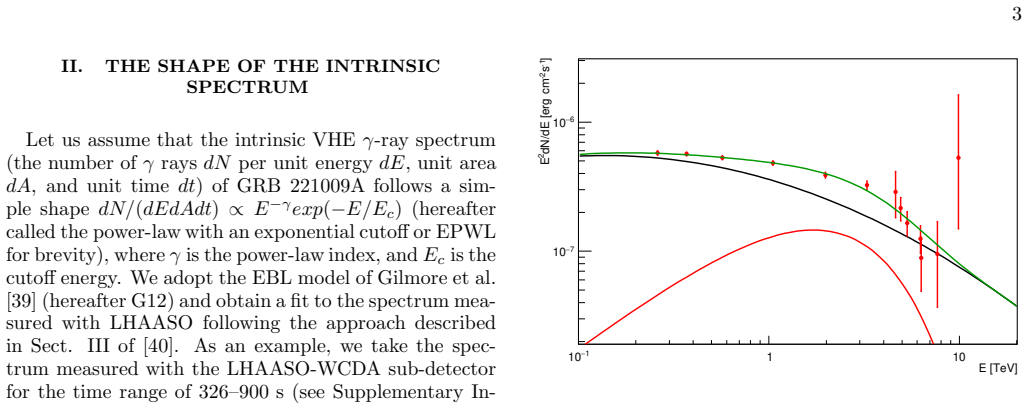
(hereafter G12) and obtain a fit to the spectrum mea- sured with LHAASO following the approach described in Sect. III of [40]. As an example, we take the spec- trum measured with the LHAASO-WCDA sub-detector for the time range of 326–900 s (see Supplementary In- formation, Fig. S4C in L23a); hereafter all time ranges are measured since the Fermi-GBM trigge...
-
[3]
neutron beam model
294, for the PWL option γ = 2. 35 and p = 1. 22 × 10− 72 corresponding to Z = 18 σ . For the time range of 230– 300 s the same values are Ec = 2 . 91 TeV, γ = 1 . 96, and p = 0 . 672 for the EPWL option and γ = 2 . 43, p = 3 . 22 × 10− 23 corresponding to Z = 9 . 9σ for the PWL option. 1−10 1 10 E [TeV] 7−10 6−10 ]-1s-2cm dN/dE [erg2E FIG. 3. The intrinsi...
-
[4]
weak universality
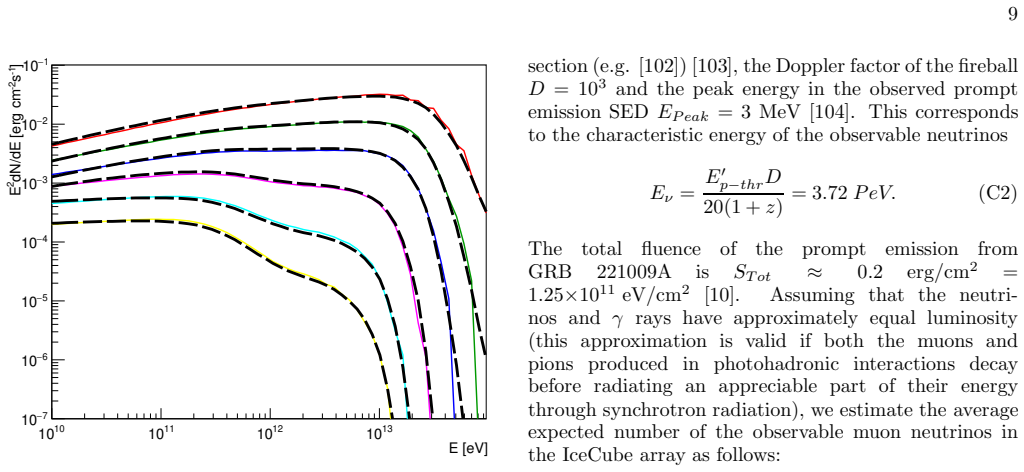
1 × 10− 4 erg/cm2 ≈ 1. 9SHard . We conclude that the fluence of these synchrotron photons in the considered scenario is sufficient to fill the gap between the intrinsic SED and the SSC model in Fig. 3. Following [52], the temporal width of the emission pulse of the hard component may be estimated as ∆ tm = R(1 − cos(θj))/c , where R is the distance from the c...
-
[5]
find Breg− f il = (0. 05 − 0. 15)Bf il. Assuming Bf il = 10 nG, Breg− f il = 0 . 1Bf il = 1 nG, df il = 1 Mpc (e.g. [70]), and Ep = 30 EeV, we get fBDE = 1. Further- more, for most models considered in [71], they estimate ∆ df il = 15 − 25 Mpc; assuming ∆ df il = 20 Mpc, we obtain the value of ∆ t = 5 . 7 × 10⁶ yr, which exceeds the LHAASO observation time...
-
[6]
the absorption and redshift-only model
(hereafter H22), including the detection of a γ-ray candidate with the reconstructed energy of 18 TeV, many studies have concluded that the conventional framework of “the absorption and redshift-only model”, accounting for only the attenuation of the primary γ-ray flux on the EBL photons and adiabatic losses, is not sufficient to interpret the information co...
-
[7]
MAGIC Collaboration, Nature 575, 455 (2019)
2019
-
[8]
V. A. Acciari, S. Ansoldi, L. A. Antonelli, A. A. Engels, D. Baack, and et al., Nature 575, 459 (2019)
2019
-
[9]
Abdalla, R
H. Abdalla, R. Adam, F. Aharonian, F. Ait Benkhali, E. O. Ang¨ uner, and et al., Nature 575, 464 (2019)
2019
-
[10]
Abdalla, F
H. Abdalla, F. Aharonian, F. Ait Benkhali, E. O. Ang¨ uner, C. Arcaro, and et al., Science 372, 1081 (2021)
2021
-
[11]
H. Abe, S. Abe, V. A. Acciari, I. Agudo, T. Aniello, and et al., MNRAS 527, 5856 (2023)
2023
-
[12]
Z. Cao, F. Aharonian, Q. An, Axikegu, L. X. Bai, and et al., Science 380, 1390 (2023)
2023
-
[13]
The LHAASO Collaboration, Science Advances 9, eadj2778 (2023)
2023
-
[14]
Lesage, P
S. Lesage, P. Veres, M. S. Briggs, A. Goldstein, D. Kocevski, and et al., The Astrophysical Journal Letters 952, L42 (2023)
2023
-
[15]
M. A. Williams, J. A. Kennea, S. Dichiara, K. Kobayashi, W. B. Iwakiri, and et al., The Astrophysical Journal Letters 946, L24 (2023)
2023
-
[16]
Burns, D
E. Burns, D. Svinkin, E. Fenimore, D. A. Kann, J. F. Agui Fernandez, and et al., The Astrophysical Journal Letters 946, L31 (2023)
2023
-
[17]
the brightest of all time
GRB 221009A is sometimes referred to as “the brightest of all time” (BOAT) [10]
-
[18]
de Ugarte Postigo, L
A. de Ugarte Postigo, L. Izzo, G. Pugliese, D. Xu, B. Schneider, and et al., GRB Coordinates Network 32648, 1 (2022)
2022
-
[19]
A. J. Castro-Tirado, R. Sanchez-Ramirez, Y. D. Hu, M. D. Caballero-Garcia, M. A. Castro Tirado, and et al., GRB Coordinates Network 32686, 1 (2022)
2022
-
[20]
D. B. Malesani, A. J. Levan, L. Izzo, A. de Ugarte Postigo, G. Ghirlanda, and et al., Astronomy & Astrophysics 701, A134 (2025)
2025
-
[21]
Ma, Y.-J
X.-H. Ma, Y.-J. Bi, Z. Cao, M.-J. Chen, S.-Z. Chen, and et al., Chinese Physics C 46, 030001 (2022)
2022
-
[22]
A. I. Nikishov, Sov. Phys. JETP 14, 393 (1962)
1962
-
[23]
R. J. Gould and G. P. Schr´ eder, Phys. Rev. 155, 1408 (1967)
1967
-
[24]
S. V. Troitsky, JETP Letters 116, 767 (2022)
2022
-
[25]
Galanti, L
G. Galanti, L. Nava, M. Ron- cadelli, F. Tavecchio, and G. Bonnoli, Physical Review Letters 131, 251001 (2023)
2023
-
[26]
Galanti, M
G. Galanti, M. Roncadelli, and F. Tavecchio, Assessment of ALP scenarios for GRB 221009A (2022)
2022
-
[27]
Carenza and M
P. Carenza and M. C. D. Marsh, On ALP scenarios and GRB 221009A (2022)
2022
-
[28]
Baktash, D
A. Baktash, D. Horns, and M. Meyer, Interpretation of multi-TeV photons from GRB221009A (2022)
2022
-
[29]
Wang and B.-Q
L. Wang and B.-Q. Ma, Physical Review D 108, 023002 (2023). 7
2023
-
[30]
M. M. Gonzalez, D. Avila Rojas, A. Pratts, S. Hernandez-Cadena, N. Fraija, R. Al- faro, Y. Perez Araujo, and J. A. Montes, The Astrophysical Journal 944, 178 (2023)
2023
-
[31]
Lin and T
W. Lin and T. T. Yanagida, Chinese Physics Letters 40, 069801 (2023)
2023
-
[32]
Nakagawa, F
S. Nakagawa, F. Takahashi, M. Yamada, and W. Yin, Physics Letters B 839, 137824 (2023)
2023
-
[33]
G. Zhang and B.-Q. Ma, Chinese Physics Letters 10.1088/0256-307x/40/01/011401 (2022)
-
[34]
Avila Rojas, S
D. Avila Rojas, S. Hernandez-Cadena, M. M. Gon- zalez, A. Pratts, R. Alfaro, and J. Serna-Franco, The Astrophysical Journal 966, 114 (2024)
2024
-
[35]
J. D. Finke and S. Razzaque, The Astrophysical Journal Letters 942, L21 (2023)
2023
-
[36]
Li and B.-Q
H. Li and B.-Q. Ma, JCAP 2023 (10), 061
2023
-
[37]
H. Li and B.-Q. Ma, Modern Physics Letters A 39, 10.1142/s0217732323502012 (2024)
-
[38]
P. S. Satunin and S. V. Troitsky, JETP Letters 123, 73 (2026)
2026
-
[39]
A. Y. Smirnov and A. Trautner, Physical Review Letters 131, 021002 (2023)
2023
-
[40]
Balaji, M
S. Balaji, M. E. Ramirez-Quezada, J. Silk, and Y. Zhang, Physical Review D 107, 083038 (2023)
2023
-
[41]
S.-Y. Guo, M. Khlopov, L. Wu, and B. Zhu, Physical Review D 108, L021302 (2023)
2023
-
[42]
Brdar and Y.-Y
V. Brdar and Y.-Y. Li, Physics Letters B 839, 137763 (2023)
2023
-
[43]
Huang, Y
J. Huang, Y. Wang, B. Yu, and S. Zhou, JCAP 2023 (04), 056
2023
-
[44]
Aghanim, Y
N. Aghanim, Y. Akrami, M. Ashdown, J. Aumont, C. Baccigalupi, and et al., Astronomy & Astrophysics 641, A6 (2020)
2020
-
[45]
R. C. Gilmore, R. S. Somerville, J. R. Primack, and A. Dom ´ ınguez, MNRAS422, 3189 (2012)
2012
-
[46]
Dzhatdoev, E
T. Dzhatdoev, E. Podlesnyi, and I. Vaiman, Physical Review D 102, 123017 (2020)
2020
-
[47]
Lazzati, MNRAS 357, 722 (2005)
D. Lazzati, MNRAS 357, 722 (2005)
2005
-
[48]
P. A. Zyla, R. M. Barnett, J. Beringer, O. Dahl, D. A. Dwyer, and et al., Progress of Theoretical and Experi- mental Physics 2020, 10.1093/ptep/ptaa104 (2020)
-
[49]
Saldana-Lopez, A
A. Saldana-Lopez, A. Dominguez, P. G. Perez- Gonzalez, J. Finke, M. Ajello, J. R. Primack, V. S. Paliya, and A. Desai, MNRAS 507, 5144–5160 (2021)
2021
-
[50]
T. A. Dzhatdoev, Talk at the RICAP-24 conference (2024)
2024
-
[51]
Dzhappuev, I
D. Dzhappuev, I. Dzaparova, T. Dzhat- doev, E. Gorbacheva, I. Karpikov, and et al., Physical Review D 111, 102005 (2025)
2025
-
[52]
S. R. Kelner and F. A. Aharonian, Physical Review D 78, 034013 (2008)
2008
-
[53]
This approximation is justified in the scenario with an isotropic target photon field internal to the fireball
-
[54]
We note, however, that an additional neutron flux may come from the process of photodisintegration of nuclei, see Appendix B
-
[55]
Knapp, D
J. Knapp, D. Heck, and G. Schatz, Comparison of hadronic interaction models used in air shower simula- tions and of their influence on shower development and observables (1996)
1996
-
[56]
S. R. Kelner, F. A. Aharonian, and V. V. Bugayov, Physical Review D 74, 034018 (2006)
2006
-
[57]
M. R. Krumholz and C. F. McKee, Nature 451, 1082 (2008)
2008
-
[58]
C. D. Dermer and A. Atoyan, Astronomy & Astrophysics 418, L5 (2004)
2004
-
[59]
W. J. Forrest and M. A. Shure, The Astrophysical Journal 311, L81 (1986)
1986
-
[60]
Khangulyan, M
D. Khangulyan, M. Arakawa, and F. Aharonian, MNRAS 491, 3217 (2019)
2019
-
[61]
R. M. Crutcher, ApJ 520, 706 (1999)
1999
-
[62]
Razzaque, O
S. Razzaque, O. Mena, and C. D. Dermer, The Astrophysical Journal 691, L37 (2009)
2009
-
[63]
T. A. Dzhatdoev, E. I. Podlesnyi, and G. I. Rubtsov, MNRAS Lett. 527, L95–L102 (2023)
2023
-
[64]
Waxman and P
E. Waxman and P. Coppi, The Astrophysical Journal 464, L75 (1996)
1996
-
[65]
Berezinsky, A
V. Berezinsky, A. Gazizov, and S. Grigorieva, Physical Review D 74, 043005 (2006)
2006
-
[66]
A. V. Uryson, JETP 86, 213 (1998)
1998
-
[67]
Das and S
S. Das and S. Razzaque, Astronomy & Astrophysics 670, L12 (2023)
2023
-
[68]
Mirabal, MNRAS Lett
N. Mirabal, MNRAS Lett. 519, L85–L86 (2022)
2022
-
[69]
V. S. Berezinsky and A. Y. Smirnov, Astrophysics and Space Science 32, 461–482 (1975)
1975
-
[70]
V. Berezinsky and O. Kalashev, Physical Review D 94, 10.1103/physrevd.94.023007 (2016)
-
[71]
T. A. Dzhatdoev, E. V. Khalikov, A. P. Kircheva, and A. A. Lyukshin, Astronomy & Astrophysics 603, A59 (2017)
2017
-
[72]
E. V. Khalikov and T. A. Dzhatdoev, MNRAS 505, 1940–1953 (2021)
1940
-
[73]
Alcock and S
C. Alcock and S. Hatchett, The Astrophysical Journal 222, 456 (1978)
1978
-
[74]
Carretti, F
E. Carretti, F. Vazza, S. P. O’Sullivan, V. Vacca, A. Bonafede, G. Heald, C. Horel- lou, S. Mtchedlidze, and T. Vernstrom, Astronomy & Astrophysics 693, A208 (2025)
2025
-
[75]
Vernstrom, G
T. Vernstrom, G. Heald, F. Vazza, T. J. Galvin, J. L. West, N. Locatelli, N. Fornengo, and E. Pinetti, MNRAS 505, 4178–4196 (2021)
2021
-
[76]
Q.-R. Yang, W. Zhu, G.-Y. Yu, J.-F. Mo, Y. Zheng, and L.-L. Feng, The Astrophysical Journal 989, 187 (2025)
2025
-
[77]
Tjemsland, M
J. Tjemsland, M. Meyer, and F. Vazza, The Astrophysical Journal 963, 135 (2024)
2024
-
[78]
Huang, S
Y. Huang, S. Hu, S. Chen, M. Zha, C. Liu, and et al., GRB Coordinates Network 32677, 1 (2022)
2022
-
[79]
Tang and H
R. Tang and H. Zhou on behalf of the LHAASO collab- oration, Talk at the ICRC-2025 conference (2025)
2025
-
[80]
W. Cao, Y. Luo, R. Tang, J. Wang, and H. Zhou on behalf of the LHAASO collaboration, Talk at the ICRC- 2025 conference (2025)
2025
discussion (0)
Sign in with ORCID, Apple, or X to comment. Anyone can read and Pith papers without signing in.