Recognition: unknown
Estimating heterogeneous treatment effects with survival outcomes via a deep survival learner
Pith reviewed 2026-05-10 16:35 UTC · model grok-4.3
The pith
A deep survival learner estimates time-specific heterogeneous treatment effects in right-censored data using doubly robust pseudo-outcomes and joint neural network fitting.
A machine-rendered reading of the paper's core claim, the machinery that carries it, and where it could break.
Core claim
The DSL method constructs a doubly robust pseudo-outcome for the time-specific CATE that accounts for right censoring and remains unbiased if either the outcome model or the treatment assignment model is correctly specified. Estimation proceeds via a multi-output deep neural network with shared representations that jointly estimates the CATE function over a spectrum of times. Error bounds establish that joint estimation over time controls estimation error by leveraging temporal structure under smoothness conditions, without substantial extra approximation cost relative to separate estimation at each time point. Cross-fitting is used to mitigate bias from estimating the nuisance functions.
What carries the argument
Doubly robust pseudo-outcome for time-specific CATE, estimated jointly via multi-output deep neural network with shared layers.
If this is right
- Clinicians can obtain full trajectories of treatment effect heterogeneity rather than estimates at isolated times.
- The estimator stays consistent for the CATE even under misspecification of one nuisance function.
- Joint estimation over time yields more stable results than pointwise estimation when effects vary smoothly.
- Cross-fitting reduces overfitting bias in the presence of flexible nuisance estimators.
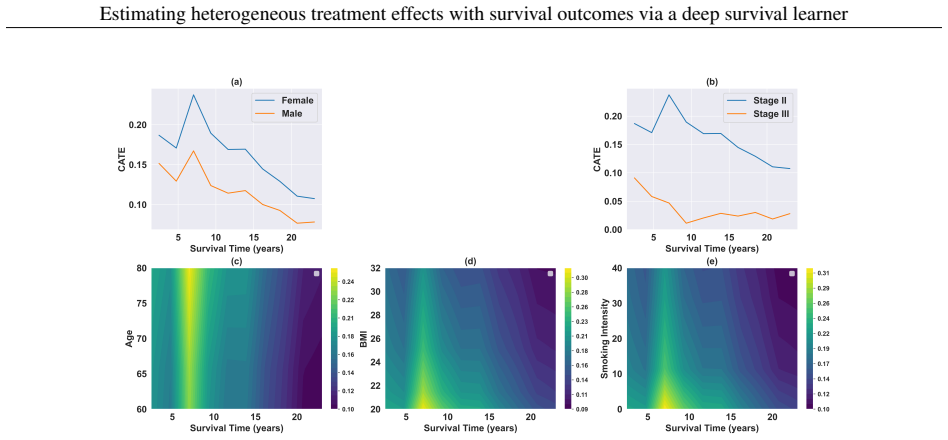
- Applied to real data, it can uncover patient subgroups with differing time-dependent benefits from treatment.
Where Pith is reading between the lines
- The smoothness-based stability gain suggests that similar joint modeling could improve other longitudinal or time-to-event estimators.
- This framework might be adapted to handle competing risks or time-varying treatments by extending the pseudo-outcome construction.
- Practitioners could use the estimated trajectories to time interventions or monitor when benefits accrue differently across patients.
Load-bearing premise
At least one of the outcome or treatment assignment models is correctly specified, and the heterogeneous treatment effects satisfy smoothness conditions over time.
What would settle it
If both the outcome regression and treatment assignment models are misspecified, the estimated CATEs should show substantial bias in finite samples; alternatively, when treatment effects change abruptly over time, the joint estimator should not show stability improvements over separate time-point fits.
Figures

read the original abstract
Estimating heterogeneous treatment effects in survival settings is complicated by right censoring as well as the time-varying nature of the estimand. While the conditional average treatment effect (CATE) provides a natural target, most existing approaches focus on a single prespecified time point and do not account for the temporal trajectory, leading to instability in estimation. We propose a deep survival learner (DSL) for estimating heterogeneous treatment effects with right-censored outcomes. The method is based on a doubly robust pseudo-outcome whose conditional expectation identifies time-specific CATEs under standard assumptions. This construction remains unbiased if either the outcome model or the treatment assignment model is correctly specified, when properly accounting for censoring. To estimate CATEs over a clinically relevant time spectrum, DSL employs a multi-output deep neural network with shared representations, enabling joint estimation of treatment effect trajectories. From a theoretical perspective, we derive error bounds for both pointwise and joint estimation over time. We show that joint estimation can leverage temporal structure to control estimation error without incurring much additional approximation cost under smoothness conditions, leading to improved stability relative to separate estimation. Cross-fitting is incorporated to reduce overfitting and mitigate bias arising from flexible nuisance estimation. Simulation studies demonstrate favorable finite-sample performance, particularly under nuisance model misspecification. Applied to the Boston Lung Cancer Study, DSL reveals heterogeneity in the effects of perioperative chemotherapy across patient characteristics and over time.
Editorial analysis
A structured set of objections, weighed in public.
Referee Report
Summary. The manuscript proposes a deep survival learner (DSL) for estimating heterogeneous treatment effects with right-censored survival outcomes. It constructs a doubly robust pseudo-outcome whose conditional expectation identifies time-specific CATEs, employs a multi-output deep neural network with shared representations for joint estimation of treatment effect trajectories over time, derives error bounds for pointwise and joint estimation, incorporates cross-fitting to mitigate bias from flexible nuisance estimation, and reports favorable finite-sample performance in simulations under nuisance misspecification along with an application to the Boston Lung Cancer Study.
Significance. If the doubly robust property holds after proper accounting for censoring and the error bounds confirm stability gains from joint estimation under smoothness, the work would advance methods for time-varying HTE estimation in survival data by combining DR identification with deep learning for trajectory estimation. The simulation results under misspecification and the clinical application provide practical support for the approach.
major comments (2)
- [Abstract] Abstract: The central claim that the pseudo-outcome 'remains unbiased if either the outcome model or the treatment assignment model is correctly specified, when properly accounting for censoring' is load-bearing for the unbiasedness result. It is unclear whether the construction is only doubly robust or additionally requires a correctly specified censoring distribution G(t|X,A) (as is standard for IPCW or augmented IPCW in right-censored data). If the pseudo-outcome augments only the outcome and propensity while treating censoring separately, unbiasedness would fail under censoring misspecification even if one of the other two models is correct. This requires explicit clarification in the identification argument.
- [Theoretical results] Theoretical analysis: The claim that joint estimation 'can leverage temporal structure to control estimation error without incurring much additional approximation cost under smoothness conditions' is load-bearing for the stability advantage over separate estimation. The specific smoothness assumptions, the form of the error bounds (pointwise vs. integrated over time), and the derivation showing no extra approximation cost need to be verified to confirm the result holds.
minor comments (2)
- [Abstract] The abstract mentions incorporation of cross-fitting but does not detail its implementation within the multi-output neural network architecture or how it interacts with the shared representations.
- [Simulations] Simulation studies are described as showing favorable performance, but the abstract lacks specifics on the metrics (e.g., MSE, coverage), data-generating processes, or how misspecification was induced.
Simulated Author's Rebuttal
We thank the referee for the detailed and constructive report. The comments highlight two important areas requiring clarification: the precise scope of the doubly robust property under censoring, and the explicit conditions and derivations supporting the joint estimation advantage. We have revised the manuscript to address both points directly, adding explicit statements in the identification section, updating the abstract, and expanding the theoretical results with clearer assumptions and bound comparisons. We believe these changes strengthen the paper without altering its core contributions.
read point-by-point responses
-
Referee: [Abstract] Abstract: The central claim that the pseudo-outcome 'remains unbiased if either the outcome model or the treatment assignment model is correctly specified, when properly accounting for censoring' is load-bearing for the unbiasedness result. It is unclear whether the construction is only doubly robust or additionally requires a correctly specified censoring distribution G(t|X,A) (as is standard for IPCW or augmented IPCW in right-censored data). If the pseudo-outcome augments only the outcome and propensity while treating censoring separately, unbiasedness would fail under censoring misspecification even if one of the other two models is correct. This requires explicit clarification in the identification argument.
Authors: We agree that the original wording in the abstract was insufficiently precise. The pseudo-outcome is constructed via an augmented inverse-probability-of-censoring-weighted (AIPCW) estimator. It is doubly robust with respect to the outcome regression and propensity score (i.e., remains unbiased if either is correctly specified), but the censoring survival function G(t|X,A) must be consistently estimated for the weights to be valid. We have revised Section 2.2 to state the identification assumptions explicitly, including that the censoring model is estimated separately via a correctly specified Cox model or nonparametric estimator, and we have updated the abstract to read: 'This construction remains unbiased if either the outcome model or the treatment assignment model is correctly specified, provided the censoring distribution is consistently estimated.' A short remark has also been added noting that full triple robustness would require an additional augmentation term for the censoring model, which is left for future work. revision: yes
-
Referee: [Theoretical results] Theoretical analysis: The claim that joint estimation 'can leverage temporal structure to control estimation error without incurring much additional approximation cost under smoothness conditions' is load-bearing for the stability advantage over separate estimation. The specific smoothness assumptions, the form of the error bounds (pointwise vs. integrated over time), and the derivation showing no extra approximation cost need to be verified to confirm the result holds.
Authors: We appreciate the request for greater transparency. The smoothness assumption is that the time-varying CATE function τ(t,x) belongs to a Hölder class of order α > 1/2 uniformly in t (Assumption 4). Theorem 3 provides both pointwise bounds (O(n^{-2β/(2β+d)}) for each fixed t) and integrated bounds over [0,T] that exploit the shared representation; the extra approximation error term arising from the multi-output head is shown to be of lower order than the separate-estimation penalty when the temporal smoothness holds, because the shared layers amortize the approximation cost across time points. We have added a new paragraph in Section 3.3 that states the precise Hölder exponent, reproduces the key steps of the derivation from Appendix B in the main text, and includes a side-by-side comparison of the joint versus separate estimation rates. These additions make the 'no extra approximation cost' claim fully verifiable from the main paper. revision: yes
Circularity Check
No significant circularity in derivation chain
full rationale
The paper constructs a doubly robust pseudo-outcome whose conditional expectation is shown to identify the time-specific CATE under standard assumptions (correct outcome or propensity model, with censoring accounted for). This is a standard identification strategy rather than a self-definition. Error bounds for pointwise and joint estimation are derived from approximation theory and smoothness conditions on the target functions, without reducing to fitted parameters renamed as predictions. Cross-fitting is used to mitigate overfitting in nuisance estimation, consistent with external doubly robust literature. No load-bearing self-citations, uniqueness theorems from prior author work, or ansatzes smuggled via citation are invoked to force the central result. The derivation remains self-contained against external benchmarks for DR identification in censored data.
Axiom & Free-Parameter Ledger
axioms (2)
- domain assumption Standard assumptions for identifying conditional average treatment effects in the presence of right censoring and treatment assignment
- domain assumption Smoothness of treatment effect trajectories over time
Reference graph
Works this paper leans on
-
[1]
Causal inference for statistics, social, and biomedical sciences: An introduction
Guido W Imbens and Donald B Rubin. Causal inference for statistics, social, and biomedical sciences: An introduction. Taylor & Francis, 2016
2016
-
[2]
Sai H. Dharmarajan, Jennifer L. Bragg-Gresham, Hal Morgenstern, Brenda W. Gillespie, Yi Li, Neil R. Powe, Delphine S. Tuot, Tanushree Banerjee, Nilka R \' os Burrows, Deborah B. Rolka, Sharon H. Saydah, and Rajiv Saran. State-level awareness of chronic kidney disease in the US . American Journal of Preventive Medicine, 53 0 (3): 0 300--307, 2017. doi:10.1...
-
[3]
HPV16 transmission between a couple with HPV -related head and neck cancer
Robert Haddad, Christopher Crum, Zigui Chen, Jeffrey Krane, Marshall Posner, Yi Li, and Robert Burk. HPV16 transmission between a couple with HPV -related head and neck cancer. Oral Oncology, 44 0 (8): 0 812--815, 2008. doi:10.1016/j.oraloncology.2007.09.004
-
[4]
Spirometry at diagnosis and overall survival in non-small cell lung cancer patients
Ting Zhai, Yi Li, Robert Brown, Michael Lanuti, Justin F Gainor, and David C Christiani. Spirometry at diagnosis and overall survival in non-small cell lung cancer patients. Cancer Medicine, 11 0 (24): 0 4796--4805, 2022
2022
-
[5]
A generalization of sampling without replacement from a finite universe
Daniel G Horvitz and Donovan J Thompson. A generalization of sampling without replacement from a finite universe. Journal of the American Statistical Association, 47 0 (260): 0 663--685, 1952
1952
-
[6]
o ren R K \
S \"o ren R K \"u nzel, Jasjeet S Sekhon, Peter J Bickel, and Bin Yu. Metalearners for estimating heterogeneous treatment effects using machine learning. Proceedings of the National academy of Sciences, 116 0 (10): 0 4156--4165, 2019
2019
-
[7]
Quasi-oracle estimation of heterogeneous treatment effects
Xinkun Nie and Stefan Wager. Quasi-oracle estimation of heterogeneous treatment effects. Biometrika, 108 0 (2): 0 299--319, 2021
2021
-
[8]
Towards optimal doubly robust estimation of heterogeneous causal effects
Edward H Kennedy. Towards optimal doubly robust estimation of heterogeneous causal effects. arXiv preprint arXiv:2004.14497, 2020
-
[9]
Doubly robust estimators for heterogeneous treatment effects in heteroskedastic survival data
Yuhui Yang, Weiwei Hu, Zhenli Liao, and Fangyao Chen. Doubly robust estimators for heterogeneous treatment effects in heteroskedastic survival data. Statistics in Medicine, 44 0 (23-24): 0 e70301, 2025
2025
-
[10]
Evaluating meta-learners to analyze treatment heterogeneity in survival data: Application to electronic health records of pediatric asthma care in covid-19 pandemic
Na Bo, Jong-Hyeon Jeong, Erick Forno, and Ying Ding. Evaluating meta-learners to analyze treatment heterogeneity in survival data: Application to electronic health records of pediatric asthma care in covid-19 pandemic. Statistics in Medicine, 44 0 (3-4): 0 e10333, 2025
2025
-
[11]
Estimating heterogeneous treatment effects with right-censored data via causal survival forests
Yifan Cui, Michael R Kosorok, Erik Sverdrup, Stefan Wager, and Ruoqing Zhu. Estimating heterogeneous treatment effects with right-censored data via causal survival forests. Journal of the Royal Statistical Society Series B: Statistical Methodology, 85 0 (2): 0 179--211, 2023
2023
-
[12]
Heterogeneous treatment effect estimation for observational data using model-based forests
Susanne Dandl, Andreas Bender, and Torsten Hothorn. Heterogeneous treatment effect estimation for observational data using model-based forests. Statistical Methods in Medical Research, 33 0 (3): 0 392--413, 2024
2024
-
[13]
A new method for clustered survival data: Estimation of treatment effect heterogeneity and variable selection
Liangyuan Hu. A new method for clustered survival data: Estimation of treatment effect heterogeneity and variable selection. Biometrical Journal, 66 0 (1): 0 2200178, 2024
2024
-
[14]
Survite: Learning heterogeneous treatment effects from time-to-event data
Alicia Curth, Changhee Lee, and Mihaela van der Schaar. Survite: Learning heterogeneous treatment effects from time-to-event data. Advances in Neural Information Processing Systems, 34: 0 26740--26753, 2021
2021
-
[15]
Treatment heterogeneity with survival outcomes
Yizhe Xu, Nikolaos Ignatiadis, Erik Sverdrup, Scott Fleming, Stefan Wager, and Nigam Shah. Treatment heterogeneity with survival outcomes. In Handbook of matching and weighting adjustments for causal inference, pages 445--482. Chapman and Hall/CRC, 2023
2023
-
[16]
The central role of the propensity score in observational studies for causal effects
Paul R Rosenbaum and Donald B Rubin. The central role of the propensity score in observational studies for causal effects. Biometrika, 70 0 (1): 0 41--55, 1983
1983
-
[17]
Causal Inference for Statistics, Social, and Biomedical Sciences: An Introduction
Guido W Imbens and Donald B Rubin. Causal Inference for Statistics, Social, and Biomedical Sciences: An Introduction. Cambridge University Press, 2015
2015
-
[18]
Cox's regression model for counting processes: A large sample study
Per Kragh Andersen and Richard D Gill. Cox's regression model for counting processes: A large sample study. Annals of Statistics, 10 0 (4): 0 1100--1120, 1982
1982
-
[19]
Semiparametric Theory and Missing Data
Anastasios A Tsiatis. Semiparametric Theory and Missing Data. Springer, 2006
2006
-
[20]
Asymptotic Statistics
Aad W van der Vaart. Asymptotic Statistics. Cambridge University Press, 1998
1998
-
[21]
Double/debiased machine learning for treatment and structural parameters
Victor Chernozhukov, Denis Chetverikov, Mert Demirer, Esther Duflo, Christian Hansen, Whitney Newey, and James Robins. Double/debiased machine learning for treatment and structural parameters. The Econometrics Journal, 21 0 (1): 0 C1--C68, 2018 a
2018
-
[22]
Alexandre B. Tsybakov. Introduction to Nonparametric Estimation. Springer Series in Statistics. Springer, 2009. doi:10.1007/b13794
-
[23]
A Distribution-Free Theory of Nonparametric Regression
L \'a szl \'o Gy \"o rfi, Michael Kohler, Adam Krzy \.z ak, and Harro Walk. A Distribution-Free Theory of Nonparametric Regression. Springer, 2006
2006
-
[24]
Victor Chernozhukov, Denis Chetverikov, Mert Demirer, Esther Duflo, Christian Hansen, Whitney Newey, and James Robins. Double/debiased machine learning for treatment and structural parameters. The Econometrics Journal, 21 0 (1): 0 C1--C68, 2018 b . doi:10.1111/ectj.12097
-
[25]
Deep relu network approximation of functions on a manifold
Johannes Schmidt-Hieber. Deep relu network approximation of functions on a manifold. Journal of Machine Learning Research, 21 0 (52): 0 1--26, 2020
2020
-
[26]
van der Vaart and Jon A
Aad W. van der Vaart and Jon A. Wellner. Weak Convergence and Empirical Processes. Springer, 1996
1996
-
[27]
Bartlett, Dylan J
Peter L. Bartlett, Dylan J. Foster, and Matus Telgarsky. Spectrally-normalized margin bounds for neural networks. In Advances in Neural Information Processing Systems, volume 30, 2017
2017
-
[28]
A. A. R. Alvarez, Y. Sun, Y. Li, and D. C. Christiani. Effects of sex on mortality in patients with lung cancer: A multiple mediation analysis of the Boston Lung Cancer Study . Clinical Lung Cancer, 27 0 (2): 0 201--209.e3, March 2026
2026
-
[29]
Prediagnosis smoking cessation and overall survival among patients with non--small cell lung cancer
Xinan Wang, Christopher W Romero-Gutierrez, Jui Kothari, Andrea Shafer, Yi Li, and David C Christiani. Prediagnosis smoking cessation and overall survival among patients with non--small cell lung cancer. JAMA Network Open, 6 0 (5): 0 e2311966, 2023
2023
-
[30]
Long-term results of the international adjuvant lung cancer trial evaluating adjuvant cisplatin-based chemotherapy in resected lung cancer
Rodrigo Arriagada, Ariane Dunant, Jean-Pierre Pignon, Bengt Bergman, Mariusz Chabowski, Dominique Grunenwald, Miroslaw Kozlowski, C \'e cile Le P \'e choux, Robert Pirker, Maria-Izabel Sathler Pinel, et al. Long-term results of the international adjuvant lung cancer trial evaluating adjuvant cisplatin-based chemotherapy in resected lung cancer. Journal of...
2010
-
[31]
The benefits and harms of adjuvant chemotherapy for non-small cell lung cancer in patients with major comorbidities: A simulation study
Amanda Leiter, Chung Yin Kong, Michael K Gould, Minal S Kale, Rajwanth R Veluswamy, Cardinale B Smith, Grace Mhango, Brian Z Huang, Juan P Wisnivesky, and Keith Sigel. The benefits and harms of adjuvant chemotherapy for non-small cell lung cancer in patients with major comorbidities: A simulation study. Plos one, 17 0 (11): 0 e0263911, 2022
2022
-
[32]
Gender, age, and comorbidity status predict improved survival with adjuvant chemotherapy following lobectomy for non-small cell lung cancers larger than 4 cm
Britt J Sandler, Zuoheng Wang, Jacquelyn G Hancock, Daniel J Boffa, Frank C Detterbeck, and Anthony W Kim. Gender, age, and comorbidity status predict improved survival with adjuvant chemotherapy following lobectomy for non-small cell lung cancers larger than 4 cm. Annals of surgical oncology, 23: 0 638--645, 2016
2016
-
[33]
Jean-Yves Douillard, Rafael Rosell, Mario De Lena, Francesco Carpagnano, Rodryg Ramlau, Jose Luis Gonz \'a les-Larriba, Tomasz Grodzki, Jose Rodrigues Pereira, Alain Le Groumellec, Vito Lorusso, et al. Adjuvant vinorelbine plus cisplatin versus observation in patients with completely resected stage ib--iiia non-small-cell lung cancer (adjuvant navelbine i...
2006
-
[34]
Influence of smoking on histologic type and the efficacy of adjuvant chemotherapy in resected non-small cell lung cancer
Zhenfa Zhang, Feng Xu, Shengguang Wang, Ni Li, and Changli Wang. Influence of smoking on histologic type and the efficacy of adjuvant chemotherapy in resected non-small cell lung cancer. Lung Cancer, 60 0 (3): 0 434--440, 2008
2008
-
[35]
The effect of body mass index on treatment outcomes in patients with metastatic non-small cell lung cancer treated with platinum-based therapy
Aysegul Sakin, Suleyman Sahin, Muhammed Mustafa Atci, Nurgul Yasar, Cumhur Demir, Caglayan Geredeli, Abdullah Sakin, and Sener Cihan. The effect of body mass index on treatment outcomes in patients with metastatic non-small cell lung cancer treated with platinum-based therapy. Nutrition and Cancer, 73 0 (8): 0 1411--1418, 2021
2021
discussion (0)
Sign in with ORCID, Apple, or X to comment. Anyone can read and Pith papers without signing in.