Recognition: unknown
Rethinking the Diffusion Model from a Langevin Perspective
Pith reviewed 2026-05-10 16:10 UTC · model grok-4.3
The pith
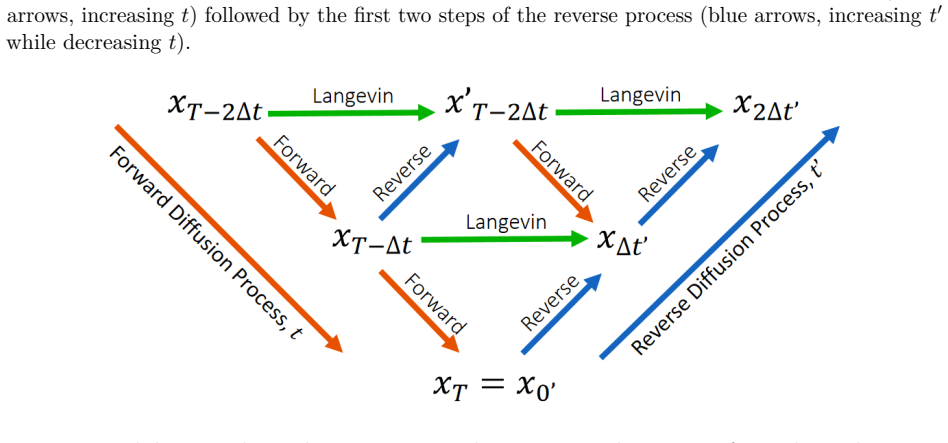
The Langevin perspective unifies diffusion model formulations and gives direct answers to how the reverse process recovers data from noise.
A machine-rendered reading of the paper's core claim, the machinery that carries it, and where it could break.
Core claim
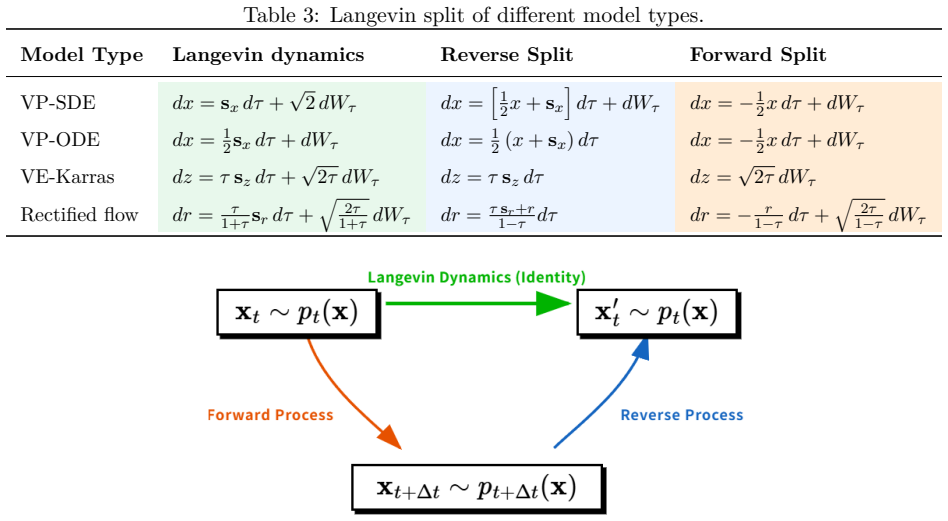
By organizing diffusion models around Langevin dynamics, the forward process of gradually adding noise and the reverse process of denoising become direct consequences of the same stochastic differential equation, allowing every other interpretation (VAE, score matching, flow matching) to be recovered as special cases or equivalent objectives under maximum likelihood.
What carries the argument
Langevin dynamics, the stochastic process that governs the evolution of the data distribution and directly supplies both the forward noising trajectory and its time-reversed denoising counterpart.
If this is right
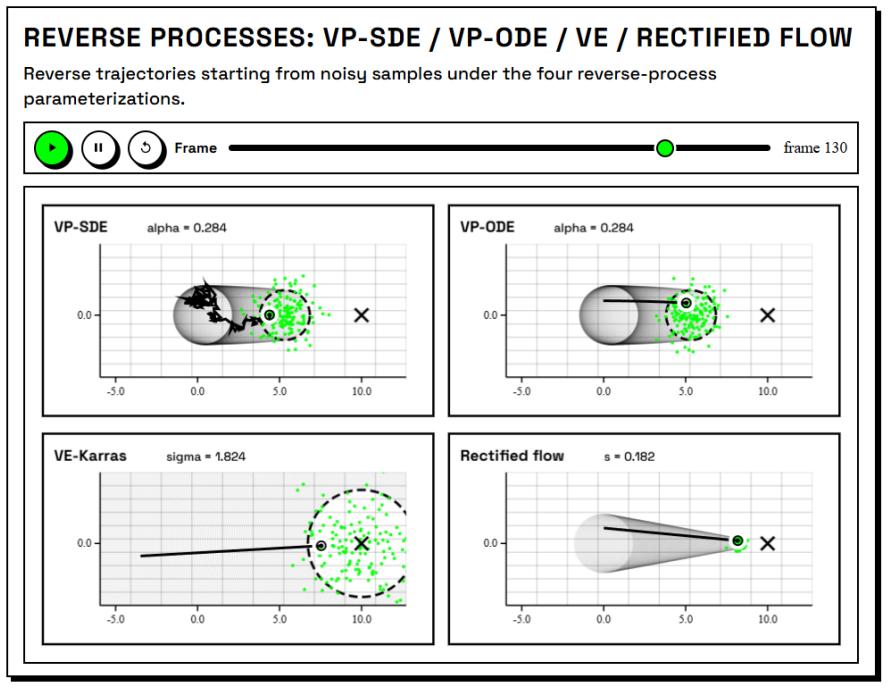
- ODE-based and SDE-based diffusion models become interchangeable within one common stochastic framework.
- Diffusion models possess a theoretical advantage over ordinary VAEs because the Langevin view supplies an explicit reverse process rather than a variational lower bound alone.
- Flow matching is not simpler in principle than score matching or denoising; the three are equivalent once the objective is maximum likelihood.
- Any formulation can be converted into any other by changing the representation of the same underlying Langevin process.
Where Pith is reading between the lines
- Training algorithms could be redesigned by directly discretizing the Langevin steps instead of starting from score or velocity objectives.
- The same perspective might extend naturally to other generative models that rely on stochastic differential equations, such as certain continuous normalizing flows.
- Textbooks and courses on generative modeling could adopt the Langevin ordering to reduce the number of separate mathematical tools introduced.
Load-bearing premise
That framing diffusion models as Langevin dynamics yields simpler derivations and clearer intuition than existing perspectives without creating new technical gaps or extra requirements.
What would settle it
A derivation in which the reverse-process sampling rule obtained from Langevin dynamics fails to match the known denoising score-matching update would show the claimed unification does not hold.
Figures



read the original abstract
Diffusion models are often introduced from multiple perspectives, such as VAEs, score matching, or flow matching, accompanied by dense and technically demanding mathematics that can be difficult for beginners to grasp. One classic question is: how does the reverse process invert the forward process to generate data from pure noise? This article systematically organizes the diffusion model from a fresh Langevin perspective, offering a simpler, clearer, and more intuitive answer. We also address the following questions: how can ODE-based and SDE-based diffusion models be unified under a single framework? Why are diffusion models theoretically superior to ordinary VAEs? Why is flow matching not fundamentally simpler than denoising or score matching, but equivalent under maximum-likelihood? We demonstrate that the Langevin perspective offers clear and straightforward answers to these questions, bridging existing interpretations of diffusion models, showing how different formulations can be converted into one another within a common framework, and offering pedagogical value for both learners and experienced researchers seeking deeper intuition.
Editorial analysis
A structured set of objections, weighed in public.
Referee Report
Summary. The manuscript reinterprets diffusion models through Langevin dynamics to provide a unified, intuitive framework that bridges VAE, score-matching, flow-matching, and ODE/SDE perspectives. It claims to deliver straightforward answers to how the reverse process inverts the forward process, how ODE- and SDE-based models unify, why diffusion models are theoretically superior to ordinary VAEs, and why flow matching is equivalent to denoising/score matching under maximum likelihood, all while emphasizing pedagogical value and conversion between formulations within a common framework.
Significance. If the claimed equivalences and derivations hold, the work supplies useful pedagogical reorganization of existing diffusion-model literature. By framing the material around Langevin dynamics without introducing new technical gaps, it could improve accessibility for learners and offer clearer intuition for researchers, complementing rather than replacing prior perspectives such as score matching.
minor comments (3)
- The abstract states that different formulations 'can be converted into one another within a common framework,' but the manuscript should include an explicit table or diagram (e.g., in §4) mapping each conversion step with the precise assumptions required for each direction.
- Notation for the Langevin drift and diffusion terms should be introduced once with a clear reference to the standard Fokker-Planck equation; subsequent sections reuse symbols without redefinition, which may confuse readers new to the perspective.
- The discussion of maximum-likelihood equivalence for flow matching would benefit from a short self-contained derivation (perhaps an appendix) showing the exact point at which the objective reduces to the denoising score-matching loss.
Simulated Author's Rebuttal
We thank the referee for their positive and accurate summary of our manuscript, which correctly identifies the core contribution of reorganizing diffusion models under a Langevin dynamics perspective to unify ODE/SDE formulations, VAEs, score matching, and flow matching while providing intuitive answers to longstanding questions. We appreciate the recommendation for minor revision and the acknowledgment of the work's pedagogical value.
Circularity Check
No significant circularity identified
full rationale
The paper reinterprets diffusion models using the established Langevin dynamics framework to unify perspectives such as VAEs, score matching, flow matching, and ODE/SDE formulations, while explaining the reverse process inversion. All central claims involve showing mathematical equivalences and conversions within a common framework, which rely on standard stochastic process relations rather than any derivation that reduces to its own inputs by construction. No self-citation load-bearing steps, fitted predictions, or ansatz smuggling are present; the work is explicitly pedagogical and equivalence-based, remaining self-contained against external benchmarks.
Axiom & Free-Parameter Ledger
Reference graph
Works this paper leans on
-
[1]
Brian D. O. Anderson. Reverse-time diffusion equation models.Stochastic Processes and their Applications, 1982. URLhttps://doi.org/10.1016/0304-4149(82)90051-5
-
[2]
Diffusion models and gaussian flow matching: Two sides of the same coin
Ruiqi Gao, Emiel Hoogeboom, Jonathan Heek, Valentin De Bortoli, Kevin Patrick Murphy, and Tim Salimans. Diffusion models and gaussian flow matching: Two sides of the same coin. InThe Fourth Blogpost Track at ICLR 2025, 2025. URL https://openreview.net/forum? id=C8Yyg9wy0s
2025
-
[3]
Denoising Diffusion Probabilistic Models
Jonathan Ho, Ajay Jain, and Pieter Abbeel. Denoising diffusion probabilistic models.arXiv preprint arXiv:2006.11239, 2020. URLhttps://arxiv.org/abs/2006.11239
work page internal anchor Pith review arXiv 2006
-
[4]
Elucidating the Design Space of Diffusion-Based Generative Models
Tero Karras, Miika Aittala, Timo Aila, and Samuli Laine. Elucidating the design space of diffusion-based generative models.arXiv preprint arXiv:2206.00364, 2022. URL https: //arxiv.org/abs/2206.00364
work page internal anchor Pith review arXiv 2022
-
[5]
Sur la théorie du mouvement brownien.Comptes Rendus de l’Académie des Sciences, 146:530–533, 1908
Paul Langevin. Sur la théorie du mouvement brownien.Comptes Rendus de l’Académie des Sciences, 146:530–533, 1908
1908
-
[6]
Flow Straight and Fast: Learning to Generate and Transfer Data with Rectified Flow
Xingchao Liu, Chengyue Gong, and Qiang Liu. Flow straight and fast: Learning to generate and transfer data with rectified flow.arXiv preprint arXiv:2209.03003, 2022. URL https: //arxiv.org/abs/2209.03003
work page internal anchor Pith review Pith/arXiv arXiv 2022
-
[7]
Calvin Luo. Understanding diffusion models: A unified perspective.arXiv preprint arXiv:2208.11970, 2022. URLhttps://arxiv.org/abs/2208.11970
-
[8]
Yang Song and Stefano Ermon. Generative modeling by estimating gradients of the data distribution.Advances in Neural Information Processing Systems, 2019. URL https://arxiv. org/abs/1907.05600
-
[9]
Score-Based Generative Modeling through Stochastic Differential Equations
Yang Song, Jascha Sohl-Dickstein, Diederik P. Kingma, Abhishek Kumar, Stefano Ermon, and Ben Poole. Score-based generative modeling through stochastic differential equations.arXiv preprint arXiv:2011.13456, 2020. URLhttps://arxiv.org/abs/2011.13456
work page internal anchor Pith review Pith/arXiv arXiv 2011
-
[10]
Lanpaint: Training-free diffusion inpainting with asymptotically exact and fast conditional sampling.Transactions on Machine Learning Research,
Candi Zheng, Yuan Lan, and Yang Wang. Lanpaint: Training-free diffusion inpainting with asymptotically exact and fast conditional sampling.Transactions on Machine Learning Research,
-
[11]
URLhttps://openreview.net/forum?id=JPC8JyOUSW. 20
discussion (0)
Sign in with ORCID, Apple, or X to comment. Anyone can read and Pith papers without signing in.