Recognition: unknown
Beyond Compliance: A Resistance-Informed Motivation Reasoning Framework for Challenging Psychological Client Simulation
Pith reviewed 2026-05-10 15:47 UTC · model grok-4.3
The pith
A motivation-reasoning framework creates more realistic resistant client simulators for counselor training.
A machine-rendered reading of the paper's core claim, the machinery that carries it, and where it could break.
Core claim
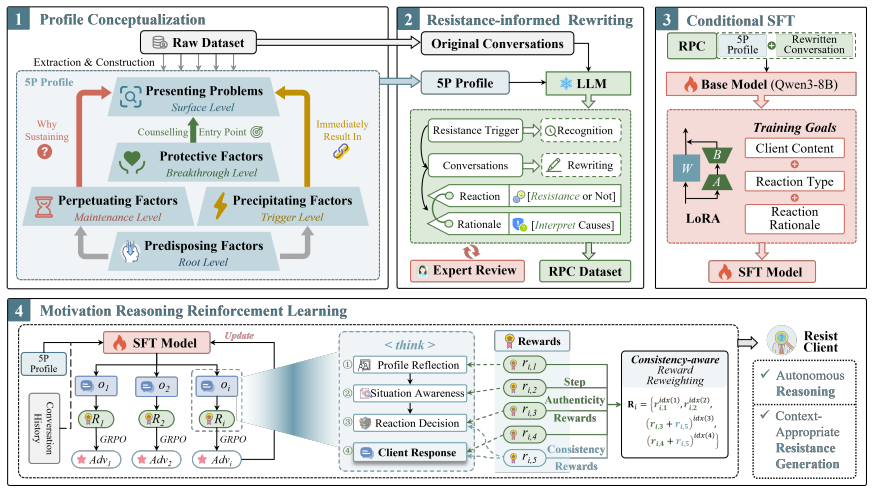
ResistClient models challenging client behaviors by integrating external behaviors with underlying motivational mechanisms using the Resistance-Informed Motivation Reasoning framework. This involves supervised fine-tuning on a large-scale resistance-oriented dataset to reduce compliance bias, followed by process-supervised reinforcement learning that optimizes both motivation authenticity and response consistency. Evaluations demonstrate superior performance in challenge fidelity, behavioral plausibility, and reasoning coherence compared to prior simulators.
What carries the argument
The Resistance-Informed Motivation Reasoning (RIMR) two-stage framework, which first applies supervised fine-tuning on resistance-focused data and then employs process-supervised reinforcement learning to model motivation reasoning prior to response generation.
If this is right
- Counselor trainees become better prepared for real-world resistant client behaviors.
- Psychological LLMs can be evaluated and optimized under more realistic challenging conditions.
- New directions emerge for developing mental health dialogue systems that handle resistance effectively.
- Simulators achieve higher levels of behavioral plausibility and reasoning coherence.
Where Pith is reading between the lines
- This modeling of motivation before action could apply to simulating resistance in non-therapy domains such as customer service or political discourse.
- Direct validation against real therapy session transcripts would provide stronger evidence of generalization than expert ratings alone.
- Insights from the motivation reasoning component might contribute back to psychological theories of client resistance.
Load-bearing premise
Grounding the client simulator in Client Resistance Theory combined with process-supervised reinforcement learning on motivation reasoning will yield psychologically authentic behaviors that extend beyond the training dataset to actual client interactions.
What would settle it
Expert raters failing to find ResistClient dialogues more challenging and plausible than existing simulators, or no measurable improvement in trainee outcomes when using the simulator for practice, would indicate the approach does not achieve its goals.
Figures



read the original abstract
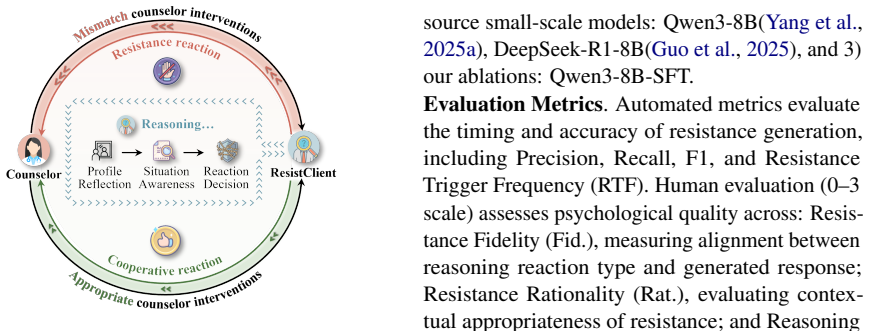
Psychological client simulators have emerged as a scalable solution for training and evaluating counselor trainees and psychological LLMs. Yet existing simulators exhibit unrealistic over-compliance, leaving counselors underprepared for the challenging behaviors common in real-world practice. To bridge this gap, we present ResistClient, which systematically models challenging client behaviors grounded in Client Resistance Theory by integrating external behaviors with underlying motivational mechanisms. To this end, we propose Resistance-Informed Motivation Reasoning (RIMR), a two-stage training framework. First, RIMR mitigates compliance bias via supervised fine-tuning on RPC, a large-scale resistance-oriented psychological conversation dataset covering diverse client profiles. Second, beyond surface-level response imitation, RIMR models psychologically coherent motivation reasoning before response generation, jointly optimizing motivation authenticity and response consistency via process-supervised reinforcement learning. Extensive automatic and expert evaluations show that ResistClient substantially outperforms existing simulators in challenge fidelity, behavioral plausibility, and reasoning coherence. Moreover, ResistClient facilities evaluation of psychological LLMs under challenging conditions, offering new optimization directions for mental health dialogue systems.
Editorial analysis
A structured set of objections, weighed in public.
Referee Report
Summary. The paper introduces ResistClient, a simulator for challenging psychological clients grounded in Client Resistance Theory. It proposes the Resistance-Informed Motivation Reasoning (RIMR) two-stage framework: supervised fine-tuning on the new RPC resistance-oriented dataset to mitigate compliance bias, followed by process-supervised reinforcement learning to jointly optimize motivation authenticity and response consistency before generating responses. The central claim is that ResistClient substantially outperforms existing simulators in challenge fidelity, behavioral plausibility, and reasoning coherence, as demonstrated by automatic and expert evaluations, while also enabling better evaluation of psychological LLMs under challenging conditions.
Significance. If the outperformance claims hold under rigorous scrutiny, this work would meaningfully advance psychological client simulation by addressing the prevalent issue of unrealistic over-compliance in existing tools, thereby better preparing counselors and LLMs for real-world resistant behaviors. The integration of an established external psychological theory with a newly constructed dataset and a process-supervised RL stage for motivation reasoning is a clear strength, providing a principled alternative to pure imitation learning and offering falsifiable directions for improving mental health dialogue systems.
major comments (1)
- Evaluation section: The manuscript asserts substantial outperformance in challenge fidelity, behavioral plausibility, and reasoning coherence via automatic and expert evaluations, yet provides no specifics on the exact metrics employed, the baselines compared against, statistical significance testing, inter-rater reliability for expert judgments, or controls for potential biases introduced by the new RPC dataset and the two-stage training process. This information is load-bearing for the central claim and must be supplied with tables or figures showing quantitative results.
Simulated Author's Rebuttal
We thank the referee for their constructive review and for acknowledging the potential significance of ResistClient and the RIMR framework in addressing compliance bias in psychological client simulation. We address the single major comment below and will revise the manuscript to strengthen the evaluation reporting as requested.
read point-by-point responses
-
Referee: Evaluation section: The manuscript asserts substantial outperformance in challenge fidelity, behavioral plausibility, and reasoning coherence via automatic and expert evaluations, yet provides no specifics on the exact metrics employed, the baselines compared against, statistical significance testing, inter-rater reliability for expert judgments, or controls for potential biases introduced by the new RPC dataset and the two-stage training process. This information is load-bearing for the central claim and must be supplied with tables or figures showing quantitative results.
Authors: We agree that the evaluation section in the submitted manuscript reports the outcomes at a summary level without the granular quantitative details, tables, or figures needed to fully support the central claims. In the revised version, we will expand this section with: (1) explicit definitions and formulas for the metrics (challenge fidelity via resistance behavior checklists, behavioral plausibility via expert Likert-scale ratings, and reasoning coherence via motivation authenticity scores); (2) a table listing all baselines (including standard SFT, RLHF, and prior client simulators) with direct numerical comparisons; (3) results of statistical significance tests (t-tests or Wilcoxon rank-sum with p-values and effect sizes); (4) inter-rater reliability statistics (Cohen's kappa or intraclass correlation coefficients for the expert judgments); and (5) descriptions of bias controls, including dataset ablation experiments, blinded rating protocols, and held-out test set evaluations to isolate effects of the RPC dataset and the two-stage RIMR process. We will also add comparative tables and bar charts visualizing these results. These additions will be placed in a new subsection with supporting figures. revision: yes
Circularity Check
No significant circularity identified
full rationale
The paper's core framework relies on an external psychological theory (Client Resistance Theory) and a newly constructed dataset (RPC) for SFT, followed by process-supervised RL to model motivation reasoning. Outperformance claims are evaluated via independent automatic metrics and expert judgments rather than any self-referential definitions, fitted parameters renamed as predictions, or self-citation chains that reduce the central result to its inputs by construction. The derivation chain remains self-contained against external benchmarks.
Axiom & Free-Parameter Ledger
axioms (1)
- domain assumption Client Resistance Theory provides a valid and operationalizable model for generating challenging client behaviors in simulated psychological conversations
invented entities (2)
-
ResistClient
no independent evidence
-
RIMR
no independent evidence
Reference graph
Works this paper leans on
-
[1]
Yuxin Hu, Danni Liu, Bo Liu, Yida Chen, Jiuxin Cao, and Yan Liu
Large language models for mental health ap- plications: systematic review.JMIR mental health, 11(1):e57400. Yuxin Hu, Danni Liu, Bo Liu, Yida Chen, Jiuxin Cao, and Yan Liu. 2025. Psyadvisor: A plug-and-play strategy advice planner with proactive questioning in psychological conversations. InProceedings of the 63rd Annual Meeting of the Association for Com...
2025
-
[2]
DeepSeek-V3.2: Pushing the Frontier of Open Large Language Models
Supervisorbot: Nlp-annotated real-time rec- ommendations of psychotherapy treatment strategies with deep reinforcement learning. InInternational Joint Conference on Artificial Intelligence. Aixin Liu, Aoxue Mei, Bangcai Lin, Bing Xue, Bingx- uan Wang, Bingzheng Xu, Bochao Wu, Bowei Zhang, Chaofan Lin, Chen Dong, and 1 others. 2025. Deepseek-v3.2: Pushing ...
work page internal anchor Pith review Pith/arXiv arXiv 2025
-
[3]
Large language models are superpositions of all characters: Attaining arbitrary role-play via self- alignment.arXiv preprint arXiv:2401.12474. OpenAI. 2025. Gpt-5.1. https://openai.com/ index/gpt-5-1/. Accessed: 2025-11-12. World Health Organization. 2025.World mental health today: latest data. World Health Organization. Akira Otani. 1989. Client resistan...
-
[4]
InProceedings of the 2025 CHI Conference on Human Factors in Computing Systems, pages 1–22
Scaffolding empathy: Training counselors with simulated patients and utterance-level perfor- mance visualizations. InProceedings of the 2025 CHI Conference on Human Factors in Computing Systems, pages 1–22. Herbert S Strean. 1985.Resolving resistances in psy- chotherapy.Brunner/Mazel. Kimi Team, Yifan Bai, Yiping Bao, Guanduo Chen, Jiahao Chen, Ningxin Ch...
2025
-
[5]
Kimi K2: Open Agentic Intelligence
Kimi k2: Open agentic intelligence.arXiv preprint arXiv:2507.20534. Kuang Wang, Xianfei Li, Shenghao Yang, Li Zhou, Feng Jiang, and Haizhou Li. 2025a. Know you first and be you better: Modeling human-like user sim- ulators via implicit profiles. InProceedings of the 63rd Annual Meeting of the Association for Compu- tational Linguistics (Volume 1: Long Pap...
work page internal anchor Pith review arXiv 2025
-
[6]
Baize: An open-source chat model with parameter-efficient tuning on self-chat data. InPro- ceedings of the 2023 Conference on Empirical Meth- ods in Natural Language Processing, pages 6268– 6278. An Yang, Anfeng Li, Baosong Yang, Beichen Zhang, Binyuan Hui, Bo Zheng, Bowen Yu, Chang Gao, Chengen Huang, Chenxu Lv, and 1 others. 2025a. Qwen3 technical repor...
work page internal anchor Pith review Pith/arXiv arXiv 2023
discussion (0)
Sign in with ORCID, Apple, or X to comment. Anyone can read and Pith papers without signing in.