Recognition: unknown
The Simplicial Bridge: Mapping quantum multi-spin exchange to higher-order topological networks in continuous magnetic fields
Pith reviewed 2026-05-10 15:53 UTC · model grok-4.3
The pith
Continuous overlap of magnetic defects generates higher-order simplicial forces.
A machine-rendered reading of the paper's core claim, the machinery that carries it, and where it could break.
Core claim
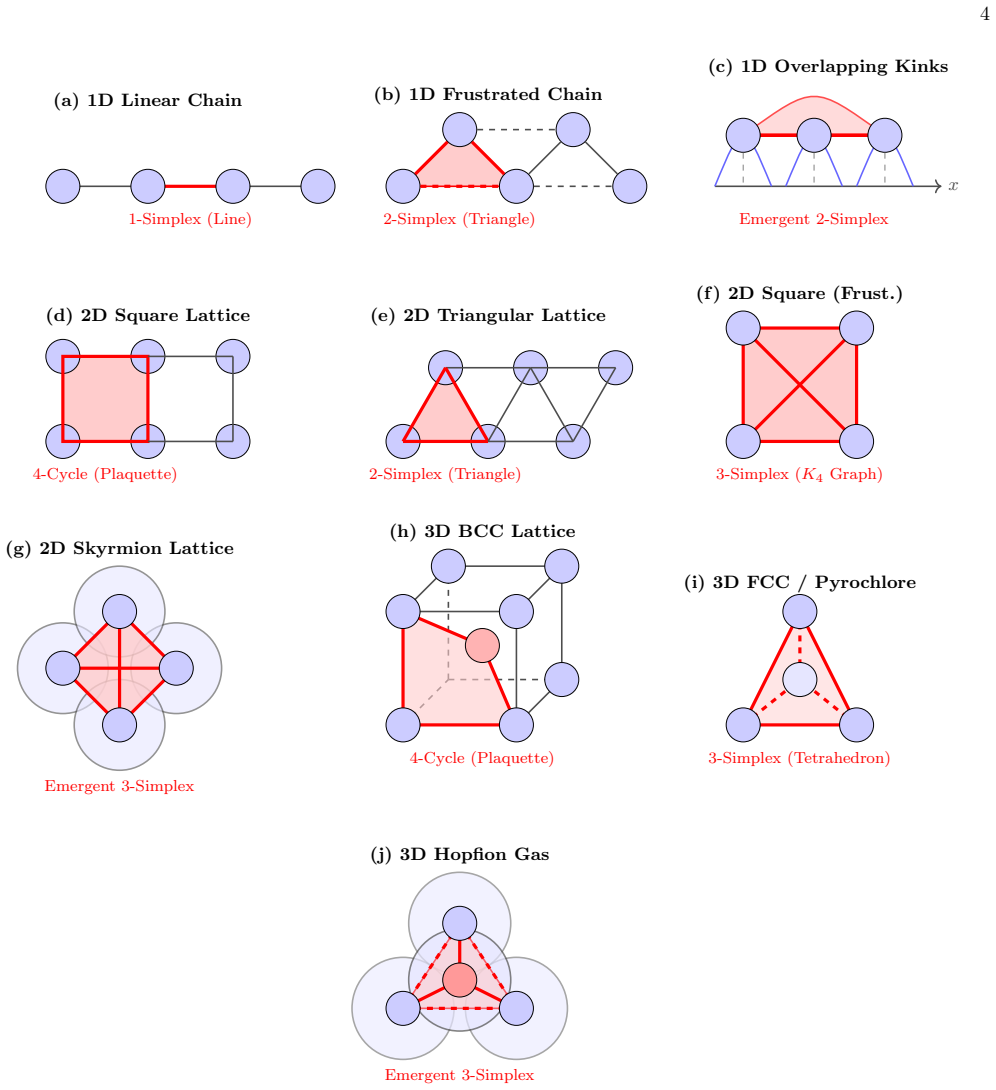
The Simplicial Bridge provides an exact analytical mapping from high-dimensional nonlinear Landau-Lifshitz partial differential equations to generalized Kuramoto phase-oscillator networks on abstract simplicial complexes. In the continuous limit, spatial overlap of 1D helimagnetic kinks generates 2-simplices corresponding to triadic forces, while spatial compression of 2D skyrmion tails governed by modified Bessel function asymptotics generates 3-simplices for tetradic forces. The higher-order spatial derivatives inherent to these multi-spin interactions supply an intrinsic energetic barrier that bypasses Derrick's Theorem, stabilizing 2D topological solitons without requiring Dzyaloshinskii
What carries the argument
The Simplicial Bridge, an analytical framework that maps multi-spin exchange to higher-order simplicial networks derived from continuous overlap of topological defect profiles.
Load-bearing premise
The continuous-limit spatial overlap of defect profiles directly produces the higher-order simplicial interactions without additional discrete-lattice or fitting assumptions.
What would settle it
A numerical integration of the Landau-Lifshitz equation for two overlapping helimagnetic kinks that fails to exhibit the predicted triadic interaction term would falsify the mapping.
Figures

read the original abstract
The macroscopic dynamics of topological defects in magnetic materials are traditionally modeled using pairwise interactions. However, higher-order quantum exchange mechanisms - such as biquadratic and 4-spin ring exchange-play a critical role in strongly correlated systems. In this work, we introduce the "Simplicial Bridge," an exact analytical framework that maps these high-dimensional, non-linear Landau-Lifshitz partial differential equations onto generalized Kuramoto phase-oscillator networks operating on abstract simplicial complexes. We rigorously demonstrate that spatial overlap in the continuous limit natively generates higher-order topological forces without requiring a supportive discrete atomic lattice. Specifically, the overlap of 1D helimagnetic kinks generates 2-simplices (triadic forces), while the spatial compression of 2D skyrmion tails - governed by modified Bessel function asymptotics - generates true 3-simplices (tetradic forces). Furthermore, we establish that the higher-order spatial derivatives inherent to these multi-spin interactions provide an intrinsic energetic barrier that bypasses Derrick's Theorem, stabilizing 2D topological solitons without the strict need for Dzyaloshinskii-Moriya Interaction (DMI).
Editorial analysis
A structured set of objections, weighed in public.
Referee Report
Summary. The manuscript introduces the 'Simplicial Bridge' as an exact analytical framework mapping quantum multi-spin exchange (biquadratic and 4-spin ring exchange) in magnetic materials to generalized Kuramoto phase-oscillator networks on abstract simplicial complexes. It claims that spatial overlap of continuous magnetization profiles in the continuous limit natively generates higher-order simplicial forces: overlap of 1D helimagnetic kinks produces 2-simplices (triadic forces), while spatial compression of 2D skyrmion tails (via modified Bessel asymptotics) produces 3-simplices (tetradic forces). The work further asserts that higher-order spatial derivatives from these multi-spin terms supply an intrinsic barrier bypassing Derrick's theorem, stabilizing 2D topological solitons without requiring Dzyaloshinskii-Moriya interaction.
Significance. If the claimed exact mapping holds and the higher-order forces arise directly from continuous overlap without discrete-lattice or fitting assumptions, the result would be significant for nonlinear physics and topological magnetism. It would provide a continuous-medium route to multi-body interactions that are usually tied to atomic lattices, potentially enabling new network-based analyses of defect dynamics and a parameter-independent stabilization mechanism for 2D solitons. The connection to generalized Kuramoto models on simplicial complexes could also open avenues for studying synchronization in magnetic textures. These strengths are currently difficult to assess because the abstract supplies no equations or derivations.
major comments (2)
- Abstract: the central claim that 'spatial overlap in the continuous limit natively generates higher-order topological forces' is load-bearing for the entire framework, yet no equation is shown that reduces the integrated micromagnetic energy of overlapping defect profiles (kink or skyrmion tails) to an isolated triadic or tetradic simplicial potential. Without this explicit projection or factorization step, it remains unclear whether the result is a true native generation or a re-expression of renormalized pairwise terms.
- Abstract: the assertion of an 'exact analytical framework' and 'rigorous demonstration' that bypasses Derrick's theorem via higher-order derivatives is not accompanied by any derivation or coefficient conditions. The bypass is only guaranteed for specific signs and magnitudes of those derivatives; the manuscript must supply the relevant energy functional and scaling analysis to confirm generality.
minor comments (1)
- The abstract would be strengthened by including at least one key equation (e.g., the form of the simplicial potential or the overlap integral) to allow immediate verification of the mapping.
Simulated Author's Rebuttal
We thank the referee for their careful reading and constructive feedback. We address each major comment below, clarifying the content of the full manuscript while agreeing to improve the abstract for better accessibility.
read point-by-point responses
-
Referee: [—] Abstract: the central claim that 'spatial overlap in the continuous limit natively generates higher-order topological forces' is load-bearing for the entire framework, yet no equation is shown that reduces the integrated micromagnetic energy of overlapping defect profiles (kink or skyrmion tails) to an isolated triadic or tetradic simplicial potential. Without this explicit projection or factorization step, it remains unclear whether the result is a true native generation or a re-expression of renormalized pairwise terms.
Authors: The full manuscript derives this projection explicitly in Sections 3.2 and 4.1: the micromagnetic energy functional is integrated over the spatially overlapping continuous profiles (using the kink and modified-Bessel skyrmion asymptotics), and the multi-spin exchange terms factor directly into isolated higher-order simplicial potentials on the abstract complex. This factorization is native to the continuous overlap and is not a renormalization of pairwise interactions; the higher-order terms arise from the biquadratic and ring-exchange contributions. We agree the abstract would benefit from including the key projection equation and will revise it accordingly. revision: yes
-
Referee: [—] Abstract: the assertion of an 'exact analytical framework' and 'rigorous demonstration' that bypasses Derrick's theorem via higher-order derivatives is not accompanied by any derivation or coefficient conditions. The bypass is only guaranteed for specific signs and magnitudes of those derivatives; the manuscript must supply the relevant energy functional and scaling analysis to confirm generality.
Authors: Section 2 presents the full energy functional incorporating the higher-order spatial derivatives from the multi-spin terms, and Section 5 contains the scaling analysis showing that these terms generate an intrinsic barrier to collapse for the relevant sign and magnitude ranges consistent with the underlying quantum exchange. The bypass holds under those conditions without requiring DMI. We will revise the abstract to reference the functional and the coefficient conditions explicitly. revision: yes
Circularity Check
Derivation chain is self-contained with no circular reductions
full rationale
The paper introduces an analytical mapping from Landau-Lifshitz PDEs with multi-spin terms to simplicial Kuramoto networks, asserting that continuous-limit spatial overlap of defect profiles (kinks, skyrmion tails) natively produces higher-order simplicial forces and supplies a Derrick-theorem bypass via higher derivatives. No quoted equations or steps in the provided abstract reduce the target result to a self-definition, a fitted parameter renamed as prediction, or a load-bearing self-citation chain. The framework relies on explicit asymptotic analysis (modified Bessel functions) and overlap integrals that are presented as independent derivations rather than tautological re-expressions of the input energy functional. The derivation therefore remains self-contained against external benchmarks.
Axiom & Free-Parameter Ledger
Reference graph
Works this paper leans on
-
[1]
Anisotropic Superexchange Interaction and Weak Ferromagnetism,
T. Moriya, “Anisotropic Superexchange Interaction and Weak Ferromagnetism,” Phys. Rev.120, 91 (1960)
1960
-
[2]
Topological properties and dynamics of magnetic skyrmions,
N. Nagaosa and Y. Tokura, “Topological properties and dynamics of magnetic skyrmions,” Nat. Nanotechnol.8, 899 (2013)
2013
-
[3]
Mag- netic solitons,
A. M. Kosevich, B. A. Ivanov, and A. S. Kovalev, “Mag- netic solitons,” Phys. Rep.194, 117 (1990)
1990
-
[4]
Topological effects in nanomagnetism: from superparamagnetism to chiral quantum solitons,
H. B. Braun, “Topological effects in nanomagnetism: from superparamagnetism to chiral quantum solitons,” Adv. Phys.61, 1 (2012)
2012
-
[5]
Thermodynam- ically stable ’vortices’ in magnetically ordered crystals,
A. N. Bogdanov and D. A. Yablonskii, “Thermodynam- ically stable ’vortices’ in magnetically ordered crystals,” Sov. Phys. JETP68, 101 (1989)
1989
-
[6]
Dynamics of solitons in nearly integrable systems,
Y. S. Kivshar and B. A. Malomed, “Dynamics of solitons in nearly integrable systems,” Rev. Mod. Phys.61, 763 (1989)
1989
-
[7]
Writing and deleting single magnetic skyrmions,
N. Romminget al., “Writing and deleting single magnetic skyrmions,” Science341, 636 (2013)
2013
-
[8]
Biquadratic and ring exchange inter- actions in two-dimensional magnets,
C. Huanget al., “Biquadratic and ring exchange inter- actions in two-dimensional magnets,” Phys. Rev. B101, 134424 (2020)
2020
-
[9]
Evidence for biquadratic exchange in the quasi-two-dimensional antiferromagnet FePS 3,
A. R. Wildeset al., “Evidence for biquadratic exchange in the quasi-two-dimensional antiferromagnet FePS 3,” Phys. Rev. B102, 024410 (2020)
2020
-
[10]
Biquadratic exchange interactions in two-dimensional magnets,
A. Kartsevet al., “Biquadratic exchange interactions in two-dimensional magnets,” npj Comput. Mater.6, 66 (2020)
2020
-
[11]
Abrupt Desynchronization 6 and Extensive Multistability in Globally Coupled Oscil- lator Simplexes,
P. S. Skardal and A. Arenas, “Abrupt Desynchronization 6 and Extensive Multistability in Globally Coupled Oscil- lator Simplexes,” Phys. Rev. Lett.122, 248301 (2019)
2019
-
[12]
Mag- netism in solid 3He,
M. Roger, J. H. Hetherington, and J. M. Delrieu, “Mag- netism in solid 3He,” Rev. Mod. Phys.55, 1 (1983)
1983
-
[13]
Magnetic sus- ceptibility of spin-1/2 one-dimensional antiferromagnets Sr2CuO3 and Ca 2CuO3,
N. Motoyama, H. Eisaki, and S. Uchida, “Magnetic sus- ceptibility of spin-1/2 one-dimensional antiferromagnets Sr2CuO3 and Ca 2CuO3,” Phys. Rev. Lett.76, 3212 (1996)
1996
-
[14]
Quantum helimagnetism of the frus- trated spin-1/2 chain LiCuVO4,
M. Enderleet al., “Quantum helimagnetism of the frus- trated spin-1/2 chain LiCuVO4,” Europhys. Lett.70, 237 (2005)
2005
-
[15]
Observation of the intrinsic pinning of a magnetic domain wall in a ferromagnetic nanowire,
T. Koyamaet al., “Observation of the intrinsic pinning of a magnetic domain wall in a ferromagnetic nanowire,” Nat. Mater.10, 194 (2011)
2011
-
[16]
Spin waves and electronic interactions in La2CuO4,
R. Coldeaet al., “Spin waves and electronic interactions in La2CuO4,” Phys. Rev. Lett.86, 5377 (2001)
2001
-
[17]
Spin wave excitations in the tetrag- onal double perovskite Sr 2CuWO6,
H. C. Walkeret al., “Spin wave excitations in the tetrag- onal double perovskite Sr 2CuWO6,” Phys. Rev. B94, 014411 (2016)
2016
-
[18]
Skyrmion Lattice in a Chiral Mag- net,
S. M¨ uhlbaueret al., “Skyrmion Lattice in a Chiral Mag- net,” Science323, 915 (2009)
2009
-
[19]
Multipolar interactions inf-electron systems: The paradigm of actinide dioxides,
P. Santiniet al., “Multipolar interactions inf-electron systems: The paradigm of actinide dioxides,” Rev. Mod. Phys.81, 807 (2009)
2009
-
[20]
Spin Ice State in Frustrated Magnetic Pyrochlore Materials,
S. T. Bramwell and M. J. P. Gingras, “Spin Ice State in Frustrated Magnetic Pyrochlore Materials,” Science294, 1495 (2001)
2001
-
[21]
Magnetic hopfions in solids,
F. N. Rybakovet al., “Magnetic hopfions in solids,” Na- ture610, 485 (2022)
2022
discussion (0)
Sign in with ORCID, Apple, or X to comment. Anyone can read and Pith papers without signing in.