Recognition: no theorem link
Maximum Independent Sets in Disk Graphs with Disks in Convex Position
Pith reviewed 2026-05-10 15:45 UTC · model grok-4.3
The pith
When all disks lie on the convex hull, an O(n^3 log n)-time algorithm solves the maximum weighted independent set problem in their intersection graph.
A machine-rendered reading of the paper's core claim, the machinery that carries it, and where it could break.
Core claim
For any set of n disks whose boundaries all appear on the convex hull of the union, there exists an O(n^3 log n)-time algorithm that returns a maximum-weight subset of pairwise non-intersecting disks. The algorithm also solves the unweighted case and improves the prior O(n^{37/11}) bound known for equal-radius disks.
What carries the argument
The cyclic ordering of the disks around the convex hull, which permits a dynamic-programming recurrence that considers intervals of consecutive disks on the boundary.
Load-bearing premise
The disks must all touch the convex hull so that they possess a well-defined cyclic order without interior disks.
What would settle it
A concrete set of n disks in convex position together with a larger-weight independent set than the one returned by the algorithm.
Figures




read the original abstract
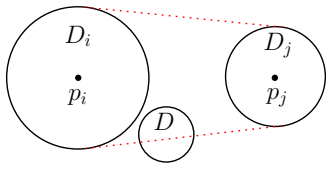
For a set $\mathcal{D}$ of disks in the plane, its disk graph $G(\mathcal{D})$ is the graph with vertex set $\mathcal{D}$, where two vertices are adjacent if and only if the corresponding disks intersect. Given a set $\mathcal{D}$ of $n$ weighted disks, computing a maximum independent set of $G(\mathcal{D})$ is NP-hard. In this paper, we present an $O(n^3\log n)$-time algorithm for this problem in a special setting in which the disks are in convex position, meaning that every disk appears on the convex hull of $\mathcal{D}$. This setting has been studied previously for disks of equal radius, for which an $O(n^{37/11})$-time algorithm was known. Our algorithm also works in the weighted case where disks have weights and the goal is to compute a maximum-weight independent set. As an application of our result, we obtain an $O(n^3\log^2 n)$-time algorithm for the dispersion problem on a set of $n$ disks in convex position: given an integer $k$, compute a subset of $k$ disks that maximizes the minimum pairwise distance among all disks in the subset.
Editorial analysis
A structured set of objections, weighed in public.
Referee Report
Summary. The paper presents an O(n^3 log n)-time algorithm for computing a maximum-weight independent set in the intersection graph of n disks whose boundaries all touch the convex hull of their union (i.e., disks in convex position). This improves on the prior O(n^{37/11}) bound known for the equal-radius special case. The same approach yields an O(n^3 log^2 n)-time algorithm for the k-dispersion problem on such disks.
Significance. If correct, the result is significant because it supplies a polynomial-time algorithm for a geometrically restricted but still NP-hard problem by exploiting the cyclic ordering induced by convex position. The extension to the weighted setting and the concrete application to dispersion are useful additions. The runtime improvement over the equal-radius literature is substantial and the DP-based approach appears to be a natural fit for the cyclic structure.
minor comments (3)
- [3] §3 (Algorithm): the recurrence and state definition are clear, but the precise origin of the log n factor in the transition time (priority queue or binary search over candidate boundary disks) would benefit from an explicit sentence or small example.
- [2] Figure 2: the illustration of the cyclic ordering and the 'active arc' maintained by the DP would be easier to follow if the disks were labeled with their indices in the hull order.
- [4] Theorem 1: the statement of the running time is correct, but the proof sketch in the text could explicitly cite the O(n) subproblems per layer and the O(n^2 log n) work per layer to make the cubic bound immediate.
Simulated Author's Rebuttal
We thank the referee for the positive summary and significance assessment of our paper, as well as the recommendation for minor revision. The referee's description of the O(n^3 log n) algorithm for maximum-weight independent set and the O(n^3 log^2 n) result for k-dispersion on disks in convex position accurately reflects the manuscript.
Circularity Check
No significant circularity detected
full rationale
The paper presents a direct algorithmic construction of an O(n^3 log n)-time dynamic programming procedure that exploits the cyclic ordering induced by convex position of the disks. No equations, fitted parameters, or predictions appear; the runtime and correctness claims follow from the recurrence structure on contiguous arcs rather than any reduction to prior fitted quantities or self-citations. The improvement over the equal-radius bound is presented as a consequence of the added convex-position structure, not as a renaming or self-referential derivation. The result is self-contained against external benchmarks.
Axiom & Free-Parameter Ledger
axioms (1)
- domain assumption Disks are in convex position (every disk lies on the convex hull of the set)
Reference graph
Works this paper leans on
-
[1]
Pankaj K. Agarwal and Nabil H. Mustafa. Independent set of intersection graphs of convex objects in 2D.Computational Geometry: Theory and Applications, 34(2):83–95, 2006.doi: 10.1016/j.comgeo.2005.12.001. 1, 2
-
[2]
Pankaj K. Agarwal, Mark H. Overmars, and Micha Sharir. Computing maximally separated sets in the plane.SIAM Journal on Computing, 36(3):815–834, 2006.doi:10.1137/S0097539704446591. 3
-
[3]
Pankaj K. Agarwal, Marc J. van Kreveld, and Subhash Suri. Label placement by maximum independent set in rectangles.Computational Geometry: Theory and Applications, 11:209–218, 1998.doi:10.1016/S0925-7721(98)00028-5. 2
-
[4]
Guibas, James Saxe, and Peter W
Alok Aggarwal, Leonidas J. Guibas, James Saxe, and Peter W. Shor. A linear-time algorithm for computing the Voronoi diagram of a convex polygon.Discrete and Computational Geometry, 4:591–604, 1989.doi:10.1007/BF02187749. 3
-
[5]
Atallah, and Susanne E
Alberto Apostolico, Mikhail J. Atallah, and Susanne E. Hambrusch. New clique and independent set algorithms for circle graphs.Discrete Applied Mathematics, 36(1):1–24, 1992.doi:10.1016/ 0166-218X(92)90200-T. 1, 2
1992
-
[6]
Paul Balister, Béla Bollobás, Amites Sarkar, and Mark Walters. Connectivity of random k- nearest-neighbour graphs.Advances in Applied Probability, 37(1):1–24, 2005.doi:doi:10.1239/ aap/1113402397. 1
-
[7]
Bodlaender, Corinne Feremans, Alexander Grigoriev, Eelko Penninkx, Ren´ e Sitters, and Thomas Wolle
Prosenjit Bose, Paz Carmi, J Mark Keil, Anil Maheshwari, Saeed Mehrabi, Debajyoti Mondal, and Michiel Smid. Computing maximum independent set on outerstring graphs and their relatives. Computational Geometry: Theory and Applications, 103:101852, 2022.doi:10.1016/j.comgeo. 2021.101852. 1 20
-
[8]
Maximum clique of disks in convex position
Onur Çağı rıcıand Bodhayan Roy. Maximum clique of disks in convex position. InAbstracts of Computational Geometry: Young Researchers Forum (CG:YRF), pages 21:1–21:3, 2018. URL: https://www.computational-geometry.org/old/YRF/cgyrf2018.pdf. 3
2018
-
[9]
Timothy M. Chan. Approximation algorithms for maximum independent set of pseudo-disks. Discrete and Computational Geometry, 48:373–392, 2012.doi:10.1007/s00454-012-9417-5. 2
-
[10]
Improved bounds on weakϵ-nets for convex sets
Bernard Chazelle, Herbert Edelsbrunner, Michelangelo Grigni, Leonidas Guibas, Micha Sharir, and Emo Welzl. Improved bounds on weakϵ-nets for convex sets. InProceedings of the 25th Annual ACM Symposium on Theory of Computing (STOC), pages 495–504, 1993.doi:10.1145/ 167088.167222. 3
-
[11]
Efficientk-center algorithms for planar points in convex position
Jongmin Choi, Jaegun Lee, and Hee-Kap Ahn. Efficientk-center algorithms for planar points in convex position. InProceedings of the 18th Algorithms and Data Structures Symposium (WADS), pages 262–274, 2023.doi:10.1007/978-3-031-38906-1_18. 3
-
[12]
Brent N. Clark, Charles J. Colbourn, and David S. Johnson. Unit disk graphs.Discrete Mathe- matics, 86:165–177, 1990.doi:10.1016/0012-365X(90)90358-O. 1, 2
-
[13]
Das, Guilherme D
Gautam K. Das, Guilherme D. da Fonseca, and Ramesh K. Jallu. Efficient independent set approximation in unit disk graphs.Discrete Applied Mathematics, 280:63–70, 2020.doi:10. 1016/j.dam.2018.05.049. 2
2020
-
[14]
Das, Minati De, Sudeshna Kolay, Subhas C
Gautam K. Das, Minati De, Sudeshna Kolay, Subhas C. Nandy, and Susmita Sur-Kolay. Approx- imation algorithms for maximum independent set of a unit disk graph.Information Processing Letters, 115:439–446, 2015.doi:10.1016/j.ipl.2014.11.002. 2
-
[15]
Trapezoid graphs and generalizations, geometry and algorithms.Discrete Applied Mathematics, 74(1):13–32, 1997.doi:10.1016/ S0166-218X(96)00013-3
Stefan Felsner, Rudolf Müller, and Lorenz Wernisch. Trapezoid graphs and generalizations, geometry and algorithms.Discrete Applied Mathematics, 74(1):13–32, 1997.doi:10.1016/ S0166-218X(96)00013-3. 1
1997
-
[16]
Fănică Gavril. Algorithms for minimum coloring, maximum clique, minimum covering by cliques, and maximum independent set of a chordal graph.SIAM Journal on Computing, 1(2):180–187, 1972.doi:10.1137/0201013. 1
-
[17]
Fănică Gavril. Algorithms for a maximum clique and a maximum independent set of a circle graph.Networks, 3(3):261–273, 1973.doi:10.1002/net.3230030305. 1
-
[18]
Herrera and Pablo Pérez-Lantero
Luis H. Herrera and Pablo Pérez-Lantero. On the intersection graph of the disks with diameters the sides of a convexn-gon.Applied Mathematics and Computation, 411:126472, 2021.doi: 10.1016/j.amc.2021.126472. 3
-
[19]
Almost color-balanced perfect matchings in color-balanced complete graphs
Clemens Huemer and Pablo Pérez-Lantero. The intersection graph of the disks with diameters the sides of a convex n-gon.Discrete Mathematics, 343(2):111669, 2020.doi:10.1016/j.disc. 2019.111669. 3
-
[20]
Richard M. Karp. Reducibility among combinatorial problems.Complexity of Computer Compu- tations, pages 85–103, 1972.doi:10.1007/978-1-4684-2001-2_9. 1
-
[21]
Andrzej Lingas. On approximation behavior and implementation of the greedy triangulation for convex planar point sets. InProceedings of the 2nd Annual Symposium on Computational Geometry (SoCG), pages 72–79, 1986.doi:10.1145/10515.10523. 3 21
-
[22]
Marathe, Heinz Breu, Harry B
Madhav V. Marathe, Heinz Breu, Harry B. Hunt III, Sekharipuram S. Ravi, and Daniel J. Rosenkrantz. Simple heuristics for unit disk graphs.Networks, 25:59–68, 1995.doi:10.1002/ net.3230250205. 2
1995
-
[23]
Approximation algorithms for maximum independent set problems and frac- tional coloring problems on unit disk graphs
Tomomi Matsui. Approximation algorithms for maximum independent set problems and frac- tional coloring problems on unit disk graphs. InProceedings of the 2nd Japanese Confer- ence on Discrete and Computational Geometry (JCDCG), pages 194–200, 1998.doi:10.1007/ 978-3-540-46515-7_16. 2
1998
-
[24]
Charles E. Perkins and Pravin Bhagwat. Highly dynamic destination-sequenced distance-vector routing (dsdv) for mobile computers. InProceedings of the Conference on Communications Archi- tectures, Protocols and Applications (SIGCOMM), pages 234–244, 1994.doi:10.1145/190809. 190336. 1
-
[25]
Ad-hocon-demanddistancevectorrouting
CharlesE.PerkinsandPravinBhagwat. Ad-hocon-demanddistancevectorrouting. InProceedings of the 2nd IEEE Workshop on Mobile Computing Systems and Applications (WMCSA), pages 90– 100, 1999.doi:10.1109/MCSA.1999.749281. 1
-
[26]
David Rappaport. A convex hull algorithm for discs, and applications.Computational Geometry: Theory and Applications, 1(3):171–187, 1992.doi:10.1016/0925-7721(92)90015-K. 16, 19
-
[27]
Dana S. Richards and Jeffrey S. Salowe. A rectilinear steiner minimal tree algorithm for convex point sets. InProceedings of the 2nd Scandinavian Workshop on Algorithm Theory (SWAT), pages 201–212, 1990.doi:10.1007/3-540-52846-6_90. 3
-
[28]
Polynomial-time recognition and maximum independent set in burling graphs
Paweł Rzążewski and Bartosz Walczak. Polynomial-time recognition and maximum independent set in burling graphs. InProceedings of the International Workshop on Graph-Theoretic Concepts in Computer Science (WG), pages 445–460, 2026.doi:10.1007/978-3-032-11835-6_32. 1
-
[29]
Micha Sharir. Intersection and closest-pair problems for a set of planar discs.SIAM Journal on Computing, 14(2):448–468, 1985.doi:10.1137/0214034. 4, 5, 8, 10, 12
-
[30]
Singireddy, Manjanna Basappa, and Joseph S.B
Vishwanath R. Singireddy, Manjanna Basappa, and Joseph S.B. Mitchell. Algorithms fork- dispersion for points in convex position in the plane. InProceedings of the 9th International Conference on Algorithms and Discrete Applied Mathematics (CALDAM), pages 59–70, 2023. doi:10.1007/978-3-031-25211-2_5. 2, 3
-
[31]
Computing dominating sets in disk graphs with centers in convex position
Anastasiia Tkachenko and Haitao Wang. Computing dominating sets in disk graphs with centers in convex position. InProceedings of the 17th Latin American Theoretical Informatics Symposium (LATIN), page to appear, 2025.doi:10.48550/arXiv.2601.22609. 3
-
[32]
Computing maximum cliques in unit disk graphs
Anastasiia Tkachenko and Haitao Wang. Computing maximum cliques in unit disk graphs. In Proceedings of the 37th Canadian Conference on Computational Geometry (CCCG), pages 283– 291, 2025. URL:https://cccg-wads-2025.eecs.yorku.ca/cccg-papers/6B2.pdf. 3
2025
-
[33]
Anastasiia Tkachenko and Haitao Wang. Dominating set, independent set, discretek-center, dispersion, and related problems for planar points in convex position. InProceedings of the 42nd International Symposium on Theoretical Aspects of Computer Science (STACS), pages 73:1–73:20, 2025.doi:10.4230/LIPIcs.STACS.2025.73. 2, 3
-
[34]
Da-Wei Wang and Yue-Sun Kuo. A study on two geometric location problems.Information processing letters, 28(6):281–286, 1988.doi:10.1016/0020-0190(88)90174-3. 3 22
discussion (0)
Sign in with ORCID, Apple, or X to comment. Anyone can read and Pith papers without signing in.