Recognition: unknown
Sensitivity of Neutron Star Observables to Transition Density in Hybrid Equation-of-State Models
Pith reviewed 2026-05-10 16:32 UTC · model grok-4.3
The pith
The standard transition density of about twice nuclear saturation leaves neutron star radii and tidal deformabilities dependent on the low-density equation of state.
A machine-rendered reading of the paper's core claim, the machinery that carries it, and where it could break.
Core claim
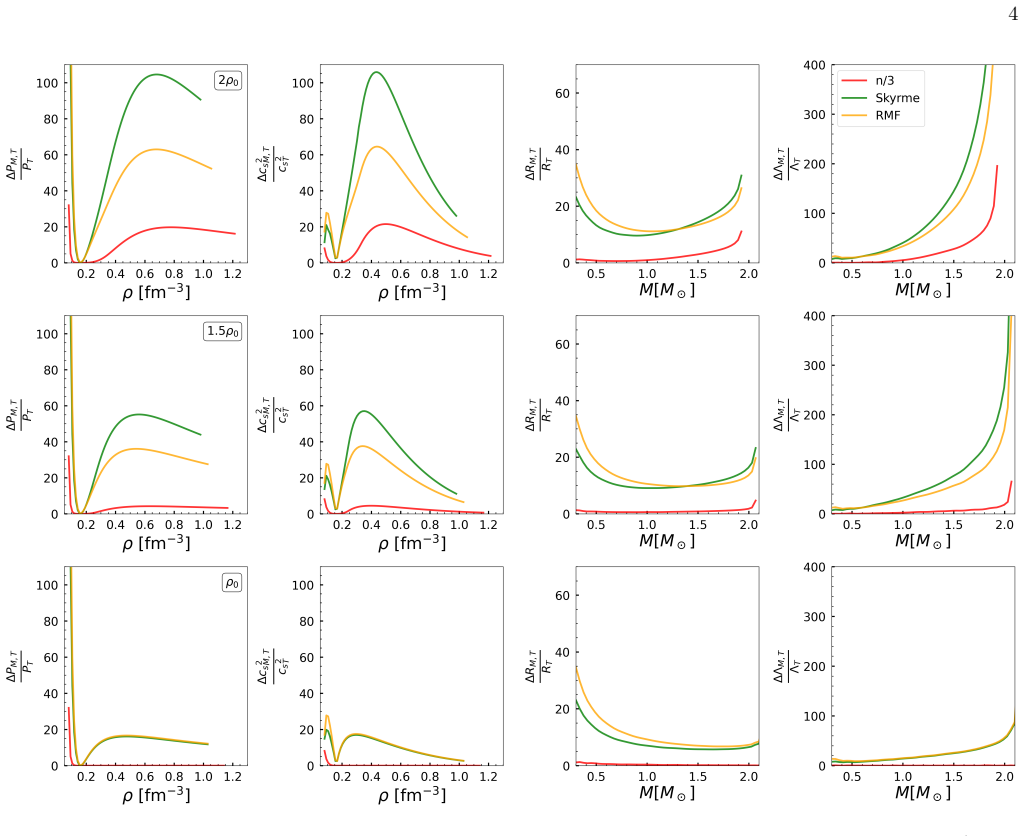
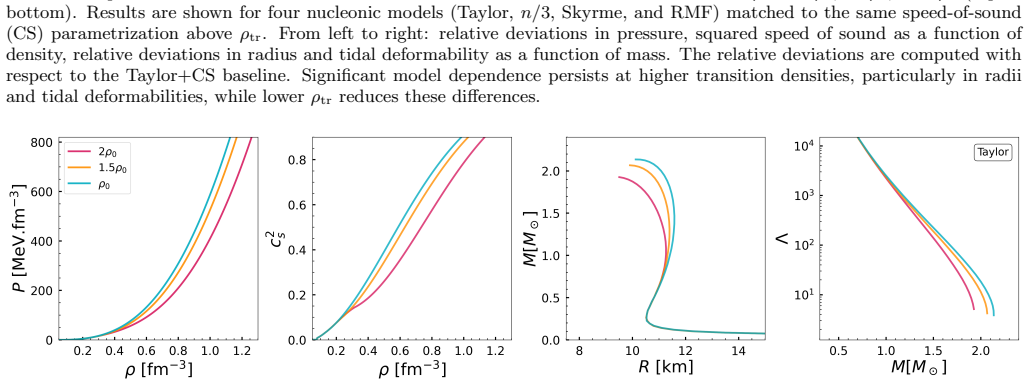
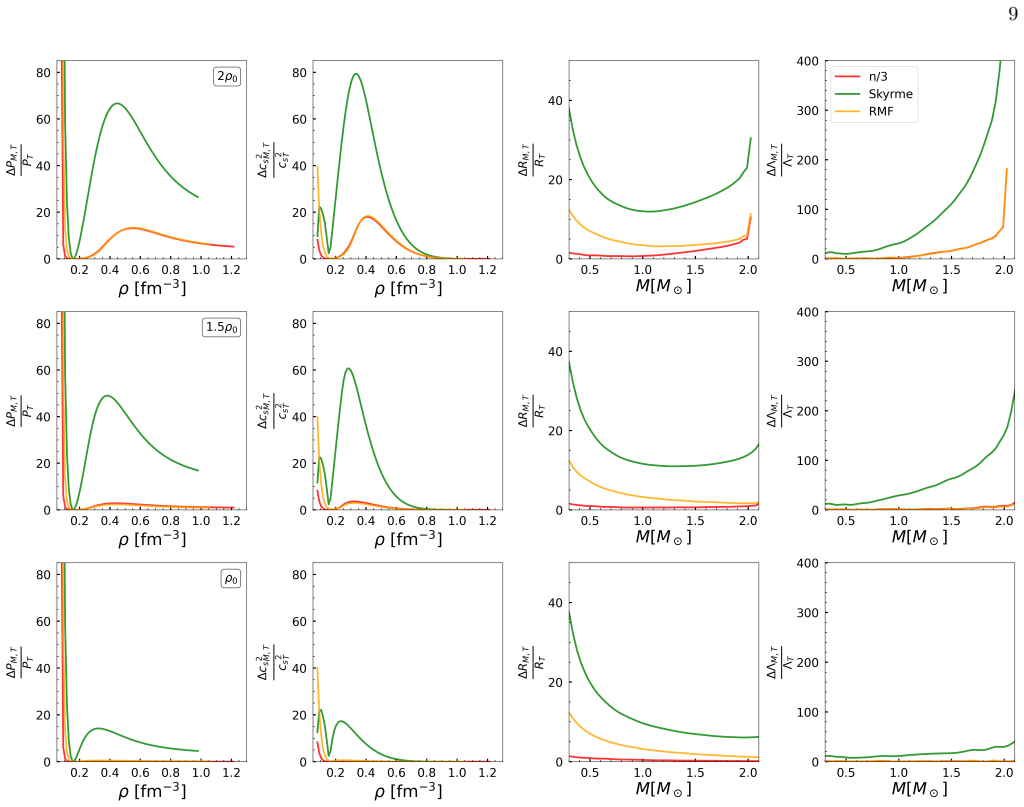
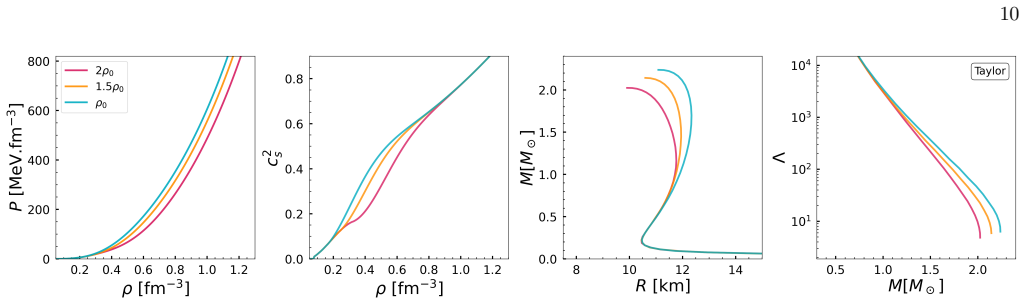
When four representative nucleonic equations of state are matched smoothly at a transition density ρ_tr ≈ 2ρ₀ to the same high-density speed-of-sound extension, the resulting hybrid models produce neutron star radii and tidal deformabilities that differ by amounts larger than current observational errors. This occurs because variations in the matching conditions at ρ_tr lead to different effective high-density behaviors. The spread shrinks substantially when the transition is placed at ρ_tr = ρ₀ instead.
What carries the argument
The smooth-matching prescription at the transition density ρ_tr, which fixes the starting pressure, energy density, and their derivatives for the high-density speed-of-sound parametrization from the low-density nucleonic input.
If this is right
- At ρ_tr ≈ 2ρ₀ the model spread in radius at 1.4 solar masses exceeds current observational uncertainty by a factor of about 1.8.
- At ρ_tr ≈ 2ρ₀ the model spread in tidal deformability at 1.4 solar masses exceeds current observational uncertainty by a factor of about 1.4.
- Lowering ρ_tr to saturation density reduces the radius spread factor to about 1.05 and the tidal deformability spread factor to about 0.4.
- The choice of transition density must be treated as an explicit systematic uncertainty when using neutron-star observations to constrain dense matter.
Where Pith is reading between the lines
- Bayesian inferences that fix the transition density near 2ρ₀ may systematically understate the uncertainty coming from the low-density nuclear sector.
- Alternative matching schemes that do not rely on smooth continuity at a single density could further reduce the residual model dependence.
- Higher-precision radius or tidal measurements could be used to test whether an optimal transition density exists that truly decouples low- and high-density regimes.
Load-bearing premise
That any differences among the low-density nucleonic models affect neutron-star structure only through the values they supply at the transition density and produce no further model-specific effects at higher densities.
What would settle it
A calculation showing that, for fixed speed-of-sound parameters, matching different nucleonic models at ρ_tr ≈ 2ρ₀ yields identical pressure-density relations above ρ_tr and therefore identical neutron-star radii and tidal deformabilities.
Figures

read the original abstract
We investigate how the transition density \(\rho_{tr}\) affects hybrid constructions of the neutron-star equation of state (EoS) in which a nucleonic description at low densities is matched to a model-agnostic high-density extension based on a speed-of-sound parametrization. Using four representative nucleonic models--Taylor expansion, \(\frac{n}{3}\) expansion, Skyrme, and relativistic mean-field--built from identical nuclear matter parameters, we isolate the impact of the low-density EoS and the transition density on neutron star observables. We find that, within the present smooth-matching prescription, neutron star properties such as radii and tidal deformabilities retain significant sensitivity to the choice of low-density EoS for commonly adopted transition densities around \(\rho_{tr} \approx 2\rho_0\), even when the same high-density parametrization is employed. This residual dependence arises from differences in the matching conditions at \(\rho_{tr}\), which propagate into the high-density extension, so different low-density inputs lead to different effective high-density EoSs. These findings are robust across two distinct speed-of-sound parametrizations. Quantitatively, the model spread in radius and tidal deformability at $1.4\,M_\odot$ exceeds the current observational uncertainty by factors of $\sim 1.8$ and $\sim 1.4$ at $\rho_{\mathrm{tr}} \approx 2\rho_0$, whereas these factors reduce to $\sim 1.05$ and $\sim 0.4$ at $\rho_{\mathrm{tr}} = \rho_0$. Lowering the transition density, therefore, systematically diminishes the spread among models and leads to more consistent predictions. Our results demonstrate that the widely used choice \(\rho_{tr} \approx 2\rho_0\) does not guarantee model independence in hybrid EoS constructions, and should be treated as an explicit source of systematic uncertainty when inferring dense matter properties from neutron star observations.
Editorial analysis
A structured set of objections, weighed in public.
Referee Report
Summary. The paper performs a controlled numerical sensitivity study of hybrid neutron-star equations of state. Four nucleonic models (Taylor expansion, n/3 expansion, Skyrme, and relativistic mean-field) are constructed from identical nuclear-matter parameters and smoothly matched at a variable transition density ρ_tr to two distinct speed-of-sound parametrizations for the high-density regime. The resulting spreads in radius R_{1.4} and tidal deformability Λ_{1.4} are compared to current observational uncertainties, showing that the spread at ρ_tr ≈ 2ρ_0 exceeds those uncertainties by factors of ~1.8 and ~1.4 while the factors drop to ~1.05 and ~0.4 at ρ_tr = ρ_0.
Significance. If the numerical results hold, the work supplies a concrete, reproducible quantification of residual model dependence arising from the low-density EoS choice and the smooth-matching conditions at ρ_tr. The use of four representative nucleonic models built from the same nuclear-matter parameters, together with two independent high-density parametrizations, isolates the effect of the junction values of energy density and pressure. This directly supports the claim that ρ_tr ≈ 2ρ_0 should be treated as an explicit source of systematic uncertainty in inferences from neutron-star observations.
minor comments (3)
- [§3] §3 (model construction): the statement that all four nucleonic models are built from “identical nuclear-matter parameters” should be accompanied by an explicit table listing the numerical values of saturation density, binding energy, symmetry energy, and slope parameters used for each model to allow immediate verification of the controlled comparison.
- [Figure 4] Figure 4 and associated text: the observational uncertainty bands used to compute the quoted factors (~1.8 and ~1.4) are referenced only in the caption; a brief sentence in the main text stating the adopted 1σ uncertainties on R_{1.4} and Λ_{1.4} would improve readability.
- [§4.2] §4.2 (propagation of matching conditions): the sentence “differences in the matching conditions at ρ_tr … propagate into the high-density extension” would benefit from a short analytic illustration (e.g., how a small ΔP at ρ_tr shifts the integration constant in the speed-of-sound integration) before the numerical results.
Simulated Author's Rebuttal
We thank the referee for the positive and accurate summary of our work, as well as for highlighting its significance and recommending minor revision. The assessment correctly identifies the controlled nature of our sensitivity study and the implications for treating transition density as a systematic uncertainty.
Circularity Check
No significant circularity
full rationale
The paper conducts a forward numerical sensitivity analysis by building four nucleonic EoS models (Taylor, n/3, Skyrme, RMF) from identical nuclear-matter parameters, then applying the same smooth-matching conditions to a fixed speed-of-sound high-density extension at chosen ρ_tr values. The reported spreads in R_1.4 and Λ_1.4 are computed outputs of these explicit constructions and the resulting differences in junction values of ε and P; they do not reduce by the paper's own equations to any fitted parameter, self-definition, or self-citation chain. No uniqueness theorem, ansatz smuggling, or renaming of known results is invoked as load-bearing. The central claim—that ρ_tr ≈ 2ρ_0 leaves residual model dependence—is therefore a direct quantification from the controlled numerical comparison rather than an internal tautology.
Axiom & Free-Parameter Ledger
free parameters (2)
- transition density ρ_tr
- speed-of-sound parametrization coefficients
axioms (2)
- domain assumption Smooth matching of pressure and energy density at ρ_tr is sufficient to connect low- and high-density regimes.
- domain assumption The four nucleonic models share identical nuclear-matter parameters at saturation.
Reference graph
Works this paper leans on
-
[1]
N. K. Glendenning,Compact stars: Nuclear physics, particle physics, and general relativity(Springer New York, 1997)
1997
-
[2]
J. M. Lattimer and M. Prakash, Phys. Rept.442, 109 (2007), arXiv:astro-ph/0612440
work page Pith review arXiv 2007
-
[3]
Haensel, A
P. Haensel, A. Y. Potekhin, and D. G. Yakovlev, Neutron stars 1: Equation of state and structure, Vol. 326 (Springer New York, 2007)
2007
-
[4]
Equations of state for supernovae and compact stars
M. Oertel, M. Hempel, T. Kl¨ ahn, and S. Typel, Rev. Mod. Phys.89, 015007 (2017), arXiv:1610.03361 [astro-ph.HE]
work page Pith review arXiv 2017
-
[5]
G. Baym, T. Hatsuda, T. Kojo, P. D. Powell, Y. Song, and T. Takatsuka, Rept. Prog. Phys.81, 056902 (2018), arXiv:1707.04966 [astro-ph.HE]
work page Pith review arXiv 2018
-
[6]
Rezzolla, P
L. Rezzolla, P. Pizzochero, D. I. Jones, N. Rea, and I. Vida˜ na, eds.,The Physics and Astrophysics of Neutron Stars, Vol. 457 (Springer, 2018)
2018
- [7]
-
[8]
K. Hebeler, J. M. Lattimer, C. J. Pethick, and A. Schwenk, Astrophys. J.773, 11 (2013), arXiv:1303.4662 [astro-ph.SR]
-
[9]
J. M. Lattimer, Ann. Rev. Nucl. Part. Sci.71, 433 (2021)
2021
-
[10]
M. Ferreira and C. Providˆ encia, Phys. Rev. D104, 063006 (2021), arXiv:2110.00305 [nucl-th]
-
[11]
N.-B. Zhang, B.-A. Li, and J. Xu, Astrophys. J.859, 90 (2018), arXiv:1801.06855 [nucl-th]
-
[12]
M. Omana Kuttan, J. Steinheimer, K. Zhou, and H. Stoecker, Phys. Rev. Lett.131, 202303 (2023), arXiv:2211.11670 [hep-ph]
-
[13]
B.-A. Li and W.-J. Xie, Phys. Lett. B806, 135517 (2020), arXiv:1909.06616 [nucl-th]
- [14]
- [15]
-
[16]
T. Zhao and J. M. Lattimer, Phys. Rev. D102, 023021 (2020), arXiv:2004.08293 [astro-ph.HE]
-
[17]
T. Malik and C. Providˆ encia, Phys. Rev. D106, 063024 (2022), arXiv:2205.15843 [nucl-th]
- [18]
-
[19]
L. Bonanno and A. Sedrakian, Astron. Astrophys.539, A16 (2012), arXiv:1108.0559 [astro-ph.SR]
- [20]
- [21]
-
[22]
T. Miyatsu, M.-K. Cheoun, and K. Saito, Astrophys. J. 813, 135 (2015), arXiv:1506.05552 [nucl-th]
- [23]
-
[24]
B. P. Abbottet al.(LIGO Scientific, Virgo), Phys. Rev. Lett.119, 161101 (2017), arXiv:1710.05832 [gr-qc]
work page internal anchor Pith review arXiv 2017
-
[25]
B. P. Abbottet al., Phys. Rev. Lett.121, 161101 (2018)
2018
- [26]
-
[27]
D. Choudhuryet al., Astrophys. J. Lett.971, L20 (2024), arXiv:2407.06789 [astro-ph.HE]
-
[28]
Mauviard et al., arXiv:2506.14883 [astro-ph.HE] (2025),https://arxiv
L. Mauviardet al., Astrophys. J.995, 60 (2025), arXiv:2506.14883 [astro-ph.HE] . 7
- [29]
- [30]
- [31]
- [32]
-
[33]
Punturoet al., Class
M. Punturoet al., Class. Quant. Grav.27, 194002 (2010)
2010
-
[34]
Reitzeet al., Bull
D. Reitzeet al., Bull. Am. Astron. Soc.51, 035 (2019)
2019
-
[35]
E. R. Most, L. J. Papenfort, V. Dexheimer, M. Hanauske, S. Schramm, H. St¨ ocker, and L. Rezzolla, Phys. Rev. Lett.122, 061101 (2019), arXiv:1807.03684 [astro-ph.HE]
work page Pith review arXiv 2019
- [36]
-
[37]
O. Komoltsev, Phys. Rev. D110, L071502 (2024), arXiv:2404.05637 [nucl-th]
-
[38]
C. Huang and S. Sourav, Astrophys. J.983, 17 (2025), arXiv:2502.11976 [astro-ph.HE]
- [39]
- [40]
- [41]
- [42]
- [43]
- [44]
- [45]
-
[46]
A. Kurkela, P. Romatschke, and A. Vuorinen, Phys. Rev. D81, 105021 (2010), arXiv:0912.1856 [hep-ph]
- [47]
- [48]
-
[49]
Y. Fujimoto, K. Fukushima, L. D. McLerran, and M. Praszalowicz, Phys. Rev. Lett.129, 252702 (2022), arXiv:2207.06753 [nucl-th]
- [50]
- [51]
-
[52]
L.-W. Chen, B.-J. Cai, C. M. Ko, B.-A. Li, C. Shen, and J. Xu, Phys. Rev. C80, 014322 (2009), arXiv:0905.4323 [nucl-th]
- [53]
-
[54]
J. Margueron, R. Hoffmann Casali, and F. Gulminelli, Phys. Rev. C97, 025805 (2018), arXiv:1708.06894 [nucl-th]
-
[55]
J. Margueron and F. Gulminelli, Phys. Rev. C99, 025806 (2019), arXiv:1807.01729 [nucl-th]
- [56]
-
[57]
J. M. Lattimer and M. Prakash, Phys. Rept.621, 127 (2016), arXiv:1512.07820 [astro-ph.SR]
work page Pith review arXiv 2016
- [58]
- [59]
-
[60]
Chabanat, J
E. Chabanat, J. Meyer, P. Bonche, R. Schaeffer, and P. Haensel, Nucl. Phys. A627, 710 (1997)
1997
-
[61]
J. Margueron, J. Navarro, and N. Van Giai, Phys. Rev. C66, 014303 (2002), arXiv:nucl-th/0204030
-
[62]
J. M. G. G´ omez, C. Prieto, and J. Navarro, Nucl. Phys. A549, 125 (1992)
1992
- [63]
- [64]
- [65]
-
[66]
J. D. Walecka, Annals Phys.83, 491 (1974)
1974
- [67]
-
[68]
T. Dietrich, M. W. Coughlin, P. T. H. Pang, M. Bulla, J. Heinzel, L. Issa, I. Tews, and S. Antier, Science370, 1450 (2020), arXiv:2002.11355 [astro-ph.HE]
-
[69]
A. Venneti, S. Banik, and B. K. Agrawal, (2026), arXiv:2601.14194 [nucl-th]
- [70]
-
[71]
G. Baym, C. Pethick, and P. Sutherland, Astrophys. J. 170, 299 (1971)
1971
-
[72]
Low Mass Neutron Stars and the Equation of State of Dense Matter
J. Carriere, C. J. Horowitz, and J. Piekarewicz, Astrophys. J.593, 463 (2003), arXiv:nucl-th/0211015
work page Pith review arXiv 2003
-
[73]
J. R. Oppenheimer and G. M. Volkoff, Phys. Rev.55, 374 (1939)
1939
-
[74]
R. C. Tolman, Phys. Rev.55, 364 (1939)
1939
-
[75]
R. W. Romani, D. Kandel, A. V. Filippenko, T. G. Brink, and W. Zheng, Astrophys. J. Lett.934, L17 (2022)
2022
-
[76]
Linares, T
M. Linares, T. Shahbaz, and J. Casares, Astrophys. J. 859, 54 (2018)
2018
-
[77]
Hyperons and massive neutron stars: vector repulsion and SU(3) symmetry
S. Weissenborn, D. Chatterjee, and J. Schaffner-Bielich, Phys. Rev. C85, 065802 (2012), [Erratum: Phys.Rev.C 90, 019904 (2014)], arXiv:1112.0234 [astro-ph.HE]
work page Pith review arXiv 2012
-
[78]
D. Chatterjee and I. Vida˜ na, Eur. Phys. J. A52, 29 (2016), arXiv:1510.06306 [nucl-th]
- [79]
- [80]
discussion (0)
Sign in with ORCID, Apple, or X to comment. Anyone can read and Pith papers without signing in.