REVIEW 2 major objections 3 minor 1 cited by
Observations of highly inclined disks with ALMA. Results from 12CO gas and continuum observations
T0 review · 2 major / 3 minor · reviewed 2026-05-10 · grok-4.3
Pith's one-line read Most highly inclined protoplanetary disks show gas extending farther out than dust at both micron and millimeter scales.
desk verdict New ALMA data on 14 inclined disks confirms gas-over-dust size trends and settling but relies on apparent extents without full bias corrections. read the letter →
The pith
A machine-rendered reading of the paper's core claim, the machinery that carries it, and where it could break.
The reading
What carries the argument
Direct comparison of radial extents (gas, micron dust, millimeter dust) and vertical extents (gas versus millimeter dust) extracted from images and moment maps, together with dynamical masses from position-velocity diagrams.
What would settle it
Discovery of a highly inclined disk in which the millimeter continuum extends beyond the CO gas emission after inclination and optical-depth corrections would contradict the reported radial size ordering.
Extended reading notes
Core claim
The majority of the sample follows Rgas > Rdust,micron > Rdust,mm radially and Hgas > Hdust,mm vertically, with an anti-correlation between dynamical mass and disk aspect ratio. These patterns are measured from ALMA band-7 images and 12CO moment maps combined with scattered-light data, and dynamical masses are derived from position-velocity diagrams for most objects. The results indicate that millimeter dust is vertically settled and radially drifted inward relative to the gas, while micron dust is only partially coupled to the gas.
Load-bearing premise
The apparent sizes measured in the images and moment maps accurately reflect the true physical extents after corrections for optical depth, projection effects in inclined systems, and Keplerian assumptions in the velocity diagrams.
Editorial extensions
If this is right
- Millimeter dust forms a thin midplane layer because it is vertically decoupled from the gas.
- Inclination corrections make the disk size-flux correlation tighter, consistent with optically thick millimeter emission.
- Gravity dominates the vertical structure, as shown by the anti-correlation between dynamical mass and aspect ratio.
- Highly inclined disks appear less extended in CO than in millimeter dust because of optical depth and radial drift effects.
Reading between the lines
- The observed size hierarchy may set preferred locations for dust concentration and planetesimal formation at specific radii.
- Repeating the analysis on a larger sample of face-on disks would test whether the same ordering holds when vertical heights can be measured directly.
- The mass-aspect ratio trend implies that disks around higher-mass stars may experience different migration timescales for forming planets.
Signed reviews
Editorial analysis
A structured set of objections, weighed in public.
Referee Report
Summary. The paper presents ALMA Band 7 (0.9 mm) continuum and 12CO(3-2) observations of 14 highly inclined protoplanetary disks, supplemented by HST and VLT/SPHERE scattered-light images. It reports that 11/14 disks follow the radial size ordering R_gas > R_dust,micron > R_dust,mm, that most disks show H_gas > H_dust,mm, and that dynamical masses derived from PV diagrams exhibit an anti-correlation with disk aspect ratio. The work also notes that highly inclined disks appear less CO-extended than mm-continuum extended relative to face-on samples (attributed to optical depth and/or radial drift), confirms the disk size-flux correlation, and finds that inclination-corrected fluxes tighten this relation.
Significance. If the reported size orderings and mass-aspect ratio anti-correlation survive quantitative bias corrections, the results would provide direct observational support for radial drift of large grains, strong vertical settling of mm-sized dust, and the dominant role of stellar gravity in setting vertical structure. The uniform analysis of a sample of inclined systems supplies new dynamical mass estimates for most targets and highlights systematic differences in apparent sizes between inclination regimes. These are useful empirical constraints for disk evolution models.
major comments (2)
- [Abstract and radial size measurements] Abstract and radial-extent results: The majority ordering Rgas > Rdust,micron > Rdust,mm for 11/14 disks is extracted from apparent major-axis sizes in 12CO moment maps, scattered-light images, and 0.9 mm continuum images. Because 12CO(3-2) is optically thick and the systems are highly inclined, line-of-sight integration, beam smearing, and unknown flaring can systematically alter the measured radii; the text acknowledges that inclined disks appear less CO-extended than face-on samples but does not provide deprojected radii or radiative-transfer forward models to test whether the ordering survives 20-30% biases.
- [Dynamical mass estimates and vertical structure] Dynamical-mass and aspect-ratio analysis: The reported anti-correlation between dynamical mass (from PV diagrams) and aspect ratio assumes Keplerian rotation and that the measured vertical extents accurately trace intrinsic heights after projection. In near-edge-on geometries the line-of-sight integration couples radial and vertical structure, so both the mass estimates and the aspect-ratio values entering the correlation require validation against synthetic observations or additional kinematic modeling.
minor comments (3)
- [Abstract and results] The abstract and results sections report clear trends but do not quote uncertainties, formal correlation coefficients, or p-values for the anti-correlation or the 11/14 fraction; adding these would strengthen the quantitative claims.
- [Results] A summary table listing measured Rgas, Rdust,micron, Rdust,mm, Hgas, Hdust,mm, dynamical mass, and aspect ratio for each of the 14 disks (with uncertainties) is missing and would improve readability and reproducibility.
- [Introduction or sample description] The sample selection criteria for the 14 highly inclined disks are not stated; explicit inclusion of the parent sample and inclination threshold would clarify potential selection biases.
Simulated Author's Rebuttal
We thank the referee for their constructive comments and for recognizing the potential significance of our observational results on the structure of highly inclined protoplanetary disks. We address each major comment below and indicate the revisions planned for the manuscript.
read point-by-point responses
-
Referee: [Abstract and radial size measurements] Abstract and radial-extent results: The majority ordering Rgas > Rdust,micron > Rdust,mm for 11/14 disks is extracted from apparent major-axis sizes in 12CO moment maps, scattered-light images, and 0.9 mm continuum images. Because 12CO(3-2) is optically thick and the systems are highly inclined, line-of-sight integration, beam smearing, and unknown flaring can systematically alter the measured radii; the text acknowledges that inclined disks appear less CO-extended than face-on samples but does not provide deprojected radii or radiative-transfer forward models to test whether the ordering survives 20-30% biases.
Authors: We thank the referee for highlighting these potential systematic effects. Our radial extents are measured from apparent major-axis sizes in a uniform manner across the 12CO moment maps, scattered-light images, and 0.9 mm continuum images to enable consistent intra-sample comparisons. The manuscript already notes that highly inclined disks appear less CO-extended than face-on samples and attributes this to optical depth effects and/or radial drift. We agree that line-of-sight integration, beam smearing, and flaring can introduce biases, and the observed ordering is based on apparent sizes. We will expand the discussion section to address these limitations and their possible impact on the reported trends in greater detail. Full deprojected radii or radiative-transfer models to quantify the biases are not included in the current analysis. revision: partial
-
Referee: [Dynamical mass estimates and vertical structure] Dynamical-mass and aspect-ratio analysis: The reported anti-correlation between dynamical mass (from PV diagrams) and aspect ratio assumes Keplerian rotation and that the measured vertical extents accurately trace intrinsic heights after projection. In near-edge-on geometries the line-of-sight integration couples radial and vertical structure, so both the mass estimates and the aspect-ratio values entering the correlation require validation against synthetic observations or additional kinematic modeling.
Authors: We appreciate the referee's point regarding the assumptions in our analysis. Dynamical masses were derived from position-velocity diagrams assuming Keplerian rotation, following standard practice for such data. Aspect ratios are based on apparent vertical extents. We agree that near-edge-on geometries introduce line-of-sight coupling between radial and vertical structure, which may affect both quantities. The anti-correlation is presented as an observational result underscoring the role of stellar gravity in setting vertical structure. We will revise the manuscript to include additional discussion of these assumptions and their caveats. Validation with synthetic observations and advanced kinematic modeling is noted as a useful avenue for future work. revision: partial
- Full radiative-transfer forward models and synthetic observations to test whether the reported size ordering and dynamical mass-aspect ratio anti-correlation survive projection and optical depth biases.
Circularity Check
No significant circularity; results are direct empirical measurements
full rationale
The paper reports observational measurements of radial extents (Rgas, Rdust,micron, Rdust,mm) and vertical heights (Hgas, Hdust,mm) extracted from ALMA 12CO moment maps, 0.9 mm continuum images, and scattered-light data for 14 inclined disks, plus dynamical masses from standard PV diagrams. The reported ordering for 11/14 disks, the Hgas > Hdust,mm trend, the flux-size correlations (with and without inclination correction), and the dynamical-mass vs. aspect-ratio anti-correlation are all direct comparisons or empirical fits to these measured quantities. No equations or derivations reduce any claimed result to its inputs by construction, and the single reference to 'previous findings' on dust settling is supplementary rather than load-bearing for the new sample statistics. The analysis is therefore self-contained against external benchmarks.
Assumptions & free parameters
assumptions (1)
- domain assumption Disk gas follows Keplerian rotation when deriving dynamical masses from position-velocity diagrams
Cite this review
Pith. "Pith review of Observations of highly inclined disks with ALMA. Results from 12CO gas and continuum observations." pith.science (2026). https://pith.science/paper/ASKCI6JJ
@misc{pith2026260411247,
  author       = {Pith},
  title        = {Pith review of: Observations of highly inclined disks with ALMA. Results from 12CO gas and continuum observations},
  year         = {2026},
  howpublished = {\url{https://pith.science/paper/ASKCI6JJ}},
  note         = {Machine review of arXiv:2604.11247}
}
read the original abstract
[Abridged] We aim to study the radial and vertical extents of 12CO gas, millimeter dust thermal emission and optical/NIR scattered light by dust in disks. We analyze a sample of 14 highly inclined protoplanetary disks. We present ALMA high angular resolution band 7 (0.9 mm) continuum images and 12CO (3-2) gas moment maps as well as HST and VLT/SPHERE scattered light images. The majority of disks in our sample (11 out of 14) follow Rgas > Rdust,micron > Rdust,mm. The other 3 disks appear more extended in millimeter continuum than in scattered light. Highly inclined disks tend to appear less radially extended in CO gas line emission than in millimeter dust continuum compared to less inclined disks. This results from optical depth effects and/or radial drift. The known correlation between disk size and millimeter continuum and line fluxes are confirmed in our sample with highly inclined disks significantly fainter than disks seen at lower inclination for a given disk radius. We found that this correlation is significantly tightened once fluxes are corrected for the disk inclination, consistent with the disks being optically thick at millimeter wavelengths. Regarding the vertical extent defined as the apparent emitting height, most disks in our sample follow Hgas > Hdust, mm. This strengthens our previous findings that the millimeter dust is highly decoupled from the gas and forms a layer in the disk midplane due to vertical settling. Most disks appear more vertically extended in gas than in scattered light, suggesting that the micron-sized dust is not fully coupled to the gas. We also estimated dynamical masses using PV diagrams for the first time for most of the objects in our sample. We found an anti-correlation between the dynamical mass and the aspect ratio, emphasizing the dominant role of gravity in setting the disk vertical extent, but no correlation with the disk radius.
Figures

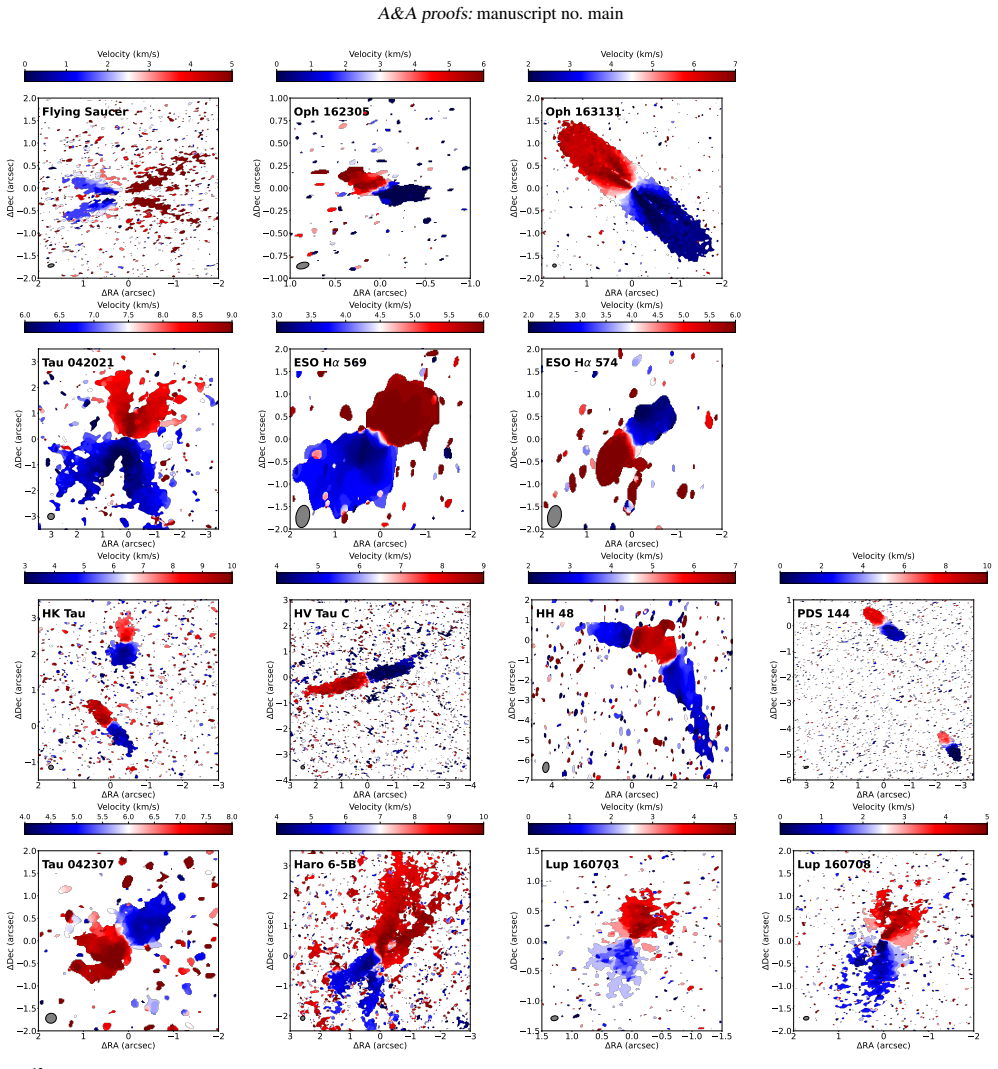

Figures from the paper (5 more)


Lean theorems connected to this paper
-
IndisputableMonolith/Foundation/RealityFromDistinction.leanreality_from_one_distinction unclear?
unclearRelation between the paper passage and the cited Recognition theorem.
The majority of disks in our sample (11 out of 14) follow Rgas > Rdust,micron > Rdust,mm. ... We found an anti-correlation between the dynamical mass and the aspect ratio.
-
IndisputableMonolith/Foundation/ArithmeticFromLogic.leanLogicNat ≃ Nat recovery unclear?
unclearRelation between the paper passage and the cited Recognition theorem.
We estimate the dynamical masses using position-velocity diagrams.
What do these tags mean?
- matches
- The paper's claim is directly supported by a theorem in the formal canon.
- supports
- The theorem supports part of the paper's argument, but the paper may add assumptions or extra steps.
- extends
- The paper goes beyond the formal theorem; the theorem is a base layer rather than the whole result.
- uses
- The paper appears to rely on the theorem as machinery.
- contradicts
- The paper's claim conflicts with a theorem or certificate in the canon.
- unclear
- Pith found a possible connection, but the passage is too broad, indirect, or ambiguous to say the theorem truly supports the claim.
Forward citations
Cited by 1 Pith paper
-
Geometry of dust rings in protoplanetary disks: the case of LkCa 15
The 69 au dust ring in LkCa 15 is broad and thick at 0.88 mm and progressively narrower and thinner at 1.34 and 3.08 mm, implying a massive population of small grains alongside a more concentrated large-grain population.
Reference graph
Works this paper leans on
-
[1]
Akeson, R. L., Jensen, E. L. N., Carpenter, J., et al. 2019, ApJ, 872, 158 Andrews, S. M. 2020, ARA&A, 58, 483 Andrews, S. M., Terrell, M., Tripathi, A., et al. 2018, ApJ, 865, 157 Angelo, I., Duchene, G., Stapelfeldt, K., et al. 2023, ApJ, 945, 130 Ansdell, M., Williams, J. P., Trapman, L., et al. 2018, ApJ, 859, 21 Artymowicz, P. & Lubow, S. H. 1994, Ap...
-
[2]
The continuum and line fluxes are listed in Table B.1
Appendix B: Parameters of disk-hosting companions We performed the same analyses on the disk-hosting compan- ions of the multiple systems as we did for the objects in our main sample. The continuum and line fluxes are listed in Table B.1. The position angles and inclinations are summarized in Ta- ble. B.2. The major axis sizes as well as the minor axis si...
work page 2012
Reviewed May 10, 2026 · model on record in the stance chip above.
Discussion (0). Continue with ORCID to comment.