Recognition: unknown
Wheel Classes in Kontsevich Graph Complex and Merkulov's Low-Valence Conjecture
Pith reviewed 2026-05-10 15:40 UTC · model grok-4.3
The pith
Wheel graphs in the Kontsevich graph complex are homologous to explicit combinations of only 3- and 4-valent graphs.
A machine-rendered reading of the paper's core claim, the machinery that carries it, and where it could break.
Core claim
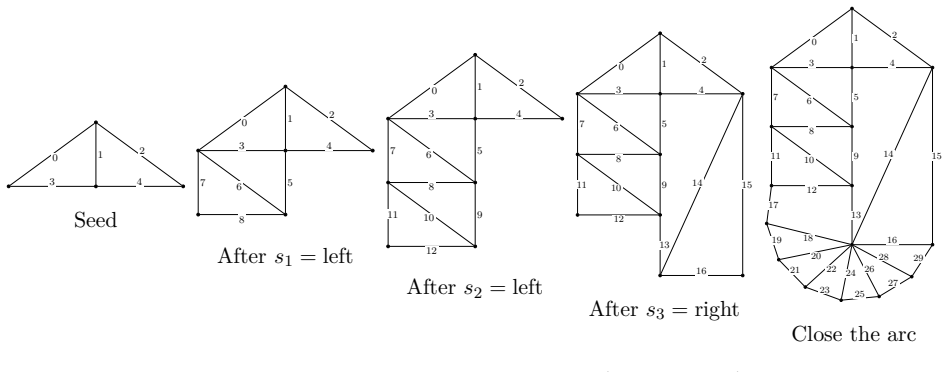
For every m ≥ 2 the wheel graph W_{2m+1} is homologous to an explicit linear combination of 2^{m-1} graphs, each having only 3- and 4-valent vertices. This shows that the wheel classes in GC_d admit representatives supported on graphs with only 3- and 4-valent vertices and thereby verifies Merkulov's low-valence conjecture for these classes.
What carries the argument
The explicit linear combination of 3- and 4-valent graphs that shares the same boundary as the wheel graph W_{2m+1} under the differential of the graph complex.
If this is right
- Merkulov's low-valence conjecture holds for every wheel class.
- Each wheel class admits a representative consisting solely of 3- and 4-valent graphs.
- Homology computations involving wheel graphs can be carried out inside the subcomplex generated by 3- and 4-valent graphs.
- The explicit combinations supply concrete cocycle representatives for these classes.
Where Pith is reading between the lines
- The same reduction technique might produce low-valence representatives for other known generators of the graph complex homology.
- If similar explicit sums can be found for a basis of the full homology, the conjecture would hold in general.
- The factor 2^{m-1} suggests a recursive or binary structure in the construction that could be generalized to higher-valence wheels or other graph families.
Load-bearing premise
The constructed linear combination of low-valence graphs is a cycle whose boundary equals the boundary of the wheel graph.
What would settle it
A direct calculation of the differential applied to the explicit linear combination that produces a result different from the differential of the wheel graph.
Figures


read the original abstract
We show that the wheel classes in the Kontsevich graph complex $GC_d$ admit representatives supported on graphs with only $3$- and $4$-valent vertices. This verifies that Merkulov's low-valence conjecture holds for the wheel classes. More precisely, for every $m \ge 2$, we prove that the wheel graph $W_{2m+1}$ is homologous to an explicit linear combination of $2^{m-1}$ graphs, each having only $3$- and $4$-valent vertices.
Editorial analysis
A structured set of objections, weighed in public.
Referee Report
Summary. The paper proves that in the Kontsevich graph complex GC_d, for every m ≥ 2 the wheel graph W_{2m+1} is homologous to an explicit linear combination of 2^{m-1} graphs with only 3- and 4-valent vertices. This is achieved by constructing the combination and verifying that the standard differential satisfies d(combination) = d(W_{2m+1}), confirming they differ by a boundary and thereby verifying Merkulov's low-valence conjecture for the wheel classes.
Significance. If the explicit constructions hold, the result supplies concrete low-valence representatives for the wheel classes, which are known generators in the homology of GC_d. The explicit linear combinations together with the direct verification of the differential equality constitute a strength, as they make the homology statement checkable in principle and may support further computations or applications in deformation quantization.
minor comments (2)
- A small illustrative example for m=2, displaying the explicit graphs in the combination and a sample boundary computation, would improve readability for readers new to the graph complex.
- The introduction could include a brief reminder of the precise definition of the differential d on GC_d and the grading, to make the paper more self-contained.
Simulated Author's Rebuttal
We thank the referee for the positive report and the recommendation to accept the manuscript. The referee's summary correctly reflects the main result: for each m ≥ 2 the wheel W_{2m+1} is shown to be homologous to an explicit sum of 2^{m-1} graphs with only 3- and 4-valent vertices, thereby verifying Merkulov's low-valence conjecture for the wheel classes.
Circularity Check
No significant circularity in explicit homology construction
full rationale
The paper claims an explicit constructive proof: for each m ≥ 2 it exhibits a concrete linear combination of 2^{m-1} trivalent/4-valent graphs and verifies that this combination is homologous to W_{2m+1} by showing equality of their images under the standard differential d of GC_d. This verification is a direct algebraic check against the differential rules of the graph complex and does not reduce to a fitted parameter, a self-defining ansatz, or a load-bearing self-citation. Merkulov's conjecture is treated as an external statement being verified for the wheel classes; no uniqueness theorem or prior result by the same author is invoked to force the choice of representative. The derivation is therefore self-contained as a constructive existence argument.
Axiom & Free-Parameter Ledger
axioms (1)
- standard math The Kontsevich graph complex GC_d is equipped with its standard differential whose homology classes are well-defined.
Reference graph
Works this paper leans on
-
[1]
S. Brun and T. Willwacher,Graph homology computations,New York Journal of Mathematics 30(2024), 58–92. arXiv:2307.12668
-
[2]
Merkulov,Grothendieck–Teichmüller group, operads and graph complexes: a survey, inInte- grability, Quantization, and Geometry: II
S. Merkulov,Grothendieck–Teichmüller group, operads and graph complexes: a survey, inInte- grability, Quantization, and Geometry: II. Quantum Theories and Algebraic Geometry, Proc. Sympos. Pure Math.103.2, Amer. Math. Soc., 2021, pp. 383–445
2021
-
[3]
T. Willwacher,M. Kontsevich’s graph complex and the Grothendieck–Teichmüller Lie algebra, Inventiones Mathematicae200(2015), no. 3, 671–760. doi:10.1007/s00222-014-0528-x. 9
discussion (0)
Sign in with ORCID, Apple, or X to comment. Anyone can read and Pith papers without signing in.