Recognition: unknown
Online Reasoning Video Object Segmentation
Pith reviewed 2026-05-10 15:24 UTC · model grok-4.3
The pith
Reasoning video object segmentation must run causally using only past and current frames while tracking shifting referents in language queries.
A machine-rendered reading of the paper's core claim, the machinery that carries it, and where it could break.
Core claim
The central claim is that reasoning video object segmentation requires strictly causal operation: models must interpret queries and produce masks incrementally from past and current frames alone, without revisiting earlier outputs or accessing future frames, while correctly handling referent shifts that occur as the video progresses. The authors support this by constructing ORVOSB with the necessary frame-level causal and shift annotations and by releasing a baseline whose continually updated prompts and temporal token reservoir allow bounded long-horizon reasoning.
What carries the argument
A baseline architecture that maintains continually-updated segmentation prompts together with a structured temporal token reservoir for efficient long-horizon causal reasoning.
If this is right
- Existing offline methods lose accuracy when future frames are withheld and when queries change reference during the video.
- Any successful model must maintain and update its interpretation of the query across time without retrospective correction.
- Benchmarks for video segmentation now need explicit causal constraints and referent-shift labels at the frame level.
- Long video sequences require memory mechanisms whose size remains bounded even as the number of frames grows.
Where Pith is reading between the lines
- Real-time systems such as live monitoring or autonomous navigation would gain immediate usability from causal models that never wait for the end of a clip.
- The temporal token reservoir idea could be combined with hierarchical memory to scale to hour-long videos while preserving causality.
- Similar causal constraints likely appear in other sequential reasoning tasks such as online video captioning or action anticipation.
Load-bearing premise
The ORVOSB benchmark's frame-level causal annotations and referent-shift labels sufficiently represent the distribution of real-world online queries and video content.
What would settle it
A new method that achieves substantially higher accuracy on ORVOSB while still obeying strict causality would falsify the claim that existing approaches cannot be adapted to the online regime without major redesign.
Figures


read the original abstract
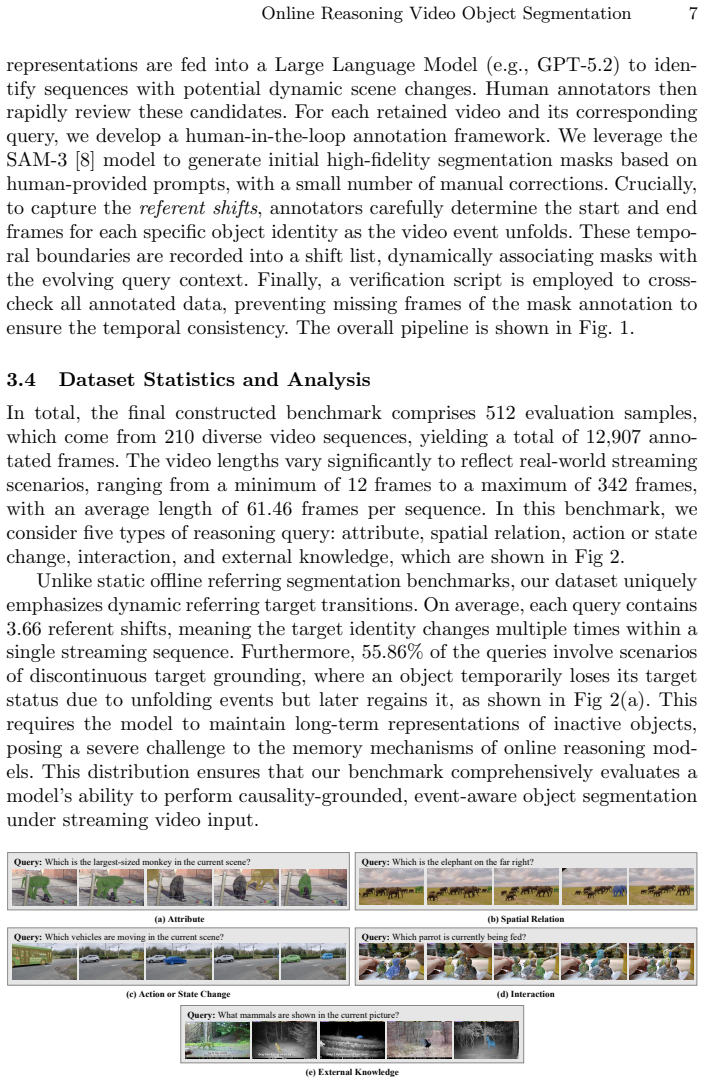
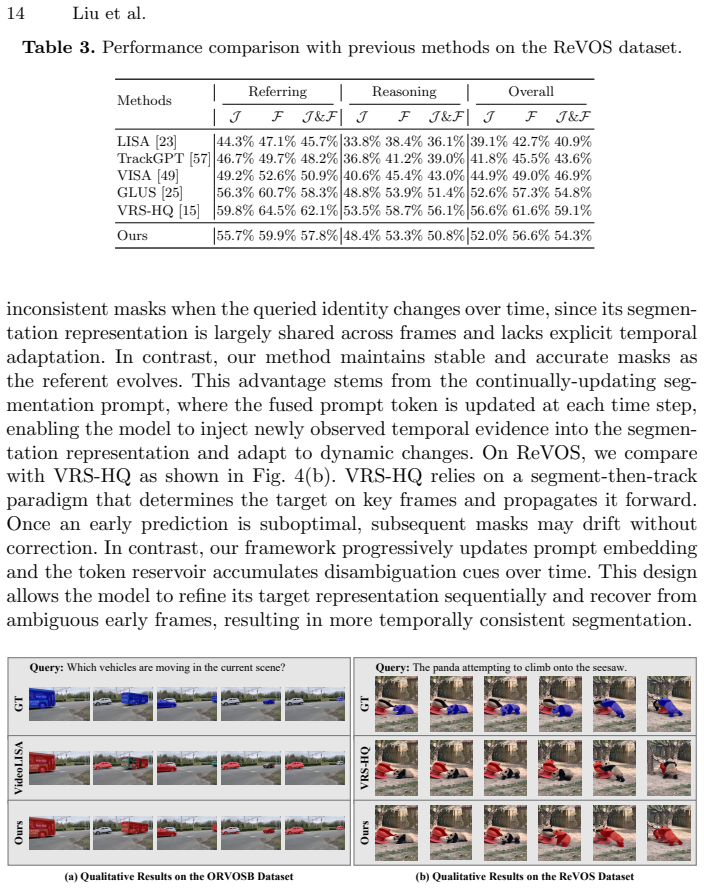
Reasoning video object segmentation predicts pixel-level masks in videos from natural-language queries that may involve implicit and temporally grounded references. However, existing methods are developed and evaluated in an offline regime, where the entire video is available at inference time and future frames can be exploited for retrospective disambiguation, deviating from real-world deployments that require strictly causal, frame-by-frame decisions. We study Online Reasoning Video Object Segmentation (ORVOS), where models must incrementally interpret queries using only past and current frames without revisiting previous predictions, while handling referent shifts as events unfold. To support evaluation, we introduce ORVOSB, a benchmark with frame-level causal annotations and referent-shift labels, comprising 210 videos, 12,907 annotated frames, and 512 queries across five reasoning categories. We further propose a baseline with continually-updated segmentation prompts and a structured temporal token reservoir for long-horizon reasoning under bounded computation. Experiments show that existing methods struggle under strict causality and referent shifts, while our baseline establishes a strong foundation for future research.
Editorial analysis
A structured set of objections, weighed in public.
Referee Report
Summary. The paper introduces Online Reasoning Video Object Segmentation (ORVOS), a task requiring strictly causal, frame-by-frame pixel-level mask prediction from natural-language queries that may contain implicit temporal references and referent shifts. It presents the ORVOSB benchmark (210 videos, 12,907 frames, 512 queries with frame-level causal annotations and referent-shift labels across five reasoning categories) and proposes a baseline using continually-updated segmentation prompts plus a structured temporal token reservoir for bounded long-horizon reasoning. Experiments claim that existing offline methods struggle under these constraints while the baseline establishes a strong foundation for future work.
Significance. If the empirical claims hold, the work is significant for exposing the gap between offline video object segmentation methods and real-world causal deployments, while providing a new benchmark and baseline to standardize evaluation of referent-shift handling. The emphasis on bounded computation in the baseline is a practical strength. Impact depends on rigorous validation that performance gaps are not artifacts of the benchmark distribution.
major comments (2)
- [Benchmark section] Benchmark section (ORVOSB construction): The central claim that existing methods 'struggle under strict causality and referent shifts' rests on ORVOSB being representative, yet no quantitative comparisons are provided for query linguistic complexity, referent-shift frequency, video duration statistics, or causal annotation consistency against larger real-world online video-query corpora. This is load-bearing, as over-representation of short clips or simple shifts could artifactually inflate observed gaps.
- [Experiments section] Experiments section: The abstract asserts that experiments demonstrate struggles for prior methods and a 'strong foundation' for the baseline, but the manuscript provides no error bars, statistical tests, or ablations on the temporal token reservoir's contribution to long-horizon performance. Without these, the strength of the empirical support for the task definition cannot be verified.
minor comments (2)
- [Abstract] Abstract: The five reasoning categories are mentioned but not enumerated; listing them would improve immediate clarity for readers.
- [Method] Notation: The term 'structured temporal token reservoir' is introduced without a precise definition or pseudocode in the early sections; a small diagram or equation would aid reproducibility.
Simulated Author's Rebuttal
We thank the referee for the constructive and detailed feedback. We address each major comment point-by-point below, indicating the revisions we will incorporate.
read point-by-point responses
-
Referee: [Benchmark section] Benchmark section (ORVOSB construction): The central claim that existing methods 'struggle under strict causality and referent shifts' rests on ORVOSB being representative, yet no quantitative comparisons are provided for query linguistic complexity, referent-shift frequency, video duration statistics, or causal annotation consistency against larger real-world online video-query corpora. This is load-bearing, as over-representation of short clips or simple shifts could artifactually inflate observed gaps.
Authors: We agree that additional context on ORVOSB's characteristics is important to support the representativeness of the claims. As the first benchmark providing frame-level causal annotations and referent-shift labels for this task, direct equivalents do not exist. In the revision we will add quantitative statistics on query linguistic complexity, referent-shift frequency, and video duration distributions, along with comparisons to published figures from existing video-query benchmarks such as Refer-YouTube-VOS. We will also report inter-annotator agreement for the causal annotations. Direct comparison of causal annotation consistency is not possible with prior datasets, which we will explicitly note as a limitation. revision: partial
-
Referee: [Experiments section] Experiments section: The abstract asserts that experiments demonstrate struggles for prior methods and a 'strong foundation' for the baseline, but the manuscript provides no error bars, statistical tests, or ablations on the temporal token reservoir's contribution to long-horizon performance. Without these, the strength of the empirical support for the task definition cannot be verified.
Authors: We appreciate the emphasis on empirical rigor. The revised manuscript will include error bars for all reported metrics, statistical significance tests comparing method performances, and dedicated ablations isolating the temporal token reservoir's role in long-horizon reasoning. These additions will provide clearer validation of the performance gaps and the baseline's contributions. revision: yes
Circularity Check
No circularity: new task definition and benchmark with independent baseline
full rationale
The paper defines a new task (ORVOS) requiring strictly causal, frame-by-frame processing with referent shifts, introduces the ORVOSB benchmark (210 videos, 12,907 frames, 512 queries with causal annotations and shift labels), and proposes a baseline using continually-updated prompts and temporal token reservoir. No equations, fitted parameters, or derivations are present that reduce to self-definition or self-citation. Central claims rest on experimental comparisons showing existing offline methods struggle on the new benchmark, which is externally falsifiable via the released annotations and does not rely on prior author results for uniqueness or ansatz. This is a standard task/benchmark contribution with no load-bearing circular steps.
Axiom & Free-Parameter Ledger
axioms (1)
- domain assumption Real-world video deployments require strictly causal, frame-by-frame decisions without access to future frames.
Reference graph
Works this paper leans on
-
[1]
NeurIPS35, 23716–23736 (2022)
Alayrac, J.B., Donahue, J., Luc, P., Miech, A., Barr, I., Hasson, Y., Lenc, K., Mensch, A., Millican, K., Reynolds, M., et al.: Flamingo: a visual language model for few-shot learning. NeurIPS35, 23716–23736 (2022)
2022
-
[2]
Bai, J., Bai, S., Chu, Y., Cui, Z., Dang, K., Deng, X., Fan, Y., Ge, W., Han, Y., Huang, F., et al.: Qwen technical report. arXiv preprint arXiv:2309.16609 (2023)
work page internal anchor Pith review Pith/arXiv arXiv 2023
-
[3]
Bai, S., Cai, Y., Chen, R., Chen, K., Chen, X., Cheng, Z., Deng, L., Ding, W., Gao, C., Ge, C., et al.: Qwen3-vl technical report. arXiv preprint arXiv:2511.21631 (2025)
work page internal anchor Pith review Pith/arXiv arXiv 2025
-
[4]
NeurIPS37, 6833–6859 (2024)
Bai, Z., He, T., Mei, H., Wang, P., Gao, Z., Chen, J., Zhang, Z., Shou, M.Z.: One token to seg them all: Language instructed reasoning segmentation in videos. NeurIPS37, 6833–6859 (2024)
2024
-
[5]
In: CVPR
Botach, A., Zheltonozhskii, E., Baskin, C.: End-to-end referring video object seg- mentation with multimodal transformers. In: CVPR. pp. 4985–4995 (2022)
2022
-
[6]
In: SIGCOMM
Bothra, C., Gao, J., Rao, S., Ribeiro, B.: Veritas: Answering causal queries from video streaming traces. In: SIGCOMM. pp. 738–753 (2023)
2023
-
[7]
In: CVPR
Caesar, H., Uijlings, J., Ferrari, V.: Coco-stuff: Thing and stuff classes in context. In: CVPR. pp. 1209–1218 (2018)
2018
-
[8]
SAM 3: Segment Anything with Concepts
Carion, N., Gustafson, L., Hu, Y.T., Debnath, S., Hu, R., Suris, D., Ryali, C., Alwala, K.V., Khedr, H., Huang, A., et al.: Sam 3: Segment anything with concepts. arXiv preprint arXiv:2511.16719 (2025)
work page internal anchor Pith review Pith/arXiv arXiv 2025
-
[9]
In: CVPR
Chen, J., Lv, Z., Wu, S., Lin, K.Q., Song, C., Gao, D., Liu, J.W., Gao, Z., Mao, D., Shou, M.Z.: Videollm-online: Online video large language model for streaming video. In: CVPR. pp. 18407–18418 (2024)
2024
-
[10]
In: CVPR
Chen, X., Mottaghi, R., Liu, X., Fidler, S., Urtasun, R., Yuille, A.: Detect what you can: Detecting and representing objects using holistic models and body parts. In: CVPR. pp. 1971–1978 (2014)
1971
-
[11]
In: CVPR
Chen, Z., Wu, J., Wang, W., Su, W., Chen, G., Xing, S., Zhong, M., Zhang, Q., Zhu, X., Lu, L., et al.: Internvl: Scaling up vision foundation models and aligning for generic visual-linguistic tasks. In: CVPR. pp. 24185–24198 (2024)
2024
-
[12]
IEEE Trans- actions on Mobile Computing23(12), 12761–12777 (2024)
Dai, P., Chao, Y., Wu, X., Liu, K., Guo, S.: Context-aware offloading for edge- assisted on-device video analytics through online learning approach. IEEE Trans- actions on Mobile Computing23(12), 12761–12777 (2024)
2024
-
[13]
In: CVPR
Ding, H., Liu, C., He, S., Jiang, X., Loy, C.C.: Mevis: A large-scale benchmark for video segmentation with motion expressions. In: CVPR. pp. 2694–2703 (2023)
2023
-
[14]
In: CVPR
Ding, H., Liu, C., He, S., Jiang, X., Torr, P.H., Bai, S.: Mose: A new dataset for video object segmentation in complex scenes. In: CVPR. pp. 20224–20234 (2023)
2023
-
[15]
In: CVPR
Gong, S., Zhuge, Y., Zhang, L., Yang, Z., Zhang, P., Lu, H.: The devil is in temporal token: High quality video reasoning segmentation. In: CVPR. pp. 29183–29192 (2025)
2025
-
[16]
arXiv preprint arXiv:1308.0850 (2013) 4, 5
Graves, A.: Generating sequences with recurrent neural networks. arXiv preprint arXiv:1308.0850 (2013)
-
[17]
ICLR1(2), 3 (2022)
Hu, E.J., Shen, Y., Wallis, P., Allen-Zhu, Z., Li, Y., Wang, S., Wang, L., Chen, W., et al.: Lora: Low-rank adaptation of large language models. ICLR1(2), 3 (2022)
2022
-
[18]
In: CVPR
Huang, Z., Li, X., Li, J., Wang, J., Zeng, X., Liang, C., Wu, T., Chen, X., Li, L., Wang, L.: Online video understanding: Ovbench and videochat-online. In: CVPR. pp. 3328–3338 (2025)
2025
-
[19]
In: CVPR
Hui, T., Huang, S., Liu, S., Ding, Z., Li, G., Wang, W., Han, J., Wang, F.: Collab- orative spatial-temporal modeling for language-queried video actor segmentation. In: CVPR. pp. 4187–4196 (2021) Online Reasoning Video Object Segmentation 17
2021
-
[20]
In: CVPR
Jin, P., Takanobu, R., Zhang, W., Cao, X., Yuan, L.: Chat-univi: Unified visual rep- resentation empowers large language models with image and video understanding. In: CVPR. pp. 13700–13710 (2024)
2024
-
[21]
In: EMNLP
Kazemzadeh, S., Ordonez, V., Matten, M., Berg, T.: Referitgame: Referring to objects in photographs of natural scenes. In: EMNLP. pp. 787–798 (2014)
2014
-
[22]
In: CVPR
Kirillov, A., Mintun, E., Ravi, N., Mao, H., Rolland, C., Gustafson, L., Xiao, T., Whitehead, S., Berg, A.C., Lo, W.Y., et al.: Segment anything. In: CVPR. pp. 4015–4026 (2023)
2023
-
[23]
In: CVPR
Lai, X., Tian, Z., Chen, Y., Li, Y., Yuan, Y., Liu, S., Jia, J.: Lisa: Reasoning segmentation via large language model. In: CVPR. pp. 9579–9589 (2024)
2024
-
[24]
Lin, J., Fang, Z., Chen, C., Wan, Z., Luo, F., Li, P., Liu, Y., Sun, M.: Stream- ingbench: Assessing the gap for mllms to achieve streaming video understanding. arXiv preprint arXiv:2411.03628 (2024)
-
[25]
In: CVPR
Lin, L., Yu, X., Pang, Z., Wang, Y.X.: Glus: Global-local reasoning unified into a single large language model for video segmentation. In: CVPR. pp. 8658–8667 (2025)
2025
-
[26]
NeurIPS36, 34892– 34916 (2023)
Liu, H., Li, C., Wu, Q., Lee, Y.J.: Visual instruction tuning. NeurIPS36, 34892– 34916 (2023)
2023
-
[27]
Decoupled Weight Decay Regularization
Loshchilov, I., Hutter, F.: Decoupled weight decay regularization. arXiv preprint arXiv:1711.05101 (2017)
work page internal anchor Pith review Pith/arXiv arXiv 2017
-
[28]
Maaz, M., Rasheed, H., Khan, S., Khan, F.: Video-chatgpt: Towards detailed video understanding via large vision and language models. In: ACL. pp. 12585–12602 (2024)
2024
-
[29]
In: CVPR
Mao, J., Huang, J., Toshev, A., Camburu, O., Yuille, A.L., Murphy, K.: Genera- tion and comprehension of unambiguous object descriptions. In: CVPR. pp. 11–20 (2016)
2016
-
[30]
Milletari, F., Navab, N., Ahmadi, S.A.: V-net: Fully convolutional neural networks for volumetric medical image segmentation. In: 3DV. pp. 565–571. Ieee (2016)
2016
-
[31]
In: CVPR
Munasinghe, S., Gani, H., Zhu, W., Cao, J., Xing, E., Khan, F.S., Khan, S.: Videoglamm: A large multimodal model for pixel-level visual grounding in videos. In: CVPR. pp. 19036–19046 (2025)
2025
-
[32]
LiveVLM: Efficient Online Video Understanding via Streaming-Oriented KV Cache and Retrieval
Ning, Z., Liu, G., Jin, Q., Ding, W., Guo, M., Zhao, J.: Livevlm: Efficient online video understanding via streaming-oriented kv cache and retrieval. arXiv preprint arXiv:2505.15269 (2025)
work page internal anchor Pith review Pith/arXiv arXiv 2025
-
[33]
Niu, J., Li, Y., Miao, Z., Ge, C., Zhou, Y., He, Q., Dong, X., Duan, H., Ding, S., Qian, R., et al.: Ovo-bench: How far is your video-llms from real-world online video understanding? In: CVPR. pp. 18902–18913 (2025)
2025
-
[34]
AI & society40(2), 677–690 (2025)
Obrenovic, B., Gu, X., Wang, G., Godinic, D., Jakhongirov, I.: Generative ai and human–robot interaction: implications and future agenda for business, society and ethics. AI & society40(2), 677–690 (2025)
2025
-
[35]
The 2017 DAVIS Challenge on Video Object Segmentation
Pont-Tuset, J., Perazzi, F., Caelles, S., Arbel´ aez, P., Sorkine-Hornung, A., Van Gool, L.: The 2017 davis challenge on video object segmentation. arXiv preprint arXiv:1704.00675 (2017)
work page internal anchor Pith review arXiv 2017
-
[36]
IJCV130(8), 2022–2039 (2022)
Qi, J., Gao, Y., Hu, Y., Wang, X., Liu, X., Bai, X., Belongie, S., Yuille, A., Torr, P.H., Bai, S.: Occluded video instance segmentation: A benchmark. IJCV130(8), 2022–2039 (2022)
2022
-
[37]
NeurIPS37, 119336–119360 (2024) 18 Liu et al
Qian, R., Dong, X., Zhang, P., Zang, Y., Ding, S., Lin, D., Wang, J.: Streaming long video understanding with large language models. NeurIPS37, 119336–119360 (2024) 18 Liu et al
2024
-
[38]
In: Proceedings of the Computer Vision and Pattern Recognition Conference
Qian, R., Yin, X., Dou, D.: Reasoning to attend: Try to understand how¡ seg¿ token works. In: Proceedings of the Computer Vision and Pattern Recognition Conference. pp. 24722–24731 (2025)
2025
-
[39]
In: CVPR
Ramanathan, V., Kalia, A., Petrovic, V., Wen, Y., Zheng, B., Guo, B., Wang, R., Marquez, A., Kovvuri, R., Kadian, A., et al.: Paco: Parts and attributes of common objects. In: CVPR. pp. 7141–7151 (2023)
2023
-
[40]
In: SIGKDD
Rasley, J., Rajbhandari, S., Ruwase, O., He, Y.: Deepspeed: System optimiza- tions enable training deep learning models with over 100 billion parameters. In: SIGKDD. pp. 3505–3506 (2020)
2020
-
[41]
SAM 2: Segment Anything in Images and Videos
Ravi, N., Gabeur, V., Hu, Y.T., Hu, R., Ryali, C., Ma, T., Khedr, H., R¨ adle, R., Rolland, C., Gustafson, L., et al.: Sam 2: Segment anything in images and videos. arXiv preprint arXiv:2408.00714 (2024)
work page internal anchor Pith review Pith/arXiv arXiv 2024
-
[42]
In: CVPR
Ren, Z., Huang, Z., Wei, Y., Zhao, Y., Fu, D., Feng, J., Jin, X.: Pixellm: Pixel reasoning with large multimodal model. In: CVPR. pp. 26374–26383 (2024)
2024
-
[43]
In: ECCV
Seo, S., Lee, J.Y., Han, B.: Urvos: Unified referring video object segmentation network with a large-scale benchmark. In: ECCV. pp. 208–223. Springer (2020)
2020
-
[44]
arXiv preprint arXiv:2505.05467 , year=
Wang, H., Feng, B., Lai, Z., Xu, M., Li, S., Ge, W., Dehghan, A., Cao, M., Huang, P.: Streambridge: Turning your offline video large language model into a proactive streaming assistant. arXiv preprint arXiv:2505.05467 (2025)
-
[45]
In: CVPR
Wang, W., Zhou, T., Yu, F., Dai, J., Konukoglu, E., Van Gool, L.: Exploring cross-image pixel contrast for semantic segmentation. In: CVPR. pp. 7303–7313 (2021)
2021
-
[46]
In: CVPR
Wu, J., Jiang, Y., Sun, P., Yuan, Z., Luo, P.: Language as queries for referring video object segmentation. In: CVPR. pp. 4974–4984 (2022)
2022
-
[47]
arXiv preprint arXiv:2501.13468 , year=
Xiong, H., Yang, Z., Yu, J., Zhuge, Y., Zhang, L., Zhu, J., Lu, H.: Streaming video understanding and multi-round interaction with memory-enhanced knowl- edge. arXiv preprint arXiv:2501.13468 (2025)
-
[48]
arXiv preprint arXiv:2510.09608 , year=
Xu, R., Xiao, G., Chen, Y., He, L., Peng, K., Lu, Y., Han, S.: Streamingvlm: Real- time understanding for infinite video streams. arXiv preprint arXiv:2510.09608 (2025)
-
[49]
In: ECCV
Yan, C., Wang, H., Yan, S., Jiang, X., Hu, Y., Kang, G., Xie, W., Gavves, E.: Visa: Reasoning video object segmentation via large language models. In: ECCV. pp. 98–115. Springer (2024)
2024
-
[50]
In: AAAI
Yan, S., Zhang, R., Guo, Z., Chen, W., Zhang, W., Li, H., Qiao, Y., Dong, H., He, Z., Gao, P.: Referred by multi-modality: A unified temporal transformer for video object segmentation. In: AAAI. vol. 38, pp. 6449–6457 (2024)
2024
-
[51]
In: ICCV
Yang, L., Fan, Y., Xu, N.: Video instance segmentation. In: ICCV. pp. 5188–5197 (2019)
2019
-
[52]
Yang, R., Chen, H., Zhang, J., Zhao, M., Qian, C., Wang, K., Wang, Q., Koripella, T.V., Movahedi, M., Li, M., et al.: Embodiedbench: Comprehensive benchmark- ing multi-modal large language models for vision-driven embodied agents. arXiv preprint arXiv:2502.09560 (2025)
-
[53]
Lisa++: An improved baseline for reasoning segmentation with large language model,
Yang, S., Qu, T., Lai, X., Tian, Z., Peng, B., Liu, S., Jia, J.: Lisa++: An improved baseline for reasoning segmentation with large language model. arXiv preprint arXiv:2312.17240 (2023)
-
[54]
arXiv preprint arXiv:2502.10810 (2025)
Yang, Z., Hu, Y., Du, Z., Xue, D., Qian, S., Wu, J., Yang, F., Dong, W., Xu, C.: Svbench: A benchmark with temporal multi-turn dialogues for streaming video understanding. arXiv preprint arXiv:2502.10810 (2025)
-
[55]
In: ICCV
Zheng, R., Qi, L., Chen, X., Wang, Y., Wang, K., Qiao, Y., Zhao, H.: Villa: Video reasoning segmentation with large language model. In: ICCV. pp. 23667–23677 (2025) Online Reasoning Video Object Segmentation 19
2025
-
[56]
In: CVPR
Zhou, B., Zhao, H., Puig, X., Fidler, S., Barriuso, A., Torralba, A.: Scene parsing through ade20k dataset. In: CVPR. pp. 633–641 (2017)
2017
-
[57]
arXiv preprint arXiv:2312.17448 (2023)
Zhu, J., Cheng, Z.Q., He, J.Y., Li, C., Luo, B., Lu, H., Geng, Y., Xie, X.: Tracking with human-intent reasoning. arXiv preprint arXiv:2312.17448 (2023)
-
[58]
Deformable DETR: Deformable Transformers for End-to-End Object Detection
Zhu, X., Su, W., Lu, L., Li, B., Wang, X., Dai, J.: Deformable detr: Deformable transformers for end-to-end object detection. arXiv preprint arXiv:2010.04159 (2020)
work page internal anchor Pith review arXiv 2010
discussion (0)
Sign in with ORCID, Apple, or X to comment. Anyone can read and Pith papers without signing in.