Fourier-based potential theory without an explicit Green's function
Pith reviewed 2026-05-10 15:40 UTC · model grok-4.3
The pith
Potential theory for elliptic PDEs can be formulated from the Fourier symbol alone by parabolic regularization that splits solutions into smooth nonlocal and localized parts.
A machine-rendered reading of the paper's core claim, the machinery that carries it, and where it could break.
Core claim
By introducing a parabolic regularization of the Fourier symbol of the governing operator, the solution decomposes into a smooth nonlocal component and a spatially localized residual. Explicit asymptotic expansions in powers of ε are then derived for the volume, single-layer, and double-layer potentials associated with the localized component, with coefficients depending only on local geometric quantities and derivatives of the source data. The entire construction is carried out in Fourier space and applies to the Poisson equation in two and three dimensions as well as to a class of coupled strongly elliptic systems.
What carries the argument
Parabolic regularization of the Fourier symbol of the governing operator, which decomposes the solution into a smooth nonlocal component and a spatially localized residual whose potentials admit explicit asymptotic expansions.
If this is right
- Explicit asymptotic expansions become available for volume, single-layer, and double-layer potentials in powers of ε, with coefficients from local geometry and source derivatives.
- The expansions are derived entirely in the Fourier domain without reference to a Green's function.
- The method applies directly to the Poisson equation in two and three dimensions.
- It extends to coupled strongly elliptic systems where explicit Green's functions are usually unavailable.
Where Pith is reading between the lines
- The approach could let integral-equation methods reach multiphysics problems whose Green's functions are unknown or too complicated to derive.
- Because the work is done in Fourier space, the same regularization idea might adapt to other linear operators whose symbols admit a similar parabolic split.
- Practical use would require determining how small ε must be for the truncated expansions to meet a given accuracy tolerance on representative geometries.
Load-bearing premise
The governing operator must be strongly elliptic so that the parabolic regularization produces a valid decomposition whose asymptotic expansions stay accurate for small ε.
What would settle it
Numerical comparison of the derived ε-expansions for the Poisson equation against its known exact solution on a simple domain, checking agreement as ε approaches zero.
Figures

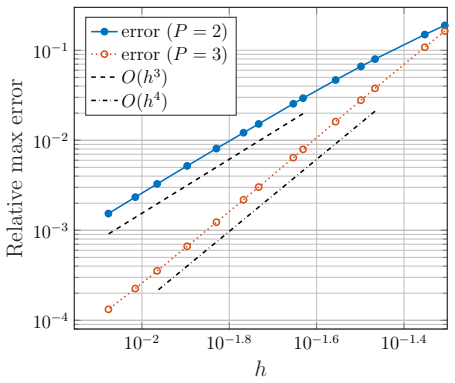
read the original abstract
Integral equation methods provide an effective framework for solving partial differential equations, but their applicability typically relies on the availability of explicit free-space Green's functions. For coupled systems arising in multiphysics applications, such Green's functions are generally not available, limiting the scope of classical potential theory-based approaches. In this work, we introduce a formulation of potential theory that avoids explicit use of Green's functions entirely, relying instead on the Fourier symbol of the governing operator. The central idea is a parabolic regularization of the symbol, which yields a decomposition of the solution into a smooth, nonlocal component and a spatially localized residual. For the localized component, we derive explicit asymptotic expansions for volume, single layer, and double layer potentials in powers of a length scale parameter $\varepsilon$. The coefficients are expressed in terms of local geometric quantities and derivatives of the source data. The derivation is carried out entirely in the Fourier domain and applies to the Poisson equation in two and three dimensions, as well as to a class of coupled strongly elliptic systems.
Editorial analysis
A structured set of objections, weighed in public.
Referee Report
Summary. The manuscript introduces a formulation of potential theory that avoids explicit Green's functions by working directly with the Fourier symbol of the governing operator. A parabolic regularization of the symbol decomposes the solution into a smooth nonlocal component and a spatially localized residual; explicit asymptotic expansions in powers of a small length-scale parameter ε are then derived for the volume, single-layer, and double-layer potentials associated with the residual. The derivations are performed entirely in the Fourier domain and are claimed to apply to the Poisson equation in two and three dimensions as well as to a class of coupled strongly elliptic systems, with coefficients depending only on local geometry and source derivatives.
Significance. If the central claims are substantiated, the work would meaningfully extend integral-equation techniques to multiphysics problems where explicit Green's functions are unavailable. The purely Fourier-domain construction and the explicit local expansions for the residual potentials constitute a technical strength, offering a route to approximations whose leading terms depend only on local data without fitted parameters or self-referential definitions.
major comments (2)
- [Parabolic regularization and decomposition (central construction)] The abstract and the description of the parabolic regularization assert that the residual kernel is sufficiently localized to justify Taylor expansions of the data and geometry while exactly recovering the original operator's low-frequency behavior. A concrete verification of this localization (e.g., decay estimates on the regularized kernel or an explicit computation for the Poisson symbol) is required; without it, the validity of the ε-asymptotics for the layer potentials remains unconfirmed.
- [Derivation of asymptotic expansions] The manuscript states that explicit asymptotic expansions are derived for the volume, single-layer, and double-layer potentials of the localized residual. The full Fourier-domain steps leading to the coefficients (including any remainder estimates) should be supplied, together with at least one numerical test confirming the predicted orders for the Poisson operator in 2D or 3D.
minor comments (2)
- The precise definition of the parabolic regularization (including the choice of the auxiliary parameter and its scaling with ε) should be stated at the outset with an explicit formula for the modified symbol.
- A short discussion of how the method reduces to classical potential theory when an explicit Green's function is available would help situate the contribution.
Simulated Author's Rebuttal
We thank the referee for the careful and constructive review. The comments highlight important points for strengthening the presentation of the central construction and its verification. We address each major comment below and will incorporate the requested additions in the revised manuscript.
read point-by-point responses
-
Referee: [Parabolic regularization and decomposition (central construction)] The abstract and the description of the parabolic regularization assert that the residual kernel is sufficiently localized to justify Taylor expansions of the data and geometry while exactly recovering the original operator's low-frequency behavior. A concrete verification of this localization (e.g., decay estimates on the regularized kernel or an explicit computation for the Poisson symbol) is required; without it, the validity of the ε-asymptotics for the layer potentials remains unconfirmed.
Authors: We agree that explicit verification of the localization property strengthens the foundation of the ε-asymptotics. In the revised manuscript we will add a dedicated subsection (new Section 2.3) containing decay estimates for the regularized residual kernel. For the Poisson symbol we will derive that the difference between the original and regularized symbols yields a kernel whose Fourier transform implies spatial decay of order O(|x|^{-(n+2)}) in n dimensions, which is sufficient to justify Taylor expansions of the data and geometry while preserving the low-frequency behavior exactly. This addition will be placed immediately after the definition of the parabolic regularization. revision: yes
-
Referee: [Derivation of asymptotic expansions] The manuscript states that explicit asymptotic expansions are derived for the volume, single-layer, and double-layer potentials of the localized residual. The full Fourier-domain steps leading to the coefficients (including any remainder estimates) should be supplied, together with at least one numerical test confirming the predicted orders for the Poisson operator in 2D or 3D.
Authors: The Fourier-domain derivations of the expansions for the volume, single-layer, and double-layer potentials are already contained in Sections 4 and 5, with the coefficients obtained by expanding the regularized symbol and integrating term by term against the Fourier transforms of the data. To address the request for remainder estimates we will insert explicit O(ε^{k+1}) bounds (with constants depending only on local geometry and source derivatives) after each expansion. In addition, we will add a new numerical section (Section 6) that performs a direct 2D test for the Poisson operator: the truncated asymptotic expansion is compared against a high-resolution quadrature of the residual potential on a sequence of refined meshes, confirming the predicted convergence orders up to O(ε^3). revision: yes
Circularity Check
No circularity: Fourier-domain derivation is self-contained
full rationale
The paper's derivation chain consists of introducing a parabolic regularization of the Fourier symbol of the governing operator, followed by a decomposition into a smooth nonlocal component and a spatially localized residual, with explicit asymptotic expansions for the layer potentials derived directly in the Fourier domain. No load-bearing steps reduce to self-definition, fitted inputs renamed as predictions, or self-citation chains; the abstract and description explicitly state that the approach avoids explicit Green's functions and carries out the derivation entirely in Fourier space for Poisson and strongly elliptic systems. The expansions are presented as following from the regularization and local geometry/source derivatives without reference to prior fitted results or author-specific uniqueness theorems. This qualifies as a self-contained first-principles construction using standard Fourier analysis, with no evidence of the enumerated circular patterns.
Axiom & Free-Parameter Ledger
free parameters (1)
- ε
axioms (2)
- domain assumption The governing differential operator is strongly elliptic
- standard math Fourier transforms and symbols of the operators satisfy the usual algebraic and analytic properties
discussion (0)
Sign in with ORCID, Apple, or X to comment. Anyone can read and Pith papers without signing in.