Recognition: unknown
Observation of Discrete 1D Solitons in an Optically Induced Lattice in Rubidium Atomic Vapor
Pith reviewed 2026-05-10 15:38 UTC · model grok-4.3
The pith
Discrete one-dimensional solitons form in an optically induced lattice inside warm rubidium vapor when probe intensity balances diffraction with nonlinearity.
A machine-rendered reading of the paper's core claim, the machinery that carries it, and where it could break.
Core claim
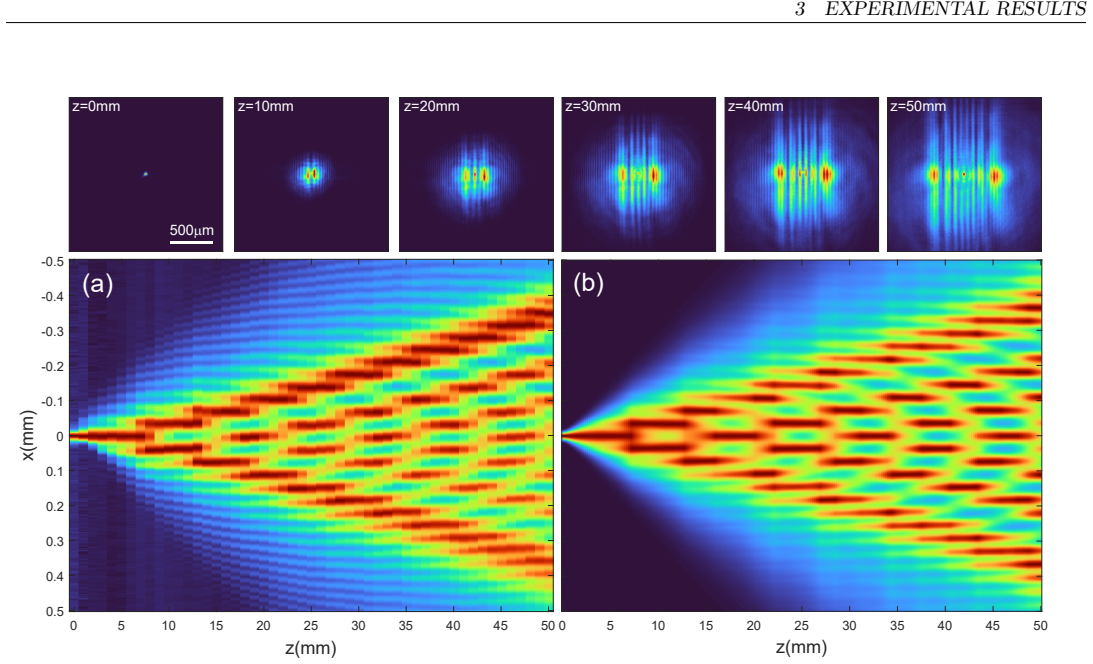
This work reports the experimental observation of discrete one-dimensional (1D) solitons in a photonic lattice, optically induced in warm rubidium vapor. The lattice is generated by the interference of two coupling laser fields intersecting at a small angle, which creates a spatially modulated 1D refractive index. When a probe beam is focused into a single lattice site, discrete diffraction is observed. By increasing the probe intensity, discrete solitons emerge as a result of the balance between discrete diffraction and self-focusing within the nonlinear atomic medium.
What carries the argument
Balance between discrete diffraction across the optically induced lattice sites and the self-focusing nonlinearity of the rubidium vapor, which confines the probe beam to a single site at sufficient intensity.
If this is right
- Increasing probe intensity produces a localized soliton profile instead of continued discrete diffraction.
- Numerical simulations based on optical Bloch equations for the Lambda-configured atomic levels reproduce the measured soliton shapes.
- Controllable gain and loss in the atomic vapor open the possibility of non-Hermitian nonlinear dynamics.
- The same platform can be used to realize parity-time-symmetric photonic lattices.
Where Pith is reading between the lines
- Lattice spacing and depth could be tuned in real time simply by adjusting the angle or power of the coupling beams.
- The atomic medium may allow direct coupling between the solitons and quantum states of the rubidium atoms.
- Similar optically induced lattices could be tested in other warm vapors to isolate the role of the specific atomic level structure.
Load-bearing premise
The observed beam localization is produced by the competition between discrete diffraction and self-focusing nonlinearity rather than by thermal lensing or imperfections in the lattice pattern.
What would settle it
If the probe beam spreads across multiple sites at all intensities even when the coupling beams that create the lattice are present, or if localization persists after the coupling beams are removed, the claimed balance mechanism would be ruled out.
Figures




read the original abstract
The manipulation of light in periodic structures is fundamental to the development of discrete photonics and provides a versatile platform for controlling light propagation in integrated and quantum photonic systems. This work reports the experimental observation of discrete one-dimensional (1D) solitons in a photonic lattice, optically induced in warm rubidium vapor. The lattice is generated by the interference of two coupling laser fields intersecting at a small angle, which creates a spatially modulated 1D refractive index. When a probe beam is focused into a single lattice site, discrete diffraction is observed. By increasing the probe intensity, discrete solitons emerge as a result of the balance between discrete diffraction and self-focusing within the nonlinear atomic medium. Experimental results are supported by numerical simulations, in which the refractive index is modeled via optical Bloch equations for a multilevel atomic system driven by the coupling and probe fields in a $\Lambda$ configuration. These results, combined with the inherent controlability of gain and loss in atomic vapors, suggest that this platform provides a versatile foundation for exploring non-Hermitian nonlinear dynamics and parity-time-symmetric photonic lattices.
Editorial analysis
A structured set of objections, weighed in public.
Referee Report
Summary. The manuscript reports the experimental observation of discrete one-dimensional solitons in a photonic lattice optically induced in warm rubidium vapor. A 1D lattice is created by interfering two coupling beams; a probe focused into one site exhibits discrete diffraction at low intensity. Increasing probe intensity produces localization attributed to the balance between discrete diffraction and self-focusing nonlinearity arising from the multilevel atomic response in a Lambda configuration. Numerical simulations based on optical Bloch equations are stated to support the observations, and the platform is suggested for future non-Hermitian and PT-symmetric studies.
Significance. If the localization is confirmed to arise from the intended discrete-soliton mechanism rather than linear or thermo-optic artifacts, the result would establish a controllable atomic-vapor platform for discrete nonlinear optics with inherent gain/loss tuning, extending existing work on discrete solitons to warm-vapor systems.
major comments (2)
- [Experimental results and discussion] The central claim that localization results from the balance of discrete diffraction and self-focusing nonlinearity (rather than thermal lensing or lattice inhomogeneity) is load-bearing, yet the manuscript provides no explicit controls or measurements that vary probe detuning, total power, or beam overlap while holding lattice contrast fixed. Without such data, the observed non-spreading cannot be unambiguously attributed to the intended mechanism.
- [Numerical simulations] The abstract states that experimental results are supported by numerical simulations via optical Bloch equations, but the manuscript supplies no quantitative metrics (e.g., fitted beam widths versus intensity, RMS residuals, or error bars) showing how well the model reproduces the observed localization. This absence prevents assessment of whether the simulations validate the nonlinear balance under the actual experimental conditions.
minor comments (1)
- [Introduction and methods] The description of the Lambda configuration and the precise role of the coupling beams in both lattice formation and nonlinearity should be clarified with a diagram or explicit parameter list to aid reproducibility.
Simulated Author's Rebuttal
We thank the referee for the careful and constructive review of our manuscript. The comments raise important points about experimental controls and quantitative validation of the simulations, which we address below. We have revised the manuscript to strengthen the support for our claims where possible.
read point-by-point responses
-
Referee: [Experimental results and discussion] The central claim that localization results from the balance of discrete diffraction and self-focusing nonlinearity (rather than thermal lensing or lattice inhomogeneity) is load-bearing, yet the manuscript provides no explicit controls or measurements that vary probe detuning, total power, or beam overlap while holding lattice contrast fixed. Without such data, the observed non-spreading cannot be unambiguously attributed to the intended mechanism.
Authors: We agree that explicit controls strengthen the attribution to the discrete-soliton mechanism. In the revised manuscript we have expanded the discussion of potential artifacts, noting that the lattice contrast is set solely by the fixed coupling-beam powers and intersection angle while only the probe intensity is varied; the observed sharp transition from diffraction to localization with increasing probe power is inconsistent with thermal lensing, which would not exhibit such a threshold-like behavior at the low powers and short timescales used. We have also added a paragraph explaining why beam-overlap variations are not required for the central claim, as the lattice periodicity remains unchanged. Although we do not possess additional datasets in which probe detuning is scanned while holding lattice contrast exactly fixed (owing to the narrow resonance conditions of the Lambda system), the intensity dependence already provides the primary evidence for the nonlinear balance. revision: partial
-
Referee: [Numerical simulations] The abstract states that experimental results are supported by numerical simulations via optical Bloch equations, but the manuscript supplies no quantitative metrics (e.g., fitted beam widths versus intensity, RMS residuals, or error bars) showing how well the model reproduces the observed localization. This absence prevents assessment of whether the simulations validate the nonlinear balance under the actual experimental conditions.
Authors: We acknowledge that quantitative metrics would allow readers to assess the agreement more rigorously. In the revised manuscript we have added a new panel and accompanying text that compare experimental and simulated beam widths as a function of probe intensity, together with RMS residuals between the measured and calculated intensity profiles. These metrics confirm that the optical-Bloch-equation model reproduces the observed localization within experimental uncertainties, thereby supporting the nonlinear mechanism under the reported conditions. revision: yes
Circularity Check
No circularity: experimental observation backed by standard Bloch-equation modeling
full rationale
The paper's central claim is an empirical observation of discrete solitons in an optically induced lattice, with supporting numerics that solve the standard optical Bloch equations for a multilevel Λ-system driven by coupling and probe fields. No step equates a reported soliton profile or localization length to a fitted parameter by construction, nor does any load-bearing premise reduce to a self-citation or ansatz imported from the authors' prior work. The derivation chain therefore remains self-contained against external benchmarks.
Axiom & Free-Parameter Ledger
axioms (2)
- domain assumption The interference of two coupling beams produces a spatially periodic refractive index modulation that can be treated as a discrete lattice for the probe field.
- domain assumption The nonlinear response of the rubidium atoms is adequately captured by the optical Bloch equations in the Lambda configuration.
Reference graph
Works this paper leans on
-
[1]
D. N. Christodoulides, F. Lederer, Y. Silberberg, Nature2003,424817
-
[2]
Lederer, G
F. Lederer, G. I. Stegeman, D. N. Christodoulides, G. Assanto, M. Segev, Y. Silberberg,Phys. Rep.2008,4631
2008
-
[3]
Longhi,Laser Photonics Rev.2009,3243
S. Longhi,Laser Photonics Rev.2009,3243
2009
-
[4]
I. L. Garanovich, S. Longhi, A. A. Sukhorukov, Y. S. Kivshar,Phys. Rep.2012,5181
2012
-
[5]
Ozawa, et
T. Ozawa, et. al.,Rev. Mod. Phys.2019,91 015006
2019
-
[6]
Segev, Y
M. Segev, Y. Silberberg, D. N. Christodoulides, Nat. Photon.2013,7197
2013
-
[7]
Morandotti, U
R. Morandotti, U. Peschel, J. S. Aitchison, H. S. Eisenberg, Y. Silberberg,Phys. Rev. Lett.1999, 834756
1999
-
[8]
Trompeter, T
H. Trompeter, T. Pertsch, F. Lederer, D. Michaelis, U. Streppel, A. Brauer, U. Peschel, Phys. Rev. Lett.2006,96023901
2006
-
[9]
El-Ganainy, K
R. El-Ganainy, K. G. Makris, M. Kha- javikhan, Z. H. Musslimani, S. Rotter, D. N. Christodoulides,Nat. Phys.2018,1411
2018
-
[10]
Millar, J
P. Millar, J. Aitchison, J. Kang, G. Stegeman, A. Villeneuve, G. Kennedy, W. Sibbett,J. Opt. Soc. Am. B1997,143224
-
[11]
J. W. Fleischer, M. Segev, N. K. Efremidis, D. N. Christodoulides,Nature2003,422147
-
[12]
Iwanow, R
R. Iwanow, R. Schiek, G. Stegeman, T. Pertsch, F. Lederer, Y. Min, W. Sohler,Phys. Rev. Lett. 2004,93113902
2004
-
[13]
Pertsch, U
T. Pertsch, U. Peschel, F. Lederer, J. Burghoff, M. Will, S. Nolte, A. Tünnermann,Opt. Lett. 2004,29468
2004
-
[14]
Szameit, D
A. Szameit, D. Blömer, J. Burghoff, T. Schreiber, T. Pertsch, S. N. A. Tünnermann, F. Lederer, Opt. Express2005,1310552
-
[15]
Pertsch, U
T. Pertsch, U. Peschel, J. Kobelke, K. Schuster, H. Bartelt, S. Nolte, A. Tunnermann, F. Lederer, Phys. Rev. Lett.2004,93053901
2004
-
[16]
Sheng, J
J. Sheng, J. Wang, M.-A. Miri, D. N. Christodoulides, M. Xiao,Opt. Express2015, 2319777
-
[17]
Zhang, Y
Z. Zhang, Y. Zhang, J. Sheng, L. Yang, M.-A. Miri, D. N. Christodoulides, B. He, Y. Zhang, M. Xiao,Phys. Rev. Lett.2016,117123601
2016
-
[18]
S. Ning, J. Lu, S. Liang, Y. Feng, C. Li, Z. Zhang, Y. Zhang,Opt. Lett.2021,465035
2021
-
[19]
Y. Feng, Z. Liu, F. Liu, J. Yu, S. Liang, F. Li, Y. Zhang, M. Xiao, Z. Zhang,Phys. Rev. Lett. 2023,131013802
2023
-
[20]
Liang, Z
S. Liang, Z. Liu, J. Yu, Q. Yu, S. Ning, Y. Zhang, Z. Zhang,J. Opt. Soc. Am. B2023,401661
-
[21]
Liang, Z
S. Liang, Z. Liu, S. Ning, Y. Zhang, Z. Zhang, Opt. Lett.2023,48803
2023
-
[22]
J. Yuan, C. Wu, L. Wang, G. Chen, S. Jia,Opt. Lett.2019,444123
2019
-
[23]
Zhang, X
Z. Zhang, X. Liu, D. Zhang, J. Sheng, Y. Zhang, Y. Zhang, M. Xiao,Phys. Rev. A2018,97 013603
-
[24]
Zhang, S
Z. Zhang, S. Ning, H. Zhong, M. R. Belić, Y. Zhang, Y. Feng, S. Liang, Y. Zhang, M. Xiao, Fundam. Res.2022,2401
2022
-
[25]
Zhang, R
Z. Zhang, R. Wang, Y. Zhang, Y. V. Kar- tashov, F. Li, H. Zhong, H. Guan, K. Gao, F. Li, Y. Zhang,Nat. Commun.2020,111902
2020
-
[26]
Fleischhauer, A
M. Fleischhauer, A. Imamoglu, J. P. Marangos, Rev. Mod. Phys.2005,77633
2005
-
[27]
G. P. Agrawal,Nonlinear Fiber Optics, Aca- demic Press,2019. 8 REFERENCES REFERENCES
2019
-
[28]
Pertsch, T
T. Pertsch, T. Zentgraf, U. Peschel, A. Brauer, F. Lederer,Phys. Rev. Lett.2002,88093901
2002
-
[29]
J. W. Fleischer, T. Carmon, M. Segev, N. K. Efremidis, D. N. Christodoulides,Phys. Rev. Lett.2003,90023902
2003
-
[30]
Kitching,Appl
J. Kitching,Appl. Phys. Rev.2018,5031302
2018
-
[31]
J. Ries, B. Brezger, A. I. Lvovsky,Phys. Rev. A 2003,68025801
2003
-
[32]
D. F. Phillips, A. Fleischhauer, A. Mair, R. L. Walsworth, M. D. Lukin,Phys. Rev. Lett.2001, 86783
2001
-
[33]
Šantić, A
N. Šantić, A. Fusaro, S. Salem, J. Garnier, A. Pi- cozzi, R. Kaiser,Phys. Rev. Lett.2018,120 055301
2018
-
[34]
Glorieux, T
Q. Glorieux, T. Aladjidi, P. D. Lett, R. Kaiser, New J. Phys.2023,25051201. 9 Supporting Information: Observation of discrete 1D solitons in an optically induced lattice in rubidium atomic vapor Vjekoslav Vuli´ c Neven ˇSanti´ c Hrvoje Buljan Damir Aumiler V. Vuli´ c, N.ˇSanti´ c, D. Aumiler Centre for Advanced Laser Techniques Institute of Physics Bijeni...
2023
discussion (0)
Sign in with ORCID, Apple, or X to comment. Anyone can read and Pith papers without signing in.