Understanding the Gap Between Stated and Revealed Preferences in News Curation: A Study of Young Adult Social Media Users
Pith reviewed 2026-05-10 15:56 UTC · model grok-4.3
The pith
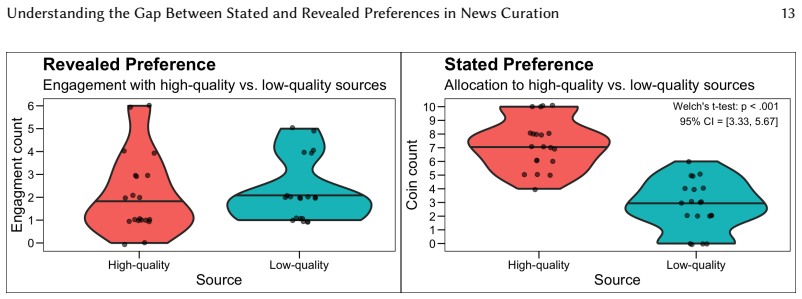
Young adults engage with low-quality social media news they reject in principle, yet they design higher-quality feeds when explicitly asked to prioritize accuracy and diversity for a hypothetical user.
A machine-rendered reading of the paper's core claim, the machinery that carries it, and where it could break.
Core claim
Participants frequently scrolled through low-quality or unendorsed news despite expressing a desire for accurate and diverse information. When tasked with creating an ideal feed for a hypothetical persona, they produced selections they judged higher in quality by emphasizing accuracy, diversity, and contextual appropriateness, while navigating trade-offs that accounted for the persona's relationships and social setting. The study concludes that news curation on platforms is a socially embedded judgment process rather than a simple reflection of past clicks.
What carries the argument
The gap between stated preferences (self-reported values from surveys and interviews) and revealed preferences (observed engagement patterns), uncovered through mixed-methods tasks including hypothetical feed curation that forces explicit value trade-offs.
If this is right
- Feed algorithms that optimize only for engagement metrics will continue to surface material users do not endorse.
- Incorporating explicit value-based curation options could produce feeds users rate as more satisfying.
- Designers should treat feed creation as a context-sensitive social activity rather than an individual click-history problem.
- Systems that allow users to articulate preferences for accuracy and diversity may reduce the observed gap between what people say and what they see.
Where Pith is reading between the lines
- Real-world platforms could test prototypes that let users periodically rebuild sections of their feed using the same persona-based prompts, then compare retention and reported satisfaction against standard engagement-driven feeds.
- The finding that social relationships influence curation choices implies that group-level or shared-feed features might better align algorithms with user values than purely personal models.
- If the gap persists across age groups, similar curation exercises could inform policy discussions on platform transparency and user control over information environments.
Load-bearing premise
Participants' descriptions of their own values and their choices in a hypothetical curation task accurately capture what they truly want and would apply outside the study setting without distortion from how the questions were framed.
What would settle it
A longitudinal study that measures whether giving users repeated opportunities to adjust their own real feeds according to the accuracy and diversity priorities they named produces sustained higher satisfaction and lower engagement with content they previously rated as low-quality.
Figures




read the original abstract
Social media feed algorithms infer user preferences from their past behaviors. Yet what drives engagement often diverges from what users value. We examine this gap between stated preferences (what users say they prefer) and revealed preferences (what their behavior suggests they prefer) among young adults, a group deeply embedded in algorithmically mediated environments. Using a mixed-methods approach combining surveys and interviews with feed curation activities, we investigate: what gaps exist between stated and revealed preferences; how users make sense of these gaps; what values users believe should guide algorithmic curation; and how systems might reflect those values. Participants often found themselves engaging with low-quality content they did not endorse, despite wanting high-quality information. When asked to curate an ideal social media news feed for a hypothetical persona, participants created feeds they considered more satisfying and higher in quality by prioritizing values such as accuracy and diversity. In doing so, they navigated trade-offs between different values, factoring in social relationships and context surrounding the persona. These findings suggest that feed curation is a socially situated process of judging what should be visible and appropriate in shared information spaces. Based on these insights, we offer design directions for bridging the gap between stated and revealed preferences.
Editorial analysis
A structured set of objections, weighed in public.
Referee Report
Summary. The paper examines the gap between stated preferences (what young adult social media users say they value in news feeds) and revealed preferences (what their engagement behavior suggests) using a mixed-methods design of surveys, interviews, and hypothetical feed-curation tasks for a persona. Key findings are that participants report engaging with low-quality content despite desiring high-quality information, and that persona-based curation produces feeds prioritizing accuracy, diversity, and other values while navigating social and contextual trade-offs. The authors conclude that curation is socially situated and offer design implications for aligning algorithms with user values.
Significance. If the empirical claims are substantiated, the work offers a useful qualitative lens on value misalignment in algorithmic curation and concrete design directions for HCI systems. The persona-curation method is a strength for surfacing trade-offs, and the emphasis on social situatedness moves beyond purely individual preference models.
major comments (2)
- [Methods] Methods section (description of interview protocol and revealed-preference elicitation): the paper operationalizes revealed preferences exclusively via retrospective self-reports of engagement and the hypothetical persona task. No platform logs, screen recordings, or direct observation of participants' actual feeds are described. This leaves the central gap claim vulnerable to recall bias and social-desirability effects, as both 'stated' and 'revealed' data derive from verbal accounts; the protocol must be shown to isolate behavioral reports independently of value statements.
- [Results] Results (persona-curation findings): the hypothetical persona task measures constructed ideals for a third party rather than participants' own revealed behavior. This design choice distances the data from personal engagement patterns and risks conflating aspirational curation with the claimed divergence; the paper should provide evidence that the task still validly indexes participants' underlying revealed preferences.
minor comments (2)
- [Abstract] Abstract and introduction: sample size, recruitment criteria, and exact analysis procedures (e.g., thematic coding scheme) are not stated, making it harder to assess generalizability and replicability.
- [Discussion] Discussion: the design implications would benefit from more explicit mapping back to specific participant quotes or curation examples to avoid over-generalization.
Simulated Author's Rebuttal
We thank the referee for their constructive and detailed feedback on our manuscript. We have carefully considered the two major comments and provide point-by-point responses below, including proposed revisions to the manuscript.
read point-by-point responses
-
Referee: [Methods] Methods section (description of interview protocol and revealed-preference elicitation): the paper operationalizes revealed preferences exclusively via retrospective self-reports of engagement and the hypothetical persona task. No platform logs, screen recordings, or direct observation of participants' actual feeds are described. This leaves the central gap claim vulnerable to recall bias and social-desirability effects, as both 'stated' and 'revealed' data derive from verbal accounts; the protocol must be shown to isolate behavioral reports independently of value statements.
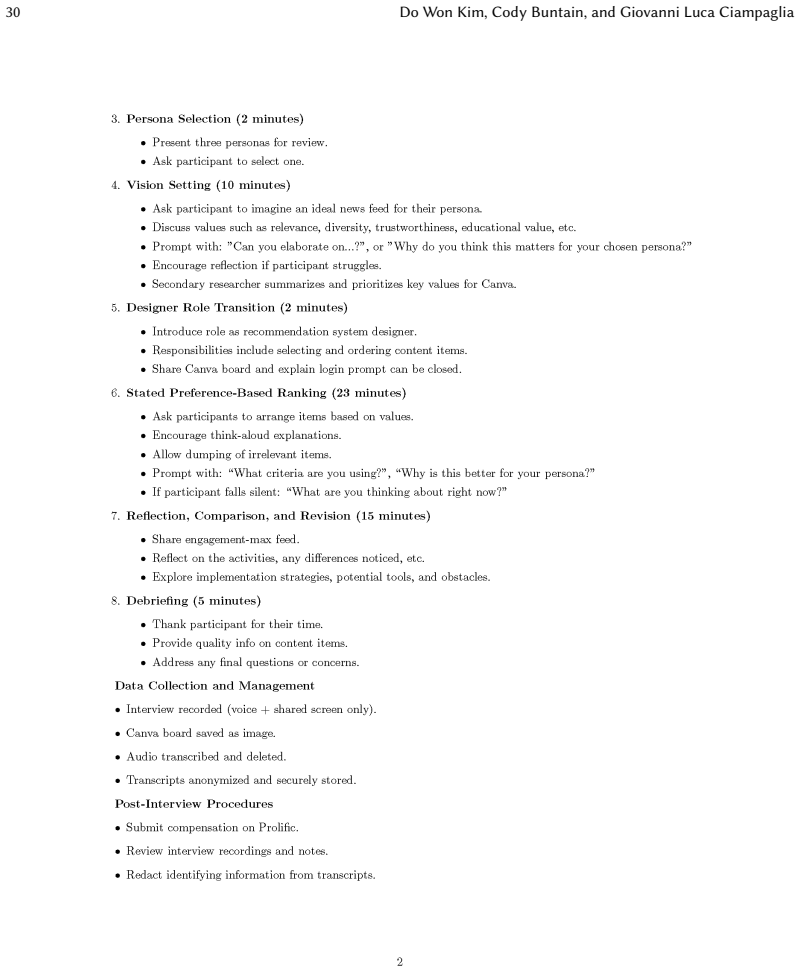
Authors: We acknowledge that the absence of direct platform logs or observational data means our operationalization of revealed preferences relies on retrospective self-reports, which introduces potential recall and social-desirability biases. This was a deliberate design choice driven by ethical and privacy constraints: our IRB protocol did not permit collection of participants' actual social media logs or screen recordings. To mitigate bias, the interview protocol was structured to first elicit stated preferences (via value-ranking exercises and questions about ideal news attributes) before transitioning to neutral, behavior-focused prompts about recent engagement (e.g., 'describe the last news-related posts you interacted with'). We will revise the methods section to explicitly detail this sequencing, add a dedicated limitations paragraph on self-report biases, and clarify that 'revealed preferences' here serve as a proxy for self-reported behavioral patterns, consistent with prior HCI work on value misalignment. revision: partial
-
Referee: [Results] Results (persona-curation findings): the hypothetical persona task measures constructed ideals for a third party rather than participants' own revealed behavior. This design choice distances the data from personal engagement patterns and risks conflating aspirational curation with the claimed divergence; the paper should provide evidence that the task still validly indexes participants' underlying revealed preferences.
Authors: The persona-curation task was intentionally designed to surface participants' underlying values and trade-offs in a decontextualized setting, rather than to directly replicate their personal revealed behavior. However, the results section already includes participant reflections explicitly connecting the persona feeds to their own experiences (e.g., noting social pressures that prevent similar curation in reality). To address the concern, we will expand the results with additional verbatim quotes demonstrating these linkages and revise the discussion to more precisely frame the task as a tool for illuminating the gap, without overstating it as a direct measure of personal revealed preferences. revision: partial
- Direct platform logs, screen recordings, or observational data of participants' actual feeds were not collected due to ethical and privacy constraints of the approved study protocol.
Circularity Check
No circularity: purely empirical qualitative study with no derivations or self-referential predictions
full rationale
This is a mixed-methods qualitative paper using surveys, interviews, and hypothetical persona curation tasks. All claims about gaps between stated and revealed preferences are tied directly to participant responses and thematic analysis. There are no equations, fitted parameters, mathematical predictions, or first-principles derivations that could reduce to inputs by construction. No self-citations function as load-bearing justifications for core results. The study is self-contained and externally grounded in collected data, meeting the criteria for a non-circular empirical finding.
Axiom & Free-Parameter Ledger
axioms (1)
- domain assumption Survey responses, interviews, and curation tasks accurately reveal participants' true preferences and values without substantial social desirability bias or demand effects.
Lean theorems connected to this paper
-
IndisputableMonolith/Foundation/RealityFromDistinction.leanreality_from_one_distinction unclear?
unclearRelation between the paper passage and the cited Recognition theorem.
mixed-methods approach combining surveys and interviews with feed curation activities... coin allocation... RBO scores... value dimensions (Balanced/Diversity, Trustworthy/Accuracy)
What do these tags mean?
- matches
- The paper's claim is directly supported by a theorem in the formal canon.
- supports
- The theorem supports part of the paper's argument, but the paper may add assumptions or extra steps.
- extends
- The paper goes beyond the formal theorem; the theorem is a base layer rather than the whole result.
- uses
- The paper appears to rely on the theorem as machinery.
- contradicts
- The paper's claim conflicts with a theorem or certificate in the canon.
- unclear
- Pith found a possible connection, but the passage is too broad, indirect, or ambiguous to say the theorem truly supports the claim.
Reference graph
Works this paper leans on
-
[1]
Himan Abdollahpouri and Robin Burke. 2022. Multistakeholder Recommender Systems. InRecommender Systems Handbook, Francesco Ricci, Lior Rokach, and Bracha Shapira (Eds.). Springer US, New York, NY, 647–677. doi:10.1007/ 978-1-0716-2197-4_17
work page 2022
-
[2]
and Davenport, Diag and Ludwig, Jens and Mullainathan, Sendhil , year =
Amanda Y. Agan, Diag Davenport, Jens Ludwig, and Sendhil Mullainathan. 2023. Automating Automaticity: How the Context of Human Choice Affects the Extent of Algorithmic Bias. doi:10.3386/w30981 national bureau of economic research:30981
-
[3]
Wajeeha Ahmad, Ananya Sen, Charles Eesley, and Erik Brynjolfsson. 2024. Companies Inadvertently Fund Online Misinformation despite Consumer Backlash.Nature630, 8015 (June 2024), 123–131. doi:10.1038/s41586-024-07404-1
-
[4]
Hunt Allcott, Matthew Gentzkow, and Lena Song. 2022. Digital Addiction.American Economic Review112, 7 (July 2022), 2424–2463. doi:10.1257/aer.20210867
-
[5]
American National Election Studies. 2021. ANES 2020 Time Series Study Full Release [dataset and documentation]. https://www.electionstudies.org July 19, 2021 version
work page 2021
-
[6]
Gaikwad, Alexis Hope, Dennis Jen, Jasmin Rubinovitz, Belén Saldías-Fuentes, and Ethan Zuckerman
Rahul Bhargava, Anna Chung, Neil S. Gaikwad, Alexis Hope, Dennis Jen, Jasmin Rubinovitz, Belén Saldías-Fuentes, and Ethan Zuckerman. 2019. Gobo: A System for Exploring User Control of Invisible Algorithms in Social Media. InCompanion Publication of the 2019 Conference on Computer Supported Cooperative Work and Social Computing (Austin, TX, USA)(CSCW ’19 C...
-
[7]
Paul Bouchaud, David Chavalarias, and Maziyar Panahi. 2023. Crowdsourced Audit of Twitter’s Recommender Systems. Scientific Reports13, 1 (Oct. 2023), 16815. doi:10.1038/s41598-023-43980-4
-
[8]
doi:10.1016/j.tics.2023.06.008
William J. Brady, Joshua Conrad Jackson, Björn Lindström, and M.J. Crockett. 2023. Algorithm-Mediated Social Learning in Online Social Networks.Trends in Cognitive Sciences27, 10 (Oct. 2023), 947–960. doi:10.1016/j.tics.2023.06.008
-
[9]
Luca Braghieri, Ro’ee Levy, and Alexey Makarin. 2022. Social Media and Mental Health.American Economic Review 112, 11 (Nov. 2022), 3660–3693. doi:10.1257/aer.20211218
-
[10]
Leonardo Bursztyn, Benjamin Handel, Rafael Jimenez-Duran, and Christopher Roth. 2023. When Product Markets Become Collective Traps: The Case of Social Media
work page 2023
-
[11]
Michael D. Ekstrand, Daniel Kluver, F. Maxwell Harper, and Joseph A. Konstan. 2015. Letting Users Choose Recom- mender Algorithms: An Experimental Study. InProceedings of the 9th ACM Conference on Recommender Systems(Vienna, Austria)(RecSys ’15). Association for Computing Machinery, New York, NY, USA, 11–18. doi:10.1145/2792838.2800195
-
[12]
Motahhare Eslami, Karrie Karahalios, Christian Sandvig, Kristen Vaccaro, Aimee Rickman, Kevin Hamilton, and Alex Kirlik. 2016. First I "like" It, Then I Hide It: Folk Theories of Social Feeds. InProceedings of the 2016 CHI Conference on Human Factors in Computing Systems. ACM, San Jose California USA, 2371–2382. doi:10.1145/2858036.2858494
-
[13]
K. J. Kevin Feng, Xander Koo, Lawrence Tan, Amy Bruckman, David W. McDonald, and Amy X. Zhang. 2024. Mapping the Design Space of Teachable Social Media Feed Experiences. InProceedings of the CHI Conference on Human Factors in Computing Systems. ACM, Honolulu HI USA, 1–20. doi:10.1145/3613904.3642120
-
[14]
Iason Gabriel. 2020. Artificial Intelligence, Values, and Alignment.Minds and Machines30, 3 (Sept. 2020), 411–437. doi:10.1007/s11023-020-09539-2
work page internal anchor Pith review doi:10.1007/s11023-020-09539-2 2020
-
[15]
Jaron Harambam, Dimitrios Bountouridis, Mykola Makhortykh, and Joris van Hoboken. 2019. Designing for the better by taking users into account: a qualitative evaluation of user control mechanisms in (news) recommender systems. In Proceedings of the 13th ACM Conference on Recommender Systems(Copenhagen, Denmark)(RecSys ’19). Association for Computing Machin...
-
[16]
Maurice Jakesch, Zana Buçinca, Saleema Amershi, and Alexandra Olteanu. 2022. How Different Groups Prioritize Ethical Values for Responsible AI. InProceedings of the 2022 ACM Conference on Fairness, Accountability, and Transparency (Seoul, Republic of Korea)(FAccT ’22). Association for Computing Machinery, New York, NY, USA, 310–323. doi:10. 1145/3531146.3533097
-
[17]
Shagun Jhaver, Alice Qian Zhang, Quan Ze Chen, Nikhila Natarajan, Ruotong Wang, and Amy X. Zhang. 2023. Personalizing Content Moderation on Social Media: User Perspectives on Moderation Choices, Interface Design, and Labor.Proc. ACM Hum.-Comput. Interact.7, CSCW2, Article 289 (Oct. 2023), 33 pages. doi:10.1145/3610080
-
[18]
Prerna Juneja, Md Momen Bhuiyan, and Tanushree Mitra. 2023. Assessing Enactment of Content Regulation Policies: A Post Hoc Crowd-Sourced Audit of Election Misinformation on YouTube. InProceedings of the 2023 CHI Conference on Human Factors in Computing Systems. ACM, Hamburg Germany, 1–22. doi:10.1145/3544548.3580846
-
[19]
Daniel Kahneman. 2011.Thinking, Fast and Slow. Farrar, Straus and Giroux, New York, NY
work page 2011
-
[20]
Nadia Karizat, Dan Delmonaco, Motahhare Eslami, and Nazanin Andalibi. 2021. Algorithmic Folk Theories and Identity: How TikTok Users Co-Produce Knowledge of Identity and Engage in Algorithmic Resistance.Proc. ACM Hum.-Comput. Interact.5, CSCW2, Article 305 (Oct. 2021), 44 pages. doi:10.1145/3476046
-
[21]
Jon Kleinberg, Jens Ludwig, Sendhil Mullainathan, and Manish Raghavan. 2024. The Inversion Problem: Why Algorithms Should Infer Mental State and Not Just Predict Behavior.Perspectives on Psychological Science19, 5 (Sept. , Vol. 1, No. 1, Article . Publication date: April 2026. 26 Do Won Kim, Cody Buntain, and Giovanni Luca Ciampaglia 2024), 827–838. doi:1...
- [22]
-
[23]
Pascal D. König. 2024. Challenges in enabling user control over algorithm-based services.AI & SOCIETY39, 1 (Feb. 2024), 195–205. doi:10.1007/s00146-022-01395-1
- [24]
-
[25]
David Lazer, Briony Swire-Thompson, and Christo Wilson. 2024. A Normative Framework for Assessing the Information Curation Algorithms of the Internet.Perspectives on Psychological Science19, 5 (Sept. 2024), 749–757. doi:10.1177/ 17456916231186779 First published online: November 27, 2023
work page 2024
-
[26]
Min Kyung Lee and Su Baykal. 2017. Algorithmic Mediation in Group Decisions: Fairness Perceptions of Algorithmically Mediated vs. Discussion-Based Social Division. InProceedings of the 2017 ACM Conference on Computer Supported Cooperative Work and Social Computing(Portland, Oregon, USA)(CSCW ’17). Association for Computing Machinery, New York, NY, USA, 10...
-
[27]
Min Kyung Lee, Anuraag Jain, Hea Jin Cha, Shashank Ojha, and Daniel Kusbit. 2019. Procedural Justice in Algorithmic Fairness: Leveraging Transparency and Outcome Control for Fair Algorithmic Mediation.Proc. ACM Hum.-Comput. Interact.3, CSCW, Article 182 (Nov. 2019), 26 pages. doi:10.1145/3359284
-
[28]
adaptable commitment interfaces
Kai Lukoff, Ulrik Lyngs, Karina Shirokova, Raveena Rao, Larry Tian, Himanshu Zade, Sean A. Munson, and Alexis Hiniker. 2023. Switchtube: A proof-of-concept system introducing “adaptable commitment interfaces” as a tool for digital wellbeing. InProceedings of the 2023 CHI Conference on Human Factors in Computing Systems. Association for Computing Machinery...
work page 2023
-
[29]
Vera Liao, James Choi, Kaiyue Fan, Sean A
Kai Lukoff, Ulrik Lyngs, Himanshu Zade, J. Vera Liao, James Choi, Kaiyue Fan, Sean A. Munson, and Alexis Hiniker
-
[30]
InProceedings of the 2021 CHI Conference on Human Factors in Computing Systems (CHI ’21)
How the Design of YouTube Influences User Sense of Agency. InProceedings of the 2021 CHI Conference on Human Factors in Computing Systems(Yokohama, Japan)(CHI ’21). Association for Computing Machinery, New York, NY, USA, Article 368, 17 pages. doi:10.1145/3411764.3445467
-
[31]
Ulrik Lyngs, Kai Lukoff, Petr Slovak, William Seymour, Helena Webb, Marina Jirotka, Jun Zhao, Max Van Kleek, and Nigel Shadbolt. 2020. I Just Want to Hack Myself to Not Get Distracted: Evaluating Design Interventions for Self- Control on Facebook. InProceedings of the 2020 CHI Conference on Human Factors in Computing Systems. Association for Computing Mac...
work page 2020
- [32]
-
[33]
Lillio Mok, Sasha Nanda, and Ashton Anderson. 2023. People Perceive Algorithmic Assessments as Less Fair and Trustworthy Than Identical Human Assessments.Proc. ACM Hum.-Comput. Interact.7, CSCW2, Article 309 (Oct. 2023), 26 pages. doi:10.1145/3610100
-
[34]
Morewedge, Sendhil Mullainathan, Haaya F
Carey K. Morewedge, Sendhil Mullainathan, Haaya F. Naushan, Cass R. Sunstein, Jon Kleinberg, Manish Raghavan, and Jens O. Ludwig. 2023. Human Bias in Algorithm Design.Nature Human Behaviour7, 11 (Nov. 2023), 1822–1824. doi:10.1038/s41562-023-01724-4
-
[35]
Tonya Nguyen, Sabriya Alam, Cathy Hu, Catherine Albiston, and Niloufar Salehi. 2024. Definitions of Fairness Differ Across Socioeconomic Groups & Shape Perceptions of Algorithmic Decisions.Proc. ACM Hum.-Comput. Interact.8, CSCW2, Article 519 (Nov. 2024), 31 pages. doi:10.1145/3687058
-
[36]
Joon Sung Park, Karrie Karahalios, Niloufar Salehi, and Motahhare Eslami. 2022. Power Dynamics and Value Conflicts in Designing and Maintaining Socio-Technical Algorithmic Processes.Proc. ACM Hum.-Comput. Interact.6, CSCW1, Article 110 (April 2022), 21 pages. doi:10.1145/3512957
-
[37]
Lauren Pyle, Amy X. Ko, and Yubo Wang. 2024. Algorithmic Literacy and Algorithmic Resistance Among Migrant Tech Workers.Proceedings of the ACM on Human-Computer Interaction8, CSCW1 (2024), 1–32. doi:10.1145/3626497
-
[38]
Steve Rathje, Claire Robertson, William J Brady, and Jay J Van Bavel. 2024. People Think That Social Media Platforms Do (but Should Not) Amplify Divisive Content.Perspectives on Psychological Science19, 5 (2024), 781–795
work page 2024
-
[39]
Robertson, Nicolas Pröllochs, Kaoru Schwarzenegger, Philip Pärnamets, Jay J
Claire E. Robertson, Nicolas Pröllochs, Kaoru Schwarzenegger, Philip Pärnamets, Jay J. Van Bavel, and Stefan Feuerriegel
-
[40]
doi:10.1038/ s41562-023-01538-4
Negativity Drives Online News Consumption.Nature Human Behaviour7, 5 (March 2023), 812–822. doi:10.1038/ s41562-023-01538-4
work page 2023
-
[41]
Jean-Charles Rochet and Jean Tirole. 2003. Platform competition in two-sided markets.Journal of the european economic association1, 4 (2003), 990–1029
work page 2003
-
[42]
2021.The Coding Manual for Qualitative Researchers
Johnny Saldana. 2021.The Coding Manual for Qualitative Researchers. SAGE Publications, Los Angeles, California; London
work page 2021
-
[43]
Felix Schläpfer. 2017. Stated preferences for public services: A classification and survey of approaches.Journal of Economic Surveys31, 1 (2017), 258–280. doi:10.1111/joes.12140 , Vol. 1, No. 1, Article . Publication date: April 2026. Understanding the Gap Between Stated and Revealed Preferences in News Curation 27
-
[44]
Slany, E.; Ott, Y .; Scheele, S.; Paulus, J.; and Schmid, U
Hua Shen, Tiffany Knearem, Reshmi Ghosh, Kenan Alkiek, Kundan Krishna, Yachuan Liu, Ziqiao Ma, Savvas Petridis, Yi-Hao Peng, Li Qiwei, Sushrita Rakshit, Chenglei Si, Yutong Xie, Jeffrey P. Bigham, Frank Bentley, Joyce Chai, Zachary Lipton, Qiaozhu Mei, Rada Mihalcea, Michael Terry, Diyi Yang, Meredith Ringel Morris, Paul Resnick, and David Jurgens. 2024. ...
-
[45]
Christopher St. Aubin and Jacob Liedke. 2024. Social Media and News Fact Sheet. https://www.pewresearch.org/ journalism/fact-sheet/social-media-and-news-fact-sheet/
work page 2024
-
[46]
Alexander J. Stewart, Antonio A. Arechar, David G. Rand, and Joshua B. Plotkin. 2024. The Distorting Effects of Producer Strategies: Why Engagement Does Not Reveal Consumer Preferences for Misinformation.Proceedings of the National Academy of Sciences121, 10 (March 2024), e2315195121. doi:10.1073/pnas.2315195121
-
[47]
Elias Storms, Oscar Alvarado, and Luciana Monteiro-Krebs. 2022. ’Transparency Is Meant for Control’ and Vice Versa: Learning from Co-designing and Evaluating Algorithmic News Recommenders.Proceedings of the ACM on Human-Computer Interaction6, CSCW2 (Nov. 2022), 1–24. doi:10.1145/3555130
-
[48]
Jonathan Stray, Alon Halevy, Parisa Assar, Dylan Hadfield-Menell, Craig Boutilier, Amar Ashar, Chloe Bakalar, Lex Beattie, Michael Ekstrand, Claire Leibowicz, Connie Moon Sehat, Sara Johansen, Lianne Kerlin, David Vickrey, Spandana Singh, Sanne Vrijenhoek, Amy Zhang, McKane Andrus, Natali Helberger, Polina Proutskova, Tanushree Mitra, and Nina Vasan. 2024...
-
[49]
Joëlle Swart. 2021. Experiencing Algorithms: How Young People Understand, Feel About, and Engage With Algo- rithmic News Selection on Social Media.Social Media + Society7, 2 (April 2021), 205630512110088. doi:10.1177/ 20563051211008828
work page 2021
-
[50]
Richard H. Thaler and Cass R. Sunstein. 2008.Nudge: Improving Decisions about Health, Wealth, and Happiness. Yale University Press, New Haven, CT, US. x, 293 pages
work page 2008
-
[51]
Matt Twyman, Nigel Harvey, and Clare Harries. 2008. Trust in motives, trust in competence: Separate factors determining the effectiveness of risk communication.Judgment and Decision Making3, 1 (2008), 111–120. doi:10.1017/ S1930297500000218
work page 2008
-
[52]
Yamil R. Velez, Donald P. Green, and Semra Sevi. 2025. Chatbot Voting Advice Applications Inform but Seldom Sway Young Unaligned Voters.Proceedings of the National Academy of Sciences122, 50 (2025), e2515516122. doi:10.1073/pnas. 2515516122 arXiv:https://www.pnas.org/doi/pdf/10.1073/pnas.2515516122
-
[53]
William Webber, Alistair Moffat, and Justin Zobel. 2010. A Similarity Measure for Indefinite Rankings.ACM Transactions on Information Systems28, 4 (Nov. 2010), 1–38. doi:10.1145/1852102.1852106
-
[54]
Callum Woods, Zhiyuan Luo, Dawn Watling, and Szonya Durant. 2022. Twenty Seconds of Visual Behaviour on Social Media Gives Insight into Personality.Scientific Reports12, 1 (Jan. 2022), 1178. doi:10.1038/s41598-022-05095-0
-
[55]
Eva Zangerle and Christine Bauer. 2023. Evaluating Recommender Systems: Survey and Framework.Comput. Surveys 55, 8 (Aug. 2023), 1–38. doi:10.1145/3556536
-
[56]
Tan Zhi-Xuan, Micah Carroll, Matija Franklin, and Hal Ashton. 2025. Beyond Preferences in AI Alignment.Philosophical Studies182 (2025), 1813–1863. doi:10.1007/s11098-024-02249-w
-
[57]
Haiyi Zhu, Bowen Yu, Aaron Halfaker, and Loren Terveen. 2018. Value-Sensitive Algorithm Design: Method, Case Study, and Lessons.Proc. ACM Hum.-Comput. Interact.2, CSCW, Article 194 (Nov. 2018), 23 pages. doi:10.1145/3274463 , Vol. 1, No. 1, Article . Publication date: April 2026. 28 Do Won Kim, Cody Buntain, and Giovanni Luca Ciampaglia APPENDIX A VALIDAT...
discussion (0)
Sign in with ORCID, Apple, or X to comment. Anyone can read and Pith papers without signing in.