Recognition: unknown
Heterophily as a generative mechanism for self-organized synergistic interdependencies
Pith reviewed 2026-05-10 15:02 UTC · model grok-4.3
The pith
Heterophily weakens pairwise dependencies while inducing high-order ones through geometric constraints, generating self-organized synergistic interdependencies.
A machine-rendered reading of the paper's core claim, the machinery that carries it, and where it could break.
Core claim
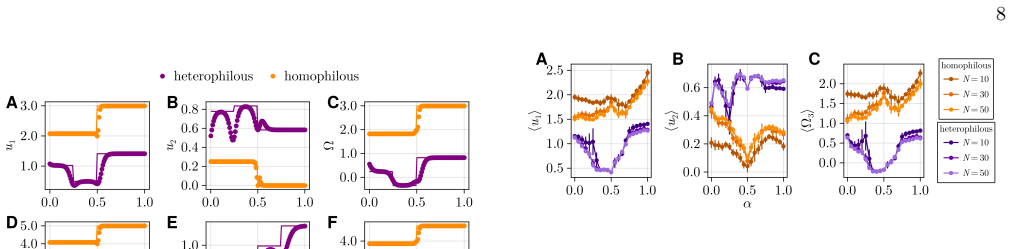
In the paradigmatic spin-glass-like model with co-evolving couplings, heterophily generates the conditions for synergy by simultaneously weakening pairwise dependencies and inducing high-order dependencies via geometric constraints on the configurations it selects. These two effects together underpin the emergence of self-organized synergistic interdependencies. The mechanism is confirmed analytically for N=3 and persists in numerical simulations of larger systems, remaining robust under parameter heterogeneities and different dynamics. The same rule applied to opinion dynamics shows heterophily disrupting polarization while making individuals' opinions better explained by group-level thanby
What carries the argument
Heterophily as the sole adaptive rule in a co-evolving spin-glass-like model, which selects configurations that reduce pairwise correlations yet enforce higher-order geometric dependencies.
If this is right
- The mechanism persists in large systems and remains stable under parameter variations and different update rules.
- Heterophily applied to opinion dynamics reduces polarization while shifting explanatory power from pairwise to group-level influences.
- Synergistic interdependencies can arise in information-processing systems through local adaptation alone.
- The same local rule offers a route to collective phenomena in computational social science, neuroscience, and biology.
Where Pith is reading between the lines
- Real-world networks that enforce heterophily might exhibit measurable rises in higher-order information measures even when pairwise correlations stay low.
- In neural or social data, tracking how connection preferences shift toward dissimilarity could predict the onset of group-level synergies.
- Models that omit heterophily may systematically underestimate collective coordination in changing environments.
Load-bearing premise
The minimal co-evolving spin-glass-like model using heterophily alone is enough to capture how synergy arises in real adaptive systems such as brains or societies, and the N=3 solution extends without extra mechanisms.
What would settle it
In an isolated three-unit system, measure whether introducing heterophily as the adaptation rule produces the predicted drop in pairwise mutual information accompanied by a rise in higher-order synergistic information; absence of this paired pattern would falsify the claimed mechanism.
Figures




read the original abstract
Understanding what and how causal dynamical mechanisms generate collective phenomena is a central challenge in complexity science. Recent studies have focused on identifying the mechanisms underlying the synergistic interdependencies that characterise these phenomena in systems with fixed interaction structures. Yet, real-world systems displaying collective phenomena, such as brains, societies, and ecosystems, are adaptive: interactions change in time. Here, we show that heterophily is a minimal local adaptive mechanism for the emergence of self-organized synergistic interdependencies. We study a paradigmatic spin-glass-like model with co-evolving couplings to show how heterophily generates the conditions for synergy to emerge. By solving the minimal $N=3$ case analytically, we reveal the precise mechanism: heterophily weakens pairwise dependencies while inducing high-order dependencies via geometric constraints on the configurations it selects. Together, these two effects underpin synergy. Numerical simulations confirm that this mechanism persists in large systems and that it is robust under parameter heterogeneities and dynamics. We demonstrate the applicability of our results by showing how heterophily can disrupt polarization while promoting synergistic information dynamics of opinions, where individuals' opinions are better explained by group-level influences than by pairwise ones. These results offer a parsimonious route to self-organized synergistic interdependencies in information-processing systems, with potential applications in computational social science, neuroscience, and biology.
Editorial analysis
A structured set of objections, weighed in public.
Referee Report
Summary. The manuscript claims that heterophily is a minimal local adaptive mechanism for the emergence of self-organized synergistic interdependencies. In a co-evolving spin-glass-like model, an exact analytical solution for the N=3 case shows that heterophily weakens pairwise dependencies while inducing higher-order dependencies via geometric constraints on the selected configurations; these two effects together generate synergy. Numerical simulations confirm that the mechanism persists for larger N, remains robust under parameter heterogeneities and varied dynamics, and can be applied to opinion dynamics where heterophily disrupts polarization while promoting group-level synergistic information processing over pairwise influences.
Significance. If the central claims hold, the work supplies a parsimonious generative account of how local adaptive rules produce collective synergy in adaptive systems, with direct relevance to complexity science, computational social science, neuroscience, and biology. The exact N=3 analytical solution and the accompanying numerical robustness checks constitute clear strengths, as they isolate the mechanism without data-fitting or additional ad-hoc terms and provide falsifiable predictions for larger systems.
major comments (1)
- [N=3 analytical solution] N=3 analytical solution: The central claim rests on the demonstration that heterophily weakens pairwise couplings yet induces higher-order dependencies through geometric selection of configurations. The manuscript should include the explicit intermediate equations (e.g., the form of the effective three-body terms or the probability distribution over the eight possible spin configurations) that establish this geometric induction, so that readers can verify the step from the model equations to the reported synergy without reconstructing the derivation.
minor comments (3)
- [Abstract] Abstract: The term 'synergistic interdependencies' and the specific information-theoretic measure of synergy employed are not defined; a one-sentence clarification would improve accessibility for readers outside the immediate subfield.
- [Numerical simulations] Numerical simulations: The ranges and distributions used for parameter heterogeneities in the robustness checks should be stated explicitly (e.g., variance of the heterophily strength or coupling disorder), together with the number of independent realizations, to support reproducibility.
- [Application to opinions] Opinion-dynamics application: The quantification of synergistic information (e.g., via partial information decomposition) and the precise baseline comparison (pairwise-only model) should be detailed, including any statistical tests for the reported reduction in polarization.
Simulated Author's Rebuttal
We thank the referee for their positive evaluation and constructive feedback, which we address below. We agree that adding the requested intermediate equations will strengthen the presentation of the N=3 solution.
read point-by-point responses
-
Referee: N=3 analytical solution: The central claim rests on the demonstration that heterophily weakens pairwise couplings yet induces higher-order dependencies through geometric selection of configurations. The manuscript should include the explicit intermediate equations (e.g., the form of the effective three-body terms or the probability distribution over the eight possible spin configurations) that establish this geometric induction, so that readers can verify the step from the model equations to the reported synergy without reconstructing the derivation.
Authors: We agree that the explicit intermediate steps will improve verifiability. In the revised manuscript we will insert the full derivation of the effective three-body terms generated by the geometric constraints, together with the exact probability distribution over the eight spin configurations for the N=3 case. These additions will allow readers to trace the transition from the co-evolution rules to the reported weakening of pairwise couplings and the emergence of synergistic higher-order dependencies without needing to reconstruct the algebra. revision: yes
Circularity Check
No significant circularity detected
full rationale
The derivation proceeds by defining a co-evolving spin-glass model with heterophily as the sole local adaptive rule, then solving the N=3 case directly from the model equations to isolate the dual effect on pairwise and higher-order dependencies. This analytical result is presented as following from the geometric constraints of the chosen configurations, with numerical simulations at larger N serving as independent confirmation rather than a fit. No parameters are tuned to target synergy values, no self-citations are invoked to justify uniqueness or the ansatz, and the model is scoped as paradigmatic without reducing the central claim to its own inputs by construction.
Axiom & Free-Parameter Ledger
free parameters (1)
- heterophily strength parameter
axioms (1)
- domain assumption The system can be represented as spins whose couplings co-evolve according to a local heterophily rule.
Reference graph
Works this paper leans on
-
[1]
It can be written as Ω(XN) = (N−2)H(X N)+ NX j=1 [H(X j)−H(X −j)],(3) whereH(·) denotes the Shannon entropy,X N = (X1,
O-information The O-information (Ω) is a symmetric, signed multi- variate extension of the mutual information that quan- tifies the relative dominance of synergistic vs redundant dependencies [12]. It can be written as Ω(XN) = (N−2)H(X N)+ NX j=1 [H(X j)−H(X −j)],(3) whereH(·) denotes the Shannon entropy,X N = (X1, . . . , X N) denotes the whole system (a...
-
[2]
Total dynamical O-information The O-information quantifies the balance between re- dundancy and synergy in the equal-time distribution of a set of variables. To extend this notion to time-lagged (directed) statistical dependencies in multivariate time series, Stramagliaet al.[34] introduced the dynamical O-information, defined as the variation of O-inform...
-
[3]
Ground state solutions for small systems Here we show precisely how the preferred dyadic dis- tances imposed by the local rule (homophily or het- erophily) must also satisfy geometric realisability con- straints, leading to particular sets of ground states that minimizeE(S). For the sake of clarity, we report in the main text the results for symmetric sys...
-
[4]
Intuitively, when a node is selected and a site gin{s g i }G g=1 is flipped, the proposal is always accepted FIG
Triangle analysis for large systems We now test whether large systems self-organize into structures in which particular triangles ∆ k are overrep- resented. Intuitively, when a node is selected and a site gin{s g i }G g=1 is flipped, the proposal is always accepted FIG. 3. Mean triangle densitiesn k of triangle types ∆ k as a function ofα, wherekdenotes t...
-
[5]
Since there is no external field, each spin marginal is uniform, henceH(s i) =Gfor alli
High-order interdependencies in small systems Letδ ⋆ ={a, b, c}be a ground state solution for a given (λ, α, G) (see Table I), and let M(δ⋆) := (s1,s 2,s 3)∈ {−1,1} 3G :{d ij, dik, djk }=δ ⋆ , (13) withi̸=j̸=k, denote the set of microstates whose distances satisfyδ ⋆. Since there is no external field, each spin marginal is uniform, henceH(s i) =Gfor alli....
-
[6]
High-order interdependencies in large systems TheN= 3 case isolates the mechanism in its mini- mal form. We now ask whether the same informational architecture regimes persist when triangles are part of larger networks, where distinct triplets can share edges and constraints can thus propagate across the network. Since the microstate space grows as 2N G, ...
-
[7]
,50 after the perturbation
For each value ofp, we construct 50 replica ensembles of sizeR= 10 5 and record snapshots of the systems stateS(t b), S(t b + 1) at timest b = 0,5,10, . . . ,50 after the perturbation. Each replica within an ensemble is initialized from the same polarized configuration att b =
-
[8]
For this experiment, as in [32], we useβ= 3.4, and small-world networks with average degree 4 and probability of rewiring equal to 0.175
Thus, replicas diverge only due to stochastic updates after the perturbation. For this experiment, as in [32], we useβ= 3.4, and small-world networks with average degree 4 and probability of rewiring equal to 0.175. Additionally, to facilitate direct comparison with Refs. [27, 32], in this section we adopt the same local Metropolis update scheme used ther...
-
[9]
H. J. Jensen,Complexity Science: The Study of Emer- gence(Cambridge University Press, New York, NY, 2023)
2023
-
[10]
Battiston and G
F. Battiston and G. Petri,Higher-order systems (Springer, 2022)
2022
-
[11]
Borsboom and A
D. Borsboom and A. O. Cramer, Network analysis: An integrative approach to the structure of psychopathology, Annual Review of Clinical Psychology9, 91–121 (2013)
2013
-
[12]
Sporns, The complex brain: connectivity, dynamics, information, Trends in Cognitive Sciences26, 1066–1067 (2022)
O. Sporns, The complex brain: connectivity, dynamics, information, Trends in Cognitive Sciences26, 1066–1067 (2022)
2022
-
[13]
D. L. Barab´ asi, G. Bianconi, E. Bullmore, M. Burgess, S. Chung, T. Eliassi-Rad, D. George, I. A. Kov´ acs, H. Makse, T. E. Nichols, C. Papadimitriou, O. Sporns, K. Stachenfeld, Z. Toroczkai, E. K. Towlson, A. M. Zador, H. Zeng, A.-L. Barab´ asi, A. Bernard, and G. Buzs´ aki, Neuroscience needs network science, The Journal of Neuroscience43, 5989–5995 (2023)
2023
-
[14]
R. Sol´ e and S. Levin, Ecological complexity and the biosphere: the next 30 years, Philosophical Transac- tions of the Royal Society B: Biological Sciences377, 10.1098/rstb.2021.0376 (2022)
-
[15]
Caldarelli, E
G. Caldarelli, E. Arcaute, M. Barthelemy, M. Batty, C. Gershenson, D. Helbing, S. Mancuso, Y. Moreno, J. J. Ramasco, C. Rozenblat, A. S´ anchez, and J. L. Fern´ andez- Villaca˜ nas, The role of complexity for digital twins of 13 cities, Nature Computational Science3, 374–381 (2023)
2023
-
[16]
F. E. Rosas, P. A. M. Mediano, A. I. Luppi, T. F. Varley, J. T. Lizier, S. Stramaglia, H. J. Jensen, and D. Mari- nazzo, Disentangling high-order mechanisms and high- order behaviours in complex systems, Nature Physics18, 476–477 (2022)
2022
-
[17]
F. Malizia, A. Corso, L. V. Gambuzza, G. Russo, V. La- tora, and M. Frasca, Reconstructing higher-order inter- actions in coupled dynamical systems, Nature Commu- nications15, 10.1038/s41467-024-49278-x (2024)
-
[18]
T. Robiglio, M. Neri, D. Coppes, C. Agostinelli, F. Bat- tiston, M. Lucas, and G. Petri, Synergistic signatures of group mechanisms in higher-order systems, Physi- cal Review Letters134, 10.1103/physrevlett.134.137401 (2025)
-
[19]
P. L. Williams and R. D. Beer, Nonnegative decomposi- tion of multivariate information (2010), arXiv:1004.2515 [cs.IT]
work page Pith review arXiv 2010
-
[20]
F. E. Rosas, P. A. M. Mediano, M. Gastpar, and H. J. Jensen, Quantifying high-order interdependencies via multivariate extensions of the mutual information, Phys. Rev. E100, 032305 (2019)
2019
-
[21]
F. E. Rosas, A. J. Gutknecht, P. A. M. Mediano, and M. Gastpar, Characterising high-order interdependence via entropic conjugation, Communications Physics8, 10.1038/s42005-025-02250-7 (2025)
-
[22]
E. Caprioglio, A. M. P. Mediano, and L. Berthouze, Syn- ergistic motifs in gaussian systems, Physical Review Let- ters 10.1103/179y-qp6j (2026)
-
[23]
J. H. Holland, Outline for a logical theory of adaptive systems, Journal of the ACM (JACM)9, 297 (1962)
1962
-
[24]
Gross and B
T. Gross and B. Blasius, Adaptive coevolutionary net- works: a review, Journal of The Royal Society Interface 5, 259–271 (2007)
2007
-
[25]
A. I. Luppi, P. A. M. Mediano, F. E. Rosas, N. Holland, T. D. Fryer, J. T. O’Brien, J. B. Rowe, D. K. Menon, D. Bor, and E. A. Stamatakis, A synergistic core for hu- man brain evolution and cognition, Nature Neuroscience 25, 771–782 (2022)
2022
-
[26]
T. F. Varley, O. Sporns, N. J. Stevenson, P. Yrj¨ ol¨ a, M. G. Welch, M. M. Myers, S. Vanhatalo, and A. Tokariev, Emergence of a synergistic scaffold in the brains of human infants, Communications Biology8, 10.1038/s42003-025- 08082-z (2025)
-
[27]
Gatica, R
M. Gatica, R. Cofr´ e, P. A. Mediano, F. E. Rosas, P. Orio, I. Diez, S. P. Swinnen, and J. M. Cortes, High-order in- terdependencies in the aging brain, Brain Connectivity 11, 734–744 (2021)
2021
-
[28]
Gatica, C
M. Gatica, C. Atkinson-Clement, C. Coronel-Oliveros, M. Alkhawashki, P. A. M. Mediano, E. Tagliazucchi, F. E. Rosas, M. Kaiser, and G. Petri, Understanding the high-order network plasticity mechanisms of ultra- sound neuromodulation, PLOS Computational Biology 21, e1013514 (2025)
2025
-
[29]
Gatica, C
M. Gatica, C. Atkinson-Clement, P. A. M. Mediano, M. Alkhawashki, J. Ross, J. Sallet, and M. Kaiser, Tran- scranial ultrasound stimulation effect in the redundant and synergistic networks consistent across macaques, Network Neuroscience8, 1032–1050 (2024)
2024
-
[30]
P. Urbina-Rodriguez, Z. Fountas, F. E. Rosas, J. Wang, A. I. Luppi, H. Bou-Ammar, M. Shanahan, and P. A. Mediano, A brain-like synergistic core in llms drives be- haviour and learning, arXiv preprint arXiv:2601.06851 (2026)
-
[31]
A. M. Proca, F. E. Rosas, A. I. Luppi, D. Bor, M. Crosby, and P. A. M. Mediano, Synergistic information supports modality integration and flexible learning in neural net- works solving multiple tasks, PLOS Computational Biol- ogy20, e1012178 (2024)
2024
-
[32]
McPherson, L
M. McPherson, L. Smith-Lovin, and J. M. Cook, Birds of a feather: Homophily in social networks, Annual Review of Sociology27, 415–444 (2001)
2001
-
[33]
FLACHE and M
A. FLACHE and M. W. MACY, Small worlds and cul- tural polarization, The Journal of Mathematical Sociol- ogy35, 146–176 (2011)
2011
-
[34]
C. A. Bail, L. P. Argyle, T. W. Brown, J. P. Bumpus, H. Chen, M. B. F. Hunzaker, J. Lee, M. Mann, F. Mer- hout, and A. Volfovsky, Exposure to opposing views on social media can increase political polarization, Proceed- ings of the National Academy of Sciences115, 9216–9221 (2018)
2018
-
[35]
T. M. Pham, J. Korbel, R. Hanel, and S. Thurner, Em- pirical social triad statistics can be explained with dyadic homophylic interactions, Proceedings of the National Academy of Sciences119, 10.1073/pnas.2121103119 (2022)
-
[36]
J. Korbel, S. D. Lindner, T. M. Pham, R. Hanel, and S. Thurner, Homophily-based social group formation in a spin glass self-assembly framework, Physical Review Letters130, 10.1103/physrevlett.130.057401 (2023)
-
[37]
Matsuda, Physical nature of higher-order mutual in- formation: Intrinsic correlations and frustration, Physi- cal Review E62, 3096–3102 (2000)
H. Matsuda, Physical nature of higher-order mutual in- formation: Intrinsic correlations and frustration, Physi- cal Review E62, 3096–3102 (2000)
2000
-
[38]
Motsch and E
S. Motsch and E. Tadmor, Heterophilious dynamics en- hances consensus, SIAM Review56, 577–621 (2014)
2014
-
[39]
D. L. Stein and C. M. Newman,Spin Glasses and Com- plexity(Princeton University Press, 2013)
2013
-
[40]
S. Thurner, M. Hofer, and J. Korbel, Why more so- cial interactions lead to more polarization in societies, Proceedings of the National Academy of Sciences122, 10.1073/pnas.2517530122 (2025)
-
[41]
M. Galesic, H. Olsson, T. M. Pham, J. Sorger, and S. Thurner, Experimental evidence confirms that tri- adic social balance can be achieved through dyadic inter- actions, npj Complexity2, 10.1038/s44260-024-00022-y (2025)
-
[42]
S. Stramaglia, T. Scagliarini, B. C. Daniels, and D. Mari- nazzo, Quantifying dynamical high-order interdepen- dencies from the o-information: An application to neural spiking dynamics, Frontiers in Physiology11, 10.3389/fphys.2020.595736 (2021)
-
[43]
H. Rajpal, C. v. Stengel, P. A. M. Mediano, F. E. Rosas, E. Viegas, P. A. Marquet, and H. J. Jensen, In- formation dynamics and the emergence of high-order in- dividuality in ecosystems, Communications Biology8, 10.1038/s42003-025-08619-2 (2025)
-
[44]
Caprioglio, Repository for self- organized synergistic interdependencies, https://github.com/EnricoCaprioglio/ HeterophilousSynergisticSpinSystem/(2026)
E. Caprioglio, Repository for self- organized synergistic interdependencies, https://github.com/EnricoCaprioglio/ HeterophilousSynergisticSpinSystem/(2026)
2026
-
[45]
S. A. Marvel, S. H. Strogatz, and J. M. Kleinberg, Energy landscape of social balance, Physical Review Letters103, 10.1103/physrevlett.103.198701 (2009)
-
[46]
Heider, Attitudes and cognitive organization, The Journal of Psychology21, 107–112 (1946)
F. Heider, Attitudes and cognitive organization, The Journal of Psychology21, 107–112 (1946)
1946
-
[47]
the hung elections scenario
S. Galam, Contrarian deterministic effects on opinion dynamics: “the hung elections scenario”, Physica A: Statistical Mechanics and its Applications333, 453–460 14 (2004)
2004
-
[48]
J. A. Davis, Clustering and structural balance in graphs, Human relations20, 181 (1967)
1967
-
[49]
Cartwright and F
D. Cartwright and F. Harary, Structural balance: a gen- eralization of heider’s theory., Psychological Review63, 277–293 (1956)
1956
-
[50]
Estrada, Rethinking structural balance in signed so- cial networks, Discrete Applied Mathematics268, 70–90 (2019)
E. Estrada, Rethinking structural balance in signed so- cial networks, Discrete Applied Mathematics268, 70–90 (2019)
2019
-
[51]
T. Antal, P. L. Krapivsky, and S. Redner, Dynamics of social balance on networks, Physical Review E72, 10.1103/physreve.72.036121 (2005)
-
[52]
Facchetti, G
G. Facchetti, G. Iacono, and C. Altafini, Computing global structural balance in large-scale signed social net- works, Proceedings of the National Academy of Sciences 108, 20953–20958 (2011)
2011
-
[53]
S. A. Marvel, J. Kleinberg, R. D. Kleinberg, and S. H. Strogatz, Continuous-time model of structural balance, Proceedings of the National Academy of Sciences108, 1771–1776 (2011)
2011
-
[54]
A. Kirkley, G. T. Cantwell, and M. E. J. Newman, Balance in signed networks, Physical Review E99, 10.1103/physreve.99.012320 (2019)
-
[55]
Healy and A
B. Healy and A. Stein, The balance of power in inter- national history: Theory and reality, Journal of Conflict Resolution17, 33–61 (1973)
1973
-
[56]
Altafini, Dynamics of opinion forming in structurally balanced social networks, PLoS ONE7, e38135 (2012)
C. Altafini, Dynamics of opinion forming in structurally balanced social networks, PLoS ONE7, e38135 (2012)
2012
-
[57]
A. Gallo, D. Garlaschelli, R. Lambiotte, F. Saracco, and T. Squartini, Testing structural balance theories in het- erogeneous signed networks, Communications Physics7, 10.1038/s42005-024-01640-7 (2024)
-
[58]
Wu and P
Y. Wu and P. Guo, Effects of relative homophily and relative heterophily on opinion dynamics in coevolving networks, Physica A: Statistical Mechanics and its Ap- plications644, 129835 (2024). 15 SUPPLEMENTARY INFORMATION Appendix A: Additional Technical Details
2024
-
[59]
We wish to find the cardinality ofM(δ ′)
Ground States Degeneracy To start, consider the fixed tupleδ ′ = (d ij, dik, djk) (i.e., without permutation of the indecesi, j, k). We wish to find the cardinality ofM(δ ′). Without loss of generality, fixs 1 =x= (x 1, x2, x3, . . .) for any oddG. At each site g∈[1,2,3, . . . , G] we have the following 4 cases: •type 0: wheres g 2 =x g ands g 3 =x g, •ty...
-
[60]
We have two options for (λ 1, λ2, λ3): either choose two negativeλ i and one positive or two positiveλ i and one negative
Mixed homophily and heterophily forN= 3 Let us consider the case for mixed values ofλ i for systems of sizeN= 3. We have two options for (λ 1, λ2, λ3): either choose two negativeλ i and one positive or two positiveλ i and one negative. Since Eq. (12) assumesλ i =λfor alli, the global energy must instead be written as E(δ) = 1 G X i<j (λi +λ j)fα,G(dij).(S...
-
[61]
Sensitivity against burn-in timet b FIG. S1. Sensitivity analysis with respect to burn-in timet b for heterophilous systems of sizeN= 30 and fixedα= 0.4. Left column (A,C,E) heterophilous systems. Right column (B,D,F) homophilous systems. Rows correspond toβ= 5.0 (A, B). Middle row correspond toβ= 10.0 (C,D). Bottom row correspond toβ= 20.0 (E,F). The res...
-
[62]
Sensitivity against inverse temperature FIG. S2. Sensitivity analysis with respect to inverse temperatureβfor systems with fixedα= 0.4. Left column (A,C, E) heterophilous systems. Right column (B,D,F) homophilous systems. Rows correspond toN= 10 (A,B). Middle row correspond toN= 20 (C,D). Bottom row correspond toN= 30 (E,F). The results shown forα= 0.4 ex...
-
[63]
S3.Sensitivity analysis with respect to replica ensemble sizeR
Sensitivity against replica ensemble sizeR FIG. S3.Sensitivity analysis with respect to replica ensemble sizeR. Red lines corresponds to the exact value of Ω computed from the Boltzmann distribution with inverse temperatureβ. For each replica we take a snapshot of the system state aftert b = 100 sweeps. 20 Appendix C: Extended theoretical analysis of theN...
-
[64]
Ground-state ensemble O-information for increasingG FIG. S4. Ground-state ensemble O-information as a function ofGin systems of sizeN= 3. Note that, forλ i = 1 andG= 1 (mod 4) values of Ω forα= 0.6 andα= 0.9 are equal. In Fig. S4 we show the O-information at zero-temperature (i.e., computed from the ground state ensemble) for increasingG. For homophilous ...
discussion (0)
Sign in with ORCID, Apple, or X to comment. Anyone can read and Pith papers without signing in.