Recognition: unknown
SemiCharmTag: a tool for Semileptonic Charm tagging
Pith reviewed 2026-05-10 16:01 UTC · model grok-4.3
The pith
A secondary vertex tagging method using hadron tracks improves charm background rejection in Drell-Yan dimuon measurements by a factor of about four.
A machine-rendered reading of the paper's core claim, the machinery that carries it, and where it could break.
Core claim
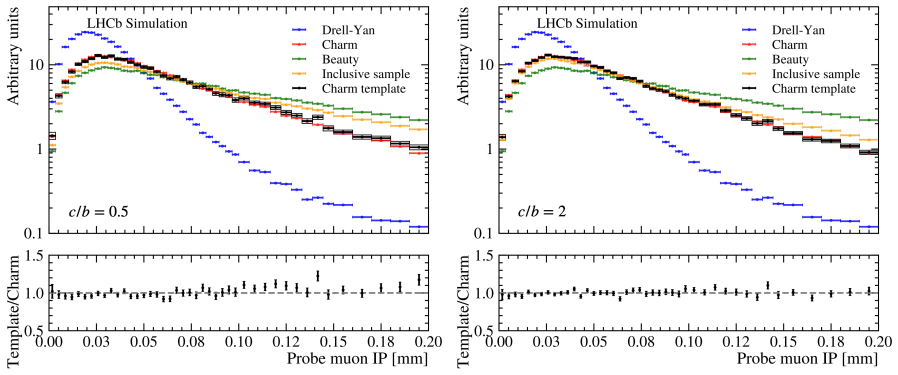
The authors present a novel strategy for background rejection in dimuon Drell-Yan measurements by tagging secondary vertices with hadron tracks, achieving a signal over background improvement of a factor ∼4 at an efficiency of 81% with minimal bias on the Drell-Yan signal properties. They also describe a second approach for constructing unbiased background-pure samples of single muons from charm decays with a charm efficiency of 21.4% at a Drell-Yan efficiency of 1.1%.
What carries the argument
The SemiCharmTag method, which associates a lepton candidate with a hadron track sharing a reconstructed secondary vertex to identify charm semileptonic decays.
If this is right
- Enhanced purity of Drell-Yan samples in the specified mass and momentum range leads to more accurate cross-section measurements.
- The method allows construction of control samples for charm backgrounds with minimal signal contamination.
- Minimal bias on signal properties preserves the integrity of kinematic distributions for physics analysis.
- The reported efficiencies provide a quantitative benchmark for background control in similar dimuon analyses.
Where Pith is reading between the lines
- Application of this tagging in actual collision data could reveal discrepancies between simulation and reality that affect background estimates.
- The technique might extend to other heavy-flavor background rejections in lepton-based searches at hadron colliders.
- Improved background control could enable tighter constraints on parton distribution functions from Drell-Yan data.
Load-bearing premise
The full Monte Carlo simulations accurately reproduce the real LHCb detector response, tracking, vertex resolution, and decay kinematics for both charm semileptonic decays and Drell-Yan processes.
What would settle it
Measuring the actual signal-to-background improvement and tagging efficiencies in real LHCb proton-proton collision data and comparing them directly to the simulation predictions would test the validity of the reported performance.
Figures



read the original abstract
A method for selecting and/or rejecting leptons from charm semileptonic decays based on the tagging of the secondary vertex using a hadron track is introduced. The method is developed for dimuon Drell-Yan measurements in LHCb using full simulations in proton-proton collisions at $\sqrt{s}=13.6$ TeV. We focus on the invariant mass range between 2.9 and 5 GeV/$c^2$ with single muon transverse momentum larger than 1 GeV/$c$. A novel strategy is detailed for background rejection, achieving an improvement of the signal over background of a factor $\sim 4$ at an efficiency of 81% with minimal bias on the Drell-Yan signal properties. Moreover, a second approach is presented for the construction of unbiased background-pure samples of single muons from charm decays, achieving a charm efficiency of 21.4% at a Drell-Yan efficiency of 1.1%.
Editorial analysis
A structured set of objections, weighed in public.
Referee Report
Summary. The manuscript introduces SemiCharmTag, a method for tagging leptons from charm semileptonic decays via secondary-vertex information from an associated hadron track. Developed using full Monte Carlo simulations of 13.6 TeV pp collisions for dimuon Drell-Yan analyses in the 2.9–5 GeV/c² mass window with muon pT > 1 GeV/c, it presents a background-rejection strategy that achieves a signal-to-background improvement of approximately 4 at 81% efficiency with minimal bias on Drell-Yan kinematics, plus a second approach yielding 21.4% charm efficiency at 1.1% Drell-Yan efficiency for constructing pure background samples.
Significance. If the Monte Carlo modeling of vertex resolution, tracking, and kinematics proves accurate for real LHCb data, the tool could meaningfully reduce charm semileptonic backgrounds in Drell-Yan measurements, aiding precision electroweak studies. The factor-of-4 S/B gain at high efficiency is a concrete, potentially useful advance for LHCb analyses, though its practical impact hinges on experimental validation.
major comments (3)
- [Abstract] Abstract: The headline performance numbers (factor ∼4 S/B improvement at 81% efficiency; 21.4% charm efficiency at 1.1% Drell-Yan efficiency) are stated without any description of the tagging algorithm, cut definitions, or how systematic uncertainties on these quantities are evaluated.
- [Performance studies] Performance studies: All quoted efficiencies and background-rejection factors are extracted exclusively from full MC samples; no data-MC comparisons are presented for the critical observables (secondary-vertex resolution, hadron-track reconstruction efficiency, or decay kinematics) in the stated 2.9–5 GeV/c² window.
- [Methodology] Methodology: The central claims rest on the assumption that the MC faithfully reproduces real LHCb detector response for both charm semileptonic decays and Drell-Yan processes; this assumption is load-bearing for applicability to data but is not tested or quantified in the manuscript.
minor comments (2)
- The manuscript would benefit from explicit pseudocode or a flow chart for the tagging algorithm to improve reproducibility.
- Notation for the two efficiency definitions (charm vs. Drell-Yan) should be standardized across text and any tables.
Simulated Author's Rebuttal
We thank the referee for the careful and constructive review of our manuscript. We have revised the paper to address the points raised, expanding the abstract, methodology, and performance sections with additional context and caveats while maintaining the focus on the simulation-based tool development.
read point-by-point responses
-
Referee: [Abstract] Abstract: The headline performance numbers (factor ∼4 S/B improvement at 81% efficiency; 21.4% charm efficiency at 1.1% Drell-Yan efficiency) are stated without any description of the tagging algorithm, cut definitions, or how systematic uncertainties on these quantities are evaluated.
Authors: We agree that the abstract would benefit from more context. The revised abstract now includes a concise description of the secondary-vertex tagging method using an associated hadron track, along with the main selection criteria (muon pT > 1 GeV/c and dimuon mass 2.9–5 GeV/c²). We have also clarified that the quoted efficiencies and S/B improvement are statistical only from the MC samples, with a note that full systematic uncertainties would require data validation. revision: yes
-
Referee: [Performance studies] Performance studies: All quoted efficiencies and background-rejection factors are extracted exclusively from full MC samples; no data-MC comparisons are presented for the critical observables (secondary-vertex resolution, hadron-track reconstruction efficiency, or decay kinematics) in the stated 2.9–5 GeV/c² window.
Authors: The manuscript is a simulation study introducing the tagging tool. We have added a dedicated paragraph in the performance studies section discussing expected data-MC agreement based on published LHCb tracking and vertexing performance, and we explicitly state that direct comparisons for these observables in the relevant mass window are not included here. Such comparisons would require dedicated data samples and analysis, which lies outside the scope of this tool-description paper. revision: partial
-
Referee: [Methodology] Methodology: The central claims rest on the assumption that the MC faithfully reproduces real LHCb detector response for both charm semileptonic decays and Drell-Yan processes; this assumption is load-bearing for applicability to data but is not tested or quantified in the manuscript.
Authors: We have expanded the methodology section to detail the simulation chain (generators, detector response, and reconstruction settings) and to explicitly discuss the assumption of MC fidelity. A new paragraph quantifies known LHCb performance metrics for vertex resolution and tracking efficiency and notes potential residual discrepancies; we recommend that users perform data-driven validation when applying the tool to real data. revision: yes
- The absence of actual data-MC comparison plots for secondary-vertex resolution, tracking efficiency, and kinematics, which cannot be generated within the current simulation-only scope of the manuscript.
Circularity Check
No significant circularity; performance metrics are direct outputs from Monte Carlo event counts.
full rationale
The paper presents a tagging algorithm based on secondary-vertex information from a hadron track, with all quoted efficiencies and background-rejection factors obtained by applying the selection to independent full Monte Carlo samples of 13.6 TeV pp collisions. No parameter is fitted to the target signal or background yields and then re-used as a prediction; no self-citation supplies a load-bearing uniqueness theorem or ansatz; and the derivation consists solely of defining the tagging criteria and tabulating their performance on simulated events. This structure is self-contained against external benchmarks and contains no reduction of any claimed result to its own inputs by construction.
Axiom & Free-Parameter Ledger
axioms (1)
- domain assumption Full Monte Carlo simulations faithfully reproduce detector response, tracking efficiency, vertex resolution, and decay kinematics for the relevant processes.
Reference graph
Works this paper leans on
- [1]
-
[2]
M. Klasen and H. Paukkunen, Nuclear PDFs After the First Decade of LHC Data , Ann. Rev. Nucl. Part. Sci. 74 (2024) 49, arXiv:2311.00450
- [3]
-
[4]
P. Salabura and J. Stroth, Dilepton radiation from strongly interacting systems , Prog. Part. Nucl. Phys. 120 (2021) 103869, arXiv:2005.14589
-
[5]
Coquet et al., Intermediate mass dileptons as pre-equilibrium probes in heavy ion collisions, Phys
M. Coquet et al., Intermediate mass dileptons as pre-equilibrium probes in heavy ion collisions, Phys. Lett. B 821 (2021) 136626, arXiv:2104.07622
-
[6]
R. Bailhache and H. Appelsh¨ auser, Dileptons at Colliders as Probes of the Quark–Gluon Plasma, Ann. Rev. Nucl. Part. Sci. 75 (2025) 463, arXiv:2512.10597
-
[7]
F. Gelis, E. Iancu, J. Jalilian-Marian, and R. Venugopalan, The Color Glass Conden- sate, Ann. Rev. Nucl. Part. Sci. 60 (2010) 463, arXiv:1002.0333
work page Pith review arXiv 2010
-
[8]
LHCb collaboration, LHCb VELO Upgrade Technical Design Report , CERN-LHCC- 2013-021, 2013
2013
-
[9]
Arnaldi et al., NA60 results on thermal dimuons , Eur
NA60 collaboration, R. Arnaldi et al., NA60 results on thermal dimuons , Eur. Phys. J. C 61 (2009) 711, arXiv:0812.3053
- [10]
-
[11]
Abe et al., Measurement of the average lifetime of B hadrons produced in p¯p collisions at √s = 1.8 TeV, Phys
CDF collaboration, F. Abe et al., Measurement of the average lifetime of B hadrons produced in p¯p collisions at √s = 1.8 TeV, Phys. Rev. Lett. 71 (1993) 3421
1993
-
[12]
ATLAS collaboration, G. Aad et al., Measurement of the low-mass Drell-Yan differ- ential cross section at √s = 7 TeV using the ATLAS detector , JHEP 06 (2014) 112, arXiv:1404.1212
-
[13]
Acharya et al., Measurement of charged jet cross section in pp collisions at √s = 5.02 TeV, Phys
ALICE collaboration, S. Acharya et al., Measurement of charged jet cross section in pp collisions at √s = 5.02 TeV, Phys. Rev. D 100 (2019) 092004, arXiv:1905.02536
-
[14]
L. Apolin´ ario, Y.-J. Lee, and M. Winn,Heavy quarks and jets as probes of the QGP , Prog. Part. Nucl. Phys. 127 (2022) 103990, arXiv:2203.16352. 19
-
[15]
Navas et al., Review of particle physics , Phys
Particle Data Group, S. Navas et al., Review of particle physics , Phys. Rev. D110 (2024) 030001
2024
-
[16]
ALICE collaboration, S. Acharya et al., Charm-quark fragmentation fractions and production cross section at midrapidity in pp collisions at the LHC , Phys. Rev. D 105 (2022) L011103, arXiv:2105.06335
-
[17]
ALICE collaboration, S. Acharya et al. , Charm production and fragmentation fractions at midrapidity in pp collisions at √s = 13 TeV , JHEP 12 (2023) 086, arXiv:2308.04877
-
[18]
Schaelet al.(ALEPH and DELPHI and L3 and OPAL and SLD), Phys
ALEPH, DELPHI, L3, OPAL, SLD, LEP Electroweak Working Group, SLD Elec- troweak Group, SLD Heavy Flavour Group, S. Schaelet al., Precision electroweak mea- surements on the Z resonance, Phys. Rept. 427 (2006) 257, arXiv:hep-ex/0509008
-
[19]
Tuning PYTHIA 8.1: the Monash 2013 Tune
P. Skands, S. Carrazza, and J. Rojo, Tuning PYTHIA 8.1: the Monash 2013 Tune , Eur. Phys. J. C 74 (2014) 3024, arXiv:1404.5630
work page Pith review arXiv 2013
-
[20]
T. Sj¨ ostrandet al., An introduction to PYTHIA 8.2 , Comput. Phys. Commun. 191 (2015) 159, arXiv:1410.3012
work page internal anchor Pith review arXiv 2015
-
[21]
Herwig 7.0 / Herwig++ 3.0 Release Note
J. Bellm et al., Herwig 7.0/Herwig++ 3.0 release note , Eur. Phys. J. C 76 (2016) 196, arXiv:1512.01178
work page Pith review arXiv 2016
-
[22]
LHCb collaboration, R. Aaij et al. , Prompt charm production in pp collisions at sqrt(s)=7 TeV, Nucl. Phys. B 871 (2013) 1, arXiv:1302.2864
- [23]
-
[24]
LHCb collaboration, R. Aaij et al. , Measurement of the B0 s → µ+µ− branching fraction and effective lifetime and search for B0 → µ+µ− decays, Phys. Rev. Lett. 118 (2017) 191801, arXiv:1703.05747
-
[25]
LHCb collaboration, R. Aaij et al., Search for Dark Photons Produced in 13 TeV pp Collisions, Phys. Rev. Lett. 120 (2018) 061801, arXiv:1710.02867
-
[26]
A Brief Introduction to PYTHIA 8.1
T. Sjostrand, S. Mrenna, and P. Z. Skands, A Brief Introduction to PYTHIA 8.1 , Comput. Phys. Commun. 178 (2008) 852, arXiv:0710.3820
work page internal anchor Pith review arXiv 2008
-
[27]
Belyaev et al., Handling of the generation of primary events in Gauss, the LHCb simulation framework , CERN, Geneva, 2011
I. Belyaev et al., Handling of the generation of primary events in Gauss, the LHCb simulation framework , CERN, Geneva, 2011. LHCb-PROC-2011-005, CERN-LHCb- PROC-2011-005
2011
-
[28]
D. J. Lange, The EvtGen particle decay simulation package , Nucl. Instrum. Meth. A462 (2001) 152
2001
-
[29]
P. Golonka and Z. Was, PHOTOS Monte Carlo: A precision tool for QED corrections in Z and W decays, Eur. Phys. J. C45 (2006) 97, arXiv:hep-ph/0506026
-
[30]
Agostinelli et al., Geant4: A simulation toolkit, Nucl
Geant4 collaboration, S. Agostinelli et al., Geant4: A simulation toolkit, Nucl. Instrum. Meth. A506 (2003) 250. 20
2003
-
[31]
Allison et al., Geant4 developments and applications , IEEE Trans
Geant4 collaboration, J. Allison et al., Geant4 developments and applications , IEEE Trans. Nucl. Sci. 53 (2006) 270
2006
-
[32]
Clemencic et al., The LHCb simulation application, Gauss: Design, evolution and experience, J
M. Clemencic et al., The LHCb simulation application, Gauss: Design, evolution and experience, J. Phys. Conf. Ser. 331 (2011) 032023
2011
-
[33]
Barrand et al
G. Barrand et al. , Gaudi — a software architecture and framework for building hep data processing applications, Computer Physics Communications 140 (2001) 45, CHEP2000
2001
-
[34]
Clemencic et al., Recent developments in the LHCb software framework gaudi , Journal of Physics: Conference Series 219 (2010) 042006
M. Clemencic et al., Recent developments in the LHCb software framework gaudi , Journal of Physics: Conference Series 219 (2010) 042006
2010
-
[35]
J. Alwall et al., The automated computation of tree-level and next-to-leading order differential cross sections, and their matching to parton shower simulations , JHEP 07 (2014) 079, arXiv:1405.0301
work page internal anchor Pith review arXiv 2014
-
[36]
R. Frederix et al., The automation of next-to-leading order electroweak calculations , JHEP 07 (2018) 185, arXiv:1804.10017, [Erratum: JHEP 11, 085 (2021)]
-
[37]
R. D. Ball et al., Parton distributions for the LHC run2 , Journal of High Energy Physics 2015 (2015)
2015
-
[38]
M. Cacciari et al., Theoretical predictions for charm and bottom production at the LHC, JHEP 10 (2012) 137, arXiv:1205.6344
-
[39]
M. Cacciari, M. L. Mangano, and P. Nason, Gluon PDF constraints from the ratio of forward heavy-quark production at the LHC at √s = 7 and 13 TeV, Eur. Phys. J. C 75 (2015) 610, arXiv:1507.06197
-
[40]
LHCb collaboration, DaVinci application GitLab repository , https://gitlab.cern.ch/lhcb/DaVinci/
-
[41]
Anderlini et al., Muon identification for LHCb Run 3 , JINST 15 (2020) T12005, arXiv:2008.01579
L. Anderlini et al., Muon identification for LHCb Run 3 , JINST 15 (2020) T12005, arXiv:2008.01579
-
[42]
T. Chen and C. Guestrin, XGBoost: A Scalable Tree Boosting System , doi: 10.1145/2939672.2939785 arXiv:1603.02754
-
[43]
Aaij et al., Identification of charm jets at LHCb , JINST 17 (2022) P02028, arXiv:2112.08435
LHCb collaboration, R. Aaij et al., Identification of charm jets at LHCb , JINST 17 (2022) P02028, arXiv:2112.08435
- [44]
-
[45]
LHCb collaboration, R. Aaij et al., Measurement of the B± production cross-section in pp collisions at √s = 7 and 13 TeV , JHEP 12 (2017) 026, arXiv:1710.04921. 21
discussion (0)
Sign in with ORCID, Apple, or X to comment. Anyone can read and Pith papers without signing in.