Recognition: unknown
Utilizing and Calibrating Hindsight Process Rewards via Reinforcement with Mutual Information Self-Evaluation
Pith reviewed 2026-05-10 15:28 UTC · model grok-4.3
The pith
Hindsight self-evaluation rewards in LLMs are equivalent to minimizing mutual information plus a KL term between policy and proxy reward model.
A machine-rendered reading of the paper's core claim, the machinery that carries it, and where it could break.
Core claim
Utilizing hindsight generative self-evaluation rewards is equivalent to minimizing an objective that combines mutual information with a KL divergence term between the policy and a proxy reward policy; the calibration step then actively aligns these rewards with the optimal policy, enabling autonomous learning from dense internal signals that supplement sparse extrinsic feedback.
What carries the argument
Mutual Information Self-Evaluation (MISE), which converts hindsight generative self-evaluations into calibrated dense rewards by linking them to mutual information maximization and policy alignment via KL divergence.
If this is right
- LLM agents can learn autonomously from dense internal rewards that supplement sparse extrinsic signals.
- Open-source models of roughly 7 billion parameters reach performance comparable to GPT-4o on validation tasks without expert supervision.
- The calibration step is theoretically justified as the mechanism that aligns self-generated rewards with the optimal policy.
- The approach supplies the first formal foundation for the paradigm of generative self-rewarding in reinforcement learning.
Where Pith is reading between the lines
- The same mutual-information-plus-KL structure could be applied to other sequential decision domains where internal generative feedback is available.
- If the equivalence holds in practice, training pipelines could reduce dependence on human preference data by substituting calibrated self-evaluations.
- Instability might appear when self-evaluation quality varies across domains, suggesting the need for adaptive calibration schedules.
- The method opens a route to test whether mutual-information objectives alone suffice for stable self-improvement without any external reward.
Load-bearing premise
Generative self-evaluations produce reliable dense signals whose calibration against environmental feedback will consistently align with the optimal policy without introducing systematic bias or instability.
What would settle it
A controlled experiment where self-evaluations are deliberately noisy or biased on a subset of tasks and the MISE-trained policy fails to outperform a standard sparse-reward baseline or shows degraded calibration accuracy.
Figures




read the original abstract
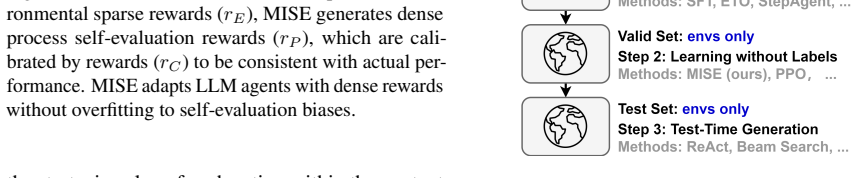
To overcome the sparse reward challenge in reinforcement learning (RL) for agents based on large language models (LLMs), we propose Mutual Information Self-Evaluation (MISE), an RL paradigm that utilizes hindsight generative self-evaluation as dense reward signals while simultaneously calibrating them against the environmental feedbacks. Empirically, MISE enables an agent to learn autonomously from dense internal rewards supplementing sparse extrinsic signals. Theoretically, our work provides the first formal foundation for the paradigm of generative self-rewarding. We prove that utilizing hindsight self-evaluation rewards is equivalent to minimizing an objective that combines mutual information with a KL divergence term between the policy and a proxy reward policy. This theoretical insight then informs and justifies our calibration step, which actively aligns these rewards with the optimal policy. Extensive experiments show that MISE outperforms strong baselines, enabling open-source LLMs about 7B parameters to achieve performance comparable to GPT-4o on validation without expert supervision.
Editorial analysis
A structured set of objections, weighed in public.
Referee Report
Summary. The manuscript proposes Mutual Information Self-Evaluation (MISE), an RL framework for LLMs that treats hindsight generative self-evaluations as dense reward signals and calibrates them against environmental feedback to address sparse rewards. It claims to prove that using these hindsight self-evaluation rewards is formally equivalent to minimizing an objective that combines a mutual information term with a KL divergence between the policy and a proxy reward policy; this equivalence is said to justify the subsequent calibration step. Experiments reportedly show that the method enables ~7B open-source LLMs to reach performance comparable to GPT-4o on validation tasks without expert supervision.
Significance. If the equivalence holds without circularity and the calibration produces unbiased dense signals, the work would supply the first formal foundation for generative self-rewarding in LLM RL, potentially enabling more autonomous training pipelines that supplement or replace sparse extrinsic rewards.
major comments (2)
- [§3 (Theoretical Analysis)] The central theoretical claim (abstract and §3) states that hindsight self-evaluation rewards are equivalent to minimizing I(·;·) + KL(π || π_proxy). The manuscript does not specify whether the proxy reward policy π_proxy is defined independently of the self-evaluation generator or whether it is itself produced by the same LLM policy being optimized; without an explicit fixed-point argument or contraction mapping, the mutual-information term risks becoming a function of the current policy, undermining the claimed equivalence and the justification for the calibration step.
- [§4 (Experiments)] The empirical claim that 7B models reach GPT-4o-level performance rests on the calibrated rewards being dense and unbiased. However, the experimental section provides no ablation isolating the effect of the MI term versus the calibration procedure, nor any analysis of systematic bias introduced when self-evaluations are generated by the policy under training (e.g., reward hacking or mode collapse).
minor comments (2)
- [§3] Notation for the mutual-information objective and the proxy policy is introduced without a clear reference to the precise definitions used in the proof; adding an explicit equation for I(·;·) and π_proxy in §3 would improve readability.
- [Abstract and §3] The abstract states a proof but the main text does not include a high-level proof sketch or key derivation steps; a one-paragraph outline of the equivalence argument would help readers assess the result without reading the full appendix.
Simulated Author's Rebuttal
We thank the referee for the thoughtful and constructive comments. These points help clarify the theoretical foundations and strengthen the empirical support. We address each major comment below, indicating where revisions will be made to the manuscript.
read point-by-point responses
-
Referee: [§3 (Theoretical Analysis)] The central theoretical claim (abstract and §3) states that hindsight self-evaluation rewards are equivalent to minimizing I(·;·) + KL(π || π_proxy). The manuscript does not specify whether the proxy reward policy π_proxy is defined independently of the self-evaluation generator or whether it is itself produced by the same LLM policy being optimized; without an explicit fixed-point argument or contraction mapping, the mutual-information term risks becoming a function of the current policy, undermining the claimed equivalence and the justification for the calibration step.
Authors: We appreciate this observation on potential circularity. In the derivation of §3, the proxy policy π_proxy is obtained by optimizing the expected calibrated reward, where calibration explicitly incorporates external environmental feedback that is independent of the policy's current self-evaluations. The mutual-information term arises from the information bottleneck between the policy trajectory and the hindsight evaluation; it is not a direct function of the instantaneous policy because the equivalence is derived from the reward definition prior to optimization. Nevertheless, we agree that an explicit fixed-point discussion would improve clarity. In the revised manuscript we will add a new subsection (3.3) that presents the calibration operator as a contraction mapping with respect to the environmental anchor, establishing convergence to a stable π_proxy. This addition directly addresses the concern while preserving the original proof structure. revision: partial
-
Referee: [§4 (Experiments)] The empirical claim that 7B models reach GPT-4o-level performance rests on the calibrated rewards being dense and unbiased. However, the experimental section provides no ablation isolating the effect of the MI term versus the calibration procedure, nor any analysis of systematic bias introduced when self-evaluations are generated by the policy under training (e.g., reward hacking or mode collapse).
Authors: We concur that isolating the contributions of the MI term and the calibration procedure, together with explicit bias diagnostics, would strengthen the experimental claims. In the revised version we will insert a dedicated ablation subsection (4.4) that reports performance for (i) full MISE, (ii) MISE without the mutual-information regularizer, and (iii) calibration alone. We will also add quantitative monitoring of reward hacking and mode collapse by tracking policy entropy, response diversity (via distinct-n), and KL divergence to a reference policy across training checkpoints; these metrics will be presented in the main text and Appendix C. These changes directly respond to the referee's request for evidence that the calibrated signals remain dense and unbiased. revision: yes
Circularity Check
No significant circularity; theoretical equivalence stands as independent derivation
full rationale
The paper's central theoretical claim is a proof that hindsight self-evaluation rewards are equivalent to minimizing an objective combining mutual information with KL(π || π_proxy). No equations, definitions, or steps are provided in the abstract or reader summary that reduce this equivalence to a tautology by construction (e.g., no indication that π_proxy is defined directly from the self-evaluations in a way that makes the objective self-referential). The calibration step is presented as informed by this insight rather than presupposed by it. No self-citations are invoked for the uniqueness or foundation of the proof, and the empirical results on 7B models are treated as separate validation. The derivation chain therefore remains self-contained against external benchmarks without reducing to fitted inputs or renamed patterns.
Axiom & Free-Parameter Ledger
axioms (1)
- domain assumption Hindsight self-evaluation produces usable dense reward signals
Reference graph
Works this paper leans on
-
[1]
Textworld: A learning environment for text-based games, 2019
Textworld: A learning environment for text- based games.CoRR, abs/1806.11532. Zhirui Deng, Zhicheng Dou, Yutao Zhu, Ji-Rong Wen, Ruibin Xiong, Mang Wang, and Weipeng Chen. 2024. From novice to expert: Llm agent policy optimization via step-wise reinforcement learning.arXiv preprint arXiv:2411.03817. Jiawei Gu, Xuhui Jiang, Zhichao Shi, Hexiang Tan, Xuehao...
-
[2]
A survey on llm-as-a-judge.arXiv preprint arXiv:2411.15594. Edward J Hu, Yelong Shen, Phillip Wallis, Zeyuan Allen-Zhu, Yuanzhi Li, Shean Wang, Lu Wang, and Weizhu Chen. 2022. LoRA: Low-rank adaptation of large language models. InInternational Conference on Learning Representations. 9 Microsoft Canada Inc. 2019. First textworld problems: A reinforcement a...
work page internal anchor Pith review Pith/arXiv arXiv 2022
-
[3]
Generative reward models.arXiv preprint arXiv:2410.12832, 2024
Generative reward models.arXiv preprint arXiv:2410.12832. Meredith Ringel Morris, Jascha Sohl-Dickstein, Noah Fiedel, Tris Warkentin, Allan Dafoe, Aleksandra Faust, Clement Farabet, and Shane Legg. 2024. Posi- tion: Levels of agi for operationalizing progress on the path to agi. InForty-first International Confer- ence on Machine Learning. Keerthiram Muru...
-
[4]
Martin Riedmiller, Roland Hafner, Thomas Lampe, Michael Neunert, Jonas Degrave, Tom Wiele, Vlad Mnih, Nicolas Heess, and Jost Tobias Springenberg
Direct preference optimization: Your language model is secretly a reward model.Advances in Neu- ral Information Processing Systems, 36. Martin Riedmiller, Roland Hafner, Thomas Lampe, Michael Neunert, Jonas Degrave, Tom Wiele, Vlad Mnih, Nicolas Heess, and Jost Tobias Springenberg
-
[5]
InInternational conference on machine learning, pages 4344–4353
Learning by playing solving sparse reward tasks from scratch. InInternational conference on machine learning, pages 4344–4353. PMLR. Sangwon Ryu, Heejin Do, Yunsu Kim, Gary Geunbae Lee, and Jungseul Ok. 2024. Multi-dimensional op- timization for text summarization via reinforcement learning.arXiv preprint arXiv:2406.00303. John Schulman, Filip Wolski, Pra...
-
[6]
Shunyu Yao, Howard Chen, John Yang, and Karthik Narasimhan
Reff: Reinforcing format faithfulness in lan- guage models across varied tasks.arXiv preprint arXiv:2412.09173. Shunyu Yao, Howard Chen, John Yang, and Karthik Narasimhan. 2022. Webshop: Towards scalable real- world web interaction with grounded language agents. Advances in Neural Information Processing Systems, 35:20744–20757. Shunyu Yao, Jeffrey Zhao, D...
-
[7]
Self-Rewarding Language Models
Self-rewarding language models.arXiv preprint arXiv:2401.10020, 3. Zheng Yuan, Hongyi Yuan, Chengpeng Li, Guanting Dong, Keming Lu, Chuanqi Tan, Chang Zhou, and Jingren Zhou. 2023. Scaling relationship on learning mathematical reasoning with large language models. arXiv preprint arXiv:2308.01825. Siliang Zeng, Quan Wei, William Brown, Oana Frunza, Yuriy N...
work page internal anchor Pith review arXiv 2023
-
[8]
and WebShop(Yao et al., 2022). The Sci- enceWorld dataset simulates an educational plat- form, encapsulates structured interactions between learners and scientific content, including problem- solving trajectories, conceptual queries, and en- gagement patterns across various STEM domains. On the other hand, the WebShop dataset simulates an e-commerce platf...
2022
discussion (0)
Sign in with ORCID, Apple, or X to comment. Anyone can read and Pith papers without signing in.