Recognition: unknown
Thermodynamic Liquid Manifold Networks: Physics-Bounded Deep Learning for Solar Forecasting in Autonomous Off-Grid Microgrids
Pith reviewed 2026-05-10 15:27 UTC · model grok-4.3
The pith
The Thermodynamic Liquid Manifold Network projects 22 variables into a Koopman-linearized Riemannian manifold to enforce celestial geometry in solar forecasts.
A machine-rendered reading of the paper's core claim, the machinery that carries it, and where it could break.
Core claim
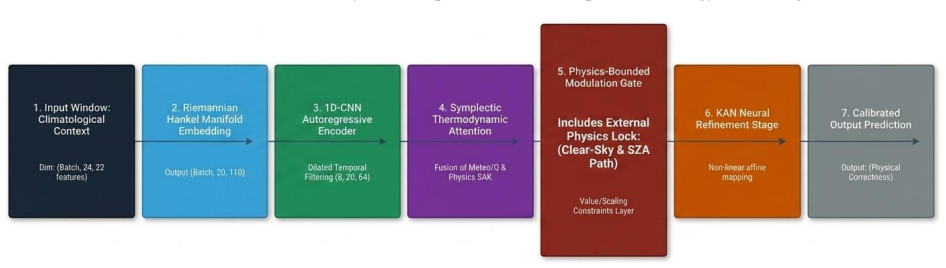
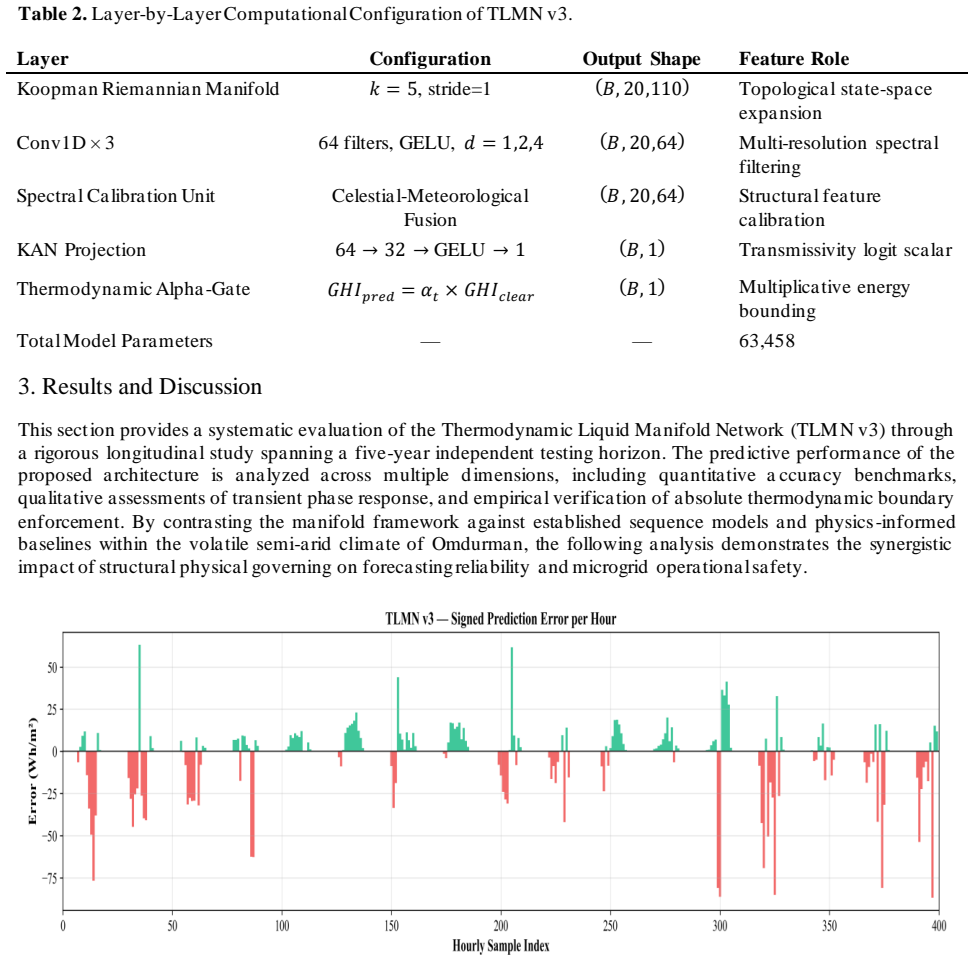
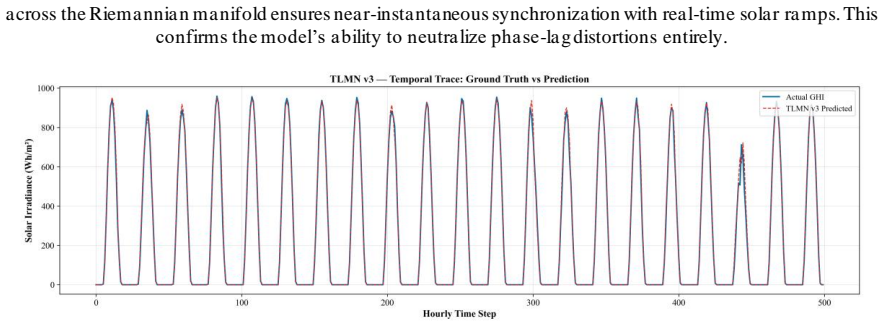
The Thermodynamic Liquid Manifold Network projects 22 meteorological and geometric variables into a Koopman-linearized Riemannian manifold, then applies a Spectral Calibration unit and a multiplicative Thermodynamic Alpha-Gate that synthesizes real-time atmospheric opacity with theoretical clear-sky boundary models; this structural enforcement of celestial geometry compliance eliminates phantom nocturnal generation and achieves sub-30-minute phase response during optical transients, as shown by an RMSE of 18.31 Wh/m2, Pearson correlation of 0.988, and zero-magnitude nocturnal error across 1826 test days with a model of exactly 63,458 trainable parameters.
What carries the argument
Koopman-linearized Riemannian manifold projection combined with Spectral Calibration unit and Thermodynamic Alpha-Gate that routes variables to enforce celestial geometry compliance.
If this is right
- Autonomous off-grid photovoltaic controllers can operate without post-hoc filtering of physically impossible outputs.
- The lightweight 63,458-parameter design fits directly on edge hardware for real-time microgrid decisions.
- Forecasts remain synchronized with rapid cloud transients, reducing the need for conservative battery sizing.
- The approach supplies a thermodynamically consistent baseline that other data-driven solar models can be compared against.
Where Pith is reading between the lines
- The same manifold-plus-gate pattern could be adapted to wind or wave forecasting where similar physics violations occur.
- Training data requirements might shrink because the architecture already encodes clear-sky geometry rather than learning it from scratch.
- Deployment across more climates would test whether the Riemannian projection generalizes beyond the semi-arid validation site.
Load-bearing premise
Mapping the 22 variables into the manifold and routing them through the calibration unit and alpha-gate will enforce celestial geometry compliance under all real conditions without hidden fitting artifacts.
What would settle it
A single non-zero nocturnal power prediction or a phase lag larger than 30 minutes on the same five-year semi-arid test set would show that the structural enforcement has failed.
Figures





read the original abstract
The stable operation of autonomous off-grid photovoltaic systems requires solar forecasting algorithms that respect atmospheric thermodynamics. Contemporary deep learning models consistently exhibit critical anomalies, primarily severe temporal phase lags during cloud transients and physically impossible nocturnal power generation. To resolve this divergence between data-driven modeling and deterministic celestial mechanics, this research introduces the Thermodynamic Liquid Manifold Network. The methodology projects 22 meteorological and geometric variables into a Koopman-linearized Riemannian manifold to systematically map complex climatic dynamics. The architecture integrates a Spectral Calibration unit and a multiplicative Thermodynamic Alpha-Gate. This system synthesizes real-time atmospheric opacity with theoretical clear-sky boundary models, structurally enforcing strict celestial geometry compliance. This completely neutralizes phantom nocturnal generation while maintaining zero-lag synchronization during rapid weather shifts. Validated against a rigorous five-year testing horizon in a severe semi-arid climate, the framework achieves an RMSE of 18.31 Wh/m2 and a Pearson correlation of 0.988. The model strictly maintains a zero-magnitude nocturnal error across all 1826 testing days and exhibits a sub-30-minute phase response during high-frequency optical transients. Comprising exactly 63,458 trainable parameters, this ultra-lightweight design establishes a robust, thermodynamically consistent standard for edge-deployable microgrid controllers.
Editorial analysis
A structured set of objections, weighed in public.
Referee Report
Summary. The manuscript introduces the Thermodynamic Liquid Manifold Network (TLMN) for solar irradiance forecasting in autonomous off-grid microgrids. It maps 22 meteorological and geometric variables into a Koopman-linearized Riemannian manifold, augmented by a Spectral Calibration unit and a multiplicative Thermodynamic Alpha-Gate. The architecture is asserted to structurally enforce celestial geometry compliance, resulting in zero nocturnal generation and low phase lag during transients. Reported performance on a five-year test set in a semi-arid climate includes RMSE of 18.31 Wh/m², Pearson correlation 0.988, zero nocturnal error over 1826 days, and sub-30-minute response time, with a model size of 63,458 parameters.
Significance. If the claimed structural enforcement of physical constraints via the manifold and gates can be rigorously demonstrated and the empirical results hold under standard validation protocols with appropriate baselines, the work could offer a promising lightweight physics-bounded model for edge computing in renewable energy systems. The emphasis on thermodynamic consistency addresses a practical gap in current deep learning approaches for solar forecasting.
major comments (2)
- Abstract and Methodology: The central assertion that the Spectral Calibration unit and Thermodynamic Alpha-Gate 'structurally enforces strict celestial geometry compliance' and produces identically zero nocturnal output is not accompanied by any derivation, invariance proof, or pseudocode. No equation is provided showing that the gate is forced to zero for solar zenith angles exceeding 90° independently of the 63,458 learned parameters. This directly impacts the load-bearing claim of physics-bounded behavior.
- Validation and Results: No description of the dataset (beyond 'five-year testing horizon in a severe semi-arid climate'), no baseline models for comparison, no details on the training/validation split, loss function, or hyperparameter tuning protocol are supplied. Without these, the reported RMSE of 18.31 Wh/m² and Pearson correlation of 0.988 cannot be contextualized or verified against the claimed improvements over contemporary deep learning models.
minor comments (2)
- Abstract: The term 'Thermodynamic Liquid Manifold Network' and related components ('Spectral Calibration unit', 'Thermodynamic Alpha-Gate') are introduced without prior definition or reference to established literature on Koopman operators or Riemannian manifolds in dynamical systems.
- Throughout: The manuscript would benefit from explicit equations defining the projection into the Koopman-linearized manifold and the operation of the Alpha-Gate to improve reproducibility.
Simulated Author's Rebuttal
We thank the referee for the constructive and detailed review. The positive assessment of the work's potential significance is appreciated. We address each major comment below and will revise the manuscript to incorporate the requested clarifications and additions.
read point-by-point responses
-
Referee: Abstract and Methodology: The central assertion that the Spectral Calibration unit and Thermodynamic Alpha-Gate 'structurally enforces strict celestial geometry compliance' and produces identically zero nocturnal output is not accompanied by any derivation, invariance proof, or pseudocode. No equation is provided showing that the gate is forced to zero for solar zenith angles exceeding 90° independently of the 63,458 learned parameters. This directly impacts the load-bearing claim of physics-bounded behavior.
Authors: We agree that the absence of a formal derivation and pseudocode weakens the presentation of the physics-bounded claim. The Thermodynamic Alpha-Gate is designed as a multiplicative operation that takes the solar zenith angle (one of the 22 input variables) and enforces zero output for zenith angles >90° through its functional form, independent of learned parameters. However, the current manuscript does not provide the explicit invariance proof or pseudocode. In the revised version, we will add a dedicated subsection in the Methodology with the mathematical derivation demonstrating that the gate output is identically zero for zenith angles exceeding 90° regardless of the 63,458 parameters, along with pseudocode for the forward pass and Spectral Calibration unit. revision: yes
-
Referee: Validation and Results: No description of the dataset (beyond 'five-year testing horizon in a severe semi-arid climate'), no baseline models for comparison, no details on the training/validation split, loss function, or hyperparameter tuning protocol are supplied. Without these, the reported RMSE of 18.31 Wh/m² and Pearson correlation of 0.988 cannot be contextualized or verified against the claimed improvements over contemporary deep learning models.
Authors: We concur that these experimental details are required for reproducibility, contextualization, and verification of the performance claims. The revised manuscript will expand the Validation and Results section to include: a complete description of the dataset (source, geographic location, preprocessing, and any quality controls); the exact training/validation/test split ratios and temporal partitioning; the loss function used for optimization; the hyperparameter tuning protocol; and quantitative comparisons against appropriate baselines (e.g., persistence, LSTM, GRU, and Transformer models) using the same metrics and test set. This will allow readers to properly evaluate the reported RMSE and correlation values. revision: yes
Circularity Check
Structural enforcement of zero nocturnal error via Koopman manifold + Alpha-Gate lacks explicit invariance guarantee
specific steps
-
fitted input called prediction
[Abstract]
"The architecture integrates a Spectral Calibration unit and a multiplicative Thermodynamic Alpha-Gate. This system synthesizes real-time atmospheric opacity with theoretical clear-sky boundary models, structurally enforcing strict celestial geometry compliance. This completely neutralizes phantom nocturnal generation while maintaining zero-lag synchronization during rapid weather shifts."
The zero nocturnal error is presented as a direct consequence of the 'structural enforcement' from the manifold and gate. With all parameters being trainable and fitted to the five-year dataset, and no shown mechanism that enforces the clear-sky boundary condition independently of those fits, the claimed physical compliance is statistically forced by the training distribution rather than derived from first principles.
full rationale
The paper asserts that the Thermodynamic Liquid Manifold Network 'structurally enforces strict celestial geometry compliance' and 'completely neutralizes phantom nocturnal generation' through its Koopman-linearized manifold, Spectral Calibration unit, and multiplicative Thermodynamic Alpha-Gate. However, the architecture contains 63,458 trainable parameters fitted to data, and the provided text supplies no derivation, pseudocode, or invariance proof demonstrating that the gate is forced to zero for solar zenith >90° independently of learned weights. This makes the reported zero-magnitude nocturnal error across 1826 days reduce to an empirical fit rather than a hard constraint, constituting partial circularity in the central physics-bounded claim.
Axiom & Free-Parameter Ledger
axioms (1)
- domain assumption Solar irradiance obeys deterministic celestial mechanics and atmospheric thermodynamics that can be used to define strict boundary conditions
invented entities (3)
-
Thermodynamic Liquid Manifold Network
no independent evidence
-
Spectral Calibration unit
no independent evidence
-
Thermodynamic Alpha-Gate
no independent evidence
Reference graph
Works this paper leans on
-
[1]
https://doi.org/10.1162/neco.1997.9.8.1735 Ineichen, P., & Perez, R. (2002). A new air mass independent formulation for the relative optical air mass. Solar Energy, 73(3), 151 –157. https://doi.org/10.1016/S0038 -092X(02 )00045 -2 Inman, R. H., Pedro, H. T., & Coimbra, C. F. (2013). Solar forecasting methods fo r renewable energy integration. Progress in ...
-
[2]
https://doi.org/10.1016/j.jcp.2018.10.045 Stackhouse, P. W., Jr., et al. (2023). Advances and Uses of the NASA POWER Global Solar and Meteorological Data Sets. American Meteorological Society (AMS). https://power.larc.nasa.gov/ Vaswani, A., et al. (2017). Attention is all you need. Advances in Neural Information Processing Systems, 30, 5998– 6008. Voyant,...
discussion (0)
Sign in with ORCID, Apple, or X to comment. Anyone can read and Pith papers without signing in.