Recognition: unknown
FlowBoost Reveals Phase Transitions and Spectral Structure in Finite Free Information Inequalities
Pith reviewed 2026-05-10 15:37 UTC · model grok-4.3
The pith
FlowBoost optimization shows p=2 is the sharp critical exponent for finite free Stam inequalities, with the Hermite pair as unique equality case and a conjectured n-independent spectrum for the coupling matrix.
A machine-rendered reading of the paper's core claim, the machinery that carries it, and where it could break.
Core claim
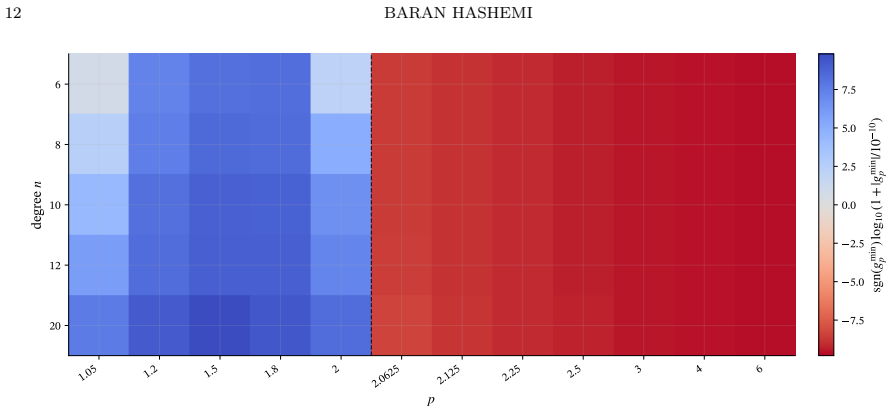
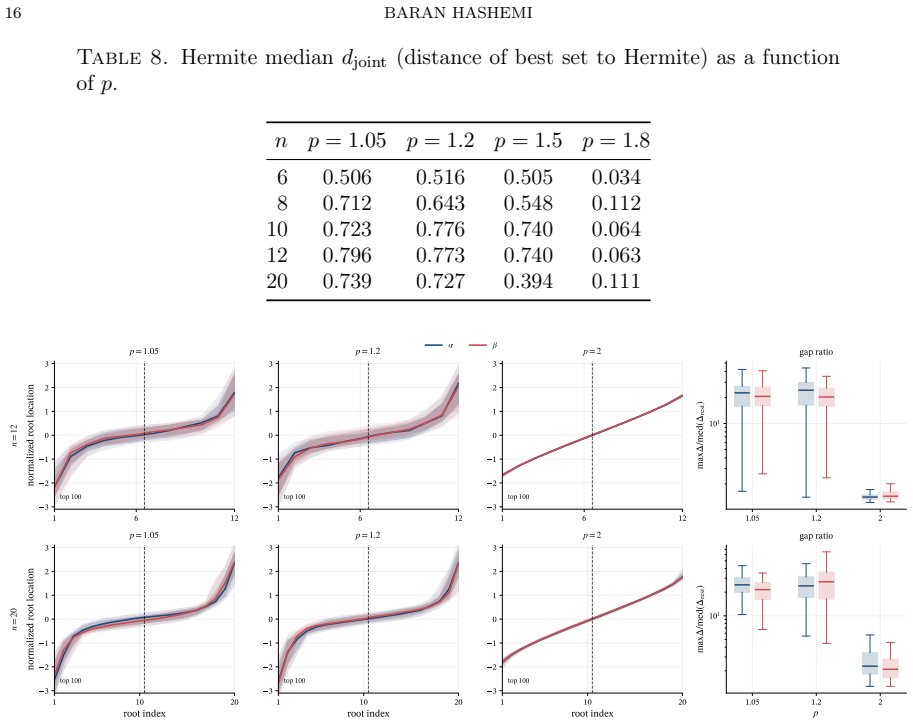
Using FlowBoost we find that the Hermite pair is the unique equality case of the p-Stam inequality at p=2 and that the singular values of the doubly stochastic coupling matrix E_n on the mean-zero subspace are conjectured to be 2^{-k/2} for k=1 to n-1 independently of n; conditional on this the local stability is sharp and the CLT converges uniformly; the inequality is violated by the Hermite pair for all p>2 with deficit controlled by the p-contraction ratio of E_n; for p<2 the extremal configurations bifurcate to non-matching bimodal pairs that converge to the Hermite diagonal only as p approaches 2 from below. Systematic FlowBoost computations support p^*=2 as the sharp critical exponent.
What carries the argument
The FlowBoost closed-loop deep generative optimization applied to extremal problems under finite free additive convolution, together with the doubly stochastic coupling matrix E_n whose singular values on the mean-zero subspace are conjectured to be 2^{-k/2}.
If this is right
- The finite free central limit theorem converges at a rate that is uniform in the degree n.
- A sharp local stability constant holds for the inequality at the critical value p=2.
- The Hermite pair produces a positive deficit for every p greater than 2, governed by the ell p contraction ratio of E_n.
- For p less than 2 the equality cases are non-matching pairs with bimodal root distributions rather than Hermite pairs.
Where Pith is reading between the lines
- Verification of the singular value conjecture would supply exact constants for stability questions in other finite free inequalities.
- The phase transition at p=2 indicates that the ell two norm is distinguished for stability under finite free convolution.
- Generative optimization methods could be applied to discover equality cases and critical exponents in other extremal problems in analysis and probability.
Load-bearing premise
The FlowBoost closed-loop optimizer is assumed to locate the true global extremal structures and equality cases, including uniqueness at p=2 and the bifurcation for p less than 2, without missing other configurations.
What would settle it
A direct numerical computation of the singular values of E_n for moderate n that finds any deviation from the sequence 2^{-k/2} would disprove the spectral conjecture and the derived uniform stability and CLT rates.
Figures





read the original abstract
Using FlowBoost, a closed-loop deep generative optimization framework for extremal structure discovery, we investigate $\ell^p$-generalizations of the finite free Stam inequality for real-rooted polynomials under finite free additive convolution $\boxplus_n$. At $p=2$, FlowBoost finds the Hermite pair as the unique equality case and reveals the spectral structure of the linearized convolution map at this extremal point. As a result, we conjecture that the singular values of the doubly stochastic coupling matrix $E_n$ on the mean-zero subspace are ${2^{-k/2}:k=1,\ldots,n-1}$, independent of $n$. Conditional on this conjecture, we obtain a sharp local stability constant and the finite free CLT convergence rate, both uniform in $n$. We introduce a one-parameter family of $p$-Stam inequalities using $\ell^p$-Fisher information and prove that the Hermite pair itself violates the inequality for every $p>2$, with the sign of the deficit governed by the $\ell^p$-contraction ratio of $E_n$. Systematic computation via FlowBoost supports the conjecture that $p^*\!=2$ is the sharp critical exponent. For $p<2$, the extremal configurations undergo a bifurcation, meaning that they become non-matching pairs with bimodal root structure, converging back to the Hermite diagonal only as $p\to 2^-$. Our findings demonstrate that FlowBoost, can be an effective tool of mathematical discovery in infinite-dimensional extremal problems.
Editorial analysis
A structured set of objections, weighed in public.
Referee Report
Summary. The manuscript introduces FlowBoost, a closed-loop deep generative optimization framework, to investigate ℓ^p-generalizations of the finite free Stam inequality for real-rooted polynomials under finite free additive convolution ⊞_n. It rigorously proves that the Hermite pair violates the inequality for every p>2, with the sign of the deficit determined by the ℓ^p-contraction ratio of the coupling matrix E_n. At p=2, FlowBoost computations identify the Hermite pair as the unique equality case and reveal spectral structure, leading to the conjecture that the singular values of the doubly stochastic matrix E_n on the mean-zero subspace are 2^{-k/2} for k=1 to n-1, independent of n. Conditional on this conjecture, sharp local stability constants and uniform finite-free CLT convergence rates are derived. Further computations indicate a bifurcation to non-matching bimodal pairs for p<2, supporting the claim that p^*=2 is the sharp critical exponent.
Significance. If the spectral conjecture holds, the work would deliver sharp, n-uniform constants for local stability and finite-free CLT rates, advancing finite free probability and information inequalities. The explicit proof of the p>2 violation (independent of numerics) is a solid contribution. The computational discovery of phase transitions and equality cases illustrates FlowBoost's potential as a discovery tool in infinite-dimensional extremal problems, though its global optimality requires additional validation.
major comments (3)
- [Abstract and spectral conjecture section] Abstract and the section presenting the spectral conjecture: the claim that singular values of E_n are exactly 2^{-k/2} (k=1,...,n-1) independent of n, and the resulting sharp local stability constant and finite-free CLT rate, rest solely on FlowBoost outputs without reported error bars, convergence diagnostics, or independent verification (e.g., exhaustive enumeration for small n or analytic bounds).
- [p<2 bifurcation and sharpness section] The section on p<2 extremal configurations: the bifurcation to non-matching bimodal pairs and the assertion that p^*=2 is sharp (supported by uniqueness of the Hermite pair at p=2) depend on FlowBoost reliably locating global extremals; no certificate rules out missed configurations or local minima in the closed-loop optimizer.
- [Computational experiments] The computational experiments supporting the equality cases: while the p>2 violation proof is load-bearing and independent, the overall central claims on sharpness and spectral structure are conditional on unverified global optimality of FlowBoost, which is an invented entity without external reproducibility guarantees.
minor comments (3)
- [Introduction] The introduction could include a brief reminder of the definition of finite free additive convolution ⊞_n and the standard Stam inequality to improve accessibility.
- [Notation and preliminaries] Notation for the coupling matrix E_n and the mean-zero subspace should be defined explicitly at first use, with a reference to prior finite free probability literature.
- [Abstract and conclusion] The abstract and conclusion could more clearly separate the rigorously proved violation for p>2 from the conjectural elements.
Simulated Author's Rebuttal
We thank the referee for the careful reading and constructive comments, which highlight the numerical foundations of several claims. We address each major point below, agreeing to add diagnostics, reproducibility measures, and explicit caveats on the conditional nature of the results. The rigorous p>2 violation proof remains independent of numerics.
read point-by-point responses
-
Referee: [Abstract and spectral conjecture section] Abstract and the section presenting the spectral conjecture: the claim that singular values of E_n are exactly 2^{-k/2} (k=1,...,n-1) independent of n, and the resulting sharp local stability constant and finite-free CLT rate, rest solely on FlowBoost outputs without reported error bars, convergence diagnostics, or independent verification (e.g., exhaustive enumeration for small n or analytic bounds).
Authors: We acknowledge that the spectral conjecture and derived constants rest on numerical evidence. In revision we will add error bars from repeated runs with varied seeds, optimizer convergence diagnostics, and independent verification for small n (n≤5) via direct computation of E_n and exhaustive search over low-degree polynomials. The text will explicitly state that the conjecture and sharp constants are conditional on the numerical observations, pending analytic confirmation. revision: partial
-
Referee: [p<2 bifurcation and sharpness section] The section on p<2 extremal configurations: the bifurcation to non-matching bimodal pairs and the assertion that p^*=2 is sharp (supported by uniqueness of the Hermite pair at p=2) depend on FlowBoost reliably locating global extremals; no certificate rules out missed configurations or local minima in the closed-loop optimizer.
Authors: We agree that the observed bifurcation and sharpness of p^*=2 lack a global optimality certificate. We will revise the section to report results from multiple independent runs with randomized initializations, discuss the risk of local minima, and qualify the sharpness claim as numerically supported by the combination of the proven p>2 violation, the p=2 equality case, and the consistent bifurcation pattern, rather than asserted as proven. revision: partial
-
Referee: [Computational experiments] The computational experiments supporting the equality cases: while the p>2 violation proof is load-bearing and independent, the overall central claims on sharpness and spectral structure are conditional on unverified global optimality of FlowBoost, which is an invented entity without external reproducibility guarantees.
Authors: We note the distinction drawn for the rigorous p>2 proof. In revision we will release the full FlowBoost implementation, hyperparameters, and experimental scripts for reproducibility. A new subsection will detail the methodology and validation procedures. The abstract and main text will be updated to state clearly that claims on spectral structure, uniqueness at p=2, and the phase transition are conditional on the numerical findings. revision: yes
- A rigorous analytic proof or certificate establishing global optimality of FlowBoost or exactness of the spectral conjecture on the singular values of E_n.
Circularity Check
No significant circularity; conjectures are computational discoveries, not reductions by construction
full rationale
The paper introduces FlowBoost as an external optimization tool for discovering extremal structures and equality cases in the finite free Stam inequalities. It then explicitly conjectures the singular values of E_n from those numerical outputs and derives conditional stability constants and convergence rates. The violation of the p-Stam inequality for p>2 is proved directly for the Hermite pair without relying on the conjecture. No step equates a claimed prediction or first-principles result to its own inputs by definition, fitted parameters, or self-referential closure. The computational support for p^*=2 is presented as empirical evidence for a conjecture, not as an algebraic identity or load-bearing self-citation. The derivation chain therefore remains self-contained against external benchmarks.
Axiom & Free-Parameter Ledger
axioms (2)
- domain assumption Real-rooted polynomials are closed under finite free additive convolution and admit well-defined Fisher information functionals
- domain assumption The linearized convolution map at the Hermite pair admits a spectral decomposition whose singular values can be extracted numerically
invented entities (1)
-
FlowBoost
no independent evidence
Reference graph
Works this paper leans on
-
[1]
Blumberg, Martin Hairer, Joe Kileel, Tamara G
Mohammed Abouzaid, Andrew J. Blumberg, Martin Hairer, Joe Kileel, Tamara G. Kolda, Paul D. Nelson, Daniel Spielman, Nikhil Srivastava, Rachel Ward, Shmuel Weinberger, and Lauren Williams. First Proof,
- [2]
-
[3]
Flow-based extremal mathematical structure discovery,
Gergely Bérczi, Baran Hashemi, and Jonas Klüver. Flow-based extremal mathematical structure discovery,
-
[4]
Can transformers do enumerative geome- try? InThe Thirteenth International Conference on Learning Representations, 2025.https://openreview
Baran Hashemi, Roger Guigo Corominas, and Andrea Giacchetto. Can transformers do enumerative geome- try? InThe Thirteenth International Conference on Learning Representations, 2025.https://openreview. net/forum?id=4X9RpKH4Ls
2025
-
[5]
Finite free information inequalities, 2026
Jorge Garza-Vargas, Nikhil Srivastava, and Zoe Stier. Finite free information inequalities, 2026. arXiv:2602.15822
-
[6]
Cumulants for finite free convolution.Journal of Combinatorial The- ory, Series A, 155:244–266, 2018
Octavio Arizmendi and Daniel Perales. Cumulants for finite free convolution.Journal of Combinatorial The- ory, Series A, 155:244–266, 2018
2018
-
[7]
Marcus, Daniel A
Adam W. Marcus, Daniel A. Spielman, and Nikhil Srivastava. Finite free convolutions of polynomials.Prob- ability Theory and Related Fields, 182:807–848, 2022
2022
-
[8]
J. L. Walsh. On the location of the roots of certain types of polynomials.Transactions of the American Mathematical Society, 24:163–180, 1922
1922
-
[9]
Bauschke, Osman Güler, Adrian S
Heinz H. Bauschke, Osman Güler, Adrian S. Lewis, and Hristo S. Sendov. Hyperbolic polynomials and convex analysis.Canadian Journal of Mathematics, 53:470–488, 2001
2001
-
[10]
N. M. Blachman. The convolution inequality for entropy powers.IEEE Transactions on Information Theory, 11:267–271, 1965
1965
-
[11]
Bobkov and Gennadii P
Sergey G. Bobkov and Gennadii P. Chistyakov. Entropy power inequality for the Rényi entropy.IEEE Transactions on Information Theory, 61:708–714, 2015
2015
-
[12]
Bobkov and Augusto Marsiglietti
Sergey G. Bobkov and Augusto Marsiglietti. Variants of the entropy power inequality.IEEE Transactions on Information Theory, 63:7747–7752, 2017
2017
-
[13]
The analogues of entropy and of Fisher’s information measure in free probability theory, I
Dan Voiculescu. The analogues of entropy and of Fisher’s information measure in free probability theory, I. Communications in Mathematical Physics, 155:71–92, 1993
1993
-
[14]
Szarek and Dan Voiculescu
Stanisław J. Szarek and Dan Voiculescu. Volumes of restricted Minkowski sums and the free analogue of the entropy power inequality.Communications in Mathematical Physics, 178:563–570, 1996
1996
-
[15]
A free analogue of Shannon’s problem on monotonicity of entropy.Advances in Math- ematics, 208:824–833, 2007
Dimitri Shlyakhtenko. A free analogue of Shannon’s problem on monotonicity of entropy.Advances in Math- ematics, 208:824–833, 2007
2007
-
[16]
Gomez, Łukasz Kaiser, and Illia Polosukhin
Ashish Vaswani, Noam Shazeer, Niki Parmar, Jakob Uszkoreit, Llion Jones, Aidan N. Gomez, Łukasz Kaiser, and Illia Polosukhin. Attention is all you need. InAdvances in Neural Information Processing Systems 30, pages 5998–6008, 2017
2017
-
[17]
Yaron Lipman, Ricky T. Q. Chen, Heli Ben-Hamu, Maximilian Nickel, and Matt Le. Flow matching for generative modeling, 2022. arXiv:2210.02747. FLOWBOOST AND PHASE TRANSITIONS IN FREE INFORMATION INEQUALITIES 21
work page internal anchor Pith review Pith/arXiv arXiv 2022
-
[18]
Testing by betting: a strategy for statistical and scientific communication.Journal of the Royal Statistical Society: Series A, 184:407–431, 2021
Glenn Shafer. Testing by betting: a strategy for statistical and scientific communication.Journal of the Royal Statistical Society: Series A, 184:407–431, 2021
2021
-
[19]
E-values: calibration, combination, and applications.The Annals of Statistics, 49:1736–1754, 2021
Alexander Vovk and Ruodu Wang. E-values: calibration, combination, and applications.The Annals of Statistics, 49:1736–1754, 2021
2021
-
[20]
Howard, Aaditya Ramdas, Jon McAuliffe, and Jasjeet Sekhon
Steven R. Howard, Aaditya Ramdas, Jon McAuliffe, and Jasjeet Sekhon. Time-uniform, nonparametric, nonasymptotic confidence sequences.The Annals of Statistics, 49:1055–1080, 2021
2021
-
[21]
mpmath: a Python library for arbitrary-precision floating-point arithmetic (version 1.4.0), 2026.http://mpmath.org/
The mpmath development team. mpmath: a Python library for arbitrary-precision floating-point arithmetic (version 1.4.0), 2026.http://mpmath.org/
2026
- [22]
-
[23]
Ball, Franck Barthe, and Assaf Naor
Shiri Artstein, Keith M. Ball, Franck Barthe, and Assaf Naor. Solution of Shannon’s problem on the mono- tonicity of entropy.Journal of the American Mathematical Society, 17:975–982, 2004
2004
-
[24]
Andrew R. Barron. Entropy and the central limit theorem.The Annals of Probability, 14:336–342, 1986. Max Planck Institute for Mathematics in the Sciences, Leipzig, Germany Email address:baran.hashemi@mis.mpg.de
1986
discussion (0)
Sign in with ORCID, Apple, or X to comment. Anyone can read and Pith papers without signing in.