Recognition: unknown
PR-MaGIC: Prompt Refinement Via Mask Decoder Gradient Flow For In-Context Segmentation
Pith reviewed 2026-05-10 15:14 UTC · model grok-4.3
The pith
Gradient flow from the mask decoder refines prompts to improve in-context segmentation without training.
A machine-rendered reading of the paper's core claim, the machinery that carries it, and where it could break.
Core claim
The central claim is that gradients derived from the mask decoder can be used to refine prompts at test time, correcting for mismatches between support and query images in in-context segmentation. This refinement is theoretically grounded in the SAM architecture and practically stabilized by selecting the top-1 refined prompt, leading to better segmentation quality on various benchmarks without any additional training or architectural changes.
What carries the argument
The mask decoder gradient flow, which back-propagates signals from the predicted mask to adjust prompt embeddings and mitigate visual inconsistencies between support and query images.
Load-bearing premise
Gradient signals from the mask decoder reliably indicate and correct visual inconsistencies between support and query images in a way that improves final masks without creating new instabilities.
What would settle it
Apply the refinement on a benchmark dataset with known large visual differences between support and query images and measure whether the refined-prompt IoU scores fall to or below the baseline in-context method scores.
Figures
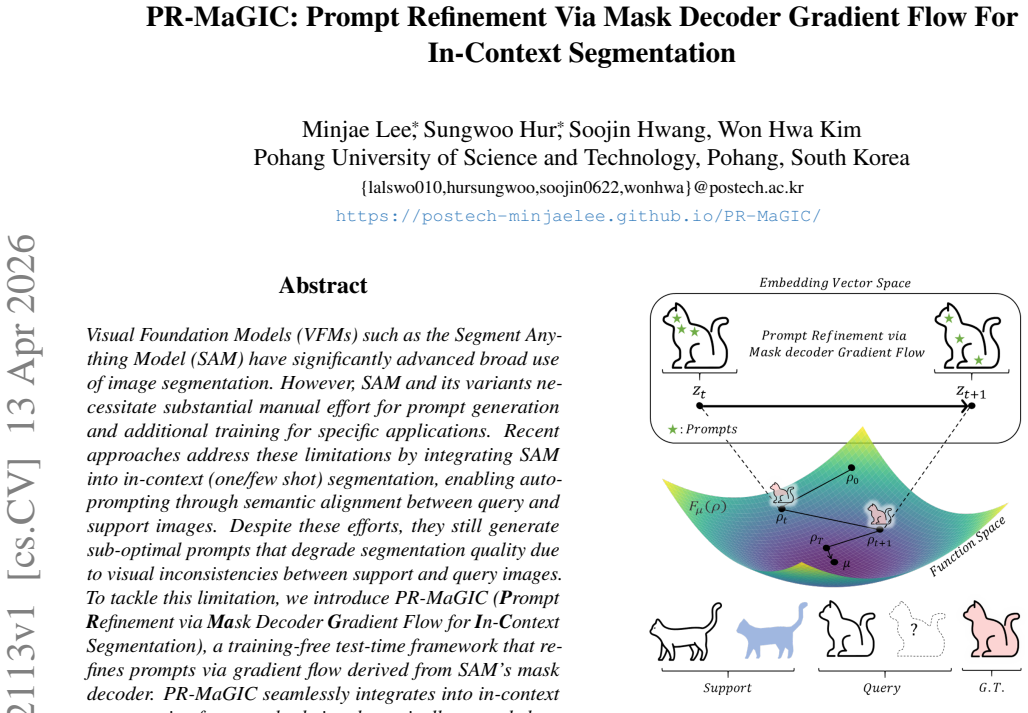





read the original abstract
Visual Foundation Models (VFMs) such as the Segment Anything Model (SAM) have significantly advanced broad use of image segmentation. However, SAM and its variants necessitate substantial manual effort for prompt generation and additional training for specific applications. Recent approaches address these limitations by integrating SAM into in-context (one/few shot) segmentation, enabling auto-prompting through semantic alignment between query and support images. Despite these efforts, they still generate sub-optimal prompts that degrade segmentation quality due to visual inconsistencies between support and query images. To tackle this limitation, we introduce PR-MaGIC (Prompt Refinement via Mask Decoder Gradient Flow for In-Context Segmentation), a training-free test-time framework that refines prompts via gradient flow derived from SAM's mask decoder. PR-MaGIC seamlessly integrates into in-context segmentation frameworks, being theoretically grounded yet practically stabilized through a simple top-1 selection strategy that ensures robust performance across samples. Extensive evaluations demonstrate that PR-MaGIC consistently improves segmentation quality across various benchmarks, effectively mitigating inadequate prompts without requiring additional training or architectural modifications.
Editorial analysis
A structured set of objections, weighed in public.
Referee Report
Summary. The manuscript introduces PR-MaGIC, a training-free test-time framework for in-context segmentation that refines initial prompts by back-propagating gradients through SAM's frozen mask decoder. It integrates with existing auto-prompting methods to address visual inconsistencies between support and query images, employs a top-1 selection heuristic for stability, and claims consistent benchmark improvements without additional training or architectural changes.
Significance. If validated, the approach would offer a practical, plug-and-play enhancement to prompt-based in-context segmentation in vision foundation models. Its training-free nature and use of existing decoder gradients could reduce manual effort in few-shot settings and inspire similar test-time refinements, provided the gradient signals reliably correct rather than amplify prompt errors.
major comments (3)
- [§3 (Method)] §3 (Method): The central mechanism assumes that gradients from the mask decoder will produce prompt updates that reduce support-query visual mismatch. No derivation, loss formulation, or analysis of the non-convex optimization landscape is provided to show why this corrects rather than reinforces errors when initial prompts are severely misaligned (e.g., large scale or appearance differences).
- [§4 (Experiments)] §4 (Experiments): The claims of 'consistent improvements across various benchmarks' and 'extensive evaluations' are not accompanied by any reported metrics, ablation tables, error bars, or controls isolating the gradient refinement from the top-1 selection strategy. This makes it impossible to assess whether gains are robust or due to post-hoc choices.
- [Abstract and §1] Abstract and §1: The top-1 selection strategy is presented as practical stabilization, yet no analysis or experiments demonstrate that at least one sampled trajectory reaches a useful basin or that the method avoids sensitivity to initialization in challenging cases.
minor comments (2)
- [Abstract] The abstract sentence 'being theoretically grounded yet practically stabilized through a simple top-1 selection strategy' is somewhat vague; a brief clarification of what 'theoretically grounded' refers to would improve readability.
- [§3 (Method)] Notation for the prompt update rule and gradient flow could be formalized with an equation in §3 to aid reproducibility.
Simulated Author's Rebuttal
We thank the referee for their detailed and constructive feedback on our manuscript. We have carefully considered each comment and provide point-by-point responses below. Where appropriate, we will revise the manuscript to address the concerns raised.
read point-by-point responses
-
Referee: [§3 (Method)] §3 (Method): The central mechanism assumes that gradients from the mask decoder will produce prompt updates that reduce support-query visual mismatch. No derivation, loss formulation, or analysis of the non-convex optimization landscape is provided to show why this corrects rather than reinforces errors when initial prompts are severely misaligned (e.g., large scale or appearance differences).
Authors: We thank the referee for highlighting this important aspect. The loss formulation minimizes a consistency objective between the mask decoder output on the refined prompt and a pseudo-target derived from support-query feature alignment. However, we acknowledge that a formal derivation and analysis of the non-convex optimization landscape were not provided. In the revised version, we will include an explicit loss function definition, a step-by-step derivation of the gradient flow, and an empirical analysis (including loss landscape visualizations on misaligned cases) to show that updates tend to correct rather than reinforce errors when combined with top-1 selection. revision: yes
-
Referee: [§4 (Experiments)] §4 (Experiments): The claims of 'consistent improvements across various benchmarks' and 'extensive evaluations' are not accompanied by any reported metrics, ablation tables, error bars, or controls isolating the gradient refinement from the top-1 selection strategy. This makes it impossible to assess whether gains are robust or due to post-hoc choices.
Authors: We thank the referee for pointing this out. Upon review, the submitted version claimed improvements but did not present the metrics, ablations, or error bars with sufficient clarity or controls. In the revised manuscript, we will add comprehensive tables with mIoU and Dice scores across benchmarks (COCO, PASCAL, etc.), explicit ablations isolating gradient refinement from top-1 selection, and error bars from multiple random seeds to demonstrate robustness. revision: yes
-
Referee: [Abstract and §1] Abstract and §1: The top-1 selection strategy is presented as practical stabilization, yet no analysis or experiments demonstrate that at least one sampled trajectory reaches a useful basin or that the method avoids sensitivity to initialization in challenging cases.
Authors: We agree that additional validation is warranted. The top-1 heuristic is based on the empirical observation that multiple trajectories frequently include at least one improved prompt. In the revision, we will add experiments showing performance distributions across trajectories on challenging cases (large scale/appearance differences), the fraction of cases where at least one trajectory reaches a useful basin, and sensitivity analysis to initialization, supported by new figures and discussion. revision: yes
Circularity Check
No circularity: new test-time gradient refinement is independent of fitted inputs or self-citation chains
full rationale
The paper introduces PR-MaGIC as a training-free test-time optimization that refines prompts by back-propagating through SAM's frozen mask decoder and applies a top-1 selection heuristic. This procedure is presented as an additive mechanism on top of existing in-context segmentation pipelines rather than a quantity derived from or fitted to the paper's own data or prior self-citations. No equation or claim reduces the output performance gain to a re-expression of the input prompt quality or to a self-referential theorem; the central improvement is therefore self-contained and externally falsifiable on benchmarks.
Axiom & Free-Parameter Ledger
axioms (1)
- domain assumption Gradient information from SAM's mask decoder can be used to improve prompt quality for visually inconsistent support-query pairs
Reference graph
Works this paper leans on
-
[1]
Refin- ing deep generative models via discriminator gradient flow
Abdul Fatir Ansari, Ming Liang Ang, and Harold Soh. Refin- ing deep generative models via discriminator gradient flow. In International Conference on Learning Representations, 2021. 3
2021
-
[2]
Lan- guage models are few-shot learners.Advances in Neural Information Processing Systems, 33:1877–1901, 2020
Tom Brown, Benjamin Mann, Nick Ryder, Melanie Sub- biah, Jared D Kaplan, Prafulla Dhariwal, Arvind Neelakantan, Pranav Shyam, Girish Sastry, Amanda Askell, et al. Lan- guage models are few-shot learners.Advances in Neural Information Processing Systems, 33:1877–1901, 2020. 1
1901
-
[3]
End- to-end object detection with transformers
Nicolas Carion, Francisco Massa, Gabriel Synnaeve, Nicolas Usunier, Alexander Kirillov, and Sergey Zagoruyko. End- to-end object detection with transformers. InEuropean con- ference on computer vision, pages 213–229. Springer, 2020. 1
2020
-
[4]
Sam-adapter: Adapting segment any- thing in underperformed scenes
Tianrun Chen, Lanyun Zhu, Chaotao Deng, Runlong Cao, Yan Wang, Shangzhan Zhang, Zejian Li, Lingyun Sun, Ying Zang, and Papa Mao. Sam-adapter: Adapting segment any- thing in underperformed scenes. InIEEE/CVF International Conference on Computer Vision, pages 3367–3375, 2023. 1, 3
2023
-
[5]
Detect what you can: De- tecting and representing objects using holistic models and body parts
Xianjie Chen, Roozbeh Mottaghi, Xiaobai Liu, Sanja Fidler, Raquel Urtasun, and Alan Yuille. Detect what you can: De- tecting and representing objects using holistic models and body parts. InIEEE conference on computer vision and pattern recognition, pages 1971–1978, 2014. 6
1971
-
[6]
Per- pixel classification is not all you need for semantic segmen- tation.Advances in Neural Information Processing Systems, 34:17864–17875, 2021
Bowen Cheng, Alex Schwing, and Alexander Kirillov. Per- pixel classification is not all you need for semantic segmen- tation.Advances in Neural Information Processing Systems, 34:17864–17875, 2021. 1
2021
-
[7]
An image is worth 16x16 words: Transformers for image recognition at scale, 2021
Alexey Dosovitskiy, Lucas Beyer, Alexander Kolesnikov, Dirk Weissenborn, Xiaohua Zhai, Thomas Unterthiner, Mostafa Dehghani, Matthias Minderer, Georg Heigold, Syl- vain Gelly, Jakob Uszkoreit, and Neil Houlsby. An image is worth 16x16 words: Transformers for image recognition at scale, 2021. 1, 6
2021
-
[8]
The pascal visual object classes (voc) challenge.International journal of computer vision, 88:303–338, 2010
Mark Everingham, Luc Van Gool, Christopher KI Williams, John Winn, and Andrew Zisserman. The pascal visual object classes (voc) challenge.International journal of computer vision, 88:303–338, 2010. 6
2010
-
[9]
Cost aggregation with 4d convolutional swin transformer for few-shot segmentation
Sunghwan Hong, Seokju Cho, Jisu Nam, Stephen Lin, and Seungryong Kim. Cost aggregation with 4d convolutional swin transformer for few-shot segmentation. InEuropean Conference on Computer Vision, pages 108–126. Springer,
-
[10]
Segment anything in high quality.Advances in Neural Information Processing Systems, 36, 2024
Lei Ke, Mingqiao Ye, Martin Danelljan, Yu-Wing Tai, Chi- Keung Tang, Fisher Yu, et al. Segment anything in high quality.Advances in Neural Information Processing Systems, 36, 2024. 1, 3
2024
-
[11]
Segment any- thing
Alexander Kirillov, Eric Mintun, Nikhila Ravi, Hanzi Mao, Chloe Rolland, Laura Gustafson, Tete Xiao, Spencer White- head, Alexander C Berg, Wan-Yen Lo, et al. Segment any- thing. InIEEE/CVF International Conference on Computer Vision, pages 4015–4026, 2023. 1
2023
-
[12]
Springer, 1992
Peter E Kloeden, Eckhard Platen, Peter E Kloeden, and Eck- hard Platen.Stochastic differential equations. Springer, 1992. 3
1992
-
[13]
Fss-1000: A 1000-class dataset for few-shot segmentation
Xiang Li, Tianhan Wei, Yau Pun Chen, Yu-Wing Tai, and Chi-Keung Tang. Fss-1000: A 1000-class dataset for few-shot segmentation. InIEEE/CVF conference on computer vision and pattern recognition, pages 2869–2878, 2020. 6
2020
-
[14]
Matcher: Segment anything with one shot using all-purpose feature matching
Yang Liu, Muzhi Zhu, Hengtao Li, Hao Chen, Xinlong Wang, and Chunhua Shen. Matcher: Segment anything with one shot using all-purpose feature matching. InInternational Conference on Learning Representations, 2024. 2, 3, 4, 5, 6
2024
-
[15]
Swin transformer: Hierarchical vision transformer using shifted windows
Ze Liu, Yutong Lin, Yue Cao, Han Hu, Yixuan Wei, Zheng Zhang, Stephen Lin, and Baining Guo. Swin transformer: Hierarchical vision transformer using shifted windows. In IEEE/CVF international conference on computer vision, pages 10012–10022, 2021. 1
2021
-
[16]
Feature weighting and boosting for few-shot segmentation
Khoi Nguyen and Sinisa Todorovic. Feature weighting and boosting for few-shot segmentation. InIEEE/CVF Interna- tional Conference on Computer Vision, pages 622–631, 2019. 6
2019
-
[17]
Maxime Oquab, Timothée Darcet, Theo Moutakanni, Huy V . V o, Marc Szafraniec, Vasil Khalidov, Pierre Fernandez, Daniel Haziza, Francisco Massa, Alaaeldin El-Nouby, Russell Howes, Po-Yao Huang, Hu Xu, Vasu Sharma, Shang-Wen Li, Wojciech Galuba, Mike Rabbat, Mido Assran, Nicolas Ballas, Gabriel Synnaeve, Ishan Misra, Herve Jegou, Julien Mairal, Patrick Laba...
-
[18]
Highly accurate dichotomous image segmentation
Xuebin Qin, Hang Dai, Xiaobin Hu, Deng-Ping Fan, Ling Shao, and Luc Van Gool. Highly accurate dichotomous image segmentation. InECCV, 2022. 6
2022
-
[19]
Paco: Parts and attributes of common objects
Vignesh Ramanathan, Anmol Kalia, Vladan Petrovic, Yi Wen, Baixue Zheng, Baishan Guo, Rui Wang, Aaron Marquez, Rama Kovvuri, Abhishek Kadian, et al. Paco: Parts and attributes of common objects. InIEEE/CVF Conference on Computer Vision and Pattern Recognition, pages 7141–7151,
-
[20]
The fokker-planck equation, 1996
H Risken. The fokker-planck equation, 1996. 3
1996
-
[21]
{Euclidean, metric, and Wasserstein} gradient flows: an overview.Bulletin of Mathematical Sci- ences, 7:87–154, 2017
Filippo Santambrogio. {Euclidean, metric, and Wasserstein} gradient flows: an overview.Bulletin of Mathematical Sci- ences, 7:87–154, 2017. 3
2017
-
[22]
One-shot learning for semantic segmentation
Amirreza Shaban, Shray Bansal, Zhen Liu, Irfan Essa, and Byron Boots. One-shot learning for semantic segmentation. arXiv preprint arXiv:1709.03410, 2017. 2
-
[23]
Segmenter: Transformer for semantic segmentation
Robin Strudel, Ricardo Garcia, Ivan Laptev, and Cordelia Schmid. Segmenter: Transformer for semantic segmentation. InIEEE/CVF international conference on computer vision, pages 7262–7272, 2021. 1
2021
-
[24]
Density ratio estimation in machine learning
Masashi Sugiyama, Taiji Suzuki, and Takafumi Kanamori. Density ratio estimation in machine learning. Cambridge University Press, 2012. 4
2012
-
[25]
Vrp-sam: Sam with visual reference prompt
Yanpeng Sun, Jiahui Chen, Shan Zhang, Xinyu Zhang, Qiang Chen, Gang Zhang, Errui Ding, Jingdong Wang, and Zechao Li. Vrp-sam: Sam with visual reference prompt. InIEEE/CVF 9 Conference on Computer Vision and Pattern Recognition, pages 23565–23574, 2024. 3
2024
-
[26]
Training data-efficient image transformers & distillation through atten- tion
Hugo Touvron, Matthieu Cord, Matthijs Douze, Francisco Massa, Alexandre Sablayrolles, and Hervé Jégou. Training data-efficient image transformers & distillation through atten- tion. InInternational conference on machine learning, pages 10347–10357. PMLR, 2021. 1
2021
-
[27]
LLaMA: Open and Efficient Foundation Language Models
Hugo Touvron, Thibaut Lavril, Gautier Izacard, Xavier Mar- tinet, Marie-Anne Lachaux, Timothée Lacroix, Baptiste Roz- ière, Naman Goyal, Eric Hambro, Faisal Azhar, et al. Llama: Open and efficient foundation language models.arXiv preprint arXiv:2302.13971, 2023. 1
work page internal anchor Pith review Pith/arXiv arXiv 2023
-
[28]
Junde Wu, Wei Ji, Yuanpei Liu, Huazhu Fu, Min Xu, Yanwu Xu, and Yueming Jin. Medical sam adapter: Adapting seg- ment anything model for medical image segmentation.arXiv preprint arXiv:2304.12620, 2023. 1
-
[29]
GLM-130B: An Open Bilingual Pre-trained Model
Aohan Zeng, Xiao Liu, Zhengxiao Du, Zihan Wang, Hanyu Lai, Ming Ding, Zhuoyi Yang, Yifan Xu, Wendi Zheng, Xiao Xia, et al. Glm-130b: An open bilingual pre-trained model. arXiv preprint arXiv:2210.02414, 2022. 1
work page internal anchor Pith review arXiv 2022
-
[30]
Faster segment anything: Towards lightweight sam for mobile applications,
Chaoning Zhang, Dongshen Han, Yu Qiao, Jung Uk Kim, Sung-Ho Bae, Seungkyu Lee, and Choong Seon Hong. Faster segment anything: Towards lightweight sam for mobile appli- cations.arXiv preprint arXiv:2306.14289, 2023. 3
-
[31]
Feature- proxy transformer for few-shot segmentation
Jian-Wei Zhang, Yifan Sun, Yi Yang, and Wei Chen. Feature- proxy transformer for few-shot segmentation. InAdvances in Neural Information Processing Systems, 2022. 2
2022
-
[32]
Personalize segment anything model with one shot
Renrui Zhang, Zhengkai Jiang, Ziyu Guo, Shilin Yan, Junt- ing Pan, Hao Dong, Yu Qiao, Peng Gao, and Hongsheng Li. Personalize segment anything model with one shot. In International Conference on Learning Representations, 2024. 1, 2, 3, 4, 5, 6 10 PR-MaGIC: Prompt Refinement Via Mask Decoder Gradient Flow For In-Context Segmentation Supplementary Material ...
2024
discussion (0)
Sign in with ORCID, Apple, or X to comment. Anyone can read and Pith papers without signing in.