Recognition: unknown
Hybrid Adaptive Tuning for Tiered Memory Systems
Pith reviewed 2026-05-10 14:36 UTC · model grok-4.3
The pith
PTMT automates runtime parameter tuning for memory tiering using an offline performance database paired with online reinforcement learning.
A machine-rendered reading of the paper's core claim, the machinery that carries it, and where it could break.
Core claim
PTMT uses a hybrid offline-plus-online method to tune memory tiering parameters: the offline phase constructs a performance database that supports fast queries and lowers runtime cost, while the online phase employs a reinforcement-learning agent tailored to memory tiering constraints to select better parameter values at each step.
What carries the argument
PTMT's hybrid offline database and customized online reinforcement-learning agent, which together enable low-overhead, workload-adaptive selection of memory tiering parameters such as migration thresholds and profiling intervals.
If this is right
- Memory tiering solutions such as TPP, UPM, Colloid, and AutoNUMA can deliver higher throughput without requiring manual or workload-specific parameter configuration.
- Applications running on tiered memory hardware experience automatic adaptation to shifting access patterns with only modest added system cost.
- The same hybrid database-plus-RL structure can be applied to other tunable components inside operating systems that manage memory movement.
- Overall system utilization and effective memory capacity increase because page migrations occur more frequently at the right times.
Where Pith is reading between the lines
- If the representative workloads capture the dominant access patterns found in production, the approach could lower the expertise barrier for deploying tiered memory across varied cloud and HPC environments.
- The technique may generalize to other hardware tiers that emerge in future systems, such as additional levels of storage-class memory.
- Developers could combine PTMT with online profiling improvements to further reduce the size of the offline database needed.
Load-bearing premise
A performance database built once from representative workloads will stay accurate enough to guide effective parameter choices for arbitrary new applications without adding unacceptable overhead or instability.
What would settle it
Run PTMT on a workload whose memory-access pattern lies outside the offline database's coverage and check whether the resulting parameter choices produce performance below the default configuration or cause instability.
Figures




read the original abstract
Memory tiering provides a cost-effective solution to increase memory capacity, utilization, and even bandwidth. Memory tiering relies on system software for memory profiling, detection of frequently accessed pages, and page migration. Such a system software often comes with system parameters. The configurations of those parameters impact application performance. We comprehensively classify system parameters, and characterize the sensitivity of application performance to them using representative memory tiering solutions. Furthermore, we introduce a lightweight and user-friendly framework PTMT, which automates tuning of parameters at runtime for various memory tiering solutions. We identify major challenges for online tuning of memory tiering. PTMT uses a hybrid "offline + online" tuning method: while the offline phase builds a performance database for online queries and reduces runtime overhead, the online phase uses reinforcement learning (customized to memory tiering) to tune. PTMT improves performance by 30%, 26%, 21%, and 14%, on four memory tiering solutions (TPP, UPM, Colloid, and AutoNUMA), compared to using the default configurations. PTMT outperforms the state-of-the-art by 32% on average.
Editorial analysis
A structured set of objections, weighed in public.
Referee Report
Summary. The paper presents PTMT, a hybrid offline+online framework for automatic runtime tuning of system parameters in memory tiering solutions. It classifies parameters, characterizes their sensitivity via representative workloads, builds an offline performance database, and employs a customized reinforcement-learning agent for online adaptation. The central empirical claim is that PTMT yields 30%, 26%, 21%, and 14% performance gains over default configurations on TPP, UPM, Colloid, and AutoNUMA respectively, while outperforming prior state-of-the-art tuning by 32% on average.
Significance. If the reported gains are reproducible and the offline database generalizes, PTMT would provide a practical, low-overhead method for improving memory-tiering efficiency across multiple existing systems. The hybrid design that amortizes profiling cost offline while retaining online adaptability is a concrete engineering contribution that could influence both research prototypes and production memory-management stacks.
major comments (2)
- [§4] §4 (Evaluation) and the abstract: the reported percentage improvements lack error bars, workload counts, statistical significance tests, or explicit description of how the four baseline systems were configured and measured. Without these, it is impossible to assess whether the gains are robust or sensitive to post-hoc workload selection.
- [§3.2] §3.2 (Offline Database Construction) and §4.3 (Generalization): the central claim that the offline performance database supplies accurate priors for unseen applications is not supported by held-out workload testing or sensitivity analysis. If the representative workloads do not cover the access patterns or migration-cost surfaces of arbitrary new applications, the RL policy can select suboptimal parameters; this assumption is load-bearing for the 14–30% gains and the 32% SOTA comparison.
minor comments (2)
- [Abstract] The abstract and §1 state concrete percentage improvements without citing the corresponding evaluation tables or figures; cross-references should be added.
- [§3.3] Notation for the RL state/action space and reward function in §3.3 is introduced without a compact summary table; a single table would improve readability.
Simulated Author's Rebuttal
We thank the referee for the constructive and detailed comments. The suggestions will improve the rigor of our evaluation section and strengthen the generalization claims. We address each major comment below and commit to the corresponding revisions.
read point-by-point responses
-
Referee: [§4] §4 (Evaluation) and the abstract: the reported percentage improvements lack error bars, workload counts, statistical significance tests, or explicit description of how the four baseline systems were configured and measured. Without these, it is impossible to assess whether the gains are robust or sensitive to post-hoc workload selection.
Authors: We agree that the current presentation would benefit from greater statistical detail. Although §4 reports results from repeated runs on representative workloads, error bars, explicit workload counts, and formal significance tests are not included. In the revised manuscript we will add error bars (standard deviation across 5+ runs) to all performance figures and tables, state that 12 workloads were used (categorized by access intensity and migration cost), and report statistical significance via paired Wilcoxon tests. We will also add a dedicated paragraph in §4 describing the exact default configurations and measurement protocol for each baseline system (TPP, UPM, Colloid, AutoNUMA), including parameter values, warm-up periods, and repetition counts. These additions will be reflected in the abstract as well. revision: yes
-
Referee: [§3.2] §3.2 (Offline Database Construction) and §4.3 (Generalization): the central claim that the offline performance database supplies accurate priors for unseen applications is not supported by held-out workload testing or sensitivity analysis. If the representative workloads do not cover the access patterns or migration-cost surfaces of arbitrary new applications, the RL policy can select suboptimal parameters; this assumption is load-bearing for the 14–30% gains and the 32% SOTA comparison.
Authors: We acknowledge that §4.3 currently lacks explicit held-out testing, which limits the strength of the generalization argument. The workloads used for the offline database were selected after the sensitivity characterization in §3.2 to span key dimensions of access patterns and migration costs. To directly address the concern, the revision will add held-out evaluation results on workloads excluded from database construction and include a sensitivity analysis quantifying how well the database priors transfer. These additions will provide empirical support for the claim while preserving the hybrid offline-online design. revision: yes
Circularity Check
No circularity: empirical claims rest on measured outcomes against external baselines
full rationale
The paper describes PTMT as a hybrid offline+online tuning framework for memory tiering parameters, with an offline performance database built from representative workloads and an online RL agent for adaptation. All reported gains (30%, 26%, 21%, 14% over defaults; 32% over SOTA) are presented as direct experimental measurements on four specific systems (TPP, UPM, Colloid, AutoNUMA) rather than as outputs of any closed-form derivation, fitted model, or self-referential prediction. No equations, uniqueness theorems, ansatzes, or self-citations appear as load-bearing steps in the provided abstract or described evaluation; the central claims therefore do not reduce to their own inputs by construction and remain externally falsifiable via independent runs on the same workloads and systems.
Axiom & Free-Parameter Ledger
Reference graph
Works this paper leans on
-
[1]
https://www.scikit-yb.org/ en/latest/api/cluster/elbow.html
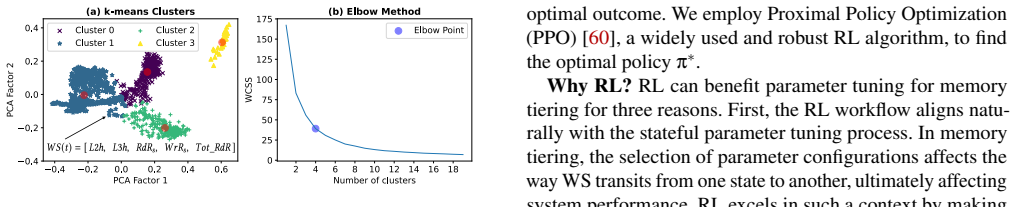
Elbow Method, 2022. https://www.scikit-yb.org/ en/latest/api/cluster/elbow.html
2022
-
[2]
https://cloud
Model Garden on Vertex AI, 2024. https://cloud. google.com/model-garden
2024
-
[3]
https://www.nas
NAS Parallel Benchmarks, 2024. https://www.nas. nasa.gov/software/npb.html
2024
-
[4]
https://cloud.google.com/solutions/ running-computer-aided-engineering-workloads
Running Computer-Aided Engineer- ing Workloads on Google Cloud, 2024. https://cloud.google.com/solutions/ running-computer-aided-engineering-workloads
2024
-
[5]
https://www.simscale.com/
AI-Native Engineering Simulation in the Cloud, 2025. https://www.simscale.com/
2025
-
[6]
https://azure.microsoft.com/en-us/products/ ai-foundry/models
Azure AI Foundry Model Catalog, 2025. https://azure.microsoft.com/en-us/products/ ai-foundry/models
2025
-
[7]
https://aws
Computational Fluid Dynamics, 2025. https://aws. amazon.com/hpc/cfd
2025
-
[8]
utk.edu/projectsfiles/hpcc/RandomAccess/
GUPS (Giga Updates Per Second), 2025.https://icl. utk.edu/projectsfiles/hpcc/RandomAccess/
2025
-
[9]
High Performance Computing for Healthcare & Life Sci- ences, 2025.https://aws.amazon.com/hpc/hcls
2025
-
[10]
https://rescale.com/ platform/hpc-as-a-service/
HPC as a Service, 2025. https://rescale.com/ platform/hpc-as-a-service/
2025
-
[11]
https://en.wikipedia
k-means clustering, 2025. https://en.wikipedia. org/wiki/K-means_clustering
2025
-
[12]
https://en.wikipedia
Normal distribution, 2025. https://en.wikipedia. org/wiki/Normal_distribution
2025
-
[13]
https://github.com/ DLR-RM/stable-baselines3
Stable Baselines3, 2025. https://github.com/ DLR-RM/stable-baselines3
2025
-
[14]
https:// anonymous.4open.science/r/UPM
User-Space Page Management, 2025. https:// anonymous.4open.science/r/UPM
2025
-
[15]
Analysis with Instruction Based Sam- pling
AMD. Analysis with Instruction Based Sam- pling. https://docs.amd.com/r/en-US/57368-uProf-user- guide, 2025
2025
-
[16]
PTMT, 2025
Anonymous. PTMT, 2025. https://anonymous. 4open.science/r/PTMT
2025
-
[17]
D. H. Bailey, L. Dagum, E. Barszcz, and H. D. Simon. Nas parallel benchmark results. InSupercomputing ’92: Proceedings of the 1992 ACM/IEEE conference on Supercomputing, pages 386–393, Los Alamitos, CA, USA, 1992. IEEE Computer Society Press
1992
-
[18]
A rule-based distributed system for self-optimization of constrained devices
Javier Baliosian, Jorge Visca, Eduardo Grampin, Leonardo Vidal, and Martin Giachino. A rule-based distributed system for self-optimization of constrained devices. In2009 IFIP/IEEE International Symposium on Integrated Network Management, 2009
2009
-
[19]
Reconsidering OS Mem- ory Optimizations in the Presence of Disaggregated Memory
Shai Bergman, Priyank Faldu, Boris Grot, Lluís Vi- lanova, and Mark Silberstein. Reconsidering OS Mem- ory Optimizations in the Presence of Disaggregated Memory. InProceedings of the 2022 ACM SIGPLAN In- ternational Symposium on Memory Management, 2022
2022
-
[20]
{Config-Snob}: Tuning for the best configurations of networking protocol stack
Manaf Bin-Yahya, Yifei Zhao, Hossein Shafieirad, An- thony Ho, Shijun Yin, Fanzhao Wang, and Geng Li. {Config-Snob}: Tuning for the best configurations of networking protocol stack. In2024 USENIX Annual Technical Conference (USENIX ATC 24), 2024
2024
-
[21]
IDT: Intelligent Data Placement for Multi-tiered Main Memory with Reinforcement Learn- ing
Juneseo Chang, Wanju Doh, Yaebin Moon, Eojin Lee, and Jung Ho Ahn. IDT: Intelligent Data Placement for Multi-tiered Main Memory with Reinforcement Learn- ing. InInternational Symposium on High-Performance Parallel and Distributed Computing (HPDC), 2024
2024
-
[22]
Optimizing data placement on hierar- chical storage architecture via machine learning
Peng Cheng, Yutong Lu, Yunfei Du, Zhiguang Chen, and Yang Liu. Optimizing data placement on hierar- chical storage architecture via machine learning. In Network and Parallel Computing: 16th IFIP WG 10.3 International Conference, 2019
2019
-
[23]
Dancing in the dark: Profiling for tiered memory
Jinyoung Choi, Sergey Blagodurov, and Hung-Wei Tseng. Dancing in the dark: Profiling for tiered memory. In2021 IEEE International Parallel and Distributed Processing Symposium (IPDPS), 2021
2021
-
[24]
LRU-list manipulation with DAMON
Jonathan Corbet. LRU-list manipulation with DAMON. 2022.https://lwn.net/Articles/905370/
2022
-
[25]
Kleio: A hybrid memory page scheduler with machine intelligence
Thaleia Dimitra Doudali, Sergey Blagodurov, Abhinav Vishnu, Sudhanva Gurumurthi, and Ada Gavrilovska. Kleio: A hybrid memory page scheduler with machine intelligence. InProceedings of the 28th International Symposium on High-Performance Parallel and Dis- tributed Computing, 2019
2019
-
[26]
Coeus: Clustering (a) like patterns for practical machine intelli- gent hybrid memory management
Thaleia Dimitra Doudali and Ada Gavrilovska. Coeus: Clustering (a) like patterns for practical machine intelli- gent hybrid memory management. In2022 22nd IEEE International Symposium on Cluster , Cloud and Internet Computing (CCGrid), 2022
2022
-
[27]
Cronus: Computer vision-based machine intelligent hybrid mem- ory management
Thaleia Dimitra Doudali and Ada Gavrilovska. Cronus: Computer vision-based machine intelligent hybrid mem- ory management. InProceedings of the 2022 Interna- tional Symposium on Memory Systems, 2022. 13
2022
-
[28]
Cori: Dancing to the right beat of periodic data movements over hybrid memory systems
Thaleia Dimitra Doudali, Daniel Zahka, and Ada Gavrilovska. Cori: Dancing to the right beat of periodic data movements over hybrid memory systems. In2021 IEEE International Parallel and Distributed Processing Symposium (IPDPS), 2021
2021
-
[29]
Data tier- ing in heterogeneous memory systems
Subramanya R Dulloor, Amitabha Roy, Zheguang Zhao, Narayanan Sundaram, Nadathur Satish, Rajesh Sankaran, Jeff Jackson, and Karsten Schwan. Data tier- ing in heterogeneous memory systems. InProceedings of the Eleventh European Conference on Computer Sys- tems, 2016
2016
-
[30]
To- wards an adaptable systems architecture for memory tiering at warehouse-scale
Padmapriya Duraisamy, Wei Xu, Scott Hare, Ravi Ra- jwar, David Culler, Zhiyi Xu, Jianing Fan, Christopher Kennelly, Bill McCloskey, Danijela Mijailovic, et al. To- wards an adaptable systems architecture for memory tiering at warehouse-scale. InProceedings of the 28th ACM International Conference on Architectural Support for Programming Languages and Oper...
2023
-
[31]
Adaptive software cache management
Gil Einziger, Ohad Eytan, Roy Friedman, and Ben Manes. Adaptive software cache management. InPro- ceedings of the 19th International Middleware Confer- ence, 2018
2018
-
[32]
System-level per- formance metrics for multiprogram workloads.IEEE micro, 28(3):42–53, 2008
Stijn Eyerman and Lieven Eeckhout. System-level per- formance metrics for multiprogram workloads.IEEE micro, 28(3):42–53, 2008
2008
-
[33]
Liblinear: A library for large linear classification.Journal of machine Learning research, 9:1871–1874, 2008
Rong-En Fan, Kai-Wei Chang, Cho-Jui Hsieh, Xiang- Rui Wang, and Chih-Jen Lin. Liblinear: A library for large linear classification.Journal of machine Learning research, 9:1871–1874, 2008
2008
-
[34]
Hetero- visor: Exploiting resource heterogeneity to enhance the elasticity of cloud platforms.ACM SIGPLAN Notices, 50(7):79–92, 2015
Vishal Gupta, Min Lee, and Karsten Schwan. Hetero- visor: Exploiting resource heterogeneity to enhance the elasticity of cloud platforms.ACM SIGPLAN Notices, 50(7):79–92, 2015
2015
-
[35]
Adaptive page migration policy with huge pages in tiered memory systems.IEEE Transac- tions on Computers, 71(1):53–68, 2020
Taekyung Heo, Yang Wang, Wei Cui, Jaehyuk Huh, and Lintao Zhang. Adaptive page migration policy with huge pages in tiered memory systems.IEEE Transac- tions on Computers, 71(1):53–68, 2020
2020
-
[36]
autonuma: Optimize page place- ment for memory tiering system, 2020
Ying Huang. autonuma: Optimize page place- ment for memory tiering system, 2020. https: //patchwork.kernel.org/project/linux-mm/ patch/20201027063217.211096-2-ying.huang@ intel.com/
-
[37]
Intel® Performance Counter Monitor (Intel® PCM).https://github.com/intel/pcm
Intel. Intel® Performance Counter Monitor (Intel® PCM).https://github.com/intel/pcm
-
[38]
Heteroos: Os design for heterogeneous memory management in datacenter
Sudarsun Kannan, Ada Gavrilovska, Vishal Gupta, and Karsten Schwan. Heteroos: Os design for heterogeneous memory management in datacenter. InProceedings of the 44th Annual International Symposium on Computer Architecture, 2017
2017
-
[39]
Exploring the design space of page management for {Multi-Tiered} memory systems
Jonghyeon Kim, Wonkyo Choe, and Jeongseob Ahn. Exploring the design space of page management for {Multi-Tiered} memory systems. In2021 USENIX Annual Technical Conference (USENIX ATC 21), 2021
2021
-
[40]
hats: A heterogeneity-aware tiered storage for hadoop
KR Krish, Ali Anwar, and Ali R Butt. hats: A heterogeneity-aware tiered storage for hadoop. In2014 14th IEEE/ACM International Symposium on Cluster , Cloud and Grid Computing, 2014
2014
-
[41]
Software-defined far memory in warehouse-scale computers
Andres Lagar-Cavilla, Junwhan Ahn, Suleiman Souhlal, Neha Agarwal, Radoslaw Burny, Shakeel Butt, Jichuan Chang, Ashwin Chaugule, Nan Deng, Junaid Shahid, et al. Software-defined far memory in warehouse-scale computers. InProceedings of the Twenty-F ourth Inter- national Conference on Architectural Support for Pro- gramming Languages and Operating Systems, 2019
2019
-
[42]
Memtis: Efficient memory tiering with dynamic page classification and page size deter- mination
Taehyung Lee, Sumit Kumar Monga, Changwoo Min, and Young Ik Eom. Memtis: Efficient memory tiering with dynamic page classification and page size deter- mination. InProceedings of the 29th Symposium on Operating Systems Principles, 2023
2023
-
[43]
Qtune: A query-aware database tuning system with deep reinforcement learning.Proceedings of the VLDB En- dowment, 12(12):2118–2130, 2019
Guoliang Li, Xuanhe Zhou, Shifu Li, and Bo Gao. Qtune: A query-aware database tuning system with deep reinforcement learning.Proceedings of the VLDB En- dowment, 12(12):2118–2130, 2019
2019
-
[44]
Capes: Unsupervised storage performance tuning using neural network-based deep reinforcement learning
Yan Li, Kenneth Chang, Oceane Bel, Ethan L Miller, and Darrell DE Long. Capes: Unsupervised storage performance tuning using neural network-based deep reinforcement learning. InProceedings of the inter- national conference for high performance computing, networking, storage and analysis, 2017
2017
-
[45]
{AutoSys}: The design and operation of {Learning-Augmented} sys- tems
Chieh-Jan Mike Liang, Hui Xue, Mao Yang, Lidong Zhou, Lifei Zhu, Zhao Lucis Li, Zibo Wang, Qi Chen, Quanlu Zhang, Chuanjie Liu, et al. {AutoSys}: The design and operation of {Learning-Augmented} sys- tems. In2020 USENIX Annual Technical Conference (USENIX ATC 20), 2020
2020
-
[46]
An energy-efficient tuning method for cloud servers combining dvfs and parameter optimization.IEEE Transactions on Cloud Computing, 2023
Weiwei Lin, Xiaoxuan Luo, ChunKi Li, Jiechao Liang, Guokai Wu, and Keqin Li. An energy-efficient tuning method for cloud servers combining dvfs and parameter optimization.IEEE Transactions on Cloud Computing, 2023
2023
-
[47]
Tiered memory management beyond hotness
Jinshu Liu, Hamid Hadian, Hanchen Xu, and Huaicheng Li. Tiered memory management beyond hotness. In 19th USENIX Symposium on Operating Systems Design and Implementation (OSDI 25), 2025. 14
2025
-
[48]
Learning-based memory allocation for c++ server workloads
Martin Maas, David G Andersen, Michael Isard, Mo- hammad Mahdi Javanmard, Kathryn S McKinley, and Colin Raffel. Learning-based memory allocation for c++ server workloads. InProceedings of the Twenty-Fifth International Conference on Architectural Support for Programming Languages and Operating Systems, 2020
2020
-
[49]
Multi- clock: Dynamic tiering for hybrid memory systems
Adnan Maruf, Ashikee Ghosh, Janki Bhimani, Daniel Campello, Andy Rudoff, and Raju Rangaswami. Multi- clock: Dynamic tiering for hybrid memory systems. In2022 IEEE International Symposium on High- Performance Computer Architecture (HPCA), 2022
2022
-
[50]
TPP: Transparent page placement for CXL-enabled tiered-memory
Hasan Al Maruf, Hao Wang, Abhishek Dhanotia, Jo- hannes Weiner, Niket Agarwal, Pallab Bhattacharya, Chris Petersen, Mosharaf Chowdhury, Shobhit Kanaujia, and Prakash Chauhan. TPP: Transparent page placement for CXL-enabled tiered-memory. InProceedings of the 28th ACM International Conference on Architectural Support for Programming Languages and Operating...
2023
-
[51]
A feature-weighted rule for the k-nearest neighbor
Tsvetelina Mladenova. A feature-weighted rule for the k-nearest neighbor. InInternational Symposium on Mul- tidisciplinary Studies and Innovative Technologies (ISM- SIT), 2021
2021
-
[52]
Introducing the graph 500.Cray Users Group (CUG), 19(45-74):22, 2010
Richard C Murphy, Kyle B Wheeler, Brian W Barrett, and James A Ang. Introducing the graph 500.Cray Users Group (CUG), 19(45-74):22, 2010
2010
-
[53]
Tmc: Near-optimal resource allocation for tiered- memory systems
Yuanjiang Ni, Pankaj Mehra, Ethan Miller, and Heiner Litz. Tmc: Near-optimal resource allocation for tiered- memory systems. InProceedings of the 2023 ACM Symposium on Cloud Computing, 2023
2023
-
[54]
Maphea: A lightweight memory hierarchy-aware profile-guided heap allocation framework
Deok-Jae Oh, Yaebin Moon, Eojin Lee, Tae Jun Ham, Yongjun Park, Jae W Lee, and Jung Ho Ahn. Maphea: A lightweight memory hierarchy-aware profile-guided heap allocation framework. InProceedings of the 22nd ACM SIGPLAN/SIGBED International Conference on Languages, Compilers, and Tools for Embedded Systems, 2021
2021
-
[55]
Daos: Data access-aware operating system
SeongJae Park, Madhuparna Bhowmik, and Alexandru Uta. Daos: Data access-aware operating system. In Proceedings of the 31st International Symposium on High-Performance Parallel and Distributed Computing, 2022
2022
-
[56]
Hemem: Scalable tiered memory management for big data applications and real nvm
Amanda Raybuck, Tim Stamler, Wei Zhang, Mattan Erez, and Simon Peter. Hemem: Scalable tiered memory management for big data applications and real nvm. In Proceedings of the ACM SIGOPS 28th Symposium on Operating Systems Principles, 2021
2021
-
[57]
Machine learning-guided memory optimization for dlrm infer- ence on tiered memory
Jie Ren, Bin Ma, Shuangyan Yang, Benjamin Francis, Ehsan K Ardestani, Min Si, and Dong Li. Machine learning-guided memory optimization for dlrm infer- ence on tiered memory. In2025 IEEE International Symposium on High Performance Computer Architec- ture (HPCA), pages 1631–1647. IEEE, 2025
2025
-
[58]
MTM: Rethinking Memory Profiling and Migration for Multi-Tiered Large Memory Systems
Jie Ren, Dong Xu, Junhee Ryu, Kwangsik Shin, Daewoo Kim, and Dong Li. MTM: Rethinking Memory Profiling and Migration for Multi-Tiered Large Memory Systems. InEuropean Conference on Computer Systems, 2024
2024
-
[59]
Archivist: A machine learning assisted data placement mechanism for hybrid storage systems
Jinting Ren, Xianzhang Chen, Yujuan Tan, Duo Liu, Moming Duan, Liang Liang, and Lei Qiao. Archivist: A machine learning assisted data placement mechanism for hybrid storage systems. In2019 IEEE 37th Interna- tional Conference on Computer Design (ICCD), 2019
2019
-
[60]
Proximal Policy Optimization Algorithms
John Schulman, Filip Wolski, Prafulla Dhariwal, Alec Radford, and Oleg Klimov. Proximal policy optimiza- tion algorithms.arXiv preprint arXiv:1707.06347, 2017
work page internal anchor Pith review Pith/arXiv arXiv 2017
-
[61]
Automating the application data placement in hybrid memory systems
Harald Servat, Antonio J Peña, Germán Llort, Estanis- lao Mercadal, Hans-Christian Hoppe, and Jesús Labarta. Automating the application data placement in hybrid memory systems. In2017 IEEE International Confer- ence on Cluster Computing (CLUSTER), 2017
2017
-
[62]
Hybridtier: an adaptive and lightweight cxl-memory tiering system
Kevin Song, Jiacheng Yang, Zixuan Wang, Jishen Zhao, Sihang Liu, and Gennady Pekhimenko. Hybridtier: an adaptive and lightweight cxl-memory tiering system. In Proceedings of the 30th ACM International Conference on Architectural Support for Programming Languages and Operating Systems (ASPLOS), 2025
2025
-
[63]
Workload-aware performance tuning for multimodel databases based on deep reinforcement learning.International Journal of Intelligent Systems, 2023(1):8835111, 2023
Jun Sun, Feng Ye, Nadia Nedjah, Ming Zhang, and Dong Xu. Workload-aware performance tuning for multimodel databases based on deep reinforcement learning.International Journal of Intelligent Systems, 2023(1):8835111, 2023
2023
-
[64]
arXiv preprint arXiv:1805.01954 , year=
Faraz Torabi, Garrett Warnell, and Peter Stone. Be- havioral cloning from observation.arXiv preprint arXiv:1805.01954, 2018
-
[65]
Speedy transactions in multicore in-memory databases
Stephen Tu, Wenting Zheng, Eddie Kohler, Barbara Liskov, and Samuel Madden. Speedy transactions in multicore in-memory databases. InProceedings of the Twenty-F ourth ACM Symposium on Operating Systems Principles, 2013
2013
-
[66]
Automatic database management system tuning through large-scale machine learning
Dana Van Aken, Andrew Pavlo, Geoffrey J Gordon, and Bohan Zhang. Automatic database management system tuning through large-scale machine learning. InPro- ceedings of the 2017 ACM international conference on management of data, 2017. 15
2017
-
[67]
Hybrid2: Combining caching and migration in hybrid memory systems
Evangelos Vasilakis, Vassilis Papaefstathiou, Pedro Trancoso, and Ioannis Sourdis. Hybrid2: Combining caching and migration in hybrid memory systems. In 2020 IEEE International Symposium on High Perfor- mance Computer Architecture (HPCA), 2020
2020
-
[68]
Tiering-0.8
Vishal Verma. Tiering-0.8. 2022. https: //git.kernel.org/pub/scm/linux/kernel/ git/vishal/tiering.git/log/?h=tiering-0.8
2022
-
[69]
Tiered mem- ory management: Access latency is the key! InProceed- ings of the ACM SIGOPS 30th Symposium on Operating Systems Principles, 2024
Midhul Vuppalapati and Rachit Agarwal. Tiered mem- ory management: Access latency is the key! InProceed- ings of the ACM SIGOPS 30th Symposium on Operating Systems Principles, 2024
2024
-
[70]
Performance characteri- zation of cxl memory and its use cases
Xi Wang, Jie Liu, Jianbo Wu, Shuangyan Yang, Jie Ren, Bhanu Shankar, and Dong Li. Performance characteri- zation of cxl memory and its use cases. In2025 IEEE International Parallel and Distributed Processing Sym- posium (IPDPS), pages 1048–1061. IEEE, 2025
2025
-
[71]
cmpi: Using cxl memory sharing for mpi one-sided and two-sided inter-node communica- tions
Xi Wang, Bin Ma, Jongryool Kim, Byungil Koh, Hoshik Kim, and Dong Li. cmpi: Using cxl memory sharing for mpi one-sided and two-sided inter-node communica- tions. InProceedings of the International Conference for High Performance Computing, Networking, Storage and Analysis, 2025
2025
-
[72]
Tmo: Transparent memory offloading in datacenters
Johannes Weiner, Niket Agarwal, Dan Schatzberg, Leon Yang, Hao Wang, Blaise Sanouillet, Bikash Sharma, Tejun Heo, Mayank Jain, Chunqiang Tang, et al. Tmo: Transparent memory offloading in datacenters. InPro- ceedings of the 27th ACM International Conference on Architectural Support for Programming Languages and Operating Systems, 2022
2022
-
[73]
Enabling and exploiting flexible task assignment on gpu through sm-centric program trans- formations
Bo Wu, Guoyang Chen, Dong Li, Xipeng Shen, and Jeffrey Vetter. Enabling and exploiting flexible task assignment on gpu through sm-centric program trans- formations. InProceedings of the 29th ACM on Inter- national Conference on Supercomputing, 2015
2015
-
[74]
Unimem: Run- time data managementon non-volatile memory-based heterogeneous main memory
Kai Wu, Yingchao Huang, and Dong Li. Unimem: Run- time data managementon non-volatile memory-based heterogeneous main memory. InProceedings of the International Conference for High Performance Com- puting, Networking, Storage and Analysis, 2017
2017
-
[75]
Nomad: Non- Exclusive Memory Tiering via Transactional Page Mi- gration
Lingfeng Xiang, Zhen Lin, Weishu Deng, Hui Lu, Jia Rao, Yifan Yuan, and Ren Wang. Nomad: Non- Exclusive Memory Tiering via Transactional Page Mi- gration. InUSENIX Symposium on Operating Systems Design and Implementation (OSDI), 2024
2024
-
[76]
CCCL: Node-Spanning GPU Collectives with CXL Memory Pooling
Dong Xu, Han Meng, Xinyu Chen, Dengcheng Zhu, Wei Tang, Fei Liu, Liguang Xie, Wu Xiang, Rui Shi, Yue Li, et al. Cccl: Node-spanning gpu collectives with cxl memory pooling.arXiv preprint arXiv:2602.22457, 2026
work page internal anchor Pith review Pith/arXiv arXiv 2026
-
[77]
FlexMem: Adaptive Page Profiling and Migration for Tiered Memory
Dong Xu, Junhee Ryu, Jinho Baek, Kwangsik Shin, Pengfei Su, and Dong Li. FlexMem: Adaptive Page Profiling and Migration for Tiered Memory. In30th USENIX Annual Technical Conference (ATC), 2024
2024
-
[78]
Parameters tuning of multi-model database based on deep reinforcement learning.Jour- nal of Intelligent Information Systems, 61(1):167–190, 2023
Feng Ye, Yang Li, Xiwen Wang, Nadia Nedjah, Peng Zhang, and Hong Shi. Parameters tuning of multi-model database based on deep reinforcement learning.Jour- nal of Intelligent Information Systems, 61(1):167–190, 2023
2023
-
[79]
An end-to-end automatic cloud database tuning system using deep reinforcement learning
Ji Zhang, Yu Liu, Ke Zhou, Guoliang Li, Zhili Xiao, Bin Cheng, Jiashu Xing, Yangtao Wang, Tianheng Cheng, Li Liu, et al. An end-to-end automatic cloud database tuning system using deep reinforcement learning. In Proceedings of the 2019 international conference on management of data, 2019. 16
2019
discussion (0)
Sign in with ORCID, Apple, or X to comment. Anyone can read and Pith papers without signing in.