Recognition: unknown
Knowledge Is Not Static: Order-Aware Hypergraph RAG for Language Models
Pith reviewed 2026-05-10 16:16 UTC · model grok-4.3
The pith
OKH-RAG treats interaction order as a first-class property in hypergraph retrieval to recover coherent sequences instead of unordered fact sets.
A machine-rendered reading of the paper's core claim, the machinery that carries it, and where it could break.
Core claim
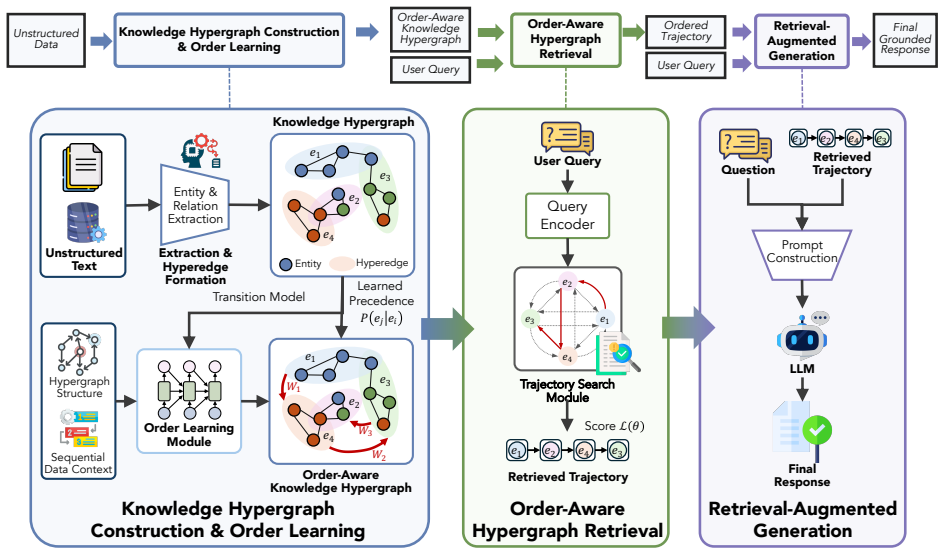
OKH-RAG represents knowledge as higher-order interactions inside a hypergraph augmented with precedence structure, then reformulates retrieval as sequence inference over hyperedges; a learned transition model recovers coherent interaction trajectories that reflect underlying reasoning processes without requiring explicit temporal supervision.
What carries the argument
Order-augmented hypergraph whose hyperedges carry learned precedence relations, with retrieval recast as inference of full interaction trajectories rather than selection of independent facts.
If this is right
- On order-sensitive question answering and explanation tasks, performance improves when retrieval returns ordered trajectories instead of unordered sets.
- Ablation experiments isolate the gains to the modeling of interaction precedence.
- Retrieval shifts from picking independent facts to reconstructing full reasoning sequences.
- The method applies directly to domains such as disaster response and logistics where temporal ordering of events is decisive.
Where Pith is reading between the lines
- The same ordering machinery could be tested on dialogue systems where the sequence of prior turns determines the next response.
- If the learned transition model proves domain-agnostic, it might reduce the need for hand-crafted temporal annotations across many knowledge-intensive applications.
- Causal-inference pipelines that currently treat events as bags of facts could adopt the same hyperedge-precedence layer to capture directed dependencies.
Load-bearing premise
Real-world reasoning tasks depend on the order in which interactions unfold, and a transition model trained on ordinary data can recover that order without any explicit temporal labels.
What would settle it
If OKH-RAG shows no accuracy gain over standard hypergraph RAG once the ground-truth sequences in the evaluation sets are randomly permuted, the claim that order modeling drives the improvement would be refuted.
Figures


read the original abstract
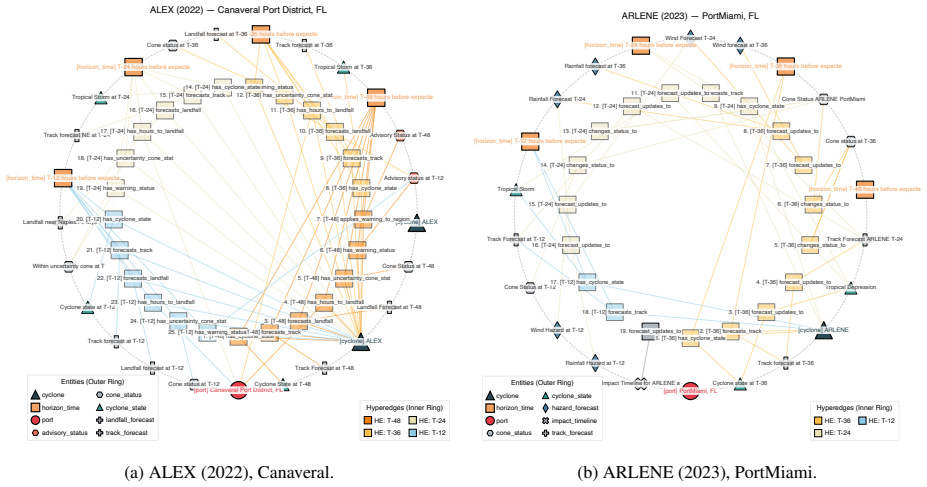
Retrieval-augmented generation (RAG) enhances large language models by grounding outputs in retrieved knowledge. However, existing RAG methods including graph- and hypergraph-based approaches treat retrieved evidence as an unordered set, implicitly assuming permutation invariance. This assumption is misaligned with many real-world reasoning tasks, where outcomes depend not only on which interactions occur, but also on the order in which they unfold. We propose Order-Aware Knowledge Hypergraph RAG (OKH-RAG), which treats order as a first-class structural property. OKH-RAG represents knowledge as higher-order interactions within a hypergraph augmented with precedence structure, and reformulates retrieval as sequence inference over hyperedges. Instead of selecting independent facts, it recovers coherent interaction trajectories that reflect underlying reasoning processes. A learned transition model infers precedence directly from data without requiring explicit temporal supervision. We evaluate OKH-RAG on order-sensitive question answering and explanation tasks, including tropical cyclone and port operation scenarios. OKH-RAG consistently outperforms permutation-invariant baselines, and ablations show that these gains arise specifically from modeling interaction order. These results highlight a key limitation of set-based retrieval: effective reasoning requires not only retrieving relevant evidence, but organizing it into structured sequences.
Editorial analysis
A structured set of objections, weighed in public.
Referee Report
Summary. The paper claims that existing RAG methods, including graph- and hypergraph-based variants, treat retrieved evidence as unordered sets under a permutation-invariance assumption that misaligns with real-world reasoning tasks where interaction order matters. It introduces Order-Aware Knowledge Hypergraph RAG (OKH-RAG), which augments hypergraphs with precedence structure to represent higher-order interactions, reformulates retrieval as sequence inference over precedence-augmented hyperedges, and employs a learned transition model to infer order directly from data without explicit temporal supervision. Evaluations on order-sensitive QA and explanation tasks in tropical cyclone and port operation domains show consistent outperformance over permutation-invariant baselines, with ablations attributing gains specifically to the order-modeling component.
Significance. If the empirical results and ablations hold under scrutiny, this work identifies a substantive limitation in set-based retrieval paradigms and offers a structured alternative that could improve grounding for procedural, causal, or temporally dependent reasoning tasks. The combination of hypergraph representations for higher-order relations with a data-driven precedence model is a technically coherent extension of prior RAG literature and provides falsifiable predictions about when order awareness yields gains.
major comments (2)
- [§3.2] §3.2 (Transition Model): The central claim that the learned transition model infers precedence 'directly from data without requiring explicit temporal supervision' is load-bearing for distinguishing OKH-RAG from baselines; the section should explicitly state the training objective, how positive/negative sequences are constructed from the raw data, and whether any implicit ordering present in the source corpora (e.g., narrative structure in cyclone reports) could be exploited by a suitably augmented baseline.
- [§5] §5 (Evaluation): The abstract and evaluation summary assert 'consistent outperformance' and 'ablations show gains arise specifically from modeling interaction order,' yet the manuscript must include full tables with exact metrics (accuracy, F1, or explanation quality scores), dataset sizes, number of runs, and statistical tests; without these, the ablation results cannot be verified as isolating the order component rather than added model capacity.
minor comments (2)
- [§2] The notation for hyperedges, precedence relations, and the transition probability matrix should be introduced with a single consolidated table or definition block in §2 to improve readability when referenced in later equations.
- [Figures in §5] Figure captions and axis labels in the ablation plots should explicitly state the permutation-invariant baseline variants being compared (e.g., standard Hypergraph RAG vs. OKH-RAG without transition model).
Simulated Author's Rebuttal
We thank the referee for the constructive and detailed feedback on our manuscript. The comments highlight important areas for improving clarity and verifiability, particularly around the transition model and empirical reporting. We address each major comment point by point below and will revise the manuscript to incorporate the suggested details.
read point-by-point responses
-
Referee: [§3.2] §3.2 (Transition Model): The central claim that the learned transition model infers precedence 'directly from data without requiring explicit temporal supervision' is load-bearing for distinguishing OKH-RAG from baselines; the section should explicitly state the training objective, how positive/negative sequences are constructed from the raw data, and whether any implicit ordering present in the source corpora (e.g., narrative structure in cyclone reports) could be exploited by a suitably augmented baseline.
Authors: We agree that the current description in §3.2 would benefit from greater explicitness to support the central claim and allow precise comparison with baselines. In the revised manuscript we will expand this section to state the training objective (a next-hyperedge prediction loss trained via contrastive objectives on ordered versus shuffled trajectories), describe how positive sequences are extracted from the inherent document structure of the source corpora, and detail the construction of negative sequences through controlled permutations. We will also add a paragraph discussing the potential for implicit narrative ordering in the cyclone and port corpora and explain why our permutation-invariant baselines, even if augmented with document-level order, do not model the higher-order precedence relations captured by the learned transition model over hyperedges. revision: yes
-
Referee: [§5] §5 (Evaluation): The abstract and evaluation summary assert 'consistent outperformance' and 'ablations show gains arise specifically from modeling interaction order,' yet the manuscript must include full tables with exact metrics (accuracy, F1, or explanation quality scores), dataset sizes, number of runs, and statistical tests; without these, the ablation results cannot be verified as isolating the order component rather than added model capacity.
Authors: We acknowledge that the present manuscript reports summarized performance figures rather than exhaustive tables, which limits independent verification of the ablation claims. In the revised version we will add complete tables in §5 that report exact accuracy and F1 scores (and explanation quality metrics where applicable) for every baseline and ablation variant, together with dataset sizes, the number of experimental runs (five independent runs with different seeds, reporting mean and standard deviation), and the results of statistical significance tests (paired t-tests with p-values) comparing OKH-RAG against the permutation-invariant baselines. These additions will make explicit that the observed gains are attributable to the order-modeling component. revision: yes
Circularity Check
No significant circularity detected
full rationale
The paper introduces OKH-RAG by augmenting hypergraphs with precedence structure and reformulating retrieval as sequence inference over hyperedges, with a transition model learned directly from data. Central claims rest on empirical outperformance versus permutation-invariant baselines on order-sensitive tasks (cyclone, port operations) plus ablations isolating the order component. No equations, fitted parameters, or predictions are presented that reduce by construction to inputs; the transition model is explicitly data-driven without explicit temporal labels. No load-bearing self-citations, uniqueness theorems, or smuggled ansatzes appear in the provided text. The derivation is therefore self-contained and externally falsifiable via the reported evaluations.
Axiom & Free-Parameter Ledger
free parameters (1)
- learned transition model parameters
axioms (2)
- domain assumption Outcomes in many real-world reasoning tasks depend on the order of interactions in addition to which interactions occur.
- domain assumption Hypergraphs can be augmented with precedence structure to represent ordered higher-order interactions.
invented entities (1)
-
Order-Aware Knowledge Hypergraph
no independent evidence
Reference graph
Works this paper leans on
-
[1]
A Survey of Large Language Models
Wayne Xin Zhao, Kun Zhou, Junyi Li, Tianyi Tang, Xiaolei Wang, Yupeng Hou, Yingqian Min, Beichen Zhang, Junjie Zhang, Zican Dong, et al. A survey of large language models.arXiv preprint arXiv:2303.18223, 1(2):1–124, 2023
work page internal anchor Pith review arXiv 2023
-
[2]
A survey on evaluation of large language models.ACM transactions on intelligent systems and technology, 15(3):1–45, 2024
Yupeng Chang, Xu Wang, Jindong Wang, Yuan Wu, Linyi Yang, Kaijie Zhu, Hao Chen, Xiaoyuan Yi, Cunxiang Wang, Yidong Wang, et al. A survey on evaluation of large language models.ACM transactions on intelligent systems and technology, 15(3):1–45, 2024
2024
-
[3]
Unifying large language models and knowledge graphs: A roadmap.IEEE Transactions on Knowledge and Data Engineering, 36(7):3580–3599, 2024
Shirui Pan, Linhao Luo, Yufei Wang, Chen Chen, Jiapu Wang, and Xindong Wu. Unifying large language models and knowledge graphs: A roadmap.IEEE Transactions on Knowledge and Data Engineering, 36(7):3580–3599, 2024
2024
-
[4]
V2x-llm: Enhancing v2x integration and understanding in connected vehicle corridors
Keshu Wu, Pei Li, Yang Zhou, Rui Gan, Junwei You, Yang Cheng, Jingwen Zhu, Steven T Parker, Bin Ran, David A Noyce, et al. V2x-llm: Enhancing v2x integration and understanding in connected vehicle corridors. arXiv preprint arXiv:2503.02239, 2025
-
[5]
Retrieval-augmented generation for knowledge- intensive nlp tasks.Advances in neural information processing systems, 33:9459–9474, 2020
Patrick Lewis, Ethan Perez, Aleksandra Piktus, Fabio Petroni, Vladimir Karpukhin, Naman Goyal, Heinrich Küttler, Mike Lewis, Wen-tau Yih, Tim Rocktäschel, et al. Retrieval-augmented generation for knowledge- intensive nlp tasks.Advances in neural information processing systems, 33:9459–9474, 2020
2020
-
[7]
Graphusion: A rag framework for scientific knowledge graph construction with a global perspective
Rui Yang, Boming Yang, Xinjie Zhao, Fan Gao, Aosong Feng, Sixun Ouyang, Moritz Blum, Tianwei She, Yuang Jiang, Freddy Lecue, et al. Graphusion: A rag framework for scientific knowledge graph construction with a global perspective. InCompanion Proceedings of the ACM on Web Conference 2025, pages 2579–2588, 2025. 9
2025
-
[8]
Chenchen Kuai, Zihao Li, Braden Rosen, Stephanie Paal, Navid Jafari, Jean-Louis Briaud, Yunlong Zhang, Youssef Hashash, and Yang Zhou. Knowledge-grounded agentic large language models for multi-hazard understanding from reconnaissance reports.arXiv preprint arXiv:2511.14010, 2025
-
[9]
Knowledge graph-guided retrieval augmented generation
Xiangrong Zhu, Yuexiang Xie, Yi Liu, Yaliang Li, and Wei Hu. Knowledge graph-guided retrieval augmented generation. InProceedings of the 2025 Conference of the Nations of the Americas Chapter of the Association for Computational Linguistics: Human Language Technologies (Volume 1: Long Papers), pages 8912–8924, 2025
2025
-
[10]
A survey on rag meeting llms: Towards retrieval-augmented large language models
Wenqi Fan, Yujuan Ding, Liangbo Ning, Shijie Wang, Hengyun Li, Dawei Yin, Tat-Seng Chua, and Qing Li. A survey on rag meeting llms: Towards retrieval-augmented large language models. InProceedings of the 30th ACM SIGKDD conference on knowledge discovery and data mining, pages 6491–6501, 2024
2024
-
[11]
From Local to Global: A Graph RAG Approach to Query-Focused Summarization, April 2024
Darren Edge, Ha Trinh, Newman Cheng, Joshua Bradley, Alex Chao, Apurva Mody, Steven Truitt, Dasha Metropolitansky, Robert Osazuwa Ness, and Jonathan Larson. From Local to Global: A Graph RAG Approach to Query-Focused Summarization, April 2024
2024
-
[12]
G-retriever: Retrieval-augmented generation for textual graph understanding and question answering
Xiaoxin He, Yijun Tian, Yifei Sun, Nitesh V Chawla, Thomas Laurent, Yann LeCun, Xavier Bresson, and Bryan Hooi. G-retriever: Retrieval-augmented generation for textual graph understanding and question answering. Advances in Neural Information Processing Systems, 37:132876–132907, 2024
2024
-
[13]
Junde Wu, Jiayuan Zhu, Yunli Qi, Jingkun Chen, Min Xu, Filippo Menolascina, and Vicente Grau. Medical graph rag: Towards safe medical large language model via graph retrieval-augmented generation.arXiv preprint arXiv:2408.04187, 2024
-
[14]
Knowledge hypergraphs: Prediction beyond binary relations
Bahare Fatemi, Perouz Taslakian, David Vazquez, and David Poole. Knowledge hypergraphs: Prediction beyond binary relations.arXiv preprint arXiv:1906.00137, 2019
-
[15]
Hypergraph theory.An introduction
Alain Bretto. Hypergraph theory.An introduction. Mathematical Engineering. Cham: Springer, 1:209–216, 2013
2013
-
[16]
Hypergraph-based motion gener- ation with multi-modal interaction relational reasoning.Transportation Research Part C: Emerging Technologies, 180:105349, 2025
Keshu Wu, Yang Zhou, Haotian Shi, Dominique Lord, Bin Ran, and Xinyue Ye. Hypergraph-based motion gener- ation with multi-modal interaction relational reasoning.Transportation Research Part C: Emerging Technologies, 180:105349, 2025
2025
-
[17]
Keshu Wu, Zihao Li, Sixu Li, Xinyue Ye, Dominique Lord, and Yang Zhou. Ai2-active safety: Ai-enabled interaction-aware active safety analysis with vehicle dynamics.arXiv preprint arXiv:2505.00322, 2025
-
[18]
Chenchen Kuai, Jiwan Jiang, Zihao Zhu, Hao Wang, Keshu Wu, Zihao Li, Yunlong Zhang, Chenxi Liu, Zhengzhong Tu, Zhiwen Fan, and Yang Zhou. How independent are large language models? a statistical frame- work for auditing behavioral entanglement and reweighting verifier ensembles.arXiv preprint arXiv:2604.07650, 2026
work page internal anchor Pith review Pith/arXiv arXiv 2026
-
[19]
Hyper-rag: Combating llm hallucinations using hypergraph-driven retrieval-augmented generation, 2025
Yifan Feng, Hao Hu, Xingliang Hou, Shiquan Liu, Shihui Ying, Shaoyi Du, Han Hu, and Yue Gao. Hyper-rag: Combating llm hallucinations using hypergraph-driven retrieval-augmented generation, 2025
2025
-
[20]
Haoran Luo, Haihong E, Guanting Chen, Yandan Zheng, Xiaobao Wu, Yikai Guo, Qika Lin, Yu Feng, Zemin Kuang, Meina Song, Yifan Zhu, and Luu Anh Tuan. HyperGraphRAG: Retrieval-Augmented Generation via Hypergraph-Structured Knowledge Representation, October 2025. arXiv:2503.21322 [cs]
-
[21]
Cross-granularity hypergraph retrieval- augmented generation for multi-hop question answering
Changjian Wang, Weihong Deng, Weili Guan, Quan Lu, and Ning Jiang. Cross-granularity hypergraph retrieval- augmented generation for multi-hop question answering. InProceedings of the AAAI Conference on Artificial Intelligence, volume 40, pages 33368–33376, 2026
2026
-
[22]
Cog-rag: Cognitive-inspired dual-hypergraph with theme alignment retrieval-augmented generation
Hao Hu, Yifan Feng, Ruoxue Li, Rundong Xue, Xingliang Hou, Zhiqiang Tian, Yue Gao, and Shaoyi Du. Cog-rag: Cognitive-inspired dual-hypergraph with theme alignment retrieval-augmented generation. InProceedings of the AAAI Conference on Artificial Intelligence, volume 40, pages 31032–31040, 2026
2026
-
[23]
Chenchen Kuai, Zihao Li, Yunlong Zhang, Xiubin Bruce Wang, Dominique Lord, and Yang Zhou. Us port disruptions under tropical cyclones: Resilience analysis by harnessing multiple-source dataset.arXiv preprint arXiv:2509.22656, 2025
-
[24]
Cyportqa: Benchmarking multimodal large language models for cyclone preparedness in port operation
Chenchen Kuai, Chenhao Wu, Yang Zhou, Bruce Wang, Tianbao Yang, Zhengzhong Tu, Zihao Li, and Yunlong Zhang. Cyportqa: Benchmarking multimodal large language models for cyclone preparedness in port operation. InProceedings of the AAAI Conference on Artificial Intelligence, volume 40, pages 38781–38789, 2026
2026
-
[25]
Retrieval-Augmented Generation for Knowledge-Intensive NLP Tasks
Patrick Lewis, Ethan Perez, Aleksandra Piktus, Fabio Petroni, Vladimir Karpukhin, Naman Goyal, Heinrich Küttler, Mike Lewis, Wen-tau Yih, Tim Rocktäschel, Sebastian Riedel, and Douwe Kiela. Retrieval-Augmented Generation for Knowledge-Intensive NLP Tasks, April 2021. arXiv:2005.11401 [cs]
work page internal anchor Pith review arXiv 2021
-
[26]
REALM: Retrieval-Augmented Language Model Pre-Training, February 2020
Kelvin Guu, Kenton Lee, Zora Tung, Panupong Pasupat, and Ming-Wei Chang. REALM: Retrieval-Augmented Language Model Pre-Training, February 2020. 10
2020
-
[27]
BioRAG: A RAG-LLM Framework for Biological question Reasoning,
Chengrui Wang, Qingqing Long, Meng Xiao, Xunxin Cai, Chengjun Wu, Zhen Meng, Xuezhi Wang, and Yuanchun Zhou. BioRAG: A RAG-LLM Framework for Biological Question Reasoning, August 2024. arXiv:2408.01107 [cs]
-
[28]
LegalBench-RAG: A Benchmark for Retrieval-Augmented Generation in the Legal Domain, August 2024
Nicholas Pipitone and Ghita Houir Alami. LegalBench-RAG: A Benchmark for Retrieval-Augmented Generation in the Legal Domain, August 2024
2024
-
[29]
A Systematic Framework for Enterprise Knowledge Retrieval: Leveraging LLM-Generated Metadata to Enhance RAG Systems, December 2025
Pranav Pushkar Mishra, Kranti Prakash Yeole, Ramyashree Keshavamurthy, Mokshit Bharat Surana, and Fatemeh Sarayloo. A Systematic Framework for Enterprise Knowledge Retrieval: Leveraging LLM-Generated Metadata to Enhance RAG Systems, December 2025
2025
-
[30]
arXiv preprint arXiv:2004.04906 , year=
Vladimir Karpukhin, Barlas O ˘guz, Sewon Min, Patrick Lewis, Ledell Wu, Sergey Edunov, Danqi Chen, and Wen-tau Yih. Dense Passage Retrieval for Open-Domain Question Answering, September 2020. arXiv:2004.04906 [cs]
-
[31]
Atlas: Few-shot Learning with Retrieval Augmented Language Models, August 2022
Gautier Izacard, Patrick Lewis, Maria Lomeli, Lucas Hosseini, Fabio Petroni, Timo Schick, Jane Dwivedi-Yu, Armand Joulin, Sebastian Riedel, and Edouard Grave. Atlas: Few-shot Learning with Retrieval Augmented Language Models, August 2022
2022
-
[32]
Retrieval-Augmented Generation for Large Language Models: A Survey
Yunfan Gao, Yun Xiong, Xinyu Gao, Kangxiang Jia, Jinliu Pan, Yuxi Bi, Yi Dai, Jiawei Sun, Meng Wang, and Haofen Wang. Retrieval-Augmented Generation for Large Language Models: A Survey, March 2024. arXiv:2312.10997 [cs]
work page internal anchor Pith review Pith/arXiv arXiv 2024
-
[33]
A Systematic Review of Key Retrieval-Augmented Generation (RAG) Systems: Progress, Gaps, and Future Directions, 2025
Agada Joseph Oche, Ademola Glory Folashade, Tirthankar Ghosal, and Arpan Biswas. A Systematic Review of Key Retrieval-Augmented Generation (RAG) Systems: Progress, Gaps, and Future Directions, 2025. Version Number: 1
2025
-
[34]
Retrieval Augmented End-to-End Spoken Dialog Models, February 2024
Mingqiu Wang, Izhak Shafran, Hagen Soltau, Wei Han, Yuan Cao, Dian Yu, and Laurent El Shafey. Retrieval Augmented End-to-End Spoken Dialog Models, February 2024
2024
-
[35]
Self-RAG: Learning to Retrieve, Generate, and Critique through Self-Reflection
Akari Asai, Zeqiu Wu, Yizhong Wang, Avirup Sil, and Hannaneh Hajishirzi. Self-RAG: Learning to Retrieve, Generate, and Critique through Self-Reflection, October 2023. arXiv:2310.11511 [cs]
work page internal anchor Pith review arXiv 2023
-
[36]
Self-adaptive Multimodal Retrieval-Augmented Generation, October 2024
Wenjia Zhai. Self-adaptive Multimodal Retrieval-Augmented Generation, October 2024
2024
-
[37]
Knowing You Don’t Know: Learning When to Continue Search in Multi-round RAG through Self-Practicing, May 2025
Diji Yang, Linda Zeng, Jinmeng Rao, and Yi Zhang. Knowing You Don’t Know: Learning When to Continue Search in Multi-round RAG through Self-Practicing, May 2025
2025
-
[38]
Ragas: Automated Evaluation of Retrieval Augmented Generation, September 2023
Shahul Es, Jithin James, Luis Espinosa-Anke, and Steven Schockaert. Ragas: Automated Evaluation of Retrieval Augmented Generation, September 2023
2023
-
[39]
MultiHop-RAG: Benchmarking Retrieval-Augmented Generation for Multi-Hop Queries, January 2024
Yixuan Tang and Yi Yang. MultiHop-RAG: Benchmarking Retrieval-Augmented Generation for Multi-Hop Queries, January 2024
2024
-
[40]
arXiv preprint arXiv:2408.08921 (2024) A CQ-Driven RAG Workflow for Digital Storytelling 19
Boci Peng, Yun Zhu, Yongchao Liu, Xiaohe Bo, Haizhou Shi, Chuntao Hong, Yan Zhang, and Siliang Tang. Graph Retrieval-Augmented Generation: A Survey, September 2024. arXiv:2408.08921 [cs]
-
[41]
GRAG: Graph Retrieval-Augmented Generation, May 2024
Yuntong Hu, Zhihan Lei, Zheng Zhang, Bo Pan, Chen Ling, and Liang Zhao. GRAG: Graph Retrieval-Augmented Generation, May 2024
2024
-
[42]
Knowledge Graph-Guided Retrieval Augmented Generation, February 2025
Xiangrong Zhu, Yuexiang Xie, Yi Liu, Yaliang Li, and Wei Hu. Knowledge Graph-Guided Retrieval Augmented Generation, February 2025
2025
-
[43]
Think-on- Graph 2.0: Deep and Faithful Large Language Model Reasoning with Knowledge-guided Retrieval Augmented Generation, July 2024
Shengjie Ma, Chengjin Xu, Xuhui Jiang, Muzhi Li, Huaren Qu, Cehao Yang, Jiaxin Mao, and Jian Guo. Think-on- Graph 2.0: Deep and Faithful Large Language Model Reasoning with Knowledge-guided Retrieval Augmented Generation, July 2024
2024
-
[44]
Rossi, Subhabrata Mukherjee, Xianfeng Tang, Qi He, Zhigang Hua, Bo Long, Tong Zhao, Neil Shah, Amin Javari, Yinglong Xia, and Jiliang Tang
Haoyu Han, Yu Wang, Harry Shomer, Kai Guo, Jiayuan Ding, Yongjia Lei, Mahantesh Halappanavar, Ryan A. Rossi, Subhabrata Mukherjee, Xianfeng Tang, Qi He, Zhigang Hua, Bo Long, Tong Zhao, Neil Shah, Amin Javari, Yinglong Xia, and Jiliang Tang. Retrieval-Augmented Generation with Graphs (GraphRAG), December 2024
2024
-
[45]
Reasoning on Efficient Knowledge Paths:Knowledge Graph Guides Large Language Model for Domain Question Answering, April 2024
Yuqi Wang, Boran Jiang, Yi Luo, Dawei He, Peng Cheng, and Liangcai Gao. Reasoning on Efficient Knowledge Paths:Knowledge Graph Guides Large Language Model for Domain Question Answering, April 2024
2024
-
[46]
PathRAG: Pruning Graph-based Retrieval Augmented Generation with Relational Paths, February 2025
Boyu Chen, Zirui Guo, Zidan Yang, Yuluo Chen, Junze Chen, Zhenghao Liu, Chuan Shi, and Cheng Yang. PathRAG: Pruning Graph-based Retrieval Augmented Generation with Relational Paths, February 2025
2025
-
[47]
Haoran Luo, Haihong E, Yuhao Yang, Tianyu Yao, Yikai Guo, Zichen Tang, Wentai Zhang, Kaiyang Wan, Shiyao Peng, Meina Song, Wei Lin, Yifan Zhu, and Luu Anh Tuan. Text2NKG: Fine-Grained N-ary Relation Extraction for N-ary relational Knowledge Graph Construction, October 2024. arXiv:2310.05185 [cs]. 11
-
[48]
Improving Multi-step RAG with Hypergraph-based Memory for Long-Context Complex Relational Modeling, December 2025
Chulun Zhou, Chunkang Zhang, Guoxin Yu, Fandong Meng, Jie Zhou, Wai Lam, and Mo Yu. Improving Multi-step RAG with Hypergraph-based Memory for Long-Context Complex Relational Modeling, December 2025
2025
-
[49]
GNN-RAG: Graph Neural Retrieval for Large Language Model Reasoning, May 2024
Costas Mavromatis and George Karypis. GNN-RAG: Graph Neural Retrieval for Large Language Model Reasoning, May 2024
2024
-
[50]
Aravind Sankar, Yanhong Wu, Liang Gou, Wei Zhang, and Hao Yang
Emanuele Rossi, Ben Chamberlain, Fabrizio Frasca, Davide Eynard, Federico Monti, and Michael Bronstein. Temporal Graph Networks for Deep Learning on Dynamic Graphs, October 2020. arXiv:2006.10637 [cs]
-
[51]
Temporal Graph Network for continuous-time dynamic event sequence.Knowledge-Based Systems, 304:112452, November 2024
Ke Cheng, Junchen Ye, Xiaodong Lu, Leilei Sun, and Bowen Du. Temporal Graph Network for continuous-time dynamic event sequence.Knowledge-Based Systems, 304:112452, November 2024
2024
-
[52]
Ruiyi Yang, Hao Xue, Imran Razzak, Hakim Hacid, and Flora D Salim. Beyond single pass, looping through time: Kg-irag with iterative knowledge retrieval.arXiv preprint arXiv:2503.14234, 2025
-
[53]
Dyg-rag: Dynamic graph retrieval-augmente d generation with event- centric reasoning
Qingyun Sun, Jiaqi Yuan, Shan He, Xiao Guan, Haonan Yuan, Xingcheng Fu, Jianxin Li, and Philip S Yu. Dyg-rag: Dynamic graph retrieval-augmented generation with event-centric reasoning.arXiv preprint arXiv:2507.13396, 2025
-
[54]
Message Passing for Hyper-Relational Knowledge Graphs, September 2020
Mikhail Galkin, Priyansh Trivedi, Gaurav Maheshwari, Ricardo Usbeck, and Jens Lehmann. Message Passing for Hyper-Relational Knowledge Graphs, September 2020
2020
-
[55]
Leonie Neuhäuser, Michael Scholkemper, Francesco Tudisco, and Michael T. Schaub. Learning the effective order of a hypergraph dynamical system.Science Advances, 10(19):eadh4053, May 2024
2024
-
[56]
Inference of dynamic hypergraph representations in temporal interaction data.Phys
Alec Kirkley. Inference of dynamic hypergraph representations in temporal interaction data.Phys. Rev. E, 109:054306, May 2024
2024
-
[57]
What is Event Knowledge Graph: A Survey.IEEE Transactions on Knowledge and Data Engineering, 35(7):7569–7589, July 2023
Saiping Guan, Xueqi Cheng, Long Bai, Fujun Zhang, Zixuan Li, Yutao Zeng, Xiaolong Jin, and Jiafeng Guo. What is Event Knowledge Graph: A Survey.IEEE Transactions on Knowledge and Data Engineering, 35(7):7569–7589, July 2023
2023
-
[58]
T-48 hours before expected landfall:
David Stawarczyk, Matthew A. Bezdek, and Jeffrey M. Zacks. Event Representations and Predictive Processing: The Role of the Midline Default Network Core.Topics in Cognitive Science, 13(1):164–186, January 2021. A Detailed Formulations of Methodology This appendix provides the formal definitions, algorithmic details, and design rationale supporting the met...
2021
-
[59]
Relation normalization: relation strings are mapped to R via the alias table and fuzzy matching, absorbing LLM-generated variation
-
[60]
Entity ID canonicalization: identifiers are rewritten to a hierarchical convention encoding family, storm, port, and horizon (e.g.,wind_fcst:IRMA:port_arthur:T-48), ensuring cross-block consistency
-
[61]
Horizon entity injection: a canonical temporal anchor (horizon:T-48) is created for each detected horizon and added to all hyperedges at that horizon, making horizon membership structurally explicit
-
[62]
Cross-horizon edge synthesis: for entity families at multiple horizons, synthetic hyperedges (forecast_updates_to, changes_probability_to) are created to represent evolution, providing the cross-horizon links that the precedence construction requires
-
[63]
Was the port restriction justified?
Deduplication: unique hyperedge IDs are computed as hashes of relation, entity set, and evidence text; exact duplicates are collapsed. Aggregation yields the complete hypergraph: H= [ d∈K [ fi∈F d Vei , [ d∈K {ei |f i ∈ F d} .(9) A.3 Precedence construction The precedence relation ≺ over E is constructed from domain-informed structural rules that produce ...
discussion (0)
Sign in with ORCID, Apple, or X to comment. Anyone can read and Pith papers without signing in.