Recognition: unknown
An eigenvalue result for Neumann BVPs with functional terms
Pith reviewed 2026-05-10 14:16 UTC · model grok-4.3
The pith
Neumann boundary value problems with a functional term admit localized eigenvalue-eigenfunction pairs after reformulation as Hammerstein integral equations.
A machine-rendered reading of the paper's core claim, the machinery that carries it, and where it could break.
Core claim
By integrating the second-order differential equation twice and enforcing the Neumann boundary conditions, the original boundary-value problem is converted into a Hammerstein integral equation whose kernel depends on the eigenvalue parameter; an abstract fixed-point theorem then guarantees the existence of solutions inside explicit intervals, and the same equation admits a convergent iteration that produces the eigenfunctions.
What carries the argument
The Hammerstein integral equation obtained by double integration of the differential equation together with the Neumann conditions, which carries both the existence-localization argument and the convergent iteration.
If this is right
- Eigenvalues are confined to explicit closed intervals that depend on the functional term and the boundary data.
- A simple iterative scheme starting from any continuous function converges to the eigenfunction of fixed norm.
- The same code produces both the eigenvalue approximation and the corresponding eigenfunction plot for any chosen parameter value.
- The localization intervals can be tightened by refining the bounds used in the abstract theorem.
Where Pith is reading between the lines
- The iteration scheme may be accelerated by Newton-type corrections once a rough eigenvalue is known.
- Similar double-integration tricks could convert other linear or nonlinear boundary conditions into Hammerstein form.
- The method supplies a practical way to check whether a proposed functional term produces eigenvalues inside a physically relevant window.
Load-bearing premise
The reformulated Hammerstein integral equation must satisfy every hypothesis of the abstract existence-and-localization theorem that is invoked.
What would settle it
An explicit choice of the functional term and parameter range for which the Hammerstein equation fails one of the cited hypotheses yet the original Neumann problem still possesses an eigenvalue-eigenfunction pair inside the claimed interval.
Figures


read the original abstract
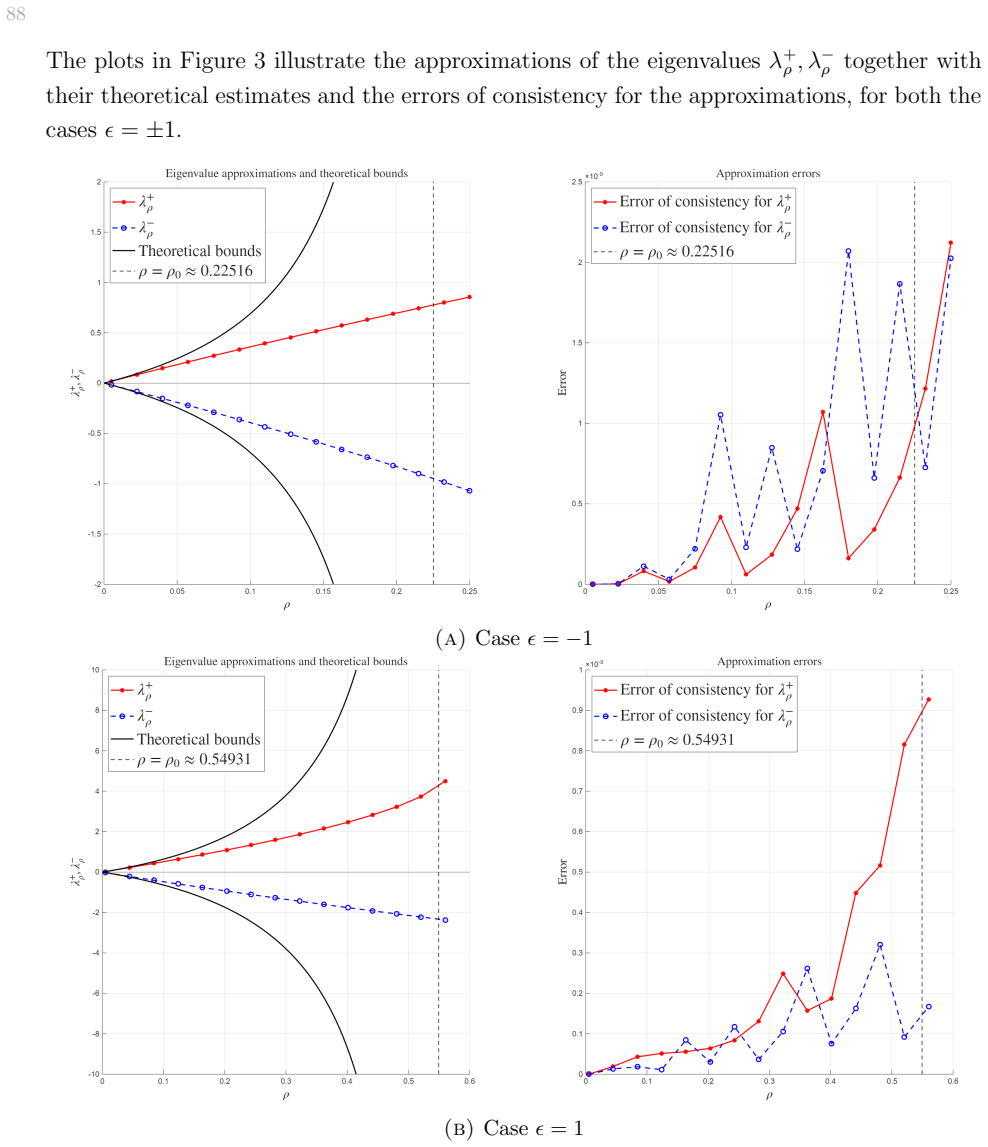
We study the existence and localization of eigenvalue-eigenfunction pairs for parameter-dependent Neumann BVPs with a functional term. By reformulating the problems as a Hammerstein integral equation, we apply an existence and localization result and propose a convergent fixed-point iteration scheme. Finally, two pseudocodes and a MATLAB implementation are provided to numerically approximate the eigenvalues and validate the theoretical localization bounds. We also illustrate an approximation of the eigenfunctions for a fixed norm.
Editorial analysis
A structured set of objections, weighed in public.
Referee Report
Summary. The paper claims to study the existence and localization of eigenvalue-eigenfunction pairs for parameter-dependent Neumann BVPs with a functional term. By reformulating the problems as Hammerstein integral equations via the Green's function, it applies an existence and localization result from fixed-point theory and proposes a convergent fixed-point iteration scheme. Pseudocodes and a MATLAB implementation are provided to numerically approximate the eigenvalues, validate the theoretical localization bounds, and illustrate eigenfunction approximations for a fixed norm.
Significance. If the central results hold, the work extends eigenvalue theory for BVPs to include functional terms, combining analytical localization with a practical iterative scheme and numerical tools. This could aid in analyzing nonlocal or parameter-dependent problems in differential equations, with the numerical validation strengthening applicability.
major comments (2)
- [§3] §3 (Main results): The verification that the reformulated Hammerstein integral operator satisfies all hypotheses of the cited existence and localization theorem is insufficiently detailed. In particular, the conditions on the functional term (e.g., growth, positivity, or cone-mapping properties) and the parameter range for λ need explicit checking against the theorem's assumptions, as this is load-bearing for the existence claim.
- [§4] §4 (Numerical scheme): The convergence of the proposed fixed-point iteration is asserted but lacks a rigorous rate estimate or dependence on the functional term and parameter; without this, the claim that the scheme converges for the parameter ranges of interest remains unverified and affects the localization validation.
minor comments (2)
- [§1] The notation distinguishing the functional term from the standard nonlinearity could be clarified in the introduction and preliminaries to prevent reader confusion.
- Figure captions for the numerical examples should explicitly state the parameter values and norm used for the eigenfunction plots.
Simulated Author's Rebuttal
We thank the referee for the careful reading of our manuscript and the constructive comments. We address each major comment below and have revised the manuscript to improve the explicitness of the arguments where needed.
read point-by-point responses
-
Referee: [§3] §3 (Main results): The verification that the reformulated Hammerstein integral operator satisfies all hypotheses of the cited existence and localization theorem is insufficiently detailed. In particular, the conditions on the functional term (e.g., growth, positivity, or cone-mapping properties) and the parameter range for λ need explicit checking against the theorem's assumptions, as this is load-bearing for the existence claim.
Authors: We agree that a more detailed verification strengthens the main result. In the revised version of Section 3 we have inserted an explicit subsection that checks each hypothesis of the cited theorem against the concrete functional term: we verify the growth bound, positivity, and cone-invariance properties directly from the assumptions on the nonlinearity, and we delineate the precise interval of λ for which the operator maps the cone into itself. These verifications are now written out step by step rather than left implicit. revision: yes
-
Referee: [§4] §4 (Numerical scheme): The convergence of the proposed fixed-point iteration is asserted but lacks a rigorous rate estimate or dependence on the functional term and parameter; without this, the claim that the scheme converges for the parameter ranges of interest remains unverified and affects the localization validation.
Authors: We accept that an explicit convergence-rate estimate was missing. The iteration is a standard Picard iteration for the Hammerstein operator; under the contraction condition already established in Section 3 the Banach fixed-point theorem supplies a geometric rate whose constant depends on the Lipschitz modulus of the functional term and on λ. In the revised Section 4 we now derive this rate explicitly and show that it remains strictly less than one throughout the parameter interval used for the localization bounds, thereby justifying the numerical validation. revision: yes
Circularity Check
No significant circularity detected in derivation chain
full rationale
The paper's core steps are: (1) reformulate the parameter-dependent Neumann BVP with functional term as a Hammerstein integral equation via the standard Green's function for the Neumann problem, (2) invoke an external existence/localization theorem for Hammerstein equations to obtain eigenvalue-eigenfunction pairs, and (3) construct a convergent fixed-point iteration whose convergence is justified by the same external theorem. No equation is defined in terms of its own output, no fitted parameter is relabeled as a prediction, and no load-bearing premise rests on a self-citation chain. The cited existence result is treated as an independent black box; the numerical pseudocodes merely illustrate the bounds already guaranteed by the theorem. The derivation is therefore self-contained against external benchmarks and contains no reduction of the claimed result to its own inputs.
Axiom & Free-Parameter Ledger
Reference graph
Works this paper leans on
-
[1]
G. A. Afrouzi, H. Haghshenas and A. Solimaninia, Variational approach to impulsive Neumann problems with variable exponents and two parameters,Tamkang J. Math.,55(2024), 203–221
2024
-
[2]
Averna, G
D. Averna, G. Bonanno, Three solutions for a Neumann boundary value problem involving thep- Laplacian,Matematiche,60(2005), 81–91
2005
-
[3]
G. M. Bisci, G. Bonanno and V. D. R˘ adulescu, Existence of three solutions for a non-homogeneous Neumann problem through Orlicz–Sobolev spaces,Nonlinear Anal., Theory Methods Appl., Ser. A, Theory Methods,74(2011), 4785–4795
2011
-
[4]
G. M. Bisci, G. Bonanno and V. D. R˘ adulescu, Weak Solutions and Energy Estimates for a Class of Nonlinear Elliptic Neumann Problems,Adv. Nonlinear Stud.,13(2013), 373–389
2013
-
[5]
Bonanno and P
G. Bonanno and P. F. Pizzimenti, Neumann Boundary Value Problems with not Coercive Potential, Mediterr. J. Math.,9(2012), 601–609. 18
2012
-
[6]
Feltrin, E
G. Feltrin, E. Sovrano and A. Tellini, On the number of positive solutions to an indefinite parameter- dependent Neumann problem,Discrete Contin. Dyn. Syst.,42(2022), 21–71
2022
-
[7]
Henderson and N
J. Henderson and N. Kosmatov, Positive Solutions of the Semipositone Neumann Boundary Value Problem,Math. Model. Anal.,20(2015), 578–584
2015
-
[8]
Infante, P
G. Infante, P. Pietramala and F. A. F. Tojo, Non-trivial solutions of local and non-local Neumann boundary-value problems,Proc. R. Soc. Edinb., Sect. A, Math.,146(2016), 337–369
2016
-
[9]
G. Infante and G. A. Veltri, An eigenvalue result for Hammerstein integral equations with sign chang- ing nonlinearities and functional terms,Discrete Dynamics: Theory and Applications, to appear, (see arXiv:2505.15382 for the preprint version)
-
[10]
M. N. Nkashama and J. Santanilla, Existence of multiple solutions for some nonlinear boundary value problems,J. Differ. Equations,84(1990), 148–164
1990
-
[11]
P. F. Pizzimenti and A. Sciammetta, Existence results for a quasi-linear differential problem,Matem- atiche,66(2011), 163–171
2011
-
[12]
Veltri, On topological degree and the Birkhoff–Kellogg Theorem: theory and applications, Master’s degree thesis, University of Calabria, A.Y
G.A. Veltri, On topological degree and the Birkhoff–Kellogg Theorem: theory and applications, Master’s degree thesis, University of Calabria, A.Y. 2024/2025
2024
-
[13]
F. Wang, Y. Yu and F. Zhang, Existence of Positive Solutions of Neumann Boundary Value Problem via a Convex Functional Compression-Expansion Fixed Point Theorem,Fixed Point Theory,11(2010), 395–400
2010
-
[14]
Yao, Multiple positive solutions of nonlinear Neumann problems with time and space singularities, Appl
Q. Yao, Multiple positive solutions of nonlinear Neumann problems with time and space singularities, Appl. Math. Lett.,25(2012), 93–98
2012
-
[15]
Zhai and J
C. Zhai and J. Zhang, Existence and Uniqueness Results for Perturbed Neumann Boundary Value Problems,Bound. Value Probl.,2010(2010), 10
2010
-
[16]
Li, Existence of positive solutions of superlinear second-order Neumann boundary value problem, Nonlinear Anal., Theory Methods Appl., Ser
Z. Li, Existence of positive solutions of superlinear second-order Neumann boundary value problem, Nonlinear Anal., Theory Methods Appl., Ser. A, Theory Methods,72(2010), 3216–3221. Giuseppe Antonio Veltri, Dipartimento di Scienze Matematiche e Informatiche, Scienze Fisiche e Scienze della Terra, Universit `a degli Studi di Messina, 98100 Messina, Italy E...
2010
discussion (0)
Sign in with ORCID, Apple, or X to comment. Anyone can read and Pith papers without signing in.