Recognition: unknown
RACF: A Resilient Autonomous Car Framework with Object Distance Correction
Pith reviewed 2026-05-10 15:43 UTC · model grok-4.3
The pith
A resilient framework corrects depth camera distance errors in autonomous cars by switching to LiDAR and kinematics data when inconsistencies appear.
A machine-rendered reading of the paper's core claim, the machinery that carries it, and where it could break.
Core claim
The authors establish that their RACF framework, incorporating the Object Distance Correction Algorithm, detects inconsistencies in depth camera estimates via a cross-sensor gate and corrects them using LiDAR range data combined with physics-based vehicle kinematics, yielding measurable gains in estimation accuracy and control safety on a Quanser QCar 2 platform.
What carries the argument
The cross-sensor gate and Object Distance Correction Algorithm (ODCA), which activates LiDAR-plus-kinematics correction precisely when depth camera distance outputs are inconsistent with the other sources.
If this is right
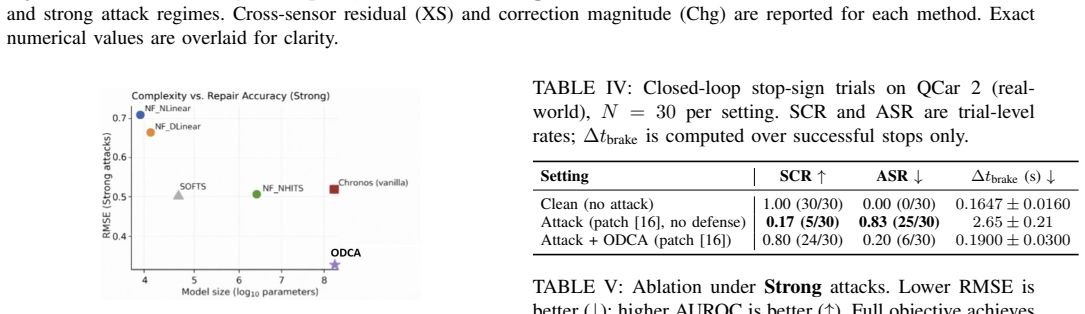
- Distance estimation RMSE drops by up to 35 percent when the depth camera is heavily corrupted.
- Stop compliance improves because corrected distances allow earlier and more accurate braking commands.
- Braking latency decreases as the framework supplies timely, consistent obstacle information.
- The entire correction process runs fast enough for real-time operation on embedded hardware.
- The approach remains lightweight because it adds only a conditional correction step rather than full sensor fusion at every timestep.
Where Pith is reading between the lines
- The same gate-and-correct pattern could be applied to other perception outputs such as object classification or lane detection.
- In field deployments the framework might lower the success rate of camera-targeted adversarial attacks by falling back to harder-to-spoof sensors.
- Integration into existing autonomous stacks would require only modest additional compute since LiDAR and odometry are already present in most vehicles.
- Longer-term testing on public roads could show whether kinematics assumptions hold under slippery surfaces or strong wind.
Load-bearing premise
The system can reliably detect when the depth camera is wrong and that LiDAR plus kinematics will stay accurate enough to supply the correct distance value.
What would settle it
A controlled test run in which the depth camera is corrupted yet the gate does not trigger correction, resulting in RMSE values that remain as high as the uncorrected baseline.
Figures


read the original abstract
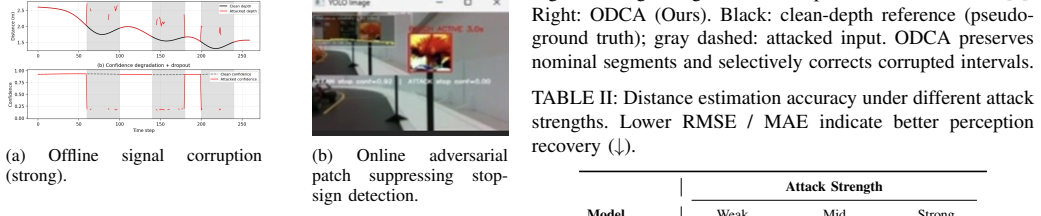
Autonomous vehicles are increasingly deployed in safety-critical applications, where sensing failures or cyberphysical attacks can lead to unsafe operations resulting in human loss and/or severe physical damages. Reliable real-time perception is therefore critically important for their safe operations and acceptability. For example, vision-based distance estimation is vulnerable to environmental degradation and adversarial perturbations, and existing defenses are often reactive and too slow to promptly mitigate their impacts on safe operations. We present a Resilient Autonomous Car Framework (RACF) that incorporates an Object Distance Correction Algorithm (ODCA) to improve perception-layer robustness through redundancy and diversity across a depth camera, LiDAR, and physics-based kinematics. Within this framework, when obstacle distance estimation produced by depth camera is inconsistent, a cross-sensor gate activates the correction algorithm to fix the detected inconsistency. We have experiment with the proposed resilient car framework and evaluate its performance on a testbed implemented using the Quanser QCar 2 platform. The presented framework achieved up to 35% RMSE reduction under strong corruption and improves stop compliance and braking latency, while operating in real time. These results demonstrate a practical and lightweight approach to resilient perception for safety-critical autonomous driving
Editorial analysis
A structured set of objections, weighed in public.
Referee Report
Summary. The paper introduces the Resilient Autonomous Car Framework (RACF) incorporating an Object Distance Correction Algorithm (ODCA). It uses redundancy across a depth camera, LiDAR, and physics-based kinematics, with a cross-sensor gate that detects inconsistencies in depth-camera distance estimates and activates correction. Experiments on a Quanser QCar 2 testbed report up to 35% RMSE reduction under strong corruption, along with improved stop compliance and braking latency, while maintaining real-time operation.
Significance. If validated, the work offers a lightweight, practical method for enhancing perception robustness in safety-critical autonomous vehicles by exploiting sensor diversity without heavy computation. The real-time testbed results and focus on stop compliance provide a concrete step toward deployable resilience, though generalizability remains to be established.
major comments (2)
- [Experimental evaluation (inferred from abstract and framework description)] The central quantitative claim of up to 35% RMSE reduction (and qualitative improvements in stop compliance and braking latency) is presented without details on experimental design, including how corruption was applied to the depth camera, choice of baselines, number of trials, statistical significance, or error bars. This information is required to evaluate whether the reported gains support the resilience claim.
- [Framework description and ODCA section] The cross-sensor gate and ODCA correction rely on the assumption that LiDAR and kinematics remain reliable when the depth camera is corrupted. No ablation studies or attack models address correlated degradations (e.g., fog or spoofing affecting multiple modalities simultaneously), which directly undermines the general resilience property asserted in the abstract.
minor comments (2)
- [Abstract and §3 (framework)] The abstract and framework overview would benefit from explicit definitions of the cross-sensor gate threshold and the exact correction formula in ODCA to improve reproducibility.
- [Experimental section] Clarify the testbed setup, including sensor specifications on the Quanser QCar 2 and the precise metrics for 'stop compliance' and 'braking latency'.
Simulated Author's Rebuttal
We thank the referee for the constructive comments, which have helped us improve the clarity and rigor of the manuscript. We address each major comment point by point below and have revised the paper accordingly.
read point-by-point responses
-
Referee: The central quantitative claim of up to 35% RMSE reduction (and qualitative improvements in stop compliance and braking latency) is presented without details on experimental design, including how corruption was applied to the depth camera, choice of baselines, number of trials, statistical significance, or error bars. This information is required to evaluate whether the reported gains support the resilience claim.
Authors: We agree that the original manuscript lacked sufficient detail on the experimental protocol. In the revised version, we have substantially expanded the 'Experimental Evaluation' section to specify: (1) the corruption model applied to the depth camera (additive Gaussian noise with variance levels calibrated to produce 'strong corruption' as defined in the abstract); (2) the baselines (raw depth-camera estimates and a naive sensor-fusion average); (3) the number of trials (20 independent runs per scenario on the Quanser QCar 2); (4) statistical analysis (paired t-tests with reported p-values confirming significance of the RMSE reduction); and (5) error bars (standard deviation) on all quantitative plots. These additions directly support the 35% RMSE claim and the observed improvements in stop compliance and braking latency. revision: yes
-
Referee: The cross-sensor gate and ODCA correction rely on the assumption that LiDAR and kinematics remain reliable when the depth camera is corrupted. No ablation studies or attack models address correlated degradations (e.g., fog or spoofing affecting multiple modalities simultaneously), which directly undermines the general resilience property asserted in the abstract.
Authors: The referee correctly identifies a key modeling assumption. Our framework targets modality-specific degradations (e.g., visual corruption that affects only the depth camera), which is justified by the physical properties of the sensors: LiDAR operates on time-of-flight rather than image intensity and kinematics derive from vehicle dynamics. We have added an explicit 'Assumptions and Limitations' subsection that states this scope, explains the rationale, and acknowledges that simultaneous multi-modal attacks (fog, spoofing) are outside the current evaluation. No new ablation experiments on correlated attacks are included, as they would require additional testbed runs beyond the scope of a revision; instead, we have strengthened the abstract and conclusion to qualify the resilience claim as applying to independent sensor failures and flagged correlated degradations as future work. revision: partial
Circularity Check
No circularity detected in RACF derivation or claims
full rationale
The paper describes an empirical framework that activates ODCA correction upon detecting inconsistency via cross-sensor gate comparing depth camera output against LiDAR and physics-based kinematics. No equations, fitted parameters, or self-citations are presented that define a result in terms of itself or rename a fitted quantity as a prediction. The 35% RMSE reduction and latency improvements are reported from independent Quanser QCar 2 experiments under controlled single-sensor corruption, not derived tautologically from the framework definition. The approach is self-contained against external benchmarks and does not invoke uniqueness theorems or prior author work to force its structure.
Axiom & Free-Parameter Ledger
Reference graph
Works this paper leans on
-
[1]
Perception and sensing for autonomous vehicles under adverse weather conditions: A survey,
Y . Zhang, A. Carballo, H. Yang, and K. Takeda, “Perception and sensing for autonomous vehicles under adverse weather conditions: A survey,” ISPRS Journal of Photogrammetry and Remote Sensing, vol. 196, pp. 146–177, 2023
2023
-
[2]
{TPatch}: A trig- gered physical adversarial patch,
W. Zhu, X. Ji, Y . Cheng, S. Zhang, and W. Xu, “{TPatch}: A trig- gered physical adversarial patch,” in32nd USENIX Security Symposium (USENIX Security 23), 2023, pp. 661–678
2023
-
[3]
Targeted adversarial perturbations for monocular depth prediction,
A. Wong, S. Cicek, and S. Soatto, “Targeted adversarial perturbations for monocular depth prediction,”Advances in neural information processing systems, vol. 33, pp. 8486–8497, 2020
2020
-
[4]
Chronos-2: From Univariate to Universal Forecasting
A. F. Ansari, O. Shchur, J. K ¨uken, A. Auer, B. Han, P. Mercado, S. S. Rangapuram, H. Shen, L. Stella, X. Zhanget al., “Chronos-2: From univariate to universal forecasting,”arXiv preprint arXiv:2510.15821, 2025
work page internal anchor Pith review arXiv 2025
-
[5]
Exploring the unseen: A survey of multi-sensor fusion and the role of explainable ai (xai) in autonomous vehicles,
J. De Yeong, K. Panduru, and J. Walsh, “Exploring the unseen: A survey of multi-sensor fusion and the role of explainable ai (xai) in autonomous vehicles,” 2025
2025
-
[6]
https://doi.org/10.48550/arXiv.1712.09665
T. B. Brown, D. Man ´e, A. Roy, M. Abadi, and J. Gilmer, “Adver- sarial patch,” inAdvances in Neural Information Processing Systems (NeurIPS) Workshop, 2017, arXiv:1712.09665
-
[7]
Robust physical-world attacks on deep learning models,
K. Eykholtet al., “Robust physical-world attacks on deep learning models,” inProceedings of the IEEE Conference on Computer Vision and Pattern Recognition (CVPR), 2018
2018
-
[8]
https://doi.org/10.48550/arXiv.1806.02299
X. Liu, H. Yang, Z. Liu, L. Song, and H. Li, “Dpatch: An adversarial patch attack on object detectors,” 2018, arXiv:1806.02299
-
[9]
Security and resilience in autonomous vehicles: A proac- tive design approach,
Anonymous, “Security and resilience in autonomous vehicles: A proac- tive design approach,” 2026, submitted for publication
2026
-
[10]
On calibration of modern neural networks,
C. Guo, G. Pleiss, Y . Sun, and K. Q. Weinberger, “On calibration of modern neural networks,” inInternational Conference on Machine Learning (ICML), 2017
2017
-
[11]
Simple and scalable predictive uncertainty estimation using deep ensembles,
B. Lakshminarayanan, A. Pritzel, and C. Blundell, “Simple and scalable predictive uncertainty estimation using deep ensembles,”Advances in Neural Information Processing Systems (NeurIPS), 2017
2017
-
[12]
Microsoft coco: Common objects in context,
T.-Y . Lin, M. Maire, S. Belongie, J. Hayset al., “Microsoft coco: Common objects in context,” inEuropean Conference on Computer Vision (ECCV), 2014
2014
-
[13]
Softs: Efficient multivari- ate time series forecasting with series-core fusion,
L. Han, X.-Y . Chen, H.-J. Ye, and D.-C. Zhan, “Softs: Efficient multivari- ate time series forecasting with series-core fusion,”Advances in Neural Information Processing Systems, vol. 37, pp. 64 145–64 175, 2024
2024
-
[14]
M. Yaseen, “What is yolov8: An in-depth exploration of the next-generation object detector,”arXiv:2408.15857, 2024. [Online]. Available: https://doi.org/10.48550/arXiv.2408.15857
-
[15]
A density-based al- gorithm for discovering clusters in large spatial databases with noise,
M. Ester, H.-P. Kriegel, J. Sander, and X. Xu, “A density-based al- gorithm for discovering clusters in large spatial databases with noise,” inProceedings of the Second International Conference on Knowledge Discovery and Data Mining (KDD). Portland, Oregon: AAAI Press, 1996, pp. 226–231
1996
-
[16]
Naturalistic physical adversarial patch for object detectors,
Y .-C.-T. Hu, B.-H. Kung, D. S. Tan, J.-C. Chen, K.-L. Hua, and W.- H. Cheng, “Naturalistic physical adversarial patch for object detectors,” inProceedings of the IEEE/CVF international conference on computer vision, 2021, pp. 7848–7857
2021
-
[17]
Nhits: Neural hierarchical interpolation for time series forecasting,
C. Challu, K. G. Olivares, B. N. Oreshkin, F. G. Ramirez, M. M. Canseco, and A. Dubrawski, “Nhits: Neural hierarchical interpolation for time series forecasting,” inProceedings of the AAAI conference on artificial intelligence, vol. 37, no. 6, 2023, pp. 6989–6997
2023
-
[18]
Are transformers effective for time series forecasting?
A. Zeng, M. Chen, L. Zhang, and Q. Xu, “Are transformers effective for time series forecasting?” inProceedings of the AAAI conference on artificial intelligence, vol. 37, no. 9, 2023, pp. 11 121–11 128
2023
-
[19]
Extended kalman filter,
K. Fujii, “Extended kalman filter,”Refernce Manual, vol. 14, no. 41, p. 2, 2013
2013
discussion (0)
Sign in with ORCID, Apple, or X to comment. Anyone can read and Pith papers without signing in.