Recognition: unknown
Euler-inspired Decoupling Neural Operator for Efficient Pansharpening
Pith reviewed 2026-05-10 15:36 UTC · model grok-4.3
The pith
The Euler-inspired Decoupling Neural Operator redefines pansharpening as a frequency-domain functional mapping using polar coordinates for adaptive fusion.
A machine-rendered reading of the paper's core claim, the machinery that carries it, and where it could break.
Core claim
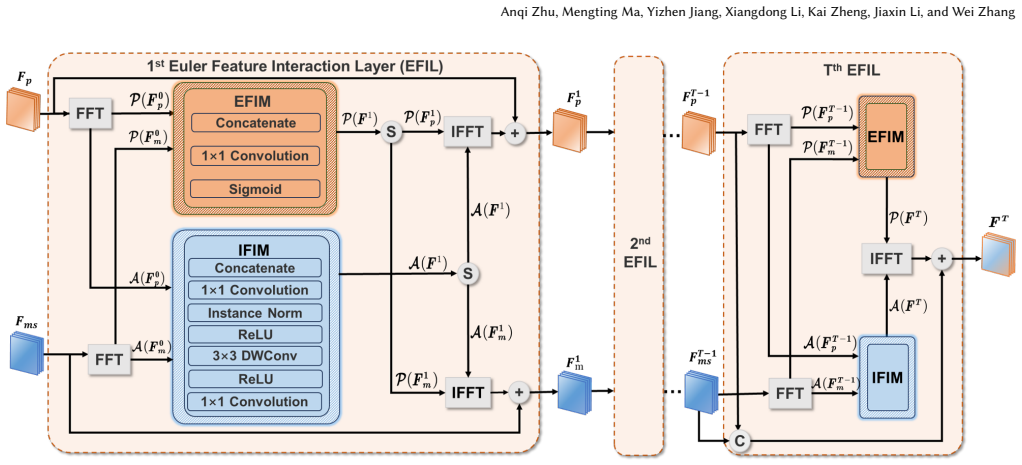
EDNO operates in the frequency domain and uses an Euler Feature Interaction Layer that applies explicit linear weighting to simulate phase rotation and a feed-forward network to model spectral distributions, achieving global receptive fields and discretization-invariance while balancing efficiency and performance on three datasets.
What carries the argument
The Euler Feature Interaction Layer (EFIL), which decouples fusion into an explicit module for phase rotation via linear weighting and an implicit module for spectral modeling via feed-forward network.
Load-bearing premise
The assumption that transforming features to polar coordinates with Euler's formula and using linear weighting for phase plus a feed-forward network for spectra will provide adaptive alignment and consistency without new artifacts or needing per-dataset adjustments.
What would settle it
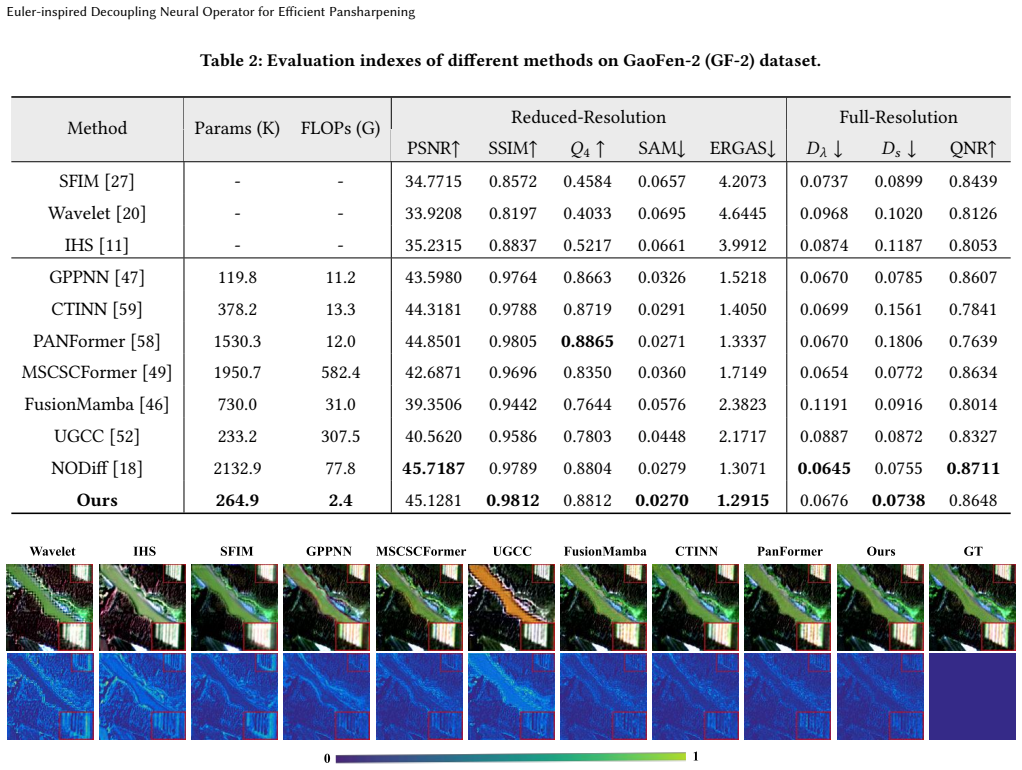
If applying EDNO to the three standard pansharpening datasets yields visible spectral distortions or fails to exceed diffusion-based methods in PSNR, SSIM, and SAM while using fewer FLOPs, the efficiency and artifact-reduction claims would be refuted.
Figures




read the original abstract
Pansharpening aims to synthesize high-resolution multispectral (HR-MS) images by fusing the spatial textures of panchromatic (PAN) images with the spectral information of low-resolution multispectral (LR-MS) images. While recent deep learning paradigms, especially diffusion-based operators, have pushed the performance boundaries, they often encounter spectral-spatial blurring and prohibitive computational costs due to their stochastic nature and iterative sampling. In this paper, we propose the Euler-inspired Decoupling Neural Operator (EDNO), a physics-inspired framework that redefines pansharpening as a continuous functional mapping in the frequency domain. Departing from conventional Cartesian feature processing, our EDNO leverages Euler's formula to transform features into a polar coordinate system, enabling a novel explicit-implicit interaction mechanism. Specifically, we develop the Euler Feature Interaction Layer (EFIL), which decouples the fusion task into two specialized modules: 1) Explicit Feature Interaction Module, utilizing a linear weighting scheme to simulate phase rotation for adaptive geometric alignment; and 2) Implicit Feature Interaction Module, employing a feed-forward network to model spectral distributions for superior color consistency. By operating in the frequency domain, EDNO inherently captures global receptive fields while maintaining discretization-invariance. Experimental results on the three datasets demonstrate that EDNO offers a superior efficiency-performance balance compared to heavyweight architectures.
Editorial analysis
A structured set of objections, weighed in public.
Referee Report
Summary. The manuscript proposes the Euler-inspired Decoupling Neural Operator (EDNO) for pansharpening. It redefines the fusion of panchromatic and low-resolution multispectral images as a continuous functional mapping in the frequency domain by applying Euler's formula to convert features to polar coordinates. This enables the Euler Feature Interaction Layer (EFIL) with an explicit linear-weighting module for phase rotation (geometric alignment) and an implicit feed-forward network for spectral modeling (color consistency). The approach claims inherent global receptive fields, discretization invariance, and a superior efficiency-performance trade-off versus heavyweight architectures, supported by results on three datasets.
Significance. If the performance and invariance claims hold with rigorous validation, the method could provide an efficient, non-stochastic alternative to diffusion-based pansharpening operators. The explicit-implicit decoupling in polar coordinates offers a structured way to handle geometric and spectral components separately, which may generalize to other frequency-domain image fusion tasks and reduce computational overhead from iterative sampling.
major comments (2)
- [Abstract] Abstract: the central experimental claim of 'superior efficiency-performance balance' on three datasets is unsupported by any reported metrics, baselines, error bars, ablation studies, or implementation details, preventing verification of the efficiency advantage over heavyweight architectures.
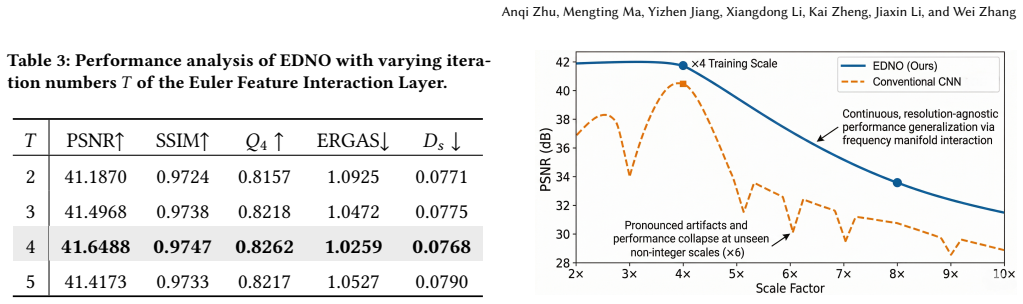
- [Abstract] The discretization-invariance and global receptive field claims rest on frequency-domain operation plus the Euler polar transform, but without an explicit derivation or proof that the linear phase weighting plus FFN does not reduce to standard Fourier properties or learned parameters, it is unclear whether these properties are independently achieved or follow by construction.
minor comments (2)
- [Abstract] The abstract would be strengthened by briefly stating the three datasets and the primary quantitative metrics (e.g., PSNR, SAM) used to support the balance claim.
- [Abstract] Clarify the exact parameterization of the 'linear weighting scheme' in the explicit module and how it differs from conventional phase manipulation in Fourier-based methods.
Simulated Author's Rebuttal
We thank the referee for the constructive comments on our manuscript. We address each major comment point-by-point below, providing clarifications based on the full paper content and outlining planned revisions to strengthen the presentation.
read point-by-point responses
-
Referee: [Abstract] Abstract: the central experimental claim of 'superior efficiency-performance balance' on three datasets is unsupported by any reported metrics, baselines, error bars, ablation studies, or implementation details, preventing verification of the efficiency advantage over heavyweight architectures.
Authors: We agree that the abstract summarizes the claim without embedding specific numerical values. The full manuscript details these in Section 4 (Experiments), reporting PSNR/SSIM/SAM/ERGAS metrics, parameter counts, FLOPs, and runtime comparisons against baselines (including diffusion-based methods) on the three datasets, with error bars from multiple runs and ablation studies on EFIL components. To address the concern directly, we will revise the abstract to include a concise quantitative statement referencing these results. revision: yes
-
Referee: [Abstract] The discretization-invariance and global receptive field claims rest on frequency-domain operation plus the Euler polar transform, but without an explicit derivation or proof that the linear phase weighting plus FFN does not reduce to standard Fourier properties or learned parameters, it is unclear whether these properties are independently achieved or follow by construction.
Authors: The global receptive field follows directly from the Fourier transform's integration over the entire frequency spectrum, independent of the EFIL modules. Discretization invariance is inherited from the neural operator formulation (continuous functional mapping in frequency space), which the Euler polar conversion and subsequent linear phase weighting preserve by operating on frequency coefficients without spatial discretization dependence. The explicit-implicit decoupling in EFIL adds structure beyond vanilla Fourier by separating phase (geometric) and magnitude (spectral) handling, but we acknowledge the manuscript would benefit from a short formal derivation. We will add this in Section 3.2 to clarify independence from standard properties. revision: partial
Circularity Check
No significant circularity detected in derivation chain
full rationale
The paper proposes EDNO as a frequency-domain operator that applies Euler's formula to convert features to polar coordinates, then decouples the task into an explicit linear weighting module for phase alignment and an implicit FFN for spectral modeling. This is framed as a physics-inspired continuous functional mapping that yields global receptive fields and discretization invariance by construction of the frequency-domain representation. No equation or step in the abstract or description reduces a claimed prediction or result to a fitted parameter, self-defined quantity, or self-citation chain; the performance claims rest on empirical results across three datasets rather than internal redefinition. The approach is self-contained against external benchmarks and does not invoke load-bearing uniqueness theorems or ansatzes from prior author work.
Axiom & Free-Parameter Ledger
free parameters (2)
- linear weighting coefficients in explicit module
- feed-forward network weights in implicit module
axioms (2)
- standard math Euler's formula permits a stable transformation of features into polar coordinates that separates phase and magnitude
- domain assumption Frequency-domain processing automatically supplies global receptive fields and discretization invariance
invented entities (1)
-
Euler Feature Interaction Layer (EFIL)
no independent evidence
Reference graph
Works this paper leans on
-
[1]
Maruf Ahmad, Lei Zhang, and Muhammad EH Chowdhury. 2024. Fpga im- plementation of complex-valued neural network for polar-represented image classification.Sensors24, 3 (2024), 897
2024
-
[2]
Basem Al-Qadasi and Umair Bin Waheed. 2026. Fourier neural operator for moonquake detection.Earth and Space Science13, 3 (2026), e2025EA004792
2026
-
[3]
Luciano Alparone, Bruno Aiazzi, Stefano Baronti, Andrea Garzelli, Filippo Nencini, and Massimo Selva. 2008. Multispectral and panchromatic data fu- sion assessment without reference.Photogrammetric Engineering and Remote Sensing74 (2008), 193–200
2008
-
[4]
Luciano Alparone, Lucien Wald, Jocelyn Chanussot, Claire Thomas, Paolo Gamba, and Lori Mann Bruce. 2007. Comparison of Pansharpening Algorithms: Outcome of the 2006 GRS-S Data-Fusion Contest.IEEE Transactions on Geoscience and Remote Sensing45, 10 (2007), 3012–3021
2007
-
[5]
Wele Gedara Chaminda Bandara and Vishal M. Patel. 2022. HyperTransformer: A Textural and Spectral Feature Fusion Transformer for Pansharpening. In2022 IEEE/CVF Conference on Computer Vision and Pattern Recognition (CVPR). 1757– 1767
2022
-
[6]
Qi Cao, Liang-Jian Deng, Wu Wang, Junming Hou, and Gemine Vivone. 2024. Zero-shot semi-supervised learning for pansharpening.Information Fusion101 (2024), 102001
2024
-
[7]
Zihan Cao, Shiqi Cao, Liang-Jian Deng, Xiao Wu, Junming Hou, and Gemine Vivone. 2024. Diffusion model with disentangled modulations for sharpening multispectral and hyperspectral images.Information Fusion104 (2024), 102158
2024
-
[8]
2023.FFPN: Fourier Feature Pyramid Network for Ultrasound Image Segmentation
Chaoyu Chen, Xin Yang, Rusi Chen, Junxuan Yu, Liwei Du, Jian Wang, Xindi Hu, Yan Cao, Yingying Liu, and Dong Ni. 2023.FFPN: Fourier Feature Pyramid Network for Ultrasound Image Segmentation. 166–175
2023
-
[9]
Jaewan Choi, Kiyun Yu, and Yongil Kim. 2010. A new adaptive component- substitution-based satellite image fusion by using partial replacement.IEEE transactions on geoscience and remote sensing49, 1 (2010), 295–309
2010
-
[10]
Liang-Jian Deng, Gemine Vivone, Mercedes E Paoletti, Giuseppe Scarpa, Jiang He, Yongjun Zhang, Jocelyn Chanussot, and Antonio Plaza. 2022. Machine learning in pansharpening: A benchmark, from shallow to deep networks.IEEE Geoscience and Remote Sensing Magazine10, 3 (2022), 279–315
2022
-
[11]
Osama S. Faragallah. 2018. Enhancing multispectral imagery spatial resolution using optimized adaptive PCA and high-pass modulation.International Journal of Remote Sensing39, 20 (2018), 6572–6586. doi:10.1080/01431161.2018.1463112
-
[12]
Andrea Garzelli and Filippo Nencini. 2009. Hypercomplex Quality Assessment of Multi/Hyperspectral Images.IEEE Geoscience and Remote Sensing Letters6, 4 (2009), 662–665
2009
-
[13]
Hassan Ghassemian. 2016. A review of remote sensing image fusion methods. Information Fusion32 (2016), 75–89
2016
- [14]
-
[15]
Lin He, Jiawei Zhu, Jun Li, Antonio Plaza, Jocelyn Chanussot, and Zhuliang Yu
-
[16]
CNN-based hyperspectral pansharpening with arbitrary resolution.IEEE Transactions on Geoscience and Remote Sensing60 (2021), 1–21
2021
-
[17]
Alain Horé and Djemel Ziou. 2010. Image Quality Metrics: PSNR vs. SSIM. In 2010 20th International Conference on Pattern Recognition. 2366–2369
2010
-
[18]
Junming Hou, Qi Cao, Ran Ran, Che Liu, Junling Li, and Liang-jian Deng. 2023. Bidomain Modeling Paradigm for Pansharpening. InProceedings of the 31st ACM International Conference on Multimedia(Ottawa ON, Canada)(MM ’23). Association for Computing Machinery, New York, NY, USA, 347–357
2023
-
[19]
J. Hou, R. Ran, S. Chen, Z. Chen, X. Cong, J. Li, and L.-J. Deng. 2026. NODiff: Neural Operator Diffusion for Multispectral Image Fusion.Proceedings of the AAAI Conference on Artificial Intelligence40, 6 (2026), 4753–4761. doi:10.1609/ aaai.v40i6.42477
2026
-
[20]
Ali Kashefi and Tapan Mukerji. 2024. A novel Fourier neural operator framework for classification of multi-sized images: Application to three dimensional digital porous media.Physics of Fluids36, 5 (2024)
2024
-
[21]
King and Jianwen Wang
R.L. King and Jianwen Wang. 2001. A wavelet based algorithm for pan sharpening Landsat 7 imagery. InIGARSS 2001. Scanning the Present and Resolving the Future. Proceedings. IEEE 2001 International Geoscience and Remote Sensing Symposium (Cat. No.01CH37217), Vol. 2. 849–851 vol.2
2001
-
[22]
Jiaxin Li, Ke Zheng, Lianru Gao, Li Ni, Min Huang, and Jocelyn Chanussot
-
[23]
Model-informed multistage unsupervised network for hyperspectral image super-resolution.IEEE Transactions on Geoscience and Remote Sensing62 (2024), 1–17
2024
-
[24]
Jiaxin Li, Ke Zheng, Zhi Li, Lianru Gao, and Xiuping Jia. 2023. X-shaped in- teractive autoencoders with cross-modality mutual learning for unsupervised hyperspectral image super-resolution.IEEE transactions on geoscience and remote sensing61 (2023), 1–17
2023
-
[25]
Mingsong Li, Yikun Liu, Tao Xiao, Yuwen Huang, and Gongping Yang. 2023. Local-Global Transformer Enhanced Unfolding Network for Pan-sharpening. InProceedings of the Thirty-Second International Joint Conference on Artificial Intelligence, IJCAI-23, Edith Elkind (Ed.). International Joint Conferences on Artificial Intelligence Organization, 1071–1079. Main Track
2023
-
[26]
Mingsong Li, Yikun Liu, Tao Xiao, Yuwen Huang, and Gongping Yang. 2023. Local-global transformer enhanced unfolding network for pan-sharpening. In Proceedings of the Thirty-Second International Joint Conference on Artificial Intel- ligence. 1071–1079
2023
-
[27]
Fourier Neural Operator for Parametric Partial Differential Equations
Zong-Yi Li, Nikola B. Kovachki, Kamyar Azizzadenesheli, Burigede Liu, Kaushik Bhattacharya, Andrew M. Stuart, and Anima Anandkumar. 2020. Fourier Neural Operator for Parametric Partial Differential Equations.ArXivabs/2010.08895 (2020). https://api.semanticscholar.org/CorpusID:224705257
work page internal anchor Pith review arXiv 2020
-
[28]
Kenghong Lin, Baoquan Zhang, Demin Yu, Wenzhi Feng, Shidong Chen, Feifan Gao, Xutao Li, and Yunming Ye. 2025. AlphaPre: Amplitude-phase disentangle- ment model for precipitation nowcasting. InProceedings of the Computer Vision and Pattern Recognition Conference. 17841–17850
2025
-
[29]
J. G. Liu. 2000. Smoothing Filter-based Intensity Modulation: A spectral preserve image fusion technique for improving spatial details.International Journal of Remote Sensing21, 18 (2000), 3461–3472
2000
-
[30]
Xinyang Liu, Junming Hou, Chenxu Wu, Xiaofeng Cong, Zihao Chen, Shangqi Deng, Junling Li, Liang-Jian Deng, and Bo Liu. 2025. Physics-informed Neural Operator for Pansharpening. InThe Thirty-ninth Annual Conference on Neural Information Processing Systems. https://openreview.net/forum?id=tPI9Sw04sZ
2025
-
[31]
Xiangyu Liu, Qingjie Liu, and Yunhong Wang. 2020. Remote sensing image fusion based on two-stream fusion network.Information Fusion55 (2020), 1–15
2020
-
[32]
Chunhui Luo, Dong Li, Xiaoliang Ma, Xin Lu, Zhiyuan Wang, Jiangtong Tan, and Xueyang Fu. 2025. PanComplex: leveraging complex-valued neural networks for enhanced pansharpening. InProceedings of the Thirty-Fourth International Joint Conference on Artificial Intelligence. 1702–1710
2025
-
[33]
Giuseppe Masi, Davide Cozzolino, Luisa Verdoliva, and Giuseppe Scarpa. 2016. Pansharpening by convolutional neural networks.Remote Sensing8, 7 (2016), 594
2016
-
[34]
Giuseppe Masi, Davide Cozzolino, Luisa Verdoliva, and Giuseppe Scarpa. 2016. Pansharpening by Convolutional Neural Networks.Remote Sensing8, 7 (2016)
2016
-
[35]
Qingyan Meng, Wenxu Shi, Sijia Li, and Linlin Zhang. 2023. PanDiff: A novel pansharpening method based on denoising diffusion probabilistic model.IEEE Transactions on Geoscience and Remote Sensing61 (2023), 1–17
2023
-
[36]
Xiangchao Meng, Nan Wang, Feng Shao, and Shutao Li. 2022. Vision transformer for pansharpening.IEEE Transactions on Geoscience and Remote Sensing60 (2022), 1–11. Anqi Zhu, Mengting Ma, Yizhen Jiang, Xiangdong Li, Kai Zheng, Jiaxin Li, and Wei Zhang
2022
-
[37]
Aniruddh Sikdar, Sumanth Udupa, Suresh Sundaram, and Narasimhan Sundarara- jan. 2022. Fully complex-valued fully convolutional multi-feature fusion network (fc 2 mfn) for building segmentation of insar images. In2022 IEEE Symposium Series on Computational Intelligence (SSCI). IEEE, 581–587
2022
-
[38]
Claire Thomas, Thierry Ranchin, Lucien Wald, and Jocelyn Chanussot. 2008. Synthesis of multispectral images to high spatial resolution: A critical review of fusion methods based on remote sensing physics.IEEE Transactions on Geoscience and Remote Sensing46, 5 (2008), 1301–1312
2008
-
[39]
Zhen Tian, Ting Bai, Wayne Xin Zhao, Ji-Rong Wen, and Zhao Cao. 2023. Eu- lerNet: Adaptive Feature Interaction Learning via Euler’s Formula for CTR Pre- diction(SIGIR ’23). Association for Computing Machinery, New York, NY, USA, 1376–1385. doi:10.1145/3539618.3591681
-
[40]
Gemine Vivone, Liang-Jian Deng, Shangqi Deng, Danfeng Hong, Menghui Jiang, Chenyu Li, Wei Li, Huanfeng Shen, Xiao Wu, Jin-Liang Xiao, et al. 2024. Deep learning in remote sensing image fusion: Methods, protocols, data, and future perspectives.IEEE geoscience and remote sensing magazine13, 1 (2024), 269–310
2024
-
[41]
Lucien Wald, Thierry Ranchin, and Marc Mangolini. 1997. Fusion of satellite images of different spatial resolutions: Assessing the quality of resulting images. Photogrammetric engineering and remote sensing63, 6 (1997), 691–699
1997
-
[42]
Hebaixu Wang, Hao Zhang, Xin Tian, and Jiayi Ma. 2024. Zero-sharpen: A universal pansharpening method across satellites for reducing scale-variance gap via zero-shot variation.Information Fusion101 (2024), 102003
2024
-
[43]
Wu Wang, Liang-Jian Deng, Ran Ran, and Gemine Vivone. 2024. A general paradigm with detail-preserving conditional invertible network for image fusion. International Journal of Computer Vision132, 4 (2024), 1029–1054
2024
-
[44]
Bovik, H.R
Zhou Wang, A.C. Bovik, H.R. Sheikh, and E.P. Simoncelli. 2004. Image quality assessment: from error visibility to structural similarity.IEEE Transactions on Image Processing13, 4 (2004), 600–612
2004
-
[45]
Min Wei and Xuesong Zhang. 2023. Super-resolution neural operator. InPro- ceedings of the IEEE/CVF Conference on Computer Vision and Pattern Recognition. 18247–18256
2023
-
[46]
Xiao Wu, Ting-Zhu Huang, Liang-Jian Deng, and Tian-Jing Zhang. 2021. Dy- namic cross feature fusion for remote sensing pansharpening. InProceedings of the IEEE/CVF International Conference on Computer Vision. 14687–14696
2021
-
[47]
Zeyu Xia, Chenxi Sun, Tianyu Xin, Yubo Zeng, Haoyu Chen, and Liang-Jian Deng. 2026. Swift: A general sensitive weight identification framework for fast sensor-transfer pansharpening. InProceedings of the AAAI Conference on Artificial Intelligence, Vol. 40. 10960–10968
2026
-
[48]
Xinyu Xie, Yawen Cui, Tao Tan, Xubin Zheng, and Zitong Yu. 2024. FusionMamba: dynamic feature enhancement for multimodal image fusion with Mamba.Visual Intelligence2 (2024). https://api.semanticscholar.org/CorpusID:269148750
2024
-
[49]
Shuang Xu, Jiangshe Zhang, Zixiang Zhao, Kai Sun, Junmin Liu, and Chunxia Zhang. 2021. Deep Gradient Projection Networks for Pan-sharpening. In2021 IEEE/CVF Conference on Computer Vision and Pattern Recognition (CVPR). 1366– 1375
2021
-
[50]
Junfeng Yang, Xueyang Fu, Yuwen Hu, Yue Huang, Xinghao Ding, and John Paisley. 2017. PanNet: A Deep Network Architecture for Pan-Sharpening. In 2017 IEEE International Conference on Computer Vision (ICCV). 1753–1761
2017
-
[51]
Yongxu Ye, Tingting Wang, Faming Fang, and Guixu Zhang. 2024. MSCSCformer: Multiscale Convolutional Sparse Coding-Based Transformer for Pansharpening. IEEE Transactions on Geoscience and Remote Sensing62 (2024), 1–12
2024
-
[52]
Junru Yin, Zhiheng Huang, Qiqiang Chen, Wei Huang, Le Sun, Qinggang Wu, and Ruixia Hou. 2025. Cascaded Local–Nonlocal Pansharpening with Adaptive Channel-Kernel Convolution and Multi-Scale Large-Kernel Attention.Remote Sensing18, 1 (2025), 97
2025
-
[53]
Yuhas, Alexander F
Roberta H. Yuhas, Alexander F. H. Goetz, and Joseph W. Boardman. 1992. Dis- crimination among semi-arid landscape endmembers using the Spectral Angle Mapper (SAM) algorithm. InJPL, Summaries of the Third Annual JPL Airborne Geoscience Workshop. Volume 1: A VIRIS Workshop. 147–149
1992
-
[54]
Haoying Zeng, Xiaoyuan Yang, Kangqing Shen, Yixiao Li, Jin Jiang, and Fangyi Li. 2025. Cross-Modal Contrastive Pansharpening via Uncertainty Guidance. IEEE Transactions on Geoscience and Remote Sensing63 (2025), 1–14
2025
-
[55]
Bing Zhang, Yuanfeng Wu, Boya Zhao, Jocelyn Chanussot, Danfeng Hong, Jing Yao, and Lianru Gao. 2022. Progress and challenges in intelligent remote sensing satellite systems.IEEE Journal of Selected Topics in Applied Earth Observations and Remote Sensing15 (2022), 1814–1822
2022
- [56]
-
[57]
Ran Zhang, Xuanhua He, Li Xueheng, Ke Cao, Liu Liu, Wenbo Xu, Fang Jiabin, Yang Qize, and Jie Zhang. 2025. Rethinking Pan-sharpening: Principled Design, Unified Training, and a Universal Loss Surpass Brute-Force Scaling.arXiv e-prints (2025), arXiv–2507
2025
-
[58]
Tongshun Zhang, Pingping Liu, Ming Zhao, and Haotian Lv. 2024. Dmfourllie: Dual-stage and multi-branch fourier network for low-light image enhancement. InProceedings of the 32nd ACM international conference on multimedia. 7434– 7443
2024
-
[59]
Kaiwen Zheng, Jie Huang, Man Zhou, Danfeng Hong, and Feng Zhao. 2023. Deep adaptive pansharpening via uncertainty-aware image fusion.IEEE Transactions on Geoscience and Remote Sensing61 (2023), 1–15
2023
-
[60]
Huanyu Zhou, Qingjie Liu, and Yunhong Wang. 2022. PanFormer: A Trans- former Based Model for Pan-Sharpening. In2022 IEEE International Conference on Multimedia and Expo (ICME). 1–6
2022
-
[61]
Man Zhou, Jie Huang, Yanchi Fang, Xueyang Fu, and Aiping Liu. 2022. Pan- Sharpening with Customized Transformer and Invertible Neural Network.Pro- ceedings of the AAAI Conference on Artificial Intelligence36 (06 2022), 3553–3561
2022
-
[62]
Man Zhou, Jie Huang, Keyu Yan, Hu Yu, Xueyang Fu, Aiping Liu, Xian Wei, and Feng Zhao. 2022. Spatial-Frequency Domain Information Integration for Pan-Sharpening. InComputer Vision - ECCV 2022 - 17th European Conference, Tel A viv, Israel, October 23-27, 2022, Proceedings, Part XVIII (Lecture Notes in Computer Science). Springer, 274–291
2022
discussion (0)
Sign in with ORCID, Apple, or X to comment. Anyone can read and Pith papers without signing in.