Recognition: unknown
Designing for Error Recovery in Human-Robot Interaction
Pith reviewed 2026-05-10 16:05 UTC · model grok-4.3
The pith
Robotic AI systems should detect and recover from their own errors to handle continuous real-world interactions better than one-shot perfection.
A machine-rendered reading of the paper's core claim, the machinery that carries it, and where it could break.
Core claim
By shifting focus from error-free single actions to systems that can detect and recover from errors during extended tasks, robotic AI can reach higher success rates in interactive settings; nuclear glovebox robotics illustrates the need for such capabilities and provides a basis for simple initial designs that embed error handling directly into the control loop.
What carries the argument
Error detection and recovery mechanisms that operate continuously within human-robot interaction loops, demonstrated via nuclear glovebox use cases.
If this is right
- Robotic systems could sustain operations in uncertain or variable environments without constant human intervention for every mistake.
- Success metrics would shift from single-trial accuracy to cumulative performance over extended sessions.
- Human-robot collaboration in high-stakes settings like nuclear handling would become more reliable through mutual error correction.
- Initial designs could start with simple monitoring rules that trigger recovery actions before full autonomy is attempted.
Where Pith is reading between the lines
- Similar recovery designs might transfer to other continuous domains such as household service robots or collaborative assembly lines.
- Simulations of glovebox tasks could serve as a low-risk testbed to quantify how much recovery improves overall throughput.
- Over time, accumulated recovery data could enable robots to refine their own models without external retraining.
Load-bearing premise
Real-world robotic tasks are sufficiently continuous and interactive that recovery from errors yields a clear advantage over optimizing for flawless one-shot performance.
What would settle it
A robotic glovebox system that maintains high long-term task success rates without any built-in error detection or recovery, relying solely on initial one-shot accuracy.
Figures


read the original abstract
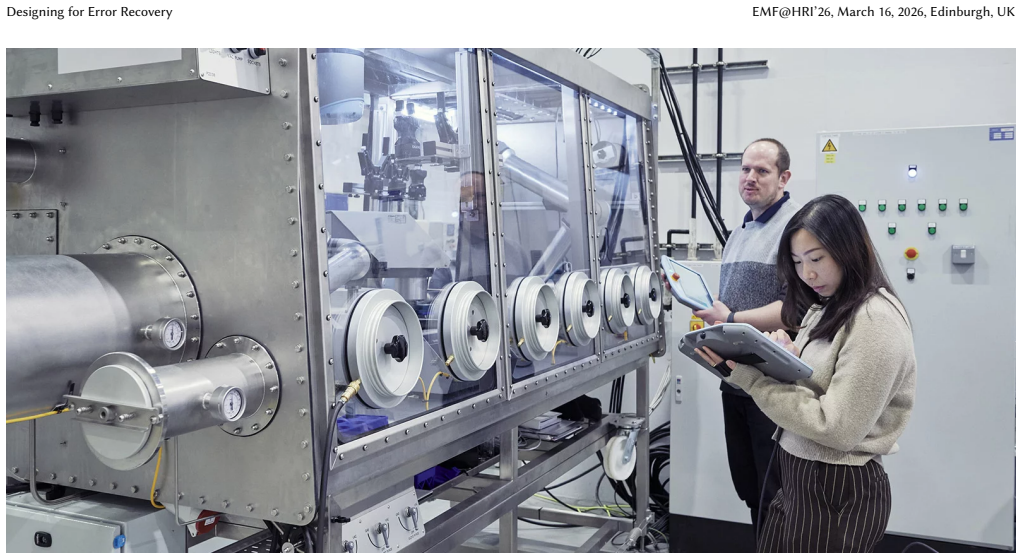
This position paper looks briefly at the way we attempt to program robotic AI systems. Many AI systems are based on the idea of trying to improve the performance of one individual system to beyond so-called human baselines. However, these systems often look at one shot and one-way decisions, whereas the real world is more continuous and interactive. Humans, however, are often able to recover from and learn from errors - enabling a much higher rate of success. We look at the challenges of building a system that can detect/recover from its own errors, using the example of robotic nuclear gloveboxes as a use case to help illustrate examples. We then go on to talk about simple starting designs.
Editorial analysis
A structured set of objections, weighed in public.
Referee Report
Summary. This position paper critiques current robotic AI systems for emphasizing one-shot, one-way decisions aimed at surpassing human baselines. It contrasts this with humans' ability to recover from and learn from errors in continuous, interactive settings, using robotic nuclear gloveboxes as a use case to illustrate challenges in self-error detection and recovery. The paper then outlines simple starting designs for incorporating such mechanisms in human-robot interaction.
Significance. If developed with concrete implementations and validation, the emphasis on error recovery could promote more resilient HRI systems in high-stakes domains. As a conceptual position statement without empirical data, formal models, or falsifiable predictions, its significance is limited to stimulating discussion rather than advancing testable knowledge.
major comments (1)
- The nuclear glovebox use case is presented as central for illustrating error detection/recovery challenges, yet the description remains high-level without specifying concrete failure modes, sensor requirements, or recovery protocols that would make the example actionable for system design.
minor comments (1)
- Additional citations to prior work on error recovery, fault-tolerant robotics, and continuous interaction models in HRI would strengthen the positioning relative to existing literature.
Simulated Author's Rebuttal
We thank the referee for their constructive feedback on our position paper. The comment regarding the nuclear glovebox use case is well taken, and we address it directly below with an indication of the revisions we have made.
read point-by-point responses
-
Referee: The nuclear glovebox use case is presented as central for illustrating error detection/recovery challenges, yet the description remains high-level without specifying concrete failure modes, sensor requirements, or recovery protocols that would make the example actionable for system design.
Authors: We agree that the original description of the nuclear glovebox use case was high-level, consistent with the paper's nature as a position statement intended to stimulate discussion on error recovery in continuous HRI rather than to deliver a detailed engineering blueprint. To strengthen the illustration without altering the paper's scope, we have revised the relevant section to incorporate concrete examples of failure modes (such as object drops causing contamination or misalignment during manipulation), basic sensor considerations (including vision and force-torque sensing for real-time state monitoring), and high-level recovery protocols (such as safe-state pausing with operator notification). These additions make the use case more actionable for designers while preserving the conceptual focus; full implementation and validation remain beyond the remit of this work. revision: partial
Circularity Check
No circularity; position paper with no derivations or fitted claims
full rationale
The paper is explicitly a position piece that contrasts one-shot AI decision models with continuous human error recovery, using nuclear glovebox robotics only as an illustrative example and offering simple starting designs. It contains no equations, parameters, predictions, formal models, or quantitative results. No load-bearing steps exist that could reduce by construction to self-definition, fitted inputs, or self-citation chains; the central argument is conceptual and self-contained without any derivational content to analyze for circularity.
Axiom & Free-Parameter Ledger
axioms (1)
- domain assumption Real-world tasks are continuous and interactive rather than one-shot decisions, and error recovery is essential for high success rates.
Reference graph
Works this paper leans on
-
[1]
Sellafield BBC. 2026. Robotic arms could aid nuclear ’glovebox’ clean-up. https: //www.bbc.co.uk/news/articles/cd979xn2v0go Accessed: 2026-02-27
2026
-
[2]
David K Dennison, Randall L Hurd, Roy D Merrill, and Thomas C Reitz. 1995. Application of glove box robotics to hazardous waste management. Technical Report. Lawrence Livermore National Lab., CA (United States)
1995
-
[3]
Inseok Jang, Ar Ryum Kim, Wondea Jung, and Poong Hyun Seong. 2014. An empirical study on the human error recovery failure probability when using soft controls in NPP advanced MCRs.Annals of Nuclear Energy73 (2014), 373–381
2014
- [4]
-
[5]
Yeray Mera, Gabriel Rodríguez, and Eugenia Marin-Garcia. 2022. Unraveling the benefits of experiencing errors during learning: Definition, modulating factors, and explanatory theories.Psychonomic bulletin & review29, 3 (2022), 753–765
2022
-
[6]
1988.Mind children: The future of robot and human intelligence
Hans Moravec. 1988.Mind children: The future of robot and human intelligence. Harvard University Press
1988
- [7]
-
[8]
Adalberto Polenghi, Laura Cattaneo, and Marco Macchi. 2024. A framework for fault detection and diagnostics of articulated collaborative robots based on hybrid series modelling of Artificial Intelligence algorithms.Journal of Intelligent Manufacturing35, 5 (2024), 1929–1947
2024
-
[9]
UKAEA RAICo. 2025. RAICo deployments. https://raico.org/technology/ deployments/ Accessed: 2026-02-27
2025
-
[10]
James Reason. 2000. Human error: models and management.Bmj320, 7237 (2000), 768–770
2000
-
[11]
Olga Russakovsky, Jia Deng, Hao Su, Jonathan Krause, Sanjeev Satheesh, Sean Ma, Zhiheng Huang, Andrej Karpathy, Aditya Khosla, Michael Bernstein, et al
-
[12]
Imagenet large scale visual recognition challenge.International journal of computer vision115, 3 (2015), 211–252
2015
-
[13]
Micol Spitale, Maria Teresa Parreira, Maia Stiber, Minja Axelsson, Neval Kara, Garima Kankariya, Chien-Ming Huang, Malte Jung, Wendy Ju, and Hatice Gunes
-
[14]
InProceedings of the 26th International Conference on Multimodal Interaction
Err@ hri 2024 challenge: Multimodal detection of errors and failures in human-robot interactions. InProceedings of the 26th International Conference on Multimodal Interaction. 652–656
2024
-
[15]
Christopher D Wallbridge, Séverin Lemaignan, Emmanuel Senft, and Tony Bel- paeme. 2019. Generating spatial referring expressions in a social robot: Dynamic vs. non-ambiguous.Frontiers in Robotics and AI6 (2019), 67
2019
-
[16]
Christopher D Wallbridge, Alex Smith, Manuel Giuliani, Chris Melhuish, Tony Belpaeme, and Séverin Lemaignan. 2021. The effectiveness of dynamically pro- cessed incremental descriptions in human robot interaction.ACM Transactions on Human-Robot Interaction (THRI)11, 1 (2021), 1–24
2021
-
[17]
Ziwei Xu, Sanjay Jain, and Mohan Kankanhalli. 2024. Hallucination is inevitable: An innate limitation of large language models.arXiv preprint arXiv:2401.11817 (2024)
work page internal anchor Pith review arXiv 2024
-
[18]
Rowan Zellers, Ari Holtzman, Yonatan Bisk, Ali Farhadi, and Yejin Choi. 2019. Hellaswag: Can a machine really finish your sentence?. InProceedings of the 57th annual meeting of the association for computational linguistics. 4791–4800
2019
discussion (0)
Sign in with ORCID, Apple, or X to comment. Anyone can read and Pith papers without signing in.