Recognition: unknown
Large-Scale Measurement of NAT Traversal for the Decentralized Web: A Case Study of DCUtR in IPFS
Pith reviewed 2026-05-10 14:29 UTC · model grok-4.3
The pith
IPFS measurements establish 70% success for decentralized NAT traversal, with TCP and QUIC matching UDP.
A machine-rendered reading of the paper's core claim, the machinery that carries it, and where it could break.
Core claim
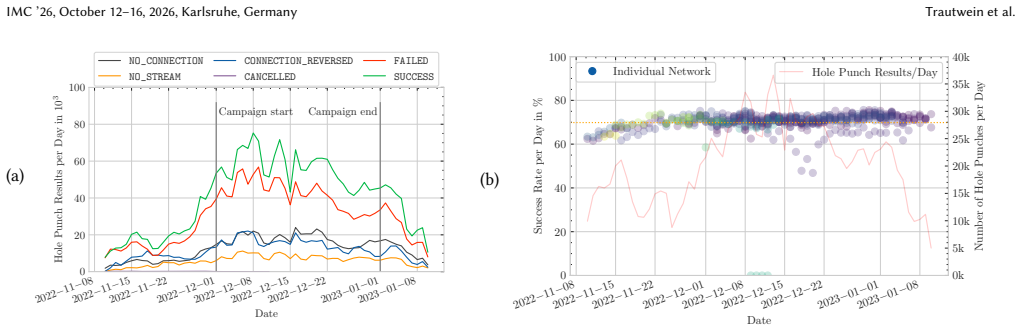
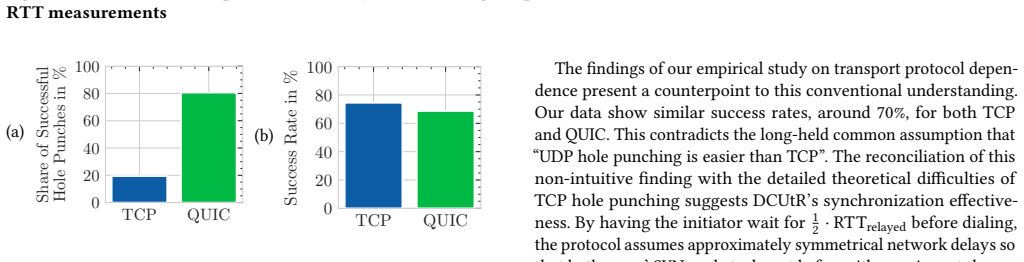
DCUtR achieves a conditional success rate of 70% ± 7.1% for hole-punching after successful relay reservation and public address discovery. This rate is statistically the same for TCP and QUIC as for UDP. The mechanism works independently of relay choice, succeeds on the first attempt in 97.6% of cases, and operates in a fully permissionless setting across 167 countries.
What carries the argument
DCUtR protocol, which sequences relay reservation, address discovery, and high-precision RTT-based synchronization to enable direct peer-to-peer hole-punching.
Load-bearing premise
The 4.4 million attempts collected from 85,000 networks form an unbiased sample of real-world NAT behaviors and the IPFS logging captures every relevant outcome without systematic errors.
What would settle it
A follow-up measurement that gathers a comparable number of DCUtR attempts from a fresh global sample of networks and obtains a hole-punching success rate clearly outside the reported 70% ± 7.1% interval.
Figures






read the original abstract
The promise of decentralized peer-to-peer (P2P) systems is fundamentally gated by the challenge of Network Address Translation (NAT) traversal, with existing solutions often reintroducing the very centralization they seek to avoid. This paper presents the first large-scale measurement study of a fully decentralized NAT traversal protocol, Direct Connection Upgrade through Relay (DCUtR), within the production libp2p-based InterPlanetary File System (IPFS) network. Drawing on over 4.4 million traversal attempts from 85,000+ distinct networks across 167 countries, we provide an empirical analysis of modern P2P connectivity. We establish a conditional success rate of $70\% \pm 7.1\%$ for the hole-punching stage, given that prerequisite relay reservation and public address discovery succeed, providing a crucial new benchmark for the field. Critically, we empirically challenge the long-held belief of UDP's superiority for NAT traversal, demonstrating that DCUtR's high-precision, RTT-based synchronization yields statistically indistinguishable success rates for both TCP and QUIC ($\sim70\%$). Our analysis further validates the protocol's design for permissionless environments by showing that success is independent of relay characteristics and that the mechanism is highly efficient, with $97.6\%$ of successful connections established on the first attempt. Building on this analysis, we propose a concrete roadmap of protocol enhancements aimed at achieving universal connectivity and contribute our complete dataset to foster further research in this domain.
Editorial analysis
A structured set of objections, weighed in public.
Referee Report
Summary. This paper presents the first large-scale measurement of the DCUtR NAT traversal protocol in the production IPFS/libp2p network. Drawing on 4.4 million traversal attempts from over 85,000 networks across 167 countries, it reports a conditional hole-punching success rate of 70% ± 7.1% (given successful relay reservation and public-address discovery), finds statistically indistinguishable success rates for TCP and QUIC, notes that 97.6% of successful connections occur on the first attempt, shows independence from relay characteristics, and releases the full dataset along with a roadmap for protocol improvements.
Significance. If the reported conditional rates are robust to sampling details, the work supplies a valuable empirical benchmark for decentralized NAT traversal in permissionless overlays and usefully challenges the UDP-superiority assumption with production data. The scale of the dataset and public release are clear strengths that enable follow-on research.
major comments (2)
- [Measurement Methodology / Data Collection] The description of peer sampling, logging of traversal outcomes, and exclusion criteria for the 4.4 M attempts is insufficient to assess selection bias. Because all measurements occur inside the live IPFS overlay (after DHT join, relay reservation, and address advertisement), the sample systematically excludes nodes that fail early discovery steps; this conditioning may inflate the reported 70% ± 7.1% hole-punching rate relative to a broader NAT population. Clarifying the exact sampling frame and how failed prerequisites are recorded is required to support the claim that the result is a general benchmark.
- [Results (TCP/QUIC comparison)] The statistical claim of indistinguishability between TCP and QUIC (~70%) requires the exact test statistic, per-protocol sample sizes, and full confidence-interval calculations to be reproducible; without these, the challenge to long-held UDP assumptions rests on an incompletely documented comparison.
minor comments (1)
- [Figures] Figure captions and axis labels should explicitly state that all rates are conditional on prerequisite success.
Simulated Author's Rebuttal
We thank the referee for their constructive and detailed review. We address each major comment below, providing clarifications and committing to specific revisions that strengthen the manuscript without altering its core claims.
read point-by-point responses
-
Referee: [Measurement Methodology / Data Collection] The description of peer sampling, logging of traversal outcomes, and exclusion criteria for the 4.4 M attempts is insufficient to assess selection bias. Because all measurements occur inside the live IPFS overlay (after DHT join, relay reservation, and address advertisement), the sample systematically excludes nodes that fail early discovery steps; this conditioning may inflate the reported 70% ± 7.1% hole-punching rate relative to a broader NAT population. Clarifying the exact sampling frame and how failed prerequisites are recorded is required to support the claim that the result is a general benchmark.
Authors: We agree that the methodology section would benefit from greater detail to allow readers to fully evaluate selection effects. The reported 70% ± 7.1% figure is explicitly a conditional success rate for the hole-punching stage, given successful relay reservation and public-address discovery; this conditioning is intentional because DCUtR is invoked only after those steps succeed in the libp2p/IPFS stack. We do not claim the rate applies to an unconditional NAT population. In the revision we will expand the Measurement Methodology section with: (1) a precise description of the DHT-based peer sampling frame, (2) the logging format for all traversal attempts including prerequisite outcomes, and (3) explicit exclusion rules applied to the 4.4 M attempts. We will also add a short discussion of how the conditioning affects generalizability and note that the released dataset permits independent re-analysis of early-failure cases. revision: yes
-
Referee: [Results (TCP/QUIC comparison)] The statistical claim of indistinguishability between TCP and QUIC (~70%) requires the exact test statistic, per-protocol sample sizes, and full confidence-interval calculations to be reproducible; without these, the challenge to long-held UDP assumptions rests on an incompletely documented comparison.
Authors: We accept that the statistical documentation must be made fully reproducible. The indistinguishability conclusion rests on overlapping 95% confidence intervals and a two-proportion hypothesis test showing no significant difference at conventional thresholds. In the revised manuscript we will report: the exact test statistic and p-value, the per-protocol attempt counts (TCP vs. QUIC), and the complete formulas and intermediate values used to compute the confidence intervals. These additions will be placed in the Results section and the associated appendix so that the challenge to the UDP-superiority assumption can be verified directly from the text. revision: yes
Circularity Check
No circularity: purely observational measurement study
full rationale
The paper reports empirical statistics (conditional success rates, TCP/QUIC equivalence, first-attempt efficiency) computed directly from 4.4 million observed traversal attempts collected in the live IPFS network. No equations, fitted parameters, predictions, or derivations are present that could reduce to prior inputs or self-citations. The 70% ± 7.1% figure is a direct aggregate of logged outcomes conditioned on observed prerequisites; it is not obtained by any modeling step that re-uses the same data as both input and output. Self-citations, if any, are not load-bearing for any claimed result. This is a standard, non-circular measurement paper whose central claims rest on external network observations rather than internal construction.
Axiom & Free-Parameter Ledger
Reference graph
Works this paper leans on
-
[1]
Harald T. Alvestrand. 2021. Overview: Real-Time Protocols for Browser-Based Applications. RFC 8825. doi:10.17487/RFC8825
-
[2]
2020.How NAT traversal works
David Anderson. 2020.How NAT traversal works. https://tailscale.com/blog/how- nat-traversal-works Accessed: 2025-05-18
2020
-
[3]
Juan Benet. 2014. IPFS-content addressed, versioned, P2P file system. arXiv:1407.3561(2014)
work page Pith review arXiv 2014
-
[4]
C Bommelaer de Leusse and Carl Gahnberg. 2019. The Global Internet Report: Consolidation in the Internet Economy.Internet Society(2019)
2019
-
[5]
Mohamed Boucadair, Reinaldo Penno, and Dan Wing. 2013. Universal Plug and Play (UPnP) Internet Gateway Device - Port Control Protocol Interworking Function (IGD-PCP IWF). RFC 6970. doi:10.17487/RFC6970
-
[6]
Vitalik Buterin. 2013. Ethereum White Paper: A Next Generation Smart Contract & Decentralized Application Platform. (2013). https://github.com/ethereum/ wiki/wiki/White-Paper
2013
-
[7]
Pouwelse, and Henk Sips
Lucia D’Acunto, J.A. Pouwelse, and Henk Sips. 2009. A Measurement of NAT & Firewall Characteristics in Peer to Peer Systems.Proc. 15-th ASCI Conference 5031 (01 2009)
2009
-
[8]
Trinh Viet Doan, Roland van Rijswijk-Deij, Oliver Hohlfeld, and Vaibhav Bajpai
-
[9]
Internet Technol.22, 3, Article 70 (Feb
An Empirical View on Consolidation of the Web.ACM Trans. Internet Technol.22, 3, Article 70 (Feb. 2022), 30 pages. doi:10.1145/3503158
-
[10]
Kjeld Borch Egevang and Paul Francis. 1994. The IP Network Address Translator (NAT). RFC 1631. doi:10.17487/RFC1631
-
[11]
Bryan Ford, Saikat Guha, Kaushik Biswas, Senthil Sivakumar, and Pyda Srisuresh
-
[12]
NAT Behavioral Requirements for TCP. RFC 5382. doi:10.17487/RFC5382
-
[13]
Bryan Ford, Dan Kegel, and Pyda Srisuresh. 2008. State of Peer-to-Peer (P2P) Communication across Network Address Translators (NATs). RFC 5128. doi:10. 17487/RFC5128
2008
-
[14]
Bryan Ford, Pyda Srisuresh, and Dan Kegel. 2005. Peer-to-Peer Communication Across Network Address Translators. InUSENIX Annual Technical Conference, General Track
2005
-
[15]
Saikat Guha and Paul Francis. 2005. Characterization and measurement of TCP traversal through NATs and firewalls. InProceedings of the 5th ACM SIGCOMM Conference on Internet Measurement(Berkeley, CA)(IMC ’05). USENIX Associa- tion, USA, 18
2005
-
[16]
Gertjan Halkes and Johan Pouwelse. 2011. UDP NAT and firewall puncturing in the wild. InLecture Notes in Computer Science. Springer Berlin Heidelberg, Berlin, Heidelberg, 1–12
2011
-
[17]
Matt Holdrege and Pyda Srisuresh. 1999. IP Network Address Translator (NAT) Terminology and Considerations. RFC 2663. doi:10.17487/RFC2663
-
[18]
2022.Introduction to and State of libp2p By Max Inden Paris P2P Festival #1
Max Inden. 2022.Introduction to and State of libp2p By Max Inden Paris P2P Festival #1. Youtube. https://youtu.be/Sbd7odDFT1w?si=CcqK6wWeUENawMIh&t=129
2022
-
[19]
Cullen Fluffy Jennings and Francois Audet. 2007. Network Address Translation (NAT) Behavioral Requirements for Unicast UDP. RFC 4787. doi:10.17487/ RFC4787
2007
-
[20]
Dan Kegel. 1999. NAT and Peer-to-peer networking. http://www.kegel.com/peer- nat.html. Accessed: 2023-03-08
1999
-
[21]
Simon Keller, Tobias Hoßfeld, and Sebastian von Mammen. 2022. Edge-Case Integration into Established NAT Traversal Techniques. In2022 IEEE Ninth International Conference on Communications and Electronics (ICCE). 75–80. doi:10.1109/ICCE55644.2022.9852092
-
[22]
Ari Keränen, Christer Holmberg, and Jonathan Rosenberg. 2018. Interactive Connectivity Establishment (ICE): A Protocol for Network Address Translator (NAT) Traversal. RFC 8445. doi:10.17487/RFC8445
-
[23]
Jinyu Liang, Wei Xu, Taotao Wang, Qing Yang, and Shengli Zhang. 2024. Imple- menting NAT Hole Punching with QUIC. doi:10.48550/arXiv.2408.01791
-
[24]
Derek MacDonald and Bruce Lowekamp. 2010. NAT Behavior Discovery Using Session Traversal Utilities for NAT (STUN). RFC 5780. doi:10.17487/RFC5780
-
[25]
Daniel Maier, Oliver Haase, Jürgen Wäsch, and Marcel Waldvogel. 2011. NAT hole punching revisited. InIEEE 36th Conference on Local Computer Networks, LCN 2011. 147–150. doi:10.1109/LCN.2011.6115173
-
[26]
Daniel McIntosh. 2018. We need to talk about data: How digital monopolies arise and why they have power and influence.J. Tech. L. & Pol’y23 (2018), 185
2018
-
[27]
Andreas Müller, Andreas Klenk, and Georg Carle. 2008. On the Applicability of Knowledge Based NAT-Traversal for Home Networks. InNETWORKING 2008 Ad Hoc and Sensor Networks, Wireless Networks, Next Generation Internet, Amitabha Das, Hung Keng Pung, Francis Bu Sung Lee, and Lawrence Wai Choong Wong (Eds.). Springer Berlin Heidelberg, Berlin, Heidelberg, 264–275
2008
-
[28]
Marc Petit-Huguenin, Gonzalo Salgueiro, Jonathan Rosenberg, Dan Wing, Rohan Mahy, and Philip Matthews. 2020. Session Traversal Utilities for NAT (STUN). RFC 8489. doi:10.17487/RFC8489
-
[29]
Tirumaleswar Reddy.K, Alan Johnston, Philip Matthews, and Jonathan Rosenberg
-
[30]
Traversal Using Relays around NAT (TURN): Relay Extensions to Session Traversal Utilities for NAT (STUN). RFC 8656. doi:10.17487/RFC8656
-
[31]
Philipp Richter, Florian Wohlfart, Narseo Vallina-Rodriguez, Mark Allman, Randy Bush, Anja Feldmann, Christian Kreibich, Nicholas Weaver, and Vern Paxson
-
[32]
InPro- ceedings of the 2016 Internet Measurement Conference(Santa Monica, California, USA)(IMC ’16)
A Multi-perspective Analysis of Carrier-Grade NAT Deployment. InPro- ceedings of the 2016 Internet Measurement Conference(Santa Monica, California, USA)(IMC ’16). Association for Computing Machinery, New York, NY, USA, 215–229. doi:10.1145/2987443.2987474
-
[33]
Jonathan Rosenberg. 2010. Interactive Connectivity Establishment (ICE): A Protocol for Network Address Translator (NAT) Traversal for Offer/Answer Protocols. RFC 5245. doi:10.17487/RFC5245
-
[34]
Daryl Seah, Wai Kay Leong, Qingwei Yang, Ben Leong, and Ali Razeen. 2009. Peer NAT proxies for peer-to-peer games. InProceedings of the 8th Annual Workshop on Network and Systems Support for Games(Paris, France)(NetGames ’09). IEEE Press, Article 6, 6 pages
2009
-
[35]
Marten Seemann, Max Inden, and Dimitris Vyzovitis. 2022. Decentralized Hole Punching. In2022 IEEE 42nd International Conference on Distributed Computing Systems Workshops (ICDCSW)(Bologna, Italy). IEEE
2022
-
[36]
Dennis Trautwein, Aravindh Raman, Gareth Tyson, Ignacio Castro, Will Scott, Moritz Schubotz, Bela Gipp, and Yiannis Psaras. 2022. Design and Evalua- tion of IPFS: A Storage Layer for the Decentralized Web. InProceedings of the ACM SIGCOMM 2022 Conference(Amsterdam, Netherlands)(SIGCOMM ’22). Association for Computing Machinery, New York, NY, USA, 739–752....
-
[37]
Stanislav Vojíř and Jan Kučera. 2022. Towards Re-Decentralized Future of the Web: Privacy, Security and Technology Development.Acta Informatica Pragensia 10 (01 2022), 349–369. doi:10.18267/j.aip.169 NAT Traversal Measurement Campaign IMC ’26, October 12–16, 2026, Karlsruhe, Germany A Appendix A.1 DCUtR Sequence Diagram Figure 10: DCUtR Protocol Sequence ...
discussion (0)
Sign in with ORCID, Apple, or X to comment. Anyone can read and Pith papers without signing in.