Recognition: unknown
Predicting success of cooperators across arbitrary heterogeneous environmental landscapes
Pith reviewed 2026-05-10 13:44 UTC · model grok-4.3
The pith
A single spatial correlation index predicts cooperator fixation across arbitrary environmental landscapes.
A machine-rendered reading of the paper's core claim, the machinery that carries it, and where it could break.
Core claim
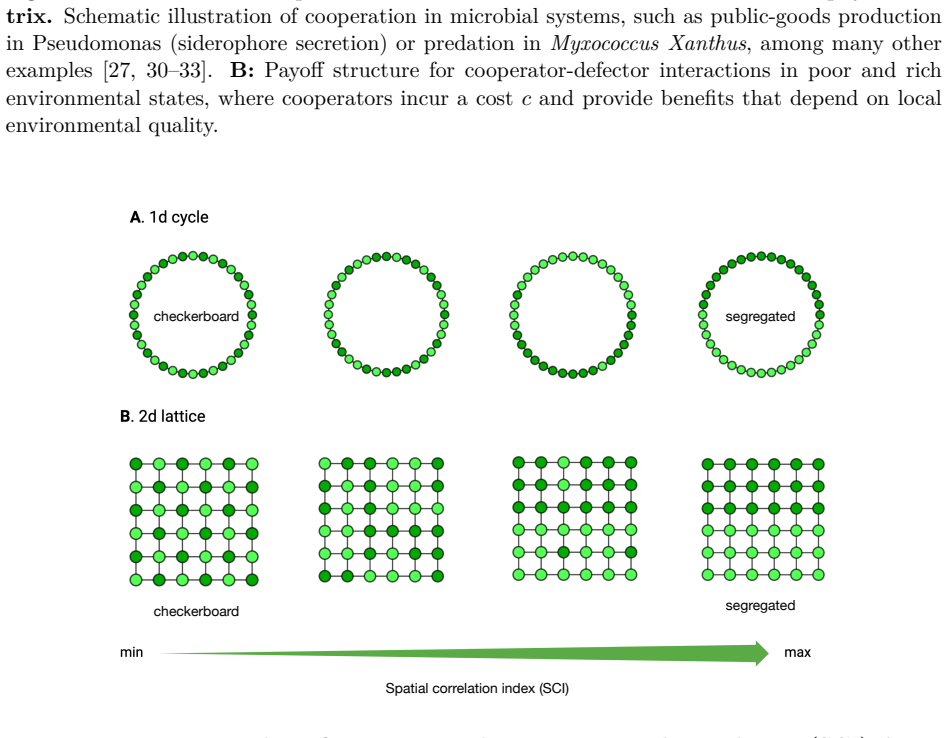
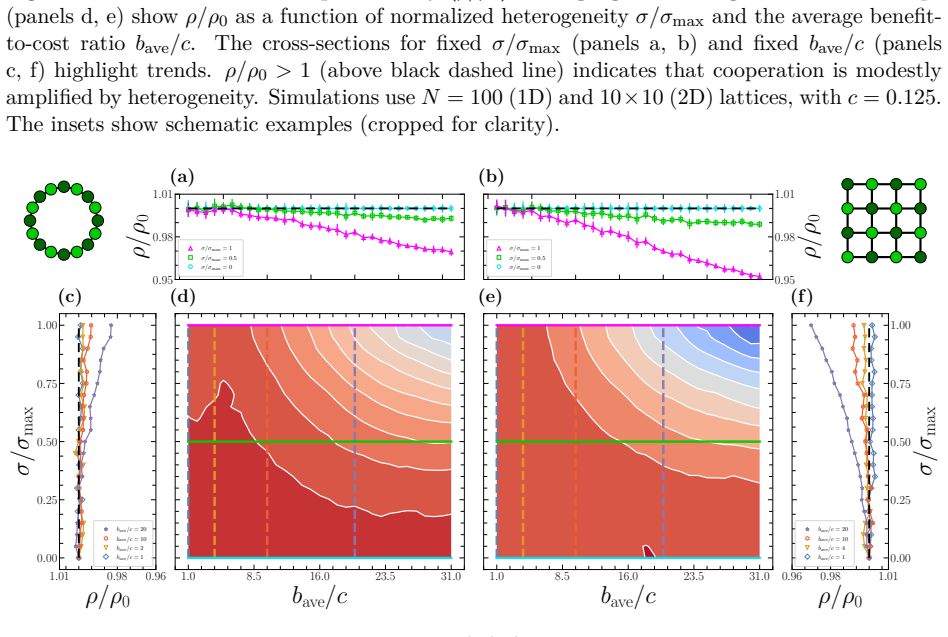
We show that whether heterogeneity promotes or suppresses cooperation is determined primarily by the spatial organization of environmental states. Across arbitrary environmental landscapes, a single quantity, the spatial correlation index (SCI), predicts the fixation probability of cooperators. Under weak selection, segregated environments enhance cooperation, whereas highly intermixed, checkerboard-like landscapes suppress it. Beyond fixation probabilities, environmental organization also controls evolutionary timescales: segregated landscapes generate long-lived metastable coexistence, whereas intermixed landscapes lead to faster but less successful fixation of cooperators.
What carries the argument
The spatial correlation index (SCI), a single quantity measuring the spatial organization of environmental states that directly predicts the fixation probability of cooperators.
If this is right
- Segregated environments enhance the fixation probability of cooperators under weak selection.
- Highly intermixed checkerboard-like landscapes suppress cooperator fixation.
- Segregated landscapes produce long-lived metastable coexistence of competing strategies.
- Intermixed landscapes produce faster but less successful fixation of cooperators.
- Environmental spatial organization supplies measurable predictors of cooperative success in biological and social populations.
Where Pith is reading between the lines
- Laboratory microbial populations could be placed on manufactured landscapes with controlled SCI values to test whether fixation probabilities match the predicted curve.
- The index supplies a rapid field metric for whether habitat patchiness in nature will favor cooperative traits.
- The same correlation approach might extend to other spatial evolutionary games once the payoff structure is mapped to local quality.
Load-bearing premise
The benefit of cooperation is determined strictly by local environmental quality at each site and selection remains weak, with cooperators in rich sites conferring greater benefits than on poor sites.
What would settle it
Compute or measure fixation probabilities of cooperators across multiple landscapes whose spatial correlation index values are known in advance, then check whether the observed probabilities follow the predicted dependence on the index.
Figures




read the original abstract
Cooperation is central to the organization of complex biological and social systems. Most theoretical models assume homogeneous environments; in reality, populations inhabit spatially varying landscapes in which the payoffs of cooperation differ across space. Here, we introduce a general framework for the evolution of cooperation in complex, heterogeneous environments where the benefit of cooperation depends on local environmental quality. Cooperators in environmentally rich sites confer greater benefits than those on poor sites. We show that whether heterogeneity promotes or suppresses cooperation is determined primarily by the spatial organization of environmental states. Across arbitrary environmental landscapes, a single quantity, the spatial correlation index (SCI), predicts the fixation probability of cooperators. Under weak selection, segregated environments enhance cooperation, whereas highly intermixed, checkerboard-like landscapes suppress it. Beyond fixation probabilities, environmental organization also controls evolutionary timescales: segregated landscapes generate long-lived metastable coexistence, whereas intermixed landscapes lead to faster but less successful fixation of cooperators. Together, these results provide a unifying description of how spatial environmental heterogeneity shapes the evolution of cooperation and suggest measurable predictors of cooperative success in biological and social settings.
Editorial analysis
A structured set of objections, weighed in public.
Referee Report
Summary. The manuscript introduces a spatial evolutionary game model in which the benefit conferred by cooperators depends on local environmental quality, with rich sites yielding higher payoffs than poor ones. It defines a spatial correlation index (SCI) and claims that this single scalar predicts cooperator fixation probability across arbitrary heterogeneous landscapes under weak selection. Segregated (positively correlated) environments are reported to enhance fixation while checkerboard-like (negatively correlated) environments suppress it; the same organization is said to control evolutionary timescales, producing long-lived metastable coexistence in segregated cases and faster but lower-success fixation in intermixed ones.
Significance. If the SCI result is robust, the work supplies a compact, measurable predictor that unifies how spatial environmental structure modulates cooperation, extending classic spatial assortment ideas to fully heterogeneous payoffs. This could be useful for interpreting field data on cooperation in patchy habitats. The framework itself is clearly motivated and the weak-selection analysis offers an analytic handle, though the strength of the contribution hinges on whether SCI truly suffices for arbitrary landscapes rather than for the one-parameter families likely used in simulations.
major comments (3)
- [§4] §4 (or equivalent results section on arbitrary landscapes): the central claim that fixation probability is determined by SCI alone for any environmental assignment is not demonstrated. Landscapes with identical SCI can differ in cluster-size distribution, boundary topology, or higher moments of the environmental field; these alter local encounter rates and payoff accumulation. No counterexamples with matched SCI but divergent fixation probabilities are shown, so the uniqueness of the prediction remains unverified.
- [§3] Weak-selection derivation (likely §3): the reduction of the effective assortment to the pairwise correlation SCI is plausible but the text does not explicitly show that higher-order spatial statistics of the environmental field vanish or are negligible. Without that step or an accompanying error bound, it is unclear whether the SCI formula is exact or an approximation whose validity depends on the landscape ensemble.
- [Methods] Simulation protocol (methods or supplementary): landscapes appear to be generated by varying a single correlation-length parameter. This samples a one-dimensional family and does not test the stronger 'arbitrary' statement. Direct comparison of fixation outcomes for distinct landscapes engineered to share the same SCI but differ in higher-order statistics is required to support the claim.
minor comments (2)
- [Abstract] The abstract states results for 'arbitrary' landscapes but the supporting simulations and derivations should be cross-referenced more explicitly in the main text so readers can assess the scope.
- [Model] Notation for environmental quality and the precise payoff matrix (rich vs. poor sites) could be introduced with a small table or diagram early in the model section to improve readability.
Simulated Author's Rebuttal
We thank the referee for the careful reading and constructive criticism of our manuscript. The comments highlight important aspects of the generality of our claims, and we address each major point below, indicating the revisions we will undertake.
read point-by-point responses
-
Referee: [§4] §4 (or equivalent results section on arbitrary landscapes): the central claim that fixation probability is determined by SCI alone for any environmental assignment is not demonstrated. Landscapes with identical SCI can differ in cluster-size distribution, boundary topology, or higher moments of the environmental field; these alter local encounter rates and payoff accumulation. No counterexamples with matched SCI but divergent fixation probabilities are shown, so the uniqueness of the prediction remains unverified.
Authors: We agree that the numerical results in the current manuscript primarily explore a one-parameter family of landscapes. The weak-selection analysis, however, is formulated for arbitrary environmental assignments and shows that the first-order change in cooperator frequency depends only on the pairwise spatial correlation captured by SCI. To provide direct empirical support for the claim beyond the parameterized family, we will add in the revised §4 (and Methods) explicit comparisons of fixation probabilities across distinct landscape realizations that are constructed to share identical SCI values while differing in cluster-size distributions, boundary lengths, and higher moments. These additional simulations will test whether outcomes remain consistent with the SCI prediction. revision: yes
-
Referee: [§3] Weak-selection derivation (likely §3): the reduction of the effective assortment to the pairwise correlation SCI is plausible but the text does not explicitly show that higher-order spatial statistics of the environmental field vanish or are negligible. Without that step or an accompanying error bound, it is unclear whether the SCI formula is exact or an approximation whose validity depends on the landscape ensemble.
Authors: The derivation proceeds from the weak-selection expansion of the birth-death process. The expected change in cooperator frequency is proportional to the covariance between an individual's strategy and its payoff; under the environmental payoff structure this covariance reduces exactly to the SCI at leading order in the selection intensity w. All terms involving three-point or higher spatial correlations of the environmental field appear multiplied by w or higher powers and therefore vanish in the w → 0 limit. We will insert an explicit statement of this ordering together with a brief error-bound remark in the revised §3 to clarify that the SCI formula is the exact leading-order result under weak selection, independent of the particular landscape ensemble. revision: yes
-
Referee: [Methods] Simulation protocol (methods or supplementary): landscapes appear to be generated by varying a single correlation-length parameter. This samples a one-dimensional family and does not test the stronger 'arbitrary' statement. Direct comparison of fixation outcomes for distinct landscapes engineered to share the same SCI but differ in higher-order statistics is required to support the claim.
Authors: The referee is correct that the reported simulations vary a single correlation-length parameter. While the analytic result is general, the numerical evidence is indeed limited to that family. In the revision we will expand the Methods section to include additional landscape-generation procedures (e.g., constrained random fields or optimization routines that fix SCI while varying other statistics) and will present direct side-by-side comparisons of fixation probabilities for such matched-SCI landscapes. These results will be reported in the revised manuscript to address the concern. revision: yes
Circularity Check
No significant circularity detected in derivation
full rationale
The paper's central result—that the spatial correlation index (SCI) predicts fixation probability across arbitrary heterogeneous landscapes under weak selection—is presented as a derived mathematical relationship from the model's payoff structure and spatial organization, rather than a redefinition or tautological fit. No load-bearing steps reduce by construction to inputs via self-definition, fitted parameters renamed as predictions, or self-citation chains. The abstract and claim describe an independent analysis of how environmental segregation versus intermixing affects cooperation, with SCI introduced as a measurable summary statistic. This is a standard theoretical reduction and does not exhibit the enumerated circularity patterns.
Axiom & Free-Parameter Ledger
Reference graph
Works this paper leans on
-
[1]
M. A. Nowak. Evolutionary Dynamics: Exploring the Equations of Life . Harvard University Press, 2006. isbn: 9780674023383
2006
-
[2]
The genetical evolution of social behaviour. II
W. Hamilton. “The genetical evolution of social behaviour. II” . In: Journal of Theoretical Biology 7.1 (1964), pp. 17–52. issn: 0022-5193. doi: https : / / doi . org / 10 . 1016 / 0022 - 5193(64 ) 90039 - 6. url: https : / / www . sciencedirect . com / science / article / pii / 0022519364900396
1964
-
[3]
R. Axelrod and W. D. Hamilton. “The Evolution of Cooperation” . In: Science 211.4489 (1981), pp. 1390–1396. doi: 10.1126/science.7466396 . eprint: https://www.science.org/doi/ pdf/10.1126/science.7466396 . url: https://www.science.org/doi/abs/10.1126/ science.7466396
-
[4]
The Evolution of Reciprocal Altruism
R. L. Trivers. “The Evolution of Reciprocal Altruism” . In: The Quarterly Review of Biology 46.1 (1971), pp. 35–57. doi: 10.1086/406755 . eprint: https://doi.org/10.1086/406755 . url: https://doi.org/10.1086/406755. 7
-
[5]
Social norms and human cooperation
E. Fehr and U. Fischbacher. “Social norms and human cooperation” . In: Trends in cognitive sciences 8.4 (2004), pp. 185–190. doi: https://doi.org/10.1016/j.tics.2004.02.007 . url: https://www.cell.com/trends/cognitive- sciences/abstract/S1364- 6613(04) 00050-6
-
[6]
Culture and the evolution of human cooperation
R. Boyd and P. J. Richerson. “Culture and the evolution of human cooperation” . In: Philo- sophical Transactions of the Royal Society B: Biological Sciences 364.1533 (2009), pp. 3281–
2009
-
[7]
doi: 10 . 1098 / rstb . 2009 . 0134. eprint: https : / / royalsocietypublishing . org / doi/pdf/10.1098/rstb.2009.0134 . url: https://royalsocietypublishing.org/doi/ abs/10.1098/rstb.2009.0134
-
[8]
D. G. Rand and M. A. Nowak. “Human cooperation” . In: Trends in Cognitive Sciences 17.8 (Aug. 2013), pp. 413–425. issn: 1364-6613. doi: 10 . 1016 / j . tics . 2013 . 06 . 003. url: https://doi.org/10.1016/j.tics.2013.06.003
-
[9]
M. A. Nowak and R. Highfield. SuperCooperators: Altruism, Evolution, and Why We Need Each Other to Succeed . New York, NY, USA: Free Press, 2011. isbn: 1451626630
2011
-
[10]
Evolution and the Theory of Games
J. M. Smith. “Evolution and the Theory of Games” . In: Did Darwin Get It Right? Essays on Games, Sex and Evolution . Boston, MA: Springer US, 1988, pp. 202–215. isbn: 978-1-4684- 7862-4. doi: 10.1007/978-1-4684-7862-4_22 . url: https://doi.org/10.1007/978-1- 4684-7862-4_22
-
[11]
J. Weibull. Evolutionary Game Theory. Mit Press. The MIT Press, 1997. isbn: 9780262731218. url: https://books.google.com/books?id=m98ed0_Na1sC
1997
-
[12]
Evolutionary game dynamics
J. Hofbauer and K. Sigmund. “Evolutionary game dynamics” . In: Bulletin of the American mathematical society 40.4 (2003), pp. 479–519
2003
-
[13]
Hofbauer and K
J. Hofbauer and K. Sigmund. Evolutionary Games and Population Dynamics . Cambridge University Press, 1998. isbn: 9780521625708. url: https://books.google.com/books?id= Xu-H0ClCHN8C
1998
-
[14]
Broom and J
M. Broom and J. Rychtár. Game-theoretical models in biology . CRC Press, 2014
2014
-
[15]
Models of cooperation based on the Prisoner’s Dilemma and the Snowdrift game
M. Doebeli and C. Hauert. “Models of cooperation based on the Prisoner’s Dilemma and the Snowdrift game” . In: Ecology Letters 8.7 (2005), pp. 748–766. doi: https://doi.org/10. 1111/j.1461-0248.2005.00773.x . eprint: https://onlinelibrary.wiley.com/doi/pdf/ 10.1111/j.1461- 0248.2005.00773.x . url: https://onlinelibrary.wiley.com/doi/ abs/10.1111/j.1461-02...
-
[17]
Five Rules for the Evolution of Cooperation
M. A. Nowak. “Five Rules for the Evolution of Cooperation” . In: Science 314.5805 (2006), pp. 1560–1563. doi: 10.1126/science.1133755 . eprint: https://www.science.org/doi/ pdf/10.1126/science.1133755 . url: https://www.science.org/doi/abs/10.1126/ science.1133755
-
[18]
2017;544(7649):227– 230.doi:10.1038/nature21723
B. Allen et al. “Evolutionary dynamics on any population structure” . In: Nature 544.7649 (Apr. 2017), pp. 227–230. issn: 1476-4687. doi: 10.1038/nature21723. url: https://doi. org/10.1038/nature21723
-
[19]
B. Allen, G. Lippner, and M. A. Nowak. “Evolutionary games on isothermal graphs” . In: Nature Communications 10.1 (Nov. 2019), p. 5107. issn: 2041-1723. doi: 10.1038/s41467- 019-13006-7. url: https://doi.org/10.1038/s41467-019-13006-7 . 8
-
[20]
Fixation probabilities in evolutionary dynamics under weak se- lection
A. McA voy and B. Allen. “Fixation probabilities in evolutionary dynamics under weak se- lection” . In: Journal of Mathematical Biology 82.3 (Feb. 2021), p. 14. issn: 1432-1416. doi: 10.1007/s00285-021-01568-4 . url: https://doi.org/10.1007/s00285-021-01568-4
-
[21]
Evolution of cooperation on large networks with community structure
B. Fotouhi et al. “Evolution of cooperation on large networks with community structure” . In: Journal of The Royal Society Interface 16.152 (2019), p. 20180677. doi: 10.1098/rsif.2018
-
[22]
url: https://royalsocietypublishing.org/doi/abs/10.1098/rsif.2018.0677
eprint: https://royalsocietypublishing.org/doi/pdf/10.1098/rsif.2018.0677. url: https://royalsocietypublishing.org/doi/abs/10.1098/rsif.2018.0677
-
[23]
Conjoining uncooperative societies facilitates evolution of cooperation
B. Fotouhi et al. “Conjoining uncooperative societies facilitates evolution of cooperation” . In: Nature Human Behaviour 2.7 (July 2018), pp. 492–499. issn: 2397-3374. doi: 10.1038/ s41562-018-0368-6 . url: https://doi.org/10.1038/s41562-018-0368-6
-
[24]
Stochastic Evolutionary Game Dynamics
A. Traulsen and C. Hauert. “Stochastic Evolutionary Game Dynamics” . In: Reviews of Non- linear Dynamics and Complexity . John Wiley & Sons, Ltd, 2009. Chap. 2, pp. 25–61. isbn: 9783527628001. doi: https : / / doi . org / 10 . 1002 / 9783527628001 . ch2. eprint: https : / / onlinelibrary . wiley . com / doi / pdf / 10 . 1002 / 9783527628001 . ch2. url: ht...
-
[25]
Spatial structure often inhibits the evolution of cooperation in the snowdrift game
C. Hauert and M. Doebeli. “Spatial structure often inhibits the evolution of cooperation in the snowdrift game” . In: Nature 428.6983 (Apr. 2004), pp. 643–646. issn: 1476-4687. doi: 10.1038/nature02360. url: https://doi.org/10.1038/nature02360
-
[26]
Games on graphs
B. Allen and M. A. Nowak. “Games on graphs” . In: EMS surveys in mathematical sciences 1.1 (2014), pp. 113–151
2014
-
[27]
Evolution of cooperation with asymmetric social interac- tions
Q. Su, B. Allen, and J. B. Plotkin. “Evolution of cooperation with asymmetric social interac- tions” . In: Proceedings of the National Academy of Sciences 119.1 (2022), e2113468118. doi: 10.1073/pnas.2113468118 . eprint: https://www.pnas.org/doi/pdf/10.1073/pnas. 2113468118. url: https://www.pnas.org/doi/abs/10.1073/pnas.2113468118
-
[28]
Evolutionary dynamics on graphs: Efficient method for weak selection
F. Fu et al. “Evolutionary dynamics on graphs: Efficient method for weak selection” . In: Phys. Rev. E 79 (4 Apr. 2009), p. 046707. doi: 10.1103/PhysRevE.79.046707. url: https: //link.aps.org/doi/10.1103/PhysRevE.79.046707
-
[29]
Understanding microbial cooperation
J. A. Damore and J. Gore. “Understanding microbial cooperation” . In: Journal of Theoretical Biology 299 (2012). Evolution of Cooperation, pp. 31–41. issn: 0022-5193. doi: https://doi. org/10.1016/j.jtbi.2011.03.008 . url: https://www.sciencedirect.com/science/ article/pii/S0022519311001482
-
[30]
Cellular cooperation: insights from microbes
H. Celiker and J. Gore. “Cellular cooperation: insights from microbes” . In: Trends in Cell Biology 23.1 (Jan. 2013), pp. 9–15. issn: 0962-8924. doi: 10.1016/j.tcb.2012.08.010. url: https://doi.org/10.1016/j.tcb.2012.08.010
-
[31]
Spatial structure, cooperation and competition in biofilms
C. D. Nadell, K. Drescher, and K. R. Foster. “Spatial structure, cooperation and competition in biofilms” . In: Nature Reviews Microbiology 14.9 (2016), pp. 589–600
2016
-
[32]
Cognitive Science36(5), 757–798 (2012).https://doi.org/10.1111/j
A. Buckling et al. “Siderophore-mediated cooperation and virulence in Pseudomonas aerug- inosa” . In: FEMS Microbiology Ecology 62.2 (Nov. 2007), pp. 135–141. issn: 0168-6496. doi: 10 . 1111 / j . 1574 - 6941 . 2007 . 00388 . x. eprint: https : / / academic . oup . com / femsec / article-pdf/62/2/135/18101146/62-2-135.pdf . url: https://doi.org/10.1111/j....
work page doi:10.1111/j 2007
-
[33]
Resource heterogeneity and the evolution of public goods cooperation
P. Stilwell et al. “Resource heterogeneity and the evolution of public goods cooperation” . In: Evolution Letters 4.2 (Apr. 2020), pp. 155–163. issn: 2056-3744. doi: 10.1002/evl3
-
[34]
eprint: https : / / academic . oup . com / evlett / article - pdf / 4 / 2 / 155 / 49850121 / evlett0155.pdf. url: https://doi.org/10.1002/evl3.158. 9
-
[35]
The predation strategy of Myxococcus xanthus
S. Thiery and C. Kaimer. “The predation strategy of Myxococcus xanthus” . In: Frontiers in microbiology 11 (2020), p. 2
2020
-
[36]
Myxococcus xanthus predation: an updated overview
F. J. Contreras-Moreno et al. “Myxococcus xanthus predation: an updated overview” . In: Frontiers in Microbiology 15 (2024), p. 1339696
2024
-
[37]
Optogenetic spatial patterning of cooperation in yeast populations
M. Le Bec et al. “Optogenetic spatial patterning of cooperation in yeast populations” . In: Nature Communications 15.1 (Jan. 2024), p. 75. issn: 2041-1723. doi: 10 . 1038 / s41467 - 023-44379-5. url: https://doi.org/10.1038/s41467-023-44379-5
-
[38]
Clonal interactions in cancer: Integrating quantitative models with experimental and clinical data
N. D. Lee, K. Kaveh, and I. Bozic. “Clonal interactions in cancer: Integrating quantitative models with experimental and clinical data” . In: Seminars in Cancer Biology 92 (2023), pp. 61–73. issn: 1044-579X. doi: https://doi.org/10.1016/j.semcancer.2023.04.002 . url: https://www.sciencedirect.com/science/article/pii/S1044579X23000603
-
[39]
Evolution of cooperation among tumor cells
R. Axelrod, D. E. Axelrod, and K. J. Pienta. “Evolution of cooperation among tumor cells” . In: Proceedings of the National Academy of Sciences 103.36 (2006), pp. 13474–13479. doi: 10.1073/pnas.0606053103 . eprint: https://www.pnas.org/doi/pdf/10.1073/pnas. 0606053103. url: https://www.pnas.org/doi/abs/10.1073/pnas.0606053103
-
[40]
Cooperation among cancer cells: applying game theory to cancer
M. Archetti and K. J. Pienta. “Cooperation among cancer cells: applying game theory to cancer” . In: Nature Reviews Cancer 19.2 (Feb. 2019), pp. 110–117. issn: 1474-1768. doi: 10.1038/s41568-018-0083-7 . url: https://doi.org/10.1038/s41568-018-0083-7
-
[41]
E. Ostrom. Governing the commons: The evolution of institutions for collective action . Cam- bridge university press, 1990
1990
-
[42]
Inequality and visibility of wealth in experimental social networks
A. Nishi et al. “Inequality and visibility of wealth in experimental social networks” . In: Nature 526.7573 (Oct. 2015), pp. 426–429. issn: 1476-4687. doi: 10.1038/nature15392. url: https: //doi.org/10.1038/nature15392
-
[43]
Cooperation, Punishment, and the Evolution of Human Institutions
J. Henrich. “Cooperation, Punishment, and the Evolution of Human Institutions” . In: Science 312.5770 (2006), pp. 60–61. doi: 10.1126/science.1126398. eprint: https://www.science. org/doi/pdf/10.1126/science.1126398 . url: https://www.science.org/doi/abs/10. 1126/science.1126398
-
[44]
Environmental fitness heterogeneity in the Moran process
K. Kaveh, A. McA voy, and M. A. Nowak. “Environmental fitness heterogeneity in the Moran process” . In: Royal Society Open Science 6.1 (Jan. 2019), p. 181661. issn: 2054-5703. doi: 10.1098/rsos.181661 . eprint: https://royalsocietypublishing.org/rsos/article- pdf/doi/10.1098/rsos.181661/973508/rsos.181661.pdf . url: https://doi.org/10. 1098/rsos.181661
-
[45]
The Moran process on 2-chromatic graphs
K. Kaveh et al. “The Moran process on 2-chromatic graphs” . In: PLOS Computational Biology 16.11 (Nov. 2020), pp. 1–18. doi: 10.1371/journal.pcbi.1008402 . url: https://doi. org/10.1371/journal.pcbi.1008402
-
[46]
Genotype by random environmental interactions gives an advantage to non-favored minor alleles
A. Mahdipour-Shirayeh et al. “Genotype by random environmental interactions gives an advantage to non-favored minor alleles” . In: Scientific Reports 7.1 (July 2017), p. 5193. issn: 2045-2322. doi: 10.1038/s41598-017-05375-0 . url: https://doi.org/10.1038/s41598- 017-05375-0
-
[47]
The effect of spatial randomness on the average fixation time of mutants
S. Farhang-Sardroodi et al. “The effect of spatial randomness on the average fixation time of mutants” . In: PLOS Computational Biology 13.11 (Nov. 2017), pp. 1–22. doi: 10.1371/ journal.pcbi.1005864. url: https://doi.org/10.1371/journal.pcbi.1005864. 10
-
[48]
Environmental spatial and temporal variability and its role in non-favoured mutant dynamics
S. Farhang-Sardroodi et al. “Environmental spatial and temporal variability and its role in non-favoured mutant dynamics” . In: Journal of The Royal Society Interface 16.157 (Aug. 2019), p. 20180781. issn: 1742-5689. doi: 10 . 1098 / rsif . 2018 . 0781. eprint: https : / / royalsocietypublishing . org / rsif / article - pdf / doi / 10 . 1098 / rsif . 2018...
-
[49]
Environmental evolutionary graph theory
W. Maciejewski and G. J. Puleo. “Environmental evolutionary graph theory” . In: Journal of Theoretical Biology 360 (2014), pp. 117–128. issn: 0022-5193. doi: https://doi.org/10. 1016/j.jtbi.2014.06.040 . url: https://www.sciencedirect.com/science/article/ pii/S0022519314003919
2014
-
[50]
Fixation probabilities in a spatially heterogeneous environ- ment
S. Gavrilets and N. Gibson. “Fixation probabilities in a spatially heterogeneous environ- ment” . In: Population Ecology 44.2 (Aug. 2002), pp. 51–58. issn: 1438-390X. doi: 10.1007/ s101440200007. url: https://doi.org/10.1007/s101440200007
-
[51]
N. Masuda, N. Gibert, and S. Redner. “Heterogeneous voter models” . In: Phys. Rev. E 82 (1 July 2010), p. 010103. doi: 10.1103/PhysRevE.82.010103 . url: https://link.aps.org/ doi/10.1103/PhysRevE.82.010103
-
[52]
Probability of Fixation in a Heterogeneous Envi- ronment
M. C. Whitlock and R. Gomulkiewicz. “Probability of Fixation in a Heterogeneous Envi- ronment” . In: Genetics 171.3 (Nov. 2005), pp. 1407–1417. issn: 1943-2631. doi: 10.1534/ genetics.104.040089. eprint: https://academic.oup.com/genetics/article-pdf/171/ 3/1407/42067771/genetics1407.pdf . url: https://doi.org/10.1534/genetics.104. 040089
-
[53]
PLOS ONE9(12), 113490 (2014) https://doi.org/10.1371/journal
V. S. K. Manem et al. “Modeling Invasion Dynamics with Spatial Random-Fitness Due to Micro-Environment” . In: PLOS ONE 10.10 (Oct. 2015), pp. 1–20. doi: 10.1371/journal. pone.0140234. url: https://doi.org/10.1371/journal.pone.0140234
-
[54]
Resource heterogeneity can facilitate cooperation
Á. Kun and U. Dieckmann. “Resource heterogeneity can facilitate cooperation” . In: Nature Communications 4.1 (Oct. 2013), p. 2453. issn: 2041-1723. doi: 10.1038/ncomms3453. url: https://doi.org/10.1038/ncomms3453
-
[55]
Does strong heterogeneity promote cooperation by group interactions?
M. Perc. “Does strong heterogeneity promote cooperation by group interactions?” In: New Journal of Physics 13.12 (Dec. 2011), p. 123027. doi: 10.1088/1367-2630/13/12/123027 . url: https://dx.doi.org/10.1088/1367-2630/13/12/123027
-
[56]
Spectral analysis of finite-time correlation matrices near equilibrium phase transitions
A. Szolnoki and X. Chen. “Environmental feedback drives cooperation in spatial social dilem- mas” . In: Europhysics Letters 120.5 (Feb. 2018), p. 58001. doi: 10.1209/0295- 5075/120/ 58001. url: https://doi.org/10.1209/0295-5075/120/58001
-
[57]
Heterogeneity in evolutionary games: an analysis of the risk perception
M. A. Amaral and M. A. Javarone. “Heterogeneity in evolutionary games: an analysis of the risk perception” . In: Proceedings of the Royal Society A: Mathematical, Physical and Engineering Sciences 476.2237 (May 2020), p. 20200116. issn: 1364-5021. doi: 10 . 1098 / rspa . 2020 . 0116. eprint: https : / / royalsocietypublishing . org / rspa / article - pdf ...
work page doi:10.1098/rspa.2020.0116/359347/rspa.2020.0116.pdf 2020
-
[58]
Evolutionary dynamics of social dilemmas in structured heterogeneous populations
F. C. Santos, J. M. Pacheco, and T. Lenaerts. “Evolutionary dynamics of social dilemmas in structured heterogeneous populations” . In: Proceedings of the National Academy of Sciences 103.9 (2006), pp. 3490–3494. doi: 10.1073/pnas.0508201103 . eprint: https://www.pnas. org/doi/pdf/10.1073/pnas.0508201103 . url: https://www.pnas.org/doi/abs/10. 1073/pnas.0508201103
-
[59]
1958;54(1):60–71.doi:10.1017/S0305004100033193
P. A. P. Moran. “Random processes in genetics” . In: Mathematical Proceedings of the Cam- bridge Philosophical Society 54.1 (1958), pp. 60–71. doi: 10.1017/S0305004100033193. 11
-
[60]
Evolutionary dynamics on graphs
E. Lieberman, C. Hauert, and M. A. Nowak. “Evolutionary dynamics on graphs” . In: Nature 433.7023 (Jan. 2005), pp. 312–316. issn: 1476-4687. doi: 10.1038/nature03204. url: https: //doi.org/10.1038/nature03204
-
[61]
H. Ohtsuki and M. A. Nowak. “Evolutionary games on cycles” . In: Proceedings of the Royal Society B: Biological Sciences 273.1598 (2006), pp. 2249–2256. doi: 10.1098/rspb.2006
-
[62]
url: https://royalsocietypublishing.org/doi/abs/10.1098/rspb.2006.3576
eprint: https://royalsocietypublishing.org/doi/pdf/10.1098/rspb.2006.3576. url: https://royalsocietypublishing.org/doi/abs/10.1098/rspb.2006.3576
-
[63]
A simple rule for the evolution of cooperation on graphs and social networks
H. Ohtsuki et al. “A simple rule for the evolution of cooperation on graphs and social networks” . In: Nature 441.7092 (May 2006), pp. 502–505. issn: 1476-4687. doi: 10 . 1038 / nature04605. url: https://doi.org/10.1038/nature04605
-
[64]
A Random Walk with Random Potential
Y. G. Sinai. “A Random Walk with Random Potential” . In: Theory of Probability & Its Applications 38.2 (1994), pp. 382–385. doi: 10.1137/1138036 . eprint: https://doi.org/ 10.1137/1138036. url: https://doi.org/10.1137/1138036
-
[65]
Limit behaviour of one-dimensional random walks in random environments
Y. G. Sinai. “Limit behaviour of one-dimensional random walks in random environments” . In: Teoriya Veroyatnostei i ee Primeneniya 27.2 (1982), pp. 247–258
1982
-
[66]
B. D. Hughes. Random walks and random environments . Oxford University Press, 1996
1996
-
[67]
Proceedings of the National Academy of Sciences , author =
M. E. J. Newman. “Modularity and community structure in networks” . In: Proceedings of the National Academy of Sciences 103.23 (2006), pp. 8577–8582. doi: 10.1073/pnas.0601602103. eprint: https : / / www . pnas . org / doi / pdf / 10 . 1073 / pnas . 0601602103. url: https : //www.pnas.org/doi/abs/10.1073/pnas.0601602103
-
[68]
Community structure in social and biological networks
M. Girvan and M. E. J. Newman. “Community structure in social and biological networks” . In: Proceedings of the National Academy of Sciences 99.12 (2002), pp. 7821–7826. doi: 10.1073/ pnas.122653799 . eprint: https://www.pnas.org/doi/pdf/10.1073/pnas.122653799 . url: https://www.pnas.org/doi/abs/10.1073/pnas.122653799
-
[69]
Physical Review E69(2), 026113 (2004) https://doi.org/10.1103/PhysRevE.69.026113
M. E. J. Newman and M. Girvan. “Finding and evaluating community structure in networks” . In: Phys. Rev. E 69 (2 Feb. 2004), p. 026113. doi: 10.1103/PhysRevE.69.026113 . url: https://link.aps.org/doi/10.1103/PhysRevE.69.026113
-
[70]
A. Kargaran and collaborators. Simulation code and data for [Your Paper Title] . 2026. doi: 10.5281/zenodo.18522974
-
[71]
S. Karlin and H. Taylor. A First Course in Stochastic Processes . First course in stochastic pro- cesses / Samuel Karlin; Howard M. Taylor v. 1. Elsevier Science, 1975. isbn: 9780123985521. url: https://books.google.nl/books?id=Vq69ZDOyLIUC. 12 biofilm substrate rich locations (high nutrient or enzyme) poor locations (low nutrient or enzyme) cooperator def...
discussion (0)
Sign in with ORCID, Apple, or X to comment. Anyone can read and Pith papers without signing in.