Recognition: unknown
Unveiling Dominant Toroidal Magnetic Fields in a Protostellar Outflow
Pith reviewed 2026-05-10 14:51 UTC · model grok-4.3
The pith
Polarization observations of CO emission show dominant toroidal magnetic fields in a protostellar outflow
A machine-rendered reading of the paper's core claim, the machinery that carries it, and where it could break.
Core claim
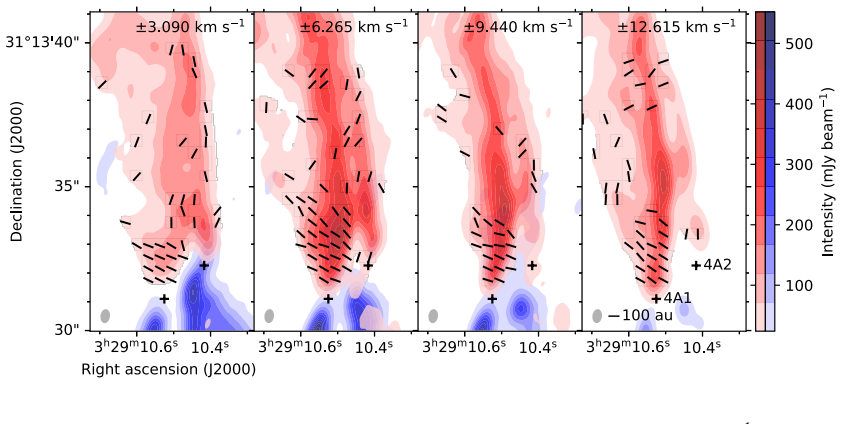
The inferred magnetic fields are perpendicular to the outflow axis and aligned with the rotational structure of the outflow, indicating toroidal fields with strengths of a few milligauss, sufficient to collimate and accelerate the outflow at several hundred astronomical units from the protostar. A linear correlation is found between the curl of plane-of-the-sky magnetic field and the line-of-sight electric current density.
What carries the argument
Polarization of CO emission used to infer the plane-of-the-sky magnetic field direction, revealing a toroidal geometry aligned with outflow rotation.
Load-bearing premise
The polarization of CO emission is assumed to trace the plane-of-the-sky magnetic field direction via standard alignment mechanisms without significant contamination from scattering, projection effects, or other polarization sources.
What would settle it
A map showing polarization angles inconsistent with toroidal geometry or direct Zeeman measurements yielding field strengths too weak to supply the required hoop stress would falsify the claim.
Figures



read the original abstract
Magnetic fields play a fundamental role in the formation of protostellar winds. In the magneto-centrifugal models, poloidal magnetic fields launch winds from accretion disks, and fast-rotating gas twists the fields into toroidal geometry that collimates and accelerates winds through magnetic hoop stress. However, toroidal fields in protostellar winds remain observationally unresolved. Here we report polarization observations of carbon monoxide emission toward the NGC1333 IRAS 4A protostellar outflow. The inferred magnetic fields are perpendicular to the outflow axis and aligned with the rotational structure of the outflow, indicating toroidal fields with strengths of a few milligauss, sufficient to collimate and accelerate the outflow at several hundred astronomical units from the protostar. A linear correlation is found between the curl of plane-of-the-sky magnetic field and the line-of-sight electric current density. Our analysis provides better constraints on ion-electron drift velocity in protostellar outflows and supports rotating outflows driven by the magneto-centrifugal mechanism.
Editorial analysis
A structured set of objections, weighed in public.
Referee Report
Summary. The manuscript reports polarization observations of CO emission toward the NGC1333 IRAS 4A protostellar outflow. The authors interpret the polarization vectors as tracing magnetic fields perpendicular to the outflow axis and aligned with the outflow's rotational structure, concluding that toroidal fields dominate with strengths of a few milligauss at scales of several hundred AU. These fields are argued to be sufficient for collimation and acceleration via magnetic hoop stress. A linear correlation is also reported between the curl of the plane-of-the-sky magnetic field and the line-of-sight electric current density, providing support for the magneto-centrifugal driving mechanism.
Significance. If the geometric and strength inferences are robust, the work would offer valuable direct observational constraints on toroidal magnetic fields in protostellar outflows, a key but elusive prediction of magneto-centrifugal wind models. The reported field strengths and B-curl vs. J correlation would help quantify the role of magnetic fields in outflow dynamics at hundreds of AU, advancing models of angular momentum transport and wind launching in low-mass star formation.
major comments (3)
- [§3 (Polarization Analysis and Magnetic Field Geometry)] The central claim that the fields are toroidal (perpendicular to the outflow axis) depends on interpreting the CO polarization direction as tracing the plane-of-the-sky B-field. The Goldreich-Kylafis 90° ambiguity is not resolved: no radiative-transfer modeling, optical-depth analysis, or multi-transition constraints are presented to determine whether polarization is parallel or perpendicular to the projected B for the specific CO transition and outflow conditions. This directly risks inverting the toroidal/poloidal assignment and invalidating the collimation argument.
- [§5 (Field Strength Estimation)] The field-strength estimates of a few milligauss are derived from assumed gas densities (or excitation conditions) and the polarization fraction. The manuscript does not detail the exact method (e.g., Chandrasekhar-Fermi variant or other) or test sensitivity to the density assumption, which is a free parameter in the analysis. This undermines the quantitative claim that the fields are 'sufficient to collimate and accelerate' the outflow.
- [§4.3 (Correlation Analysis)] The reported linear correlation between the curl of the plane-of-the-sky B and the line-of-sight current density requires clarification on projection effects and how the curl is computed from 2D vectors alone. The statistical significance (e.g., fit slope, R², or p-value) is not quantified in the text or figures, weakening the support for the current-density interpretation.
minor comments (3)
- [Abstract] The abstract does not specify the CO transition observed (e.g., J=2-1); this detail should be added for reproducibility.
- [Figures 1-3] Figure captions lack information on beam size, polarization fraction threshold for vector plotting, and any debiasing applied to the vectors.
- [References] A few references on the Goldreich-Kylafis effect applied to molecular outflows in star-forming regions are missing from the discussion.
Simulated Author's Rebuttal
We thank the referee for their careful and constructive review of our manuscript. The comments have highlighted important areas for clarification and improvement. We address each major comment point-by-point below and have revised the manuscript accordingly.
read point-by-point responses
-
Referee: [§3 (Polarization Analysis and Magnetic Field Geometry)] The central claim that the fields are toroidal (perpendicular to the outflow axis) depends on interpreting the CO polarization direction as tracing the plane-of-the-sky B-field. The Goldreich-Kylafis 90° ambiguity is not resolved: no radiative-transfer modeling, optical-depth analysis, or multi-transition constraints are presented to determine whether polarization is parallel or perpendicular to the projected B for the specific CO transition and outflow conditions. This directly risks inverting the toroidal/poloidal assignment and invalidating the collimation argument.
Authors: We acknowledge the Goldreich-Kylafis 90° ambiguity inherent to interpreting CO polarization. Our toroidal field interpretation is based on the observed alignment of polarization vectors with the outflow's rotational structure and consistency with magneto-centrifugal wind models. In the revised manuscript, we will add an explicit discussion in §3 of the ambiguity, including references to prior work on GK effects in molecular outflows, and justify our choice of orientation while noting that full radiative transfer modeling would require additional data not available here. revision: partial
-
Referee: [§5 (Field Strength Estimation)] The field-strength estimates of a few milligauss are derived from assumed gas densities (or excitation conditions) and the polarization fraction. The manuscript does not detail the exact method (e.g., Chandrasekhar-Fermi variant or other) or test sensitivity to the density assumption, which is a free parameter in the analysis. This undermines the quantitative claim that the fields are 'sufficient to collimate and accelerate' the outflow.
Authors: The estimates were obtained via a Chandrasekhar-Fermi approach using the observed polarization fraction and velocity dispersion, with densities inferred from CO excitation. We will revise §5 to provide the explicit formula, list all assumptions, and include a sensitivity test varying the density by a factor of a few to confirm the field strengths remain in the few-milligauss regime and sufficient for collimation. revision: yes
-
Referee: [§4.3 (Correlation Analysis)] The reported linear correlation between the curl of the plane-of-the-sky B and the line-of-sight current density requires clarification on projection effects and how the curl is computed from 2D vectors alone. The statistical significance (e.g., fit slope, R², or p-value) is not quantified in the text or figures, weakening the support for the current-density interpretation.
Authors: We will expand §4.3 to describe the numerical computation of the curl from the 2D vectors, explicitly note the projection limitations, and report quantitative statistics including the slope, R², and p-value both in the text and figure caption to substantiate the correlation. revision: yes
Circularity Check
No circularity: direct observational mapping from CO polarization to toroidal B geometry
full rationale
The paper's central claims rest on polarization observations of CO emission in NGC1333 IRAS 4A, with B-field directions inferred via standard alignment mechanisms and a reported correlation between curl(B_POS) and J_LOS. No equations or steps reduce the target results (toroidal geometry, field strengths, or correlation) to fitted parameters or self-citations by construction. The derivation chain is self-contained against external data and does not invoke load-bearing self-citations, ansatzes smuggled via prior work, or renaming of known results as new derivations. This is the expected outcome for a direct measurement paper.
Axiom & Free-Parameter Ledger
free parameters (1)
- gas density or excitation conditions for B-field strength
axioms (1)
- domain assumption CO polarization traces the plane-of-the-sky magnetic field orientation
Reference graph
Works this paper leans on
-
[1]
Blandford, R. D. & Payne, D. G. Hydromagnetic flows from accretion disks and the production of radio jets. Mon. Not. R. Astron. Soc.199, 883–903 (1982)
1982
-
[2]
H., Najita, J
Shu, F. H., Najita, J. R., Shang, H. & Li, Z. Y. X-Winds Theory and Observations. In Mannings, V., Boss, A. P. & Russell, S. S. (eds.)Protostars and Planets IV, 789–814 (2000)
2000
-
[3]
Disk Winds, Jets, and Outflows: Theoretical and Computational Foundations
Pudritz, R. E., Ouyed, R., Fendt, C. & Brandenburg, A. Disk Winds, Jets, and Outflows: Theoretical and Computational Foundations. In Reipurth, B., Jewitt, D. & Keil, K. (eds.) Protostars and Planets V, 277 (2007).astro-ph/0603592
work page Pith review arXiv 2007
- [4]
-
[5]
On the nature of bipolar sources in dense molecular clouds
Konigl, A. On the nature of bipolar sources in dense molecular clouds. Astrophys. J.261, 115–134 (1982)
1982
-
[6]
C., Foglizzo, T
Spruit, H. C., Foglizzo, T. & Stehle, R. Collimation of magnetically driven jets from accretion discs. Mon. Not. R. Astron. Soc.288, 333–342 (1997)
1997
-
[7]
Albertazzi, B. et al. Laboratory formation of a scaled protostellar jet by coaligned poloidal magnetic field. Science346, 325–328 (2014)
2014
-
[8]
Lei, Z. et al. Laboratory evidence of confinement and acceleration of wide-angle flows by toroidal magnetic fields. Communications Physics7, 107 (2024)
2024
- [9]
- [10]
- [11]
-
[12]
Moscadelli, L., Sanna, A., Beuther, H., Oliva, A. & Kuiper, R. Snapshot of a magnetohy- drodynamic disk wind traced by water maser observations. Nature Astronomy6, 1068–1076 (2022).2209.00432
-
[13]
Oliva, A. & Kuiper, R. Modeling disks and magnetic outflows around a forming massive star. II. Dynamics of jets from massive protostars. A&A669, A81 (2023).2210.01492
-
[14]
Lee, C.-F. et al. Unveiling a magnetized jet from a low-mass protostar.Nature Communications 9, 4636 (2018)
2018
-
[15]
D., Russell, A
Sandell, G., Aspin, C., Duncan, W. D., Russell, A. P. G. & Robson, E. I. NGC 1333 IRAS 4: A Very Young, Low-Luminosity Binary System.Astrophys. J.376, L17 (1991)
1991
-
[16]
Looney, L. W., Mundy, L. G. & Welch, W. J. Unveiling the Circumstellar Envelope and Disk: A Subarcsecond Survey of Circumstellar Structures.Astrophys. J.529, 477–498 (2000). astro-ph/9908301
- [17]
-
[18]
Girart, J. M., Rao, R. & Marrone, D. P. Magnetic Fields in the Formation of Sun-Like Stars. Science313, 812–814 (2006).astro-ph/0609177
-
[19]
Gonc ¸alves, J., Galli, D. & Girart, J. M. Modeling the magnetic field in the protostellar source NGC 1333 IRAS 4A. Astron. & Astrophys.490, L39–L42 (2008).0809.5278
-
[20]
Frau, P., Galli, D. & Girart, J. M. Comparing star formation models with interferometric observations of the protostar NGC 1333 IRAS 4A. I. Magnetohydrodynamic collapse models. Astron. & Astrophys.535, A44 (2011).1109.6251
- [21]
-
[22]
M., Crutcher, R
Girart, J. M., Crutcher, R. M. & Rao, R. Detection of Polarized CO Emission from the Molecular Outflow in NGC 1333 IRAS 4A. Astrophys. J.525, L109–L112 (1999)
1999
- [23]
-
[24]
Chahine, L. et al. Multiple chemical tracers finally unveil the intricate NGC 1333 IRAS 4A outflow system. FAUST XVI. Mon. Not. R. Astron. Soc.531, 2653–2668 (2024).2405. 12735
2024
-
[25]
& Kylafis, N
Goldreich, P. & Kylafis, N. D. On mapping the magnetic field direction in molecular clouds by polarization measurements. Astrophys. J.243, L75–L78 (1981). 32
1981
-
[26]
& Watson, W
Deguchi, S. & Watson, W. D. Linear polarization of molecular lines at radio frequencies. Astrophys. J.285, 126–133 (1984)
1984
- [27]
- [28]
- [29]
- [30]
- [31]
-
[32]
Houde, M., Lankhaar, B., Rajabi, F. & Chamma, M. A. The generation and transformation of polarization signals in molecular lines through collective anisotropic resonant scattering. Mon. Not. R. Astron. Soc.511, 295–315 (2022).2112.15104
- [33]
-
[34]
Hirota, T. et al. Disk-driven rotating bipolar outflow in Orion Source I. Nature Astronomy1, 0146 (2017).1712.04606
work page Pith review arXiv 2017
-
[35]
G., Reipurth, B., Ostriker, E
Lee, C.-F., Mundy, L. G., Reipurth, B., Ostriker, E. C. & Stone, J. M. CO Outflows from Young Stars: Confronting the Jet and Wind Models. Astrophys. J.542, 925–945 (2000)
2000
-
[36]
Lankhaar, B. & Vlemmings, W. Collisional polarization of molecular ions: a signpost of ambipolar diffusion. A&A638, L7 (2020).2006.12524
-
[37]
& Kylafis, N
Tritsis, A. & Kylafis, N. Extension of the multilevel radiative transfer code PyRaTE to model linear polarization of molecular lines. A&A692, A75 (2024)
2024
-
[38]
Yang, L.-W. & Lai, S.-P. Probing the magnetic field structure in star-forming re- gions through molecular line polarization. In ASRROC 2010 Symposium Proceedings, vol. 8 (2010). URLhttp://www-ws.gov.taipei/001/Upload/public/ Attachment/15911484947.pdf. Conference proceeding
- [39]
-
[40]
Cortes, P. C., Crutcher, R. M. & Watson, W. D. Line Polarization of Molecular Lines at Radio Frequencies: The Case of DR 21(OH). ApJ628, 780–788 (2005).astro-ph/0504258
-
[41]
ALMA Cycle 4 Technical Handbook
ALMA Partnership. ALMA Cycle 4 Technical Handbook. Atacama Large Millime- ter/submillimeter Array (2016). ALMA Technical Handbook. 34
2016
-
[42]
The Strength of Interstellar Magnetic Fields
Davis, L. The Strength of Interstellar Magnetic Fields. Physical Review81, 890–891 (1951)
1951
-
[43]
& Fermi, E
Chandrasekhar, S. & Fermi, E. Magnetic Fields in Spiral Arms. Astrophys. J.118, 113 (1953)
1953
-
[44]
Draine, B. T. Physics of the Interstellar and Intergalactic Medium (Princeton University Press, 2011)
2011
- [45]
- [46]
- [47]
-
[48]
& Koenigl, A
Wardle, M. & Koenigl, A. The Structure of Protostellar Accretion Disks and the Origin of Bipolar Flows. Astrophys. J.410, 218 (1993)
1993
- [49]
- [50]
- [51]
-
[52]
Banerjee, R. & Pudritz, R. E. Outflows and Jets from Collapsing Magnetized Cloud Cores. Astrophys. J.641, 949–960 (2006).astro-ph/0508374
-
[53]
N., Inutsuka, S.-i
Machida, M. N., Inutsuka, S.-i. & Matsumoto, T. High- and Low-Velocity Magnetized Outflows in the Star Formation Process in a Gravitationally Collapsing Cloud.Astrophys. J.676, 1088– 1108 (2008)
2008
-
[54]
Basu, S., Sharkawi, M. & Machida, M. N. Outflows Driven from a Magnetic Pseudodisk. Astrophys. J.964, 116 (2024).2401.04260
- [55]
- [56]
-
[57]
Machida, M. N., Hirano, S. & Kitta, H. Misalignment of magnetic fields, outflows, and discs in star-forming clouds. Mon. Not. R. Astron. Soc.491, 2180–2197 (2020).1911.03851
- [58]
- [59]
-
[60]
& Shu, F
Li, Z.-Y. & Shu, F. H. Magnetized Singular Isothermal Toroids.Astrophys. J.472, 211 (1996)
1996
- [61]
-
[62]
C., Stone, J
Ostriker, E. C., Stone, J. M. & Gammie, C. F. Density, Velocity, and Magnetic Field Structure in Turbulent Molecular Cloud Models. Astrophys. J.546, 980–1005 (2001).astro-ph/ 0008454
2001
-
[63]
Dickman, R. L. The ratio of carbon monoxide to molecular hydrogen in interstellar dark clouds. Astrophys. J. Suppl.37, 407–427 (1978)
1978
- [64]
- [65]
-
[66]
Vlemmings, W. H. T., Lankhaar, B. & Velilla-Prieto, L. Molecular line polarisation from the circumstellar envelopes of asymptotic giant branch stars. A&A686, A274 (2024).2404. 01681. 37
2024
-
[67]
Lopez-Rodriguez, E., Guerra, J. A., Asgari-Targhi, M. & Schmelz, J. T. The Strength and Structure of the Magnetic Field in the Galactic Outflow of Messier 82. ApJ914, 24 (2021). 2102.03362
-
[68]
A., Lopez-Rodriguez, E., Chuss, D
Guerra, J. A., Lopez-Rodriguez, E., Chuss, D. T., Butterfield, N. O. & Schmelz, J. T. The Strength of the Sheared Magnetic Field in the Galactic’s Circumnuclear Disk. AJ166, 37 (2023).2304.06823
-
[69]
Lopez-Rodriguez, E. et al. The magnetic fields of the dusty nuclei and molecular outflows of arp 220. The Astrophysical Journal Letters996, L27 (2026). URLhttps://doi.org/ 10.3847/2041-8213/ae2ed6
-
[70]
Wardle, J. F. C. & Kronberg, P. P. The linear polarization of quasi-stellar radio sources at 3.71 and 11.1 centimeters. ApJ194, 249 (1974). AcknowledgementsThis paper makes use of the following ALMA data: ADS/JAO.ALMA#2016.1.01089.S. ALMA is a partnership of ESO (representing its member states), NSF (USA) and NINS (Japan), together with NRC (Canada), MOST...
1974
discussion (0)
Sign in with ORCID, Apple, or X to comment. Anyone can read and Pith papers without signing in.