Recognition: unknown
Spectral pollution in substitution systems
Pith reviewed 2026-05-10 14:09 UTC · model grok-4.3
The pith
Periodic approximations of higher-dimensional substitution systems exhibit significant spectral pollution unlike in one dimension.
A machine-rendered reading of the paper's core claim, the machinery that carries it, and where it could break.
Core claim
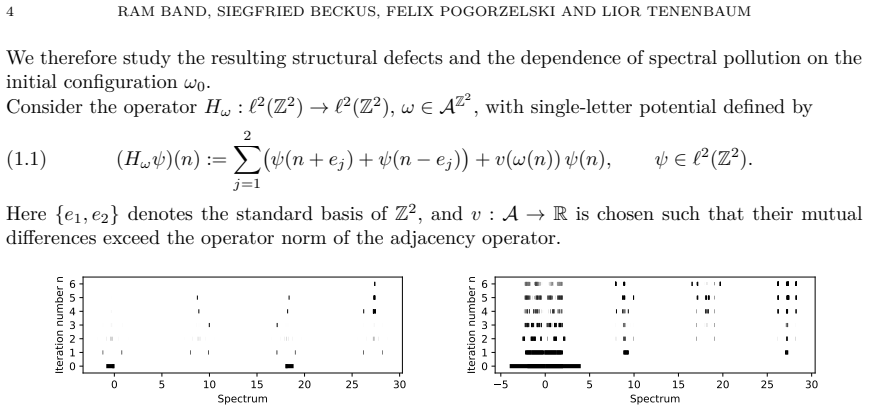
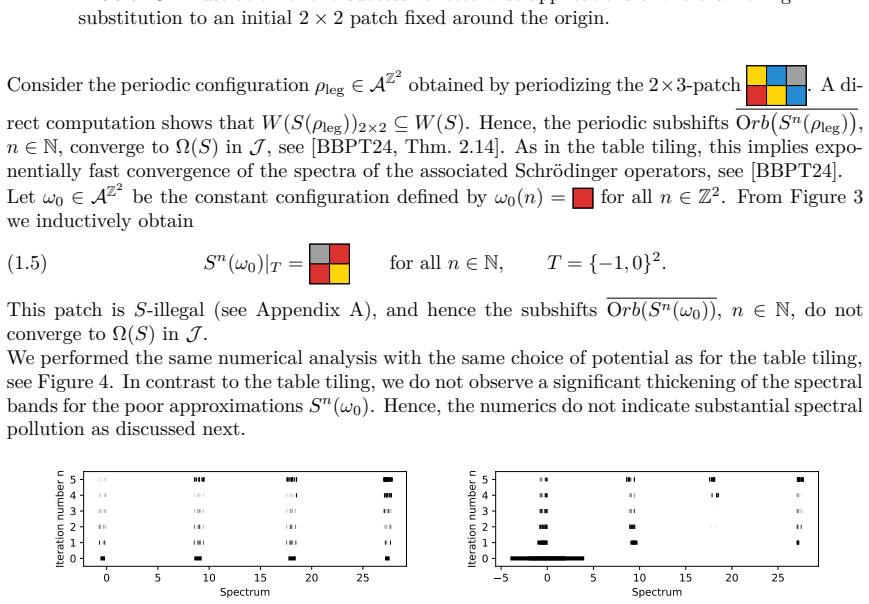
We study spectral properties of Schrödinger operators associated with substitution dynamical systems in higher dimensions. Focusing on periodic approximations generated by iterating substitutions on initial configurations, we analyze how structural defects influence the limiting spectral behavior. In contrast to the one-dimensional setting, we show that such approximations may exhibit significant spectral pollution, including changes in the essential spectrum and the Lebesgue measure.
What carries the argument
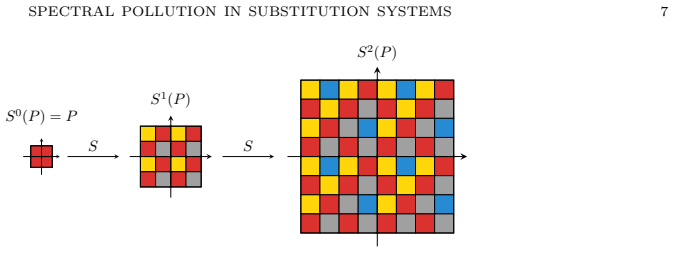
Periodic approximations generated by iterating substitutions on initial configurations in higher-dimensional substitution dynamical systems, which introduce structural defects that produce spectral pollution in the limiting Schrödinger operators.
If this is right
- The essential spectrum of the limiting operator can differ from that suggested by the approximations.
- The Lebesgue measure of the spectrum can be altered by the pollution induced in the limit.
- Spectral computations relying on such periodic approximations may fail to capture the true spectrum in dimensions greater than one.
- Substitution systems in higher dimensions require approximation methods that avoid or correct for structural defects to ensure spectral accuracy.
Where Pith is reading between the lines
- Similar pollution effects could appear in other higher-dimensional systems with aperiodic order, such as projection tilings.
- Explicit calculations for concrete two-dimensional substitutions would allow measurement of the size of the polluted spectral regions.
- Alternative constructions that eliminate structural defects might restore clean approximation properties in higher dimensions.
- The result suggests that spectral models of quasicrystals or other ordered media in three dimensions may need revised approximation techniques.
Load-bearing premise
The structural defects arising from iterating substitutions on initial configurations are the direct cause of persistent spectral pollution in the limit, rather than artifacts of the specific construction or choice of initial configurations.
What would settle it
Finding a higher-dimensional substitution system in which the spectra of all iterated periodic approximations converge to the same essential spectrum and Lebesgue measure as the infinite-volume operator without measurable changes would falsify the pollution claim.
Figures


read the original abstract
We study spectral properties of Schr\"odinger operators associated with substitution dynamical systems in higher dimensions. Focusing on periodic approximations generated by iterating substitutions on initial configurations, we analyze how structural defects influence the limiting spectral behavior. In contrast to the one-dimensional setting, we show that such approximations may exhibit significant spectral pollution, including changes in the essential spectrum and the Lebesgue measure.
Editorial analysis
A structured set of objections, weighed in public.
Referee Report
Summary. The manuscript studies Schrödinger operators associated with substitution dynamical systems in higher dimensions. Focusing on periodic approximations generated by iterating substitutions on initial configurations, it analyzes the influence of structural defects on limiting spectral behavior and shows that, unlike in one dimension, such approximations may exhibit significant spectral pollution, including changes to the essential spectrum and the Lebesgue measure of the spectrum.
Significance. If rigorously established, the result would be significant for highlighting dimension-dependent phenomena in the spectral theory of aperiodic operators. It provides a concrete contrast to the one-dimensional case (where such approximations are typically free of pollution) and identifies structural defects arising from substitution iteration as a mechanism that can alter the essential spectrum and spectral measure in higher dimensions. This advances understanding of quasicrystals and substitution systems beyond 1D and is likely to motivate further work on multidimensional examples.
minor comments (2)
- [Abstract] The abstract refers to 'higher dimensions' without specifying the dimensions treated in the main theorems or examples; adding this detail (e.g., d=2 or d≥2) would improve clarity for readers.
- Notation for the substitution rule, the initial configuration, and the resulting periodic approximants should be introduced with explicit definitions early in the paper to aid readability, especially when comparing to the 1D setting.
Simulated Author's Rebuttal
We thank the referee for their positive evaluation of our manuscript on spectral pollution in higher-dimensional substitution systems. The referee correctly identifies the key contrast with the one-dimensional case and the potential significance for quasicrystal models. No specific major comments were listed in the report, so we have no point-by-point responses to provide at this time.
Circularity Check
No significant circularity; derivation self-contained
full rationale
The paper analyzes spectral properties of Schrödinger operators on higher-dimensional substitution systems via direct comparison of periodic approximations generated by iterated substitutions. The central claim—that these approximations can exhibit spectral pollution (changes in essential spectrum and Lebesgue measure) unlike the 1D case—is presented as an existence result arising from structural defects in the construction. No equations or steps reduce a claimed prediction to a fitted input, self-definition, or load-bearing self-citation chain; the argument relies on explicit construction and spectral analysis rather than renaming or smuggling ansatzes. The result is therefore independent of its inputs by construction.
Axiom & Free-Parameter Ledger
axioms (1)
- standard math Standard properties of substitution dynamical systems and associated Schrödinger operators in higher dimensions
Reference graph
Works this paper leans on
-
[1]
Spectral and quantum dynamical properties of the weakly coupled Fibonacci Hamiltonian
doi: 10.1017/etds.2017.144. [DF22] D. Damanik and J. Fillman. One-dimensional ergodic Schrödinger operators—I. Gen- eral theory.Vol.221.AmericanMathematicalSociety,Providence,RI,2022,pp.xv+444. isbn: 978-1-4704-5606-1. [DF24] D. Damanik and J. Fillman. One-dimensional ergodic Schrödinger operators—II. Spe- cific Classes. Vol. 249. Graduate Studies in Math...
-
[2]
Multidimensional constant-length substitution sequences
doi: 10.1007/s00220-011-1220-2. [Fil25] J. Fillman. Measure of the spectra of periodic graph operators in the large-coupling limit. arXiv:2511.00757. 2025. [Fra05] N. P. Frank. “Multidimensional constant-length substitution sequences”. In:Topology Appl. 152.1-2 (2005), pp. 44–69.doi: 10.1016/j.topol.2004.08.014. [FM22] N. P. Frank and N. Manibo. “Spectral...
discussion (0)
Sign in with ORCID, Apple, or X to comment. Anyone can read and Pith papers without signing in.