Recognition: unknown
EPAC: The Last Dance
Pith reviewed 2026-05-10 14:29 UTC · model grok-4.3
The pith
A RISC-V accelerator chip integrating vector, stencil, and variable-precision tiles has been fabricated and validated in 22nm technology.
A machine-rendered reading of the paper's core claim, the machinery that carries it, and where it could break.
Core claim
EPAC is a RISC-V accelerator chip in GF22FDX technology that integrates a vector processing tile for HPC, a many-core stencil and ML tile, and a variable-precision tile, all linked by a coherent CHI network-on-chip with distributed L2 cache and SerDes memory interface. The 27 sq mm die containing approximately 0.3 billion transistors was taped out and successfully brought up, validating all major IP blocks.
What carries the argument
The CHI-based network-on-chip interconnecting the VEC, STX, and VRP tiles with distributed L2 cache and SerDes external memory link.
If this is right
- Heterogeneous RISC-V tiles can address diverse HPC workload classes on one die.
- The physical implementation process in 22FDX technology proves viable for such multi-tile designs.
- Distributed L2 cache and CHI NoC enable coherent communication across specialized compute units.
- Multi-partner academic and industrial coordination can deliver a full chip tape-out and bring-up.
- The architecture supplies a working platform for extended-precision and stencil computations alongside standard vector processing.
Where Pith is reading between the lines
- The working chip provides a concrete reference design that could encourage broader RISC-V adoption in European HPC systems.
- Bring-up data from the SerDes link and NoC may inform power and latency optimizations in follow-on chips.
- Similar modular tile approaches could extend to other domains such as embedded AI or scientific computing accelerators.
Load-bearing premise
The assumption that the tile integration via the NoC and SerDes link functions without major physical or functional issues, which supports the successful bring-up claim.
What would settle it
Test results or measurements showing that any major IP block, such as the vector unit or the coherent interconnect, failed to operate after bring-up would disprove the validation success.
Figures

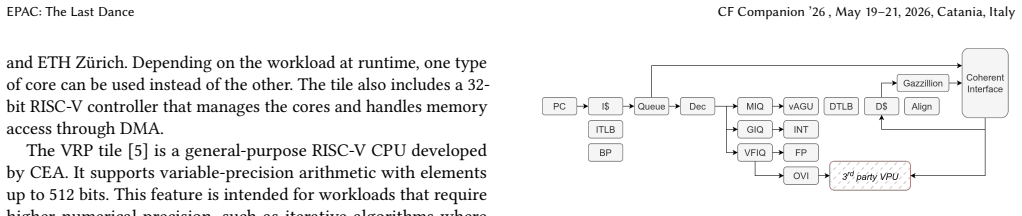


read the original abstract
This paper presents EPAC, a RISC-V-based accelerator chip developed within the European Processor Initiative (EPI) as part of a multi-year, multi-partner effort to build a European HPC processor ecosystem. EPAC is implemented in GlobalFoundries 22FDX (GF22FDX) technology, covers an area of 27 sq mm with approximately 0.3 billion transistors, and integrates three distinct RISC-V compute tiles targeting different workload classes: VEC, a vector processing tile for double-precision HPC workloads; STX, a many-core tile optimized for stencil and machine learning computations; and VRP, a variable-precision tile for iterative numerical solvers requiring extended floating-point formats. All tiles are connected through a Coherent Hub Interface (CHI) based network-on-chip with a distributed L2 cache system and communicate with external memory via a SerDes link. The chip was taped out in GF22FDX technology and successfully brought up, with all major IP blocks validated. This paper describes the architecture of each tile and the uncore infrastructure, the integration and physical implementation process, and the board-level bring-up activities. It also reflects on the engineering and coordination lessons learned from a full chip design effort distributed across academic and industrial partners in Europe.
Editorial analysis
A structured set of objections, weighed in public.
Referee Report
Summary. The paper presents EPAC, a 27 mm² RISC-V accelerator chip fabricated in GF22FDX technology with ~0.3 billion transistors. It integrates three heterogeneous compute tiles (VEC for double-precision vector HPC, STX for stencil/ML, VRP for variable-precision iterative solvers) connected by a CHI-based NoC with distributed L2 cache and a SerDes external memory interface. The manuscript describes the per-tile architectures, uncore infrastructure, physical implementation and integration process, and board-level bring-up, concluding that the chip was successfully taped out and all major IP blocks were validated.
Significance. If the bring-up and validation claims hold with supporting data, the work would constitute a concrete milestone in the European Processor Initiative by demonstrating first-silicon functionality of a multi-tile, multi-workload RISC-V SoC in an advanced node. The engineering coordination across academic and industrial partners is itself noteworthy for large-scale European HPC hardware efforts.
major comments (1)
- [board-level bring-up activities section] Board-level bring-up activities section: the central claim that the chip 'was taped out ... and successfully brought up, with all major IP blocks validated' is supported only by qualitative statements. No quantitative metrics—achieved frequencies, measured power, test-pattern pass rates, or per-block error logs—are reported for the integrated VEC/STX/VRP tiles, CHI NoC, distributed L2, or SerDes link. This absence directly undermines verification of the integration success that underpins the entire contribution.
Simulated Author's Rebuttal
We thank the referee for the constructive feedback on the board-level bring-up section. We agree that quantitative metrics are essential to substantiate the validation claims and will revise the manuscript to include them.
read point-by-point responses
-
Referee: [board-level bring-up activities section] Board-level bring-up activities section: the central claim that the chip 'was taped out ... and successfully brought up, with all major IP blocks validated' is supported only by qualitative statements. No quantitative metrics—achieved frequencies, measured power, test-pattern pass rates, or per-block error logs—are reported for the integrated VEC/STX/VRP tiles, CHI NoC, distributed L2, or SerDes link. This absence directly undermines verification of the integration success that underpins the entire contribution.
Authors: We acknowledge that the current manuscript presents the bring-up results primarily through qualitative statements. In the revised version, we will expand the board-level bring-up activities section with available quantitative data from post-silicon validation, including achieved frequencies for the VEC, STX, and VRP tiles, measured power consumption under representative workloads, functional test-pattern pass rates for the compute tiles and uncore components, and summarized error logs for the CHI NoC, distributed L2, and SerDes interface. These metrics were collected during board-level testing but were not included in the initial submission to maintain focus on architectural and implementation details; adding them will directly address the concern and strengthen the evidence for successful integration. revision: yes
Circularity Check
No circularity: purely descriptive engineering report with no derivations
full rationale
The paper is a factual engineering implementation report describing the EPAC chip architecture, tile designs (VEC, STX, VRP), CHI-based NoC integration, physical implementation in GF22FDX, tape-out, and board-level bring-up. It contains no equations, predictions, fitted parameters, or derivation chains that could reduce to inputs by construction. All content consists of architectural descriptions and process narratives; the success claim rests on reported design steps rather than any self-referential logic or self-citation load-bearing premises. No instances of self-definitional claims, fitted-input predictions, or ansatz smuggling appear.
Axiom & Free-Parameter Ledger
Reference graph
Works this paper leans on
-
[1]
Avispado: A RISC-V core supporting the RISC-V vector instruction set,
Semidynamics Technology Services. Avispado: A RISC-V core supporting the RISC-V vector instruction set, . URL https://semidynamics.com/file/pb/ mxymcvviuxxyroh4oul3tipjy0zjcd. Accessed: 2026-04-02
2026
-
[2]
Francesco Minervini, Oscar Palomar, Osman Unsal, Enrico Reggiani, Josue Quiroga, Joan Marimon, Carlos Rojas, Roger Figueras, Abraham Ruiz, Alberto Gonzalez, et al. Vitruvius+: An area-efficient RISC-V decoupled vector copro- cessor for high performance computing applications.ACM Transactions on Architecture and Code Optimization, 20(2):1–25, 2023. doi: 10...
-
[3]
Mate Kovač, Leon Dragić, Branimir Malnar, Francesco Minervini, Oscar Palomar, Carlos Rojas, Mauro Olivieri, Josip Knezović, and Mario Kovač. FAUST: Design and implementation of a pipelined RISC-V vector floating-point unit.Micropro- cessors and microsystems, 97:104762, 2023. doi: 10.1016/j.micpro.2023.104762
-
[4]
STX – Supercom- puting Hardware and Software Design
Fraunhofer Institute for Industrial Mathematics ITWM. STX – Supercom- puting Hardware and Software Design. https://www.itwm.fraunhofer.de/ en/departments/analytics-computing-en/stx-supercomputing-hardware- software-design.html. Accessed: 2026-04-02
2026
-
[5]
A Variable and Extended Precision (VRP) Accelerator and its 22 nm soc Implementation
César Fuguet, Eric Guthmuller, Andrea Bocco, Jérôme Fereyre, Adrian Evans, and Yves Durand. A Variable and Extended Precision (VRP) Accelerator and its 22 nm soc Implementation. In2024 39th Conference on Design of Circuits and Integrated Systems (DCIS), pages 1–6. IEEE, 2024. doi: 10.1109/DCIS62603.2024.10769136
-
[6]
Short reasons for long vectors in HPC CPUs: A study based on RISC-V
Pablo Vizcaino, Georgios Ieronymakis, Nikolaos Dimou, Vassilis Papaefstathiou, Jesus Labarta, and Filippo Mantovani. Short reasons for long vectors in HPC CPUs: A study based on RISC-V. InProceedings of the SC’23 Workshops of The International Conference on High Performance Computing, Network, Storage, and Analysis, pages 1543–1549, 2023. doi: 10.1145/362...
-
[7]
Open Vector Interface specification
Semidynamics Technology Services. Open Vector Interface specification. https: //github.com/semidynamics/OpenVectorInterface, . Accessed: 2026-04-02
2026
-
[8]
llvm-epi: EPI support for LLVM
Barcelona Supercomputing Center. llvm-epi: EPI support for LLVM. https: //repo.hca.bsc.es/gitlab/rferrer/llvm-epi. Accessed: 2026-04-02
2026
-
[9]
Software Development Vehicles to enable extended and early co-design: a RISC-V and HPC case of study
Filippo Mantovani, Pablo Vizcaino, Fabio Banchelli, Marta Garcia-Gasulla, Roger Ferrer, Georgios Ieronymakis, Nikolaos Dimou, Vassilis Papaefstathiou, and Jesus Labarta. Software Development Vehicles to enable extended and early co-design: a RISC-V and HPC case of study. InInternational Conference on High Performance Computing, pages 526–537. Springer, 20...
-
[10]
Designing a QEMU plugin to profile multicore long vector RISC-V architectures: RAVE
Pablo Vizcaino, Filippo Mantovani, Jesus Labarta, and Roger Ferrer. Designing a QEMU plugin to profile multicore long vector RISC-V architectures: RAVE. Future Generation Computer Systems, page 108100, 2025. doi: 10.1016/j.future. 2025.108100
-
[11]
RISC-V in HPC: a Look Into Tools for Performance Monitoring
Fabio Banchelli, Rafel Albert Bros Esqueu, Tiago Rocha, Nuno Roma, Pedro Tomás, Nuno Neves, and Filippo Mantovani. RISC-V in HPC: a Look Into Tools for Performance Monitoring. InInternational Conference on High Performance Computing, pages 562–575. Springer, 2025. doi: 10.1007/978-3-032-07612-0_43
-
[12]
Fabio Banchelli, David Jurado, Marta Garcia-Gasulla, and Filippo Mantovani. Exploring RISC-V long vector capabilities: A case study in Earth Sciences.Future Generation Computer Systems, 174:107932, 2026. doi: 10.1016/j.future.2025.107932
-
[13]
Batched DGEMMs for scientific codes running on long vector architectures
Fabio Banchelli, Marta Garcia-Gasulla, and Filippo Mantovani. Batched DGEMMs for scientific codes running on long vector architectures. InInternational Confer- ence on Parallel Processing and Applied Mathematics, pages 17–31. Springer, 2024. doi: 10.1007/978-3-031-85700-3_2
-
[14]
Rogeli Grima Torres, Pablo Vizcaíno, Filippo Mantovani, and José Julio Gutiérrez Moreno. Co-designing ab initio electronic structure methods on a RISC-V vector architecture.Open Research Europe, 4(165):165, 2024. doi: 10.12688/openreseurope. 18321.4
-
[15]
Graph computing on long vector architectures (yes, it works!)
Pablo Vizcaino, Jesus Labarta, and Filippo Mantovani. Graph computing on long vector architectures (yes, it works!). In2024 IEEE International Parallel and Distributed Processing Symposium Workshops (IPDPSW), pages 986–995. IEEE,
-
[16]
doi: 10.1109/IPDPSW63119.2024.00169
-
[17]
Alternative basis matrix multiplication is fast and stable,
Marc Blancafort, Roger Ferrer, Guillaume Houzeaux, Marta Garcia-Gasulla, and Filippo Mantovani. Exploiting long vectors with a CFD code: a co-design show case. In2024 IEEE International Parallel and Distributed Processing Symposium (IPDPS), pages 453–464. IEEE, 2024. doi: 10.1109/IPDPS57955.2024.00047
-
[18]
Snitch: A tiny pseudo dual-issue processor for area and energy efficient execution of floating- point intensive workloads.IEEE Transactions on Computers, 70(11):1845–1860,
Florian Zaruba, Fabian Schuiki, Torsten Hoefler, and Luca Benini. Snitch: A tiny pseudo dual-issue processor for area and energy efficient execution of floating- point intensive workloads.IEEE Transactions on Computers, 70(11):1845–1860,
-
[19]
doi: 10.1109/TC.2020.3027900
-
[20]
Eric Guthmuller, César Fuguet, Andrea Bocco, Jérôme Fereyre, Adrian Evans, and Yves Durand. Variable and extended precision (VRP) accelerator implemented in a 22 nm SoC.Electronics Letters, 61(1):e70255, 2025. doi: 10.1049/ell2.70255
-
[21]
Accelerating variants of the conjugate gradient with the variable precision processor
Yves Durand, Eric Guthmuller, Cesar Fuguet, Jerome Fereyre, Andrea Bocco, and Riccardo Alidori. Accelerating variants of the conjugate gradient with the variable precision processor. In2022 IEEE 29th Symposium on Computer Arithmetic (ARITH), pages 51–57. IEEE, 2022. doi: 10.1109/ARITH54963.2022.00017
-
[22]
Stabilizing the Block BiCG with Extended Precision: A Case Study
Alexandre Hoffmann, Yves Durand, and Jérome Fereyre. Stabilizing the Block BiCG with Extended Precision: A Case Study. InInternational Conference on Parallel Processing and Applied Mathematics, pages 65–81. Springer, 2024. doi: 10.1007/978-3-031-85697-6_5
-
[23]
Eric Guthmuller, César Fuguet, Andrea Bocco, Jérôme Fereyre, Riccardo Alidori, Ihsane Tahir, and Yves Durand. Xvpfloat: RISC-V ISA extension for variable extended precision floating point computation.IEEE Transactions on Computers, 73(7):1683–1697, 2024. doi: 10.1109/TC.2024.3383964
discussion (0)
Sign in with ORCID, Apple, or X to comment. Anyone can read and Pith papers without signing in.