Recognition: unknown
Spintronic THz emitters based on NiCu alloys
Pith reviewed 2026-05-10 14:03 UTC · model grok-4.3
The pith
NiCu alloys convert spin currents to THz radiation nearly as efficiently as platinum and cobalt without heavy metals.
A machine-rendered reading of the paper's core claim, the machinery that carries it, and where it could break.
Core claim
In ferromagnet/nonmagnetic nanostructures that use the same NixCu1-x alloy family for either layer, the paramagnetic composition converts spin current into electric current at 2.8 times lower efficiency than Pt, and the ferromagnetic composition sources spin current at 2 times lower efficiency than Co. The close nickel ratios chosen for the two roles make clear that interface matching, rather than heavy-metal content alone, controls conversion efficiency. The resulting devices combine high THz emission rates with a Curie temperature low enough for thermal control of the output.
What carries the argument
NiCu[FM] and NiCu[PM] alloy layers in FM/NM bilayers that rely on boundary matching to generate and convert spin current into THz radiation.
If this is right
- THz emitters can be fabricated without platinum or other heavy metals while retaining usable output power.
- Modest heating or cooling can turn the THz emission on and off or tune its strength because of the low Curie temperature.
- Interface quality between layers becomes the dominant design variable for optimizing spintronic THz sources.
- Alloys with nickel fractions near the chosen values can serve as both spin source and converter in a single material family.
Where Pith is reading between the lines
- Thermal control could enable compact, low-power THz modulators or sensors that respond directly to temperature changes.
- Replacing heavy metals with NiCu alloys may lower material costs and simplify fabrication for integrated THz devices.
- Systematic variation of the nickel ratio around the reported values could locate compositions with even better interface matching.
Load-bearing premise
The chosen nickel-copper compositions remain ferromagnetic or paramagnetic at room temperature exactly as stated, and the reported efficiency ratios relative to Pt and Co are caused mainly by interface matching.
What would settle it
No detectable THz emission from the NiCu structures when the sample temperature is raised above the ferromagnetic alloy's Curie point, or measured efficiencies that fall far below the stated ratios when the same alloy compositions are used but with deliberately mismatched interfaces.
Figures


read the original abstract
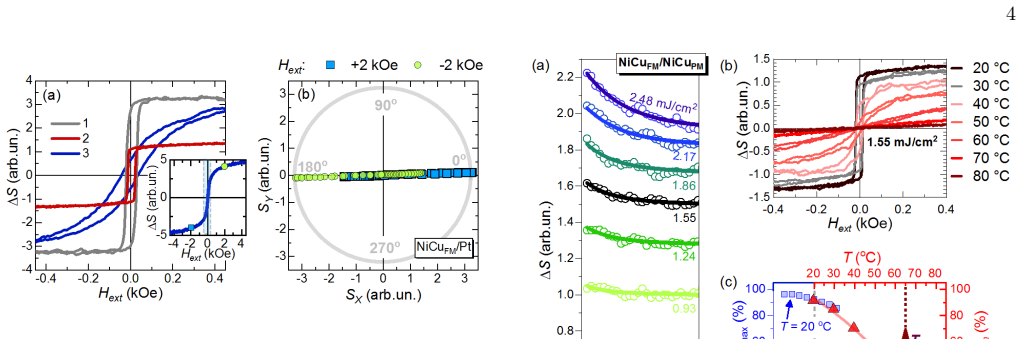
We study THz emission from ferromagnet / nonmagnetic material (FM/NM) spintronic nanostructures in which the $Ni_xCu_{1-x}$ alloy with different $x$ is used as an FM, an NM, or both layers. The stoichiometric composition of the NiCu alloys standing at two positions (we denote it as [FM] or [PM]) is chosen so that it is ferromagnetic at room temperature in the case it is used as the FM layer, and is paramagnetic at room temperature for the NM layer. Besides, we choose the nickel ratio $x$ close to each other for both [FM] and [PM] types of the alloy (the difference is only $10\%$). We show that although NiCu[PM] does not contain heavy metal it acts as an effective converter of spin current into the electric one in our structure showing only 2.8 times smaller efficiency than Pt. Besides, the NiCu[FM] alloy, despite having quite small Curie temperature (approximately $65 ^\circ C$), acts as an effective spin source having the efficiency only 2 times smaller than Co in similar structures. This shows up the importance of boundary matching in the spintronic THz sources. Our NiCu-based THz sources reveal a possibility of effective thermally induced control of emission of THz radiation due to a unique combination of high emission rate and relatively small Curie temperature.
Editorial analysis
A structured set of objections, weighed in public.
Referee Report
Summary. The manuscript reports an experimental investigation of THz emission from FM/NM spintronic bilayers in which Ni_xCu_{1-x} alloys serve as the ferromagnetic layer, the non-magnetic layer, or both. Compositions are selected to be ferromagnetic ([FM]) or paramagnetic ([PM]) at room temperature while differing by only ~10% in Ni content. The central claims are that NiCu[PM] converts spin current to charge current with an efficiency only 2.8 times lower than Pt (despite containing no heavy metal) and that NiCu[FM] generates spin current with an efficiency only 2 times lower than Co (despite a low Curie temperature of ~65 °C). The work attributes the observed performance primarily to favorable boundary matching and notes the potential for thermally tunable THz emission arising from the combination of high emission rate and low Tc.
Significance. If the reported efficiency ratios can be shown to isolate intrinsic spin-to-charge conversion and spin generation after proper controls, the results would be significant for heavy-metal-free spintronic THz sources and for thermally controllable emitters. The strategy of employing nearly identical alloy compositions in opposite magnetic states at room temperature is a useful experimental design for probing interface effects. Credit is given for the direct experimental comparison to standard Pt and Co references and for highlighting a practical route to thermal modulation.
major comments (2)
- [Abstract and Results] Abstract and Results section: The headline efficiency ratios (2.8× vs Pt for NiCu[PM] and 2× vs Co for NiCu[FM]) are load-bearing for the central claim that boundary matching is the dominant factor. THz amplitude depends on the product of optical absorption, spin generation, spin mixing conductance, spin diffusion, and ISHE conversion. The manuscript does not appear to normalize the measured THz field by absorbed pump fluence (determined from refractive indices and layer thicknesses) or to provide independent characterization of the interface spin mixing conductance (e.g., via FMR). Without this decomposition, the numerical factors cannot be attributed primarily to the alloy properties or boundary matching, as both optical absorption and interface transmission change when NiCu replaces Pt or Co.
- [Discussion] Discussion section: The possibility of effective thermally induced control of THz emission is asserted on the basis of the high emission rate combined with the low Curie temperature (~65 °C). However, no temperature-dependent THz emission data are presented to demonstrate actual tunability across the ferromagnetic-to-paramagnetic transition. This leaves the thermal-control claim as a suggestion rather than a demonstrated result.
minor comments (2)
- [Abstract] The phrase 'we show up the importance' in the abstract is a grammatical error and should read 'we show the importance'.
- [Introduction] The bracketed notations [FM] and [PM] are introduced without an explicit definition at first use; a short clarifying sentence in the introduction or sample-preparation section would improve readability.
Simulated Author's Rebuttal
We thank the referee for the constructive and positive review of our manuscript on NiCu-based spintronic THz emitters. We address the major comments point by point below, indicating where revisions will be made to strengthen the presentation.
read point-by-point responses
-
Referee: [Abstract and Results] Abstract and Results section: The headline efficiency ratios (2.8× vs Pt for NiCu[PM] and 2× vs Co for NiCu[FM]) are load-bearing for the central claim that boundary matching is the dominant factor. THz amplitude depends on the product of optical absorption, spin generation, spin mixing conductance, spin diffusion, and ISHE conversion. The manuscript does not appear to normalize the measured THz field by absorbed pump fluence (determined from refractive indices and layer thicknesses) or to provide independent characterization of the interface spin mixing conductance (e.g., via FMR). Without this decomposition, the numerical factors cannot be attributed primarily to the alloy properties or boundary matching, as both optical absorption and interface transmission change when NiCu replaces Pt or Co.
Authors: We appreciate the referee highlighting the importance of isolating the intrinsic contributions. The comparisons in the manuscript were performed under identical pump conditions and with comparable layer thicknesses across samples. Given that Ni and Cu have similar optical constants near the pump wavelength, absorption differences are expected to be modest, but we agree this should be quantified. In the revised manuscript we will add explicit calculations of absorbed fluence using literature refractive indices and our measured thicknesses, along with a brief discussion of how this affects the reported ratios. For spin mixing conductance we rely on the near-identical alloy compositions minimizing interface differences, yet we acknowledge that independent FMR characterization would be valuable. We will expand the discussion to note this limitation and, where possible, reference supporting interface studies; full new FMR measurements may be added if time permits. This constitutes a partial revision. revision: partial
-
Referee: [Discussion] Discussion section: The possibility of effective thermally induced control of THz emission is asserted on the basis of the high emission rate combined with the low Curie temperature (~65 °C). However, no temperature-dependent THz emission data are presented to demonstrate actual tunability across the ferromagnetic-to-paramagnetic transition. This leaves the thermal-control claim as a suggestion rather than a demonstrated result.
Authors: We agree that temperature-dependent measurements would provide direct evidence of tunability. The manuscript presents the thermal-control aspect as a promising prospect enabled by the combination of efficient emission and low Tc, rather than as a fully demonstrated result. In the revised version we will rephrase the relevant sentences in the Discussion to make this prospective nature explicit and to avoid any implication of demonstrated control. We will also note that experimental verification of temperature dependence is planned for future work. This is a straightforward textual revision. revision: yes
Circularity Check
No circularity: experimental measurements with no derivation chain
full rationale
The paper reports experimental THz emission data from NiCu-based FM/NM nanostructures, with efficiency ratios (2.8x vs Pt, 2x vs Co) presented as direct observations. No mathematical derivations, first-principles calculations, fitted parameters renamed as predictions, or self-citations that bear the load of central claims appear in the abstract or described content. The work is self-contained as an experimental study; comparisons rely on measured amplitudes rather than any tautological reduction to inputs. This is the expected non-finding for a pure experimental report.
Axiom & Free-Parameter Ledger
axioms (1)
- domain assumption Known mechanisms of spin current generation in ferromagnets and conversion in non-magnets via inverse spin Hall effect or similar processes.
Reference graph
Works this paper leans on
-
[1]
Kampfrath, M
T. Kampfrath, M. Battiato, P. Maldonado, G. Eil- ers, J. N¨ otzold, S. M¨ ahrlein, V. Zbarsky, F. Freimuth, Y. Mokrousov, S. Bl¨ ugel, M. Wolf, I. Radu, P. M. Oppe- neer, and M. M¨ unzenberg, Terahertz spin current pulses controlled by magnetic heterostructures, Nature Nan- otechnology8, 256 (2013)
2013
-
[2]
C. Bull, S. M. Hewett, R. Ji, C.-H. Lin, T. Thomson, D. M. Graham, and P. W. Nutter, Spintronic terahertz emitters: Status and prospects from a materials perspec- tive, APL Materials9, 090701 (2021)
2021
-
[3]
Seifert, S
T. Seifert, S. Jaiswal, U. Martens, J. Hannegan, L. Braun, P. Maldonado, F. Freimuth, A. Kronenberg, J. Henrizi, I. Radu, E. Beaurepaire, Y. Mokrousov, P. M. Oppeneer, M. Jourdan, G. Jakob, D. Turchinovich, L. M. Hayden, M. Wolf, M. M¨ unzenberg, M. Kl¨ aui, and T. Kampfrath, Efficient metallic spintronic emitters of ul- trabroadband terahertz radiation, ...
2016
-
[4]
N. S. Averkiev and M. I. Dyakonov, Current due to non- homogeneous spin orientation in semiconductors, JETP Letters35, 196 (1983)
1983
-
[5]
A. A. Bakun, B. P. Zakharchenya, A. A. Rogachev, M. N. Tkachuk, and V. G. Fleisher, Detection of a surface pho- tocurrent due to electron optical orientation in a semi- conductor, JETP Letters40, 1293 (1984)
1984
-
[6]
Sinova, S
J. Sinova, S. O. Valenzuela, J. Wunderlich, C. H. Back, and T. Jungwirth, Spin hall effects, Rev. Mod. Phys.87, 1213 (2015)
2015
-
[7]
S. O. Valenzuela and M. Tinkham, Direct electronic mea- surement of the spin hall effect, Nature442, 176 (2006)
2006
-
[8]
Saitoh, M
E. Saitoh, M. Ueda, H. Miyajima, and G. Tatara, Conver- sion of spin current into charge current at room tempera- ture: Inverse spin-hall effect, Applied Physics Letters88, 182509 (2006)
2006
-
[9]
J. C. Rojas S´ anchez, L. Vila, G. Desfonds, S. Gambarelli, J. P. Attan´ e, J. M. De Teresa, C. Mag´ en, and A. Fert, Spin-to-charge conversion using rashba coupling at the interface between non-magnetic materials, Nature Com- munications4, 2944 (2013)
2013
-
[10]
G. Li, R. Medapalli, R. V. Mikhaylovskiy, F. E. Spada, T. Rasing, E. E. Fullerton, and A. V. Kimel, Thz emission from co/pt bilayers with varied roughness, crystal struc- ture, and interface intermixing, Physical Review Materi- als3, 084415 (2019)
2019
-
[11]
A. A. Ezhevskii, D. V. Guseinov, A. V. Soukhorukov, N. I. Averina, E. A. Kalinina, D. V. Yurasov, and E. A. Karashtin, Impact of spin-flip scattering on spin current and inverse spin-hall effect in silicon doped by bismuth, antimony or phosphorus, Physica B674, 415551 (2024)
2024
-
[12]
Varotto, M
S. Varotto, M. Cosset-Ch´ eneau, C. Gr` ezes, Y. Fu, P. Warin, A. Brenac, J.-F. m. c. Jacquot, S. Gambarelli, C. Rinaldi, V. Baltz, J.-P. Attan´ e, L. Vila, and P. No¨ el, Independence of the inverse spin hall effect with the mag- netic phase in thin nicu films, Phys. Rev. Lett.125, 7 267204 (2020)
2020
-
[13]
Y. Wang, P. Deorani, X. Qiu, J. H. Kwon, and H. Yang, Determination of intrinsic spin hall angle in pt, Applied Physics Letters105, 152412 (2014)
2014
-
[14]
Cheng, Y
H. Cheng, Y. Wang, H. He, Q. Huang, and Y. Lu, Ef- ficient and temperature-independent terahertz emission from cofeb/nicu heterostructures, Phys. Rev. B105, 155141 (2022)
2022
-
[15]
Andersson and V
S. Andersson and V. Korenivski, Exchange coupling and magnetoresistance in cofe/nicu/cofe spin valves near the curie point of the spacer, Journal of Applied Physics107, 09D711 (2010)
2010
-
[16]
H. Kuru, H. Kockar, M. Alper, and M. Haciismailoglu, Relation between ferromagnetic layer thickness (nicu) and properties of nicu/cu multilayers, Journal of Materi- als Science: Materials in Electronics26, 5014 (2015)
2015
-
[17]
X. Nie, J. C. Jiang, E. I. Meletis, L. D. Tung, and L. Spinu, Synthesis, structure, and magnetic properties ofϵ-co nanocrystalline thin films and annealing effects, Journal of Applied Physics93, 4750 (2003)
2003
-
[18]
Buryakov, A
A. Buryakov, A. Gorbatova, P. Avdeev, N. Bezvikonnyi, D. Abdulaev, A. Klimov, S. Ovcharenko, and E. Mishina, Controlled spintronic emitter of thz radiation on an atomically thin ws2/silicon substrate, Metals12, 1676 (2022)
2022
-
[19]
A. M. Buryakov, A. V. Gorbatova, P. Y. Avdeev, E. D. Lebedeva, K. A. Brekhov, A. V. Ovchinnikov, N. S. Gu- sev, E. A. Karashtin, M. V. Sapozhnikov, E. D. Mishina, N. Tiercelin, and V. L. Preobrazhensky, Efficient Co/Pt THz spintronic emitter with tunable polarization, Ap- plied Physics Letters123, 082404 (2023)
2023
-
[20]
M. W. Keller, K. S. Gerace, M. Arora, E. K. Delczeg- Czirjak, J. M. Shaw, and T. J. Silva, Near-unity spin hall ratio in Ni xCu1−x alloys, Phys. Rev. B99, 214411 (2019)
2019
discussion (0)
Sign in with ORCID, Apple, or X to comment. Anyone can read and Pith papers without signing in.