Recognition: unknown
Reduced wave number dynamics in the real and complex Ginzburg-Landau equations
Pith reviewed 2026-05-10 13:54 UTC · model grok-4.3
The pith
A WKB-derived scalar equation for local wave number captures instabilities, self-similar collapses, and shock formation in the real and complex Ginzburg-Landau equations
A machine-rendered reading of the paper's core claim, the machinery that carries it, and where it could break.
Core claim
The central claim is that a single scalar reduced wave-number equation obtained via WKB expansion accurately approximates the large-scale dynamics of both the real and complex Ginzburg-Landau equations. For the real Ginzburg-Landau equation the reduced model possesses conserved gradient structure, admits exact stationary solutions after regularization, shows linear instability of every nonuniform steady state, and supplies self-similar solutions for the approach to phase-slip singularities whose exponents agree with direct numerical simulations. For the complex Ginzburg-Landau equation with nearly real coefficients the reduction adds a Burgers term that produces exact traveling shock fronts;
What carries the argument
The reduced wave number equation, a scalar partial differential equation obtained from WKB expansion that governs slow, large-scale evolution of the local wave number
If this is right
- All nonuniform steady states of the real Ginzburg-Landau equation are linearly unstable under the reduced dynamics.
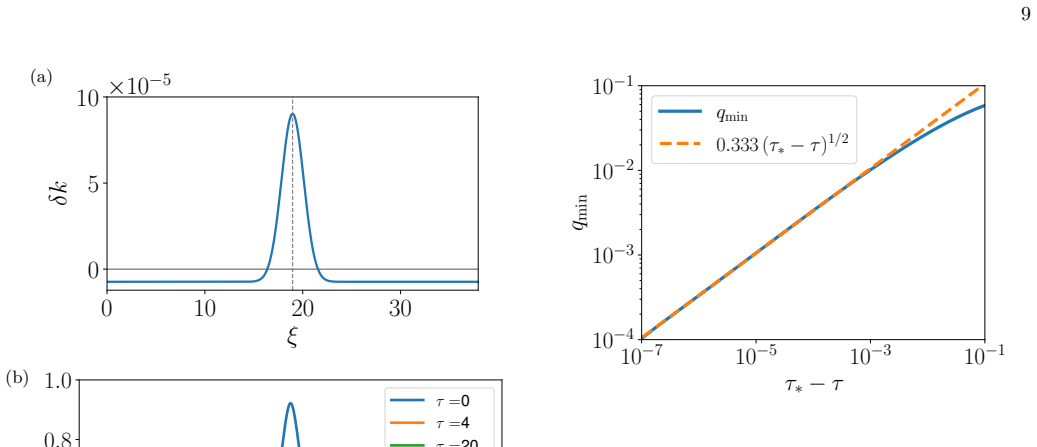
- Self-similar collapse solutions in the reduced equation give scaling exponents for the approach to phase slips that match direct numerical simulations of the full equation.
- Exact traveling shock profiles exist in the reduced equation for the nearly-real complex Ginzburg-Landau equation and connect two distinct plane-wave states.
- The wave-number profile loses monotonicity away from the nearly-real limit, which is accounted for by the spatial-dynamics structure of the reduced equation.
Where Pith is reading between the lines
- The reduction may simplify analysis of slow phase dynamics in other pattern-forming systems that admit a similar WKB treatment.
- The distinction between the reduced localized holes and the classical Langer-Ambegaokar holes points to new classes of defects that could be observed in controlled experiments on reaction-diffusion systems.
- The Burgers-shock mechanism identified here may appear in related amplitude equations whenever a small imaginary part is added to the linear dispersion.
- The nonlinear fourth-order boundary-value problem that defines the similarity profile offers a concrete numerical test for convergence of the WKB reduction as the scale separation increases.
Load-bearing premise
The WKB expansion remains accurate for large-scale slow variation of the wave number even when the Ginzburg-Landau coefficients are only nearly real, although the reduction is rigorously justified solely for the real equation and excludes phase-slip events.
What would settle it
A direct numerical simulation of the complex Ginzburg-Landau equation with nearly real coefficients in the large-scale limit that fails to approach the exact traveling shock profile predicted by the reduced equation would falsify the approximation.
Figures





read the original abstract
We study large-scale dynamics in the Ginzburg-Landau equation (GLE) using a reduced description derived from a WKB expansion. Rigorous mathematical results establishing that this reduced equation accurately approximates the full GLE are currently limited to the real GLE (RGLE) and exclude phase-slip dynamics. For the RGLE, we find that the reduced equation has conserved gradient form and show that, upon inclusion of a higher-order regularization, it admits exact stationary solutions. In the reduced dynamics, all nonuniform steady states are linearly unstable and among them, localized hole solutions identified through the reduced description differ from the classical hole solution of the RGLE due to Langer and Ambegaokar. In the Eckhaus-unstable regime, we derive a self-similar description of the approach to finite-time singularities in the reduced equation, with scaling exponents that agree with direct numerical simulations (DNS), and a similarity profile obtained from a nonlinear 4th-order boundary value problem. Extending the reduction to the complex GLE (CGLE) with nearly real coefficients introduces a Burgers nonlinearity that generates traveling shocks connecting two distinct plane-waves. We obtain exact expressions for the shock profile and perform extensive DNS to demonstrate convergence to the predicted profile in the appropriate large-scale, nearly real-coefficient limit of the CGLE. Away from this limit, the wave number profile loses monotonicity, which we explain in the framework of spatial dynamics. We further show that the exact shock solutions found here are qualitatively distinct from the Nozaki-Bekki solutions. Taken together, our results reveal how a single, scalar reduced equation elucidates unstable stationary states, self-similar collapse toward phase slips, and shock formation, providing an understanding large-scale phase dynamics in pattern-forming systems.
Editorial analysis
A structured set of objections, weighed in public.
Referee Report
Summary. The manuscript derives a reduced scalar PDE for large-scale wave number dynamics in the Ginzburg-Landau equation via WKB expansion. For the real GLE, the reduced equation has conserved gradient form, admits exact stationary solutions upon higher-order regularization, shows linear instability of all nonuniform steady states (including localized holes distinct from the Langer-Ambegaokar solution), and yields a self-similar description of approach to finite-time phase-slip singularities whose scaling exponents match DNS and whose profile solves a nonlinear fourth-order BVP. For the complex GLE with nearly real coefficients, a Burgers nonlinearity produces traveling shocks whose exact profiles are derived and shown to be approached in DNS in the appropriate limit; these shocks are distinct from Nozaki-Bekki solutions. The work claims this single reduced equation elucidates unstable states, self-similar collapse, and shock formation.
Significance. If the reduction remains accurate in the claimed regimes, the paper supplies a valuable analytical tool for large-scale phase dynamics in pattern-forming systems. Credit is due for the systematic WKB derivation, the exact analytical stationary and shock profiles, the self-similar BVP solution, and the independent DNS validation of scaling exponents and profile convergence. These elements provide falsifiable predictions and a unified scalar description that could influence studies of phase slips and wave-number selection.
major comments (2)
- [Abstract and self-similar collapse section] Abstract and the section on RGLE self-similar dynamics: the manuscript correctly notes that rigorous justification of the reduced equation is limited to the RGLE and excludes phase-slip dynamics. Nevertheless, the self-similar collapse analysis derives scaling exponents and solves the fourth-order BVP for the similarity profile approaching finite-time singularities. Because the underlying WKB large-scale, slow-variation assumption is expected to fail as gradients steepen near the excluded phase-slip regime, the reported DNS agreement on exponents does not by itself confirm validity of the reduced dynamics arbitrarily close to the singularity.
- [CGLE shocks section] Section on extension to the CGLE: the reduction is applied to the CGLE with nearly real coefficients without the error estimates or convergence proofs provided for the RGLE. While DNS demonstrates convergence to the exact shock profile in the appropriate limit and the loss of monotonicity away from the limit is interpreted via spatial dynamics, the central claim that the reduced equation elucidates shock formation would be strengthened by quantitative bounds on how close to real the coefficients must be for the approximation to hold.
minor comments (2)
- [Abstract] The abstract could more explicitly restate the CGLE limitation (analogous to the RGLE caveat) to avoid implying equal rigor for both cases.
- [Introduction and reduced-equation derivation] Notation for the wave number variable and the reduced PDE should be introduced once with a clear equation number and then used consistently in all subsequent sections and figures.
Simulated Author's Rebuttal
We thank the referee for the careful reading and constructive comments on our manuscript. We address each major comment below and indicate the revisions we plan to make.
read point-by-point responses
-
Referee: [Abstract and self-similar collapse section] Abstract and the section on RGLE self-similar dynamics: the manuscript correctly notes that rigorous justification of the reduced equation is limited to the RGLE and excludes phase-slip dynamics. Nevertheless, the self-similar collapse analysis derives scaling exponents and solves the fourth-order BVP for the similarity profile approaching finite-time singularities. Because the underlying WKB large-scale, slow-variation assumption is expected to fail as gradients steepen near the excluded phase-slip regime, the reported DNS agreement on exponents does not by itself confirm validity of the reduced dynamics arbitrarily close to the singularity.
Authors: We agree that the WKB large-scale, slow-variation assumption must break down as gradients steepen near a phase-slip event. The self-similar analysis is performed within the reduced equation and is intended to describe the approach to the singularity while the reduced model remains applicable; the DNS agreement on scaling exponents supports that the reduced dynamics captures the correct leading-order behavior during this approach. We will revise the abstract and the relevant section to state explicitly that the self-similar description holds only up to the point where the WKB assumption ceases to be valid, and that the singularity itself lies outside the regime of the approximation. This clarification will be added without changing any results or claims. revision: yes
-
Referee: [CGLE shocks section] Section on extension to the CGLE: the reduction is applied to the CGLE with nearly real coefficients without the error estimates or convergence proofs provided for the RGLE. While DNS demonstrates convergence to the exact shock profile in the appropriate limit and the loss of monotonicity away from the limit is interpreted via spatial dynamics, the central claim that the reduced equation elucidates shock formation would be strengthened by quantitative bounds on how close to real the coefficients must be for the approximation to hold.
Authors: We acknowledge that, unlike the RGLE case, the CGLE extension lacks rigorous error estimates or convergence proofs. The reduction is applied perturbatively for coefficients close to real, and we rely on DNS to demonstrate convergence to the exact shock profiles in that limit. Quantitative bounds on the required closeness to the real limit would strengthen the presentation but are not derived in the present work and would require a separate, more technical analysis. We will revise the manuscript to include an explicit statement of this limitation, provide additional details on the parameter ranges used in the DNS, and note that obtaining such bounds is an open direction for future research. This addresses the referee's concern while preserving the scope of our claims. revision: partial
Circularity Check
No circularity: WKB reduction and derived solutions are independent of validation data
full rationale
The reduced equation is obtained via systematic WKB expansion from the original GLE (explicitly stated as the starting point). All subsequent results—conserved gradient form, linear instability of steady states, self-similar collapse with derived scaling exponents, exact shock profiles from the reduced PDE, and the 4th-order BVP—are obtained by direct mathematical analysis of the reduced model itself. DNS is invoked only after the fact for independent numerical confirmation of predicted profiles and exponents, not as input to any fit or definition. The paper acknowledges the limited rigorous justification for phase-slip regimes but does not use self-citations, fitted parameters, or ansatzes that reduce the claims to their inputs by construction. The derivation chain remains self-contained.
Axiom & Free-Parameter Ledger
axioms (2)
- domain assumption WKB expansion is valid when spatial variations of amplitude and wave number are slow compared with the underlying pattern wavelength
- ad hoc to paper Higher-order regularization terms can be added to the reduced equation while preserving the leading-order large-scale dynamics
Reference graph
Works this paper leans on
-
[1]
Such solutions are known to exist in the real Ginzburg-Landau equation, for instance, the Langer-Ambegaokar hole so- lution [23, 24]
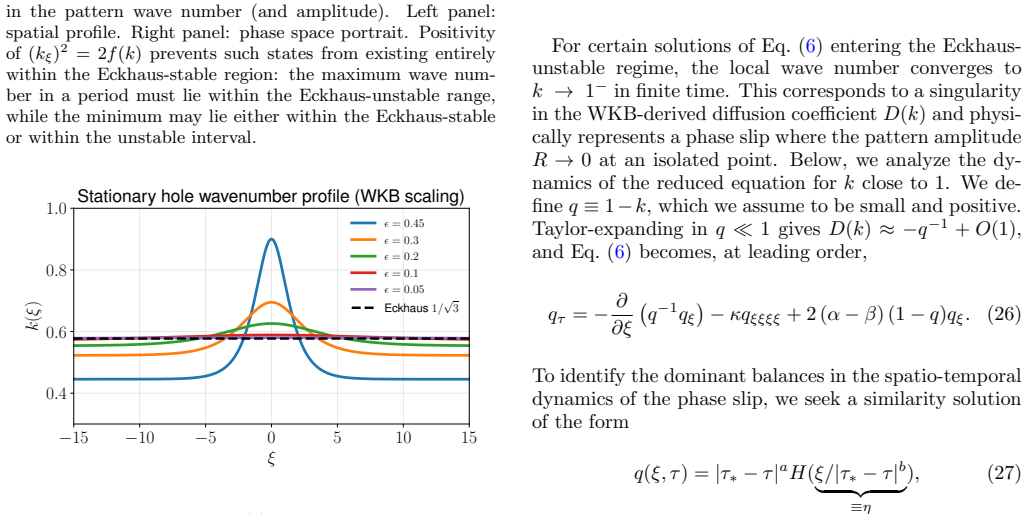
This allows for the existence of nonuniform stationary states, since the stabilizing effect of hyperdiffusion can balance the destabilizing influence of antidiffusion. Such solutions are known to exist in the real Ginzburg-Landau equation, for instance, the Langer-Ambegaokar hole so- lution [23, 24]. On an infinite domain, we can rescale space and time to...
-
[2]
(20)–(22) that is a smooth heteroclinic orbit with tails connecting two distinct wave numbersk 1 ̸=k 2 atξ→ ±∞and hence no such solution of Eq
There exists no solution of Eqs. (20)–(22) that is a smooth heteroclinic orbit with tails connecting two distinct wave numbersk 1 ̸=k 2 atξ→ ±∞and hence no such solution of Eq. (6) forα=β= 0. Proof: see Appendix B
-
[3]
The only nonconstant homoclinic orbit smoothly connecting a tail with a given wave numberk ∞ ∈ (−1/ √ 3,1/ √
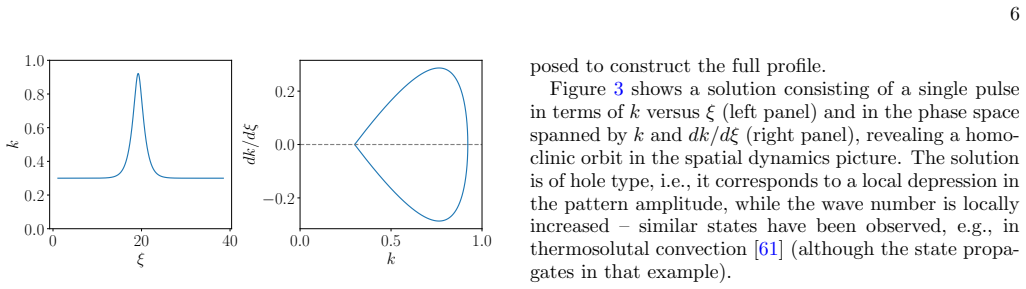
-
[4]
atξ→ −∞to the same wave num- ber atξ→ ∞has a single local maximum whose value exceeds 1/ √ 3, i.e., the solution straddles the Eckhaus stability boundary (cf. Fig. 3).Proof: see Appendix B
-
[5]
Proof: see Appendix B
The homoclinic pulse solution is linearly unstable. Proof: see Appendix B
-
[6]
(20)–(22) also admit noncon- stantspatially extendedstationary solutions, corre- sponding to periodic modulations of the wave num- ber
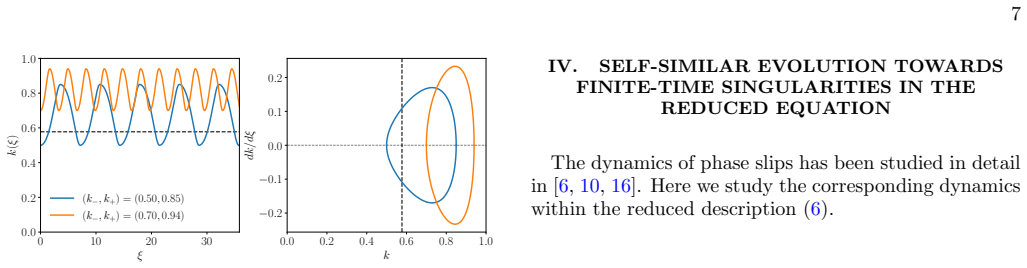
In addition to the localized homoclinic orbit dis- cussed above, Eqs. (20)–(22) also admit noncon- stantspatially extendedstationary solutions, corre- sponding to periodic modulations of the wave num- ber. These solutions are not localized, as they do not converge to a constant wave number as |ξ| → ∞. Any solution for whichf(k)>0 on an interval (k−, k+) w...
-
[7]
The spatially periodic steady states described above are linearly unstable independently of the choice ofk +, k−.Proof: see Appendix B. To summarize the above results, the only type of smooth homoclinic, localized stationary solutions con- sists of a single pulse in the wave number, asymptoting to the same value in the Eckhaus-stable regime atξ→ ±∞, neces...
-
[8]
andα > β,k ′(k) is negative between the two roots, and is positive between them whenβ > α(see Fig. 10). It can easily be ver- ified that the group velocity on either side of the front is directed into the shock in the comoving frame, i.e., the shock is a wave sink as expected. In contrast, for 1/ √ 3< k 1, k2 <1 (similar to the fronts whose existence is r...
-
[9]
(1), is that in two spatial dimensions it has spatially lo- calized spiral wave solutions with exponentially decay- ing tails
Spatial eigenvalues A well-known feature [6] of the complex GLE, Eq. (1), is that in two spatial dimensions it has spatially lo- calized spiral wave solutions with exponentially decay- ing tails. Importantly, interactions between such spiral waves, when they are spatially separated, are mediated by these exponential tails and have been studied exten- sive...
-
[10]
(1) [25, 26] (see also [24])
Comparison with Nozaki-Bekki shocks It is instructive to compare the Eckhaus fronts iden- tified via the WKB reduction with the classical Nozaki– Bekki (NB) traveling shock solutions of Eq. (1) [25, 26] (see also [24]). Both structures connect plane wave states and, for fixed asymptotic wave numbersk 1 andk 2, prop- agate with the same speed,c= (α−β)(k 1 ...
-
[11]
Whenk 0 >1/ √ 3, the coefficient D0 <0, leading to antidiffusion as in the KS equation
andD ′ 0 =−4k 0/(1−k2 0)2 < 0 for anyk 0 >0. Whenk 0 >1/ √ 3, the coefficient D0 <0, leading to antidiffusion as in the KS equation. However, unlike the KS equation, Eq. (45) also contains the term 1 2 D′(k0)(v2)ξξ. SinceD ′ 0 <0, this contribu- tion has the structure of a backward porous-medium-type term [104] and so leads to nonlinear focusing, rather t...
-
[12]
Furthermore, differentiating the leading-order terms in (A4) with respect toξgives the familiar nonlinear diffusion equation for the wave number, Eq. (4), (k0)τ =∂ ξ(D(k0)(k0)ξ), D(k 0) = 1−3k 2 0 1−k 2 0 .(A5) AtO(ϵ 2), the real part yields R2 =− (R0)τ −(R 0)ξξ 2R2 0 − k0 R0 k2.(A6) The decompositionϕ=ϕ 0 +ϵ 2ϕ2 +O(ϵ 4) (i.e.,k=k 0 + ϵ2k2) is not unique:...
-
[13]
Therefore, we can restrict our attention tok 1, k2 ∈(−1/ √ 3,1/ √ 3), wheref ′′(k)>0
This follows from the linearization about the asymptotic wave numbers k1,2, indicating that small deviations ˜kfromk 1,2 are of the form ˜k∝exp h ± p D(k1,2)ξ i , which can only converge to zero ifD(k 1,2)>0, i.e., |k1,2|<1/ √ 3; otherwise one finds pure oscillations rather than exponential decay. Therefore, we can restrict our attention tok 1, k2 ∈(−1/ √...
-
[14]
Proof: Convergencek→k ∞ asξ→ ±∞requires thatf(k ∞) =f ′(k∞) = 0 and, by assumption, f ′′(k∞)>0
atξ→ −∞andξ→ ∞have a sin- gle extremum exceeding 1/ √ 3 in magnitude. Proof: Convergencek→k ∞ asξ→ ±∞requires thatf(k ∞) =f ′(k∞) = 0 and, by assumption, f ′′(k∞)>0. Consider positive wave numbers for simplicity (the negative case is identical by sym- metry). Then, for anyk,f ′(k) = R k k∞ D(s)ds, whereD(s) changes sign exactly once between s=k ∞ ands= 1,...
-
[15]
Therefore, f ′(k) vanishes at most once fork∈(k ∞,1) and the rootk 0 =k(ξ 0) necessarily lies in (1/ √ 3,1)
one finds thatf ′(k) increases from zero, reaching positive values, whilef ′(k) mono- tonically decreases fork∈(1/ √ 3,1). Therefore, f ′(k) vanishes at most once fork∈(k ∞,1) and the rootk 0 =k(ξ 0) necessarily lies in (1/ √ 3,1). Since f ′(k0) =k ξξ(ξ0)<0, the profilek(ξ) has exactly one local maximum atk=k 0.□ 3.Claim:Letk ⋆(ξ) be a smooth stationary s...
-
[16]
V. L. Ginzburg and L. D. Landau. On the theory of superconductivity.Zh. Eksp. Teor. Fiz., 20:1064–1082, 1950
1950
-
[17]
A. C. Newell and J. A. Whitehead. Finite bandwidth, finite amplitude convection.J. Fluid Mech., 38:279–303, 1969
1969
-
[18]
L. A. Segel. Distant side-walls cause slow amplitude modulation of cellular convection.J. Fluid Mech., 38:203–224, 1969
1969
-
[19]
Haken.Synergetics: An Introduction
H. Haken.Synergetics: An Introduction. Springer, Berlin, Heidelberg, 3rd edition, 1983
1983
-
[20]
M. C. Cross and P. C. Hohenberg. Pattern formation outside of equilibrium.Rev. Mod. Phys., 65:851–1112, 1993
1993
-
[21]
I. S. Aranson and L. Kramer. The world of the complex Ginzburg-Landau equation.Rev. Mod. Phys., 74:99– 143, 2002
2002
-
[22]
Cross and H
M. Cross and H. Greenside.Pattern Formation and Dynamics in Nonequilibrium Systems. Cambridge Uni- versity Press, 2009
2009
-
[23]
Garc´ ıa-Morales and K
V. Garc´ ıa-Morales and K. Krischer. The complex Ginzburg–Landau equation: an introduction.Contemp. Phys., 53:79–95, 2012
2012
-
[24]
Eckhaus.Studies in Non-linear Stability Theory
W. Eckhaus.Studies in Non-linear Stability Theory. Springer, New York, 1965
1965
-
[25]
Kramer and W
L. Kramer and W. Zimmermann. On the Eckhaus insta- bility for spatially periodic patterns.Physica D, 16:221– 232, 1985
1985
-
[26]
R. B. Hoyle.Pattern Formation: an Introduction to Methods. Cambridge University Press, 2006
2006
-
[27]
Stewartson and J
K. Stewartson and J. T. Stuart. A non-linear instability theory for a wave system in plane Poiseuille flow.J. Fluid Mech., 48:529–545, 1971
1971
-
[28]
L. M. Hocking and K. Stewartson. On the nonlinear response of a marginally unstable plane parallel flow to a two-dimensional disturbance.Proceedings of the Royal Society of London. A. Mathematical and Physical Sciences, 326:289–313, 1972
1972
-
[29]
Conte, M
R. Conte, M. Musette, T. W. Ng, and C. Wu. New solutions to the complex Ginzburg-Landau equations. Phys. Rev. E, 106:L042201, 2022
2022
-
[30]
Avery, O
M. Avery, O. Garcia-Lopez, R. Goh, B. Hosek, and E. Shade. Fronts and patterns with a dynamic param- eter ramp.Physica D, 456:134972, 2025
2025
-
[31]
Eckmann, T
J.-P. Eckmann, T. Gallay, and C. E. Wayne. Phase slips and the Eckhaus instability.Nonlinearity, 8:943, 1995
1995
-
[32]
Tsubota, C
T. Tsubota, C. Liu, B. Foster, and E. Knobloch. Bifur- cation delay and front propagation in the real Ginzburg- Landau equation on a time-dependent domain.Phys. Rev. E, 109:044210, 2024
2024
-
[33]
B. I. Shraiman, A. Pumir, W. van Saarloos, P. C. Ho- henberg, H. Chat´ e, and M. Holen. Spatiotemporal chaos in the one-dimensional complex Ginzburg-Landau equa- tion.Physica D, 57:241–248, 1992
1992
-
[34]
H. Chat´ e. Spatio-temporal patterns in nonequilibrium complex systems. In P. E. Cladis and P. Palffy-Muhoray, editors,Proceedings of the NATO Advanced Research Workshop on Spatio-Temporal Patterns in Nonequilib- rium Complex Systems, volume 21 ofSanta Fe Insti- tute Studies in the Sciences of Complexity, page 33. Addison–Wesley, Reading, MA, 1995
1995
-
[35]
Sakaguchi
H. Sakaguchi. Breakdown of the phase dynamics.Prog. Theor. Phys., 84:792–800, 1990
1990
-
[36]
Brusch, M
L. Brusch, M. G. Zimmermann, M. van Hecke, M. B¨ ar, and A. Torcini. Modulated amplitude waves and the transition from phase to defect chaos.Phys. Rev. Lett., 85:86–89, 2000
2000
-
[37]
Brusch, A
L. Brusch, A. Torcini, M. van Hecke, M. G. Zim- mermann, and M. B¨ ar. Modulated amplitude waves and defect formation in the one-dimensional complex Ginzburg–Landau equation.Physica D, 160:127–148, 2001
2001
-
[38]
J. S. Langer and V. Ambegaokar. Intrinsic resistive transition in narrow superconducting channels.Phys. Rev., 164:498–510, 1967
1967
-
[39]
J. Lega. Traveling hole solutions of the complex Ginzburg–Landau equation: a review.Physica D, 152:269–287, 2001
2001
-
[40]
Nozaki and N
K. Nozaki and N. Bekki. Exact solutions of the gener- alized Ginzburg-Landau equation.J. Phys. Soc. Japan, 53:1581–1582, 1984
1984
-
[41]
Bekki and K
N. Bekki and K. Nozaki. Formations of spatial patterns and holes in the complex Ginzburg-Landau equation. Phys. Lett. A, 110:133–135, 1985
1985
-
[42]
Opaˇ cak, D
N. Opaˇ cak, D. Kazakov, L. L. Columbo, M. Beiser, T. P. Letsou, F. Pilat, M. Brambilla, F. Prati, M. Piccardo, and F. Capasso. Nozaki–Bekki solitons in semiconduc- tor lasers.Nature, 625:685–690, 2024
2024
-
[43]
van Saarloos and P
W. van Saarloos and P. C. Hohenberg. Fronts, pulses, sources and sinks in generalized complex Ginzburg- Landau equations.Physica D, 56:303–367, 1992
1992
-
[44]
Ebert, W
U. Ebert, W. Spruijt, and W. van Saarloos. Pattern forming pulled fronts: bounds and universal conver- gence.Physica D, 199:13–32, 2004
2004
-
[45]
M. J. Smith and J. A. Sherratt. Propagating fronts in the complex Ginzburg-Landau equation generate fixed- width bands of plane waves.Phys. Rev. E, 80:046209, 2009
2009
-
[46]
J. A. Sherratt, M. J. Smith, and J. D. M. Rademacher. Locating the transition from periodic oscillations to spa- tiotemporal chaos in the wake of invasion.Proceedings of the National Academy of Sciences, 106:10890–10895, 2009
2009
-
[47]
van Saarloos
W. van Saarloos. Front propagation into unstable states.Phys. Rep., 386:29–222, 2003
2003
-
[48]
Knobloch
E. Knobloch. Localized structures and front propaga- tion in systems with a conservation law.IMA J. Appl. Math., 81:457–487, 2016. 21
2016
-
[49]
M. Avery, M. Holzer, and A. Scheel. Selec- tion mechanisms in front invasion.arXiv preprint arXiv:2512.07764, 2025
work page internal anchor Pith review arXiv 2025
-
[50]
M. J. Landman. Solutions of the Ginzburg-Landau equation of interest in shear flow transition.Stud. Appl. Math., 76:187–237, 1987
1987
-
[51]
Melbourne and G
I. Melbourne and G. Schneider. Phase dynamics in the real Ginzburg-Landau equation.Math. Nachr., 263:171– 180, 2004
2004
-
[52]
A. J. Bernoff. Slowly varying fully nonlinear wavetrains in the Ginzburg-Landau equation.Physica D, 30:363– 381, 1988
1988
-
[53]
Gallay and A
T. Gallay and A. Mielke. Diffusive mixing of stable states in the Ginzburg-Landau equation.Commun. Math. Phys., 199:71–97, 1998
1998
-
[54]
Mielke, G
A. Mielke, G. Schneider, and H. Uecker. Stability and diffusive dynamics on extended domains. InErgodic Theory, Analysis, and Efficient Simulation of Dynami- cal Systems, pages 563–583. Springer, 2001
2001
-
[55]
Knobloch and R
E. Knobloch and R. Krechetnikov. Stability on time- dependent domains.J. Nonlin. Sci., 24:493–523, 2014
2014
-
[56]
Raitt and H
D. Raitt and H. Riecke. Domain structures in fourth- order phase and Ginzburg-Landau equations.Physica D, 82:79–94, 1995
1995
-
[57]
R. E. Pattle. Diffusion from an instantaneous point source with a concentration-dependent coefficient.Q. J. Mech. Appl. Math., 12:407–409, 1959
1959
-
[58]
M. A. Heaslet and A. Alksne. Diffusion from a fixed surface with a concentration-dependent coefficient.J. Soc. Indust. Appl. Math., 9:584–596, 1961
1961
-
[59]
L. F. Shampine. Concentration-dependent diffusion. II. Singular problems.Q. Appl. Math., 31:287–293, 1973
1973
-
[60]
D. G. Aronson. The porous medium equation.Nonlin- ear Diffusion Problems: Lectures given at the 2nd 1985 Session of the Centro Internazionale Matermatico Es- tivo (CIME) held at Montecatini Terme, Italy June 10– June 18, 1985, pages 1–46, 2006
1985
-
[61]
C. L. Emmott and A. J. Bray. Coarsening dynamics of a one-dimensional driven Cahn-Hilliard system.Phys. Rev. E, 54:4568–4575, 1996
1996
-
[62]
A. A. Golovin, A. A. Nepomnyashchy, S. H. Davis, and M. A. Zaks. Convective Cahn-Hilliard models: From coarsening to roughening.Phys. Rev. Lett., 86:1550– 1553, 2001
2001
-
[63]
S. J. Watson, F. Otto, B. Y. Rubinstein, and S. H. Davis. Coarsening dynamics of the convective Cahn- Hilliard equation.Physica D, 178:127–148, 2003
2003
-
[64]
Podolny, M.A
A. Podolny, M.A. Zaks, B.Y. Rubinstein, A. A. Golovin, and A. A. Nepomnyashchy. Dynamics of domain walls governed by the convective Cahn–Hilliard equation. Physica D, 201:291–305, 2005
2005
-
[65]
P. Howard. Spectral analysis of stationary solutions of the Cahn–Hilliard equation.Adv. Differential Equa- tions, 14:87–120, 2009
2009
-
[66]
P. Howard. Spectral analysis for periodic solutions of the Cahn–Hilliard equation onR.NoDEA Nonlinear Differ. Equ. Appl., 18:1–26, 2011
2011
-
[67]
P. S. Hagan. The instability of nonmonotonic wave solu- tions of parabolic equations.Stud. Appl. Math., 64:57– 88, 1981
1981
-
[68]
Pogan and A
A. Pogan and A. Scheel. Instability of spikes in the presence of conservation laws.Z. Angew. Math. Phys., 61:979–998, 2010
2010
-
[69]
Pogan and A
A. Pogan and A. Scheel. Instability of radially- symmetric spikes in systems with a conserved quantity. In B. Fiedler and A. Scheel, editors,Infinite Dimen- sional Dynamical Systems, volume 64 ofFields Institute Communications, pages 249–270. Springer, New York, 2013
2013
-
[70]
Pogan, A
A. Pogan, A. Scheel, and K. Zumbrun. Quasi-gradient systems, modulational dichotomies, and stability of spa- tially periodic patterns.Differ. Integral Equ., 26:389– 438, 2013
2013
-
[71]
Oh and K
M. Oh and K. Zumbrun. Stability of periodic solu- tions of conservation laws with viscosity: Analysis of the Evans function.Archive for Rational Mechanics and Analysis, 166:99–166, 2003
2003
-
[72]
Howard and K
P. Howard and K. Zumbrun. The evans function and stability criteria for degenerate viscous shock waves. Discrete and Continuous Dynamical Systems, 10:837– 856, 2004
2004
-
[73]
Kapitula
T. Kapitula. Stability analysis of pulses via the Evans function: dissipative systems. In N. Akhmediev and A. Ankiewicz, editors,Dissipative Solitons, pages 407–
-
[74]
Springer, Berlin, Heidelberg, 2005
2005
-
[75]
Barker, J
B. Barker, J. Humpherys, G. Lyng, and J. Lytle. Evans function computation for the stability of trav- elling waves.Philosophical Transactions of the Royal Society A: Mathematical, Physical and Engineering Sci- ences, 376:20170184, 2018
2018
-
[76]
K. J. Burns, G. M. Vasil, J. S. Oishi, D. Lecoanet, and B. P. Brown. Dedalus: A flexible framework for numeri- cal simulations with spectral methods.Phys. Rev. Res., 2:023068, 2020
2020
-
[77]
Spina, J
A. Spina, J. Toomre, and E. Knobloch. Confined states in large-aspect-ratio thermosolutal convection.Phys. Rev. E, 57:524–545, 1998
1998
-
[78]
R. E. Grundy. Similarity solutions of the nonlinear dif- fusion equation.Q. Appl. Math., 37:259–280, 1979
1979
-
[79]
H. E. Huppert. The propagation of two-dimensional and axisymmetric viscous gravity currents over a rigid horizontal surface.J. Fluid Mech., 121:43–58, 1982
1982
-
[80]
J. W. Rottman and J. E. Simpson. Gravity currents produced by instantaneous releases of a heavy fluid in a rectangular channel.J. Fluid Mech., 135:95–110, 1983
1983
discussion (0)
Sign in with ORCID, Apple, or X to comment. Anyone can read and Pith papers without signing in.