Recognition: unknown
Fueter trees for Dunkl-regular functions over alternative *-algebras
Pith reviewed 2026-05-10 13:51 UTC · model grok-4.3
The pith
Fueter theorems over alternative *-algebras correspond one-to-one with graphs called Fueter trees, whose count in dimension n+1 equals the number of odd-part partitions of n.
A machine-rendered reading of the paper's core claim, the machinery that carries it, and where it could break.
Core claim
Fueter theorems are in one-to-one correspondence with Fueter trees that describe the interactions between Dunkl-regular function spaces and the iterated Laplacian; the number of distinct Fueter trees on a hypercomplex space of dimension n+1 equals the number of partitions of the integer n into odd parts.
What carries the argument
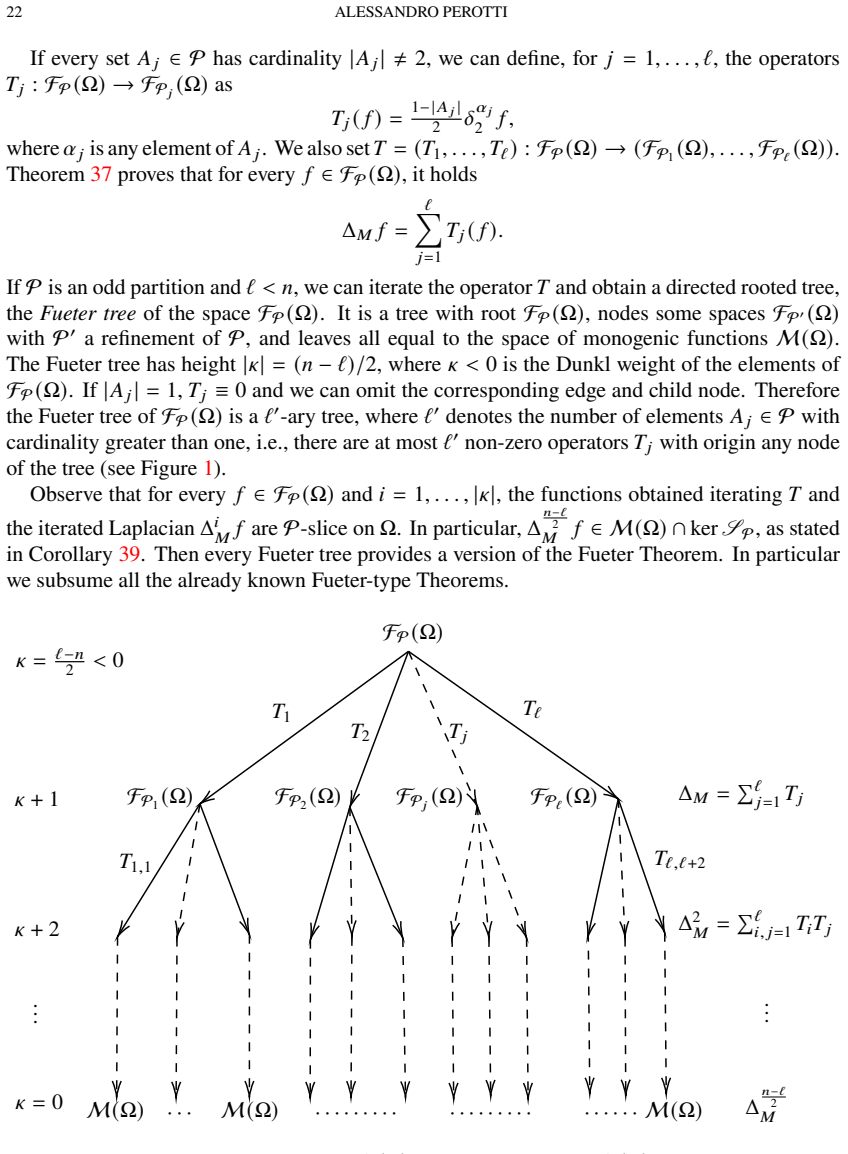
Fueter trees, graphs whose vertices and edges encode the distinct ways the iterated Laplacian maps spaces of Dunkl-regular functions into spaces of Dunkl-monogenic functions with axial symmetry.
If this is right
- Several previously separate Fueter-type results for Clifford analysis, quaternionic analysis and other hypercomplex settings become special cases of the single statement.
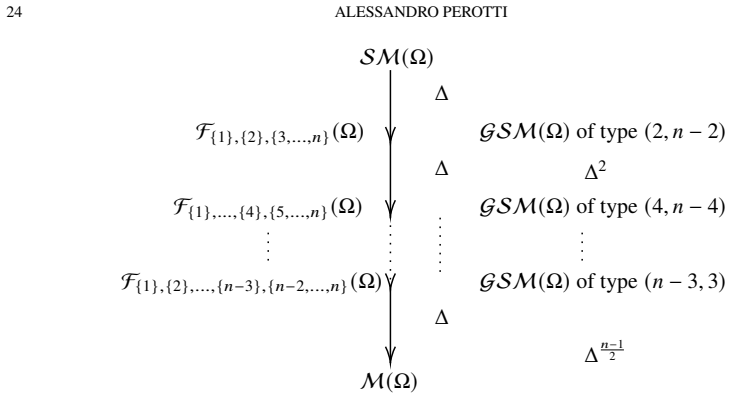
- The action of any power of the Laplacian on function spaces over a hypercomplex subspace of dimension n+1 is completely classified by the corresponding Fueter tree.
- Each Fueter tree gives an explicit recipe for constructing the image of a Dunkl-regular function under the appropriate Laplacian power.
- The combinatorial count implies that exactly as many independent Fueter-type theorems exist as there are partitions of n into odd parts.
Where Pith is reading between the lines
- The same tree enumeration might classify analogous statements for other families of monogenic or regular functions that admit a Laplacian mapping.
- Explicit construction of the functions attached to each tree in low dimensions could produce new closed-form solutions not yet recorded in the literature.
- The appearance of odd-part partitions suggests a hidden link to generating functions or symmetry groups that might be exploited to prove further identities.
Load-bearing premise
The embedding of hypercomplex function theories into the larger class of Dunkl-monogenic functions preserves all algebraic and analytic properties needed for the Laplacian mappings and the tree correspondence to hold without extra constraints.
What would settle it
Exhibit one concrete alternative *-algebra and dimension n+1 in which the number of distinct Laplacian-induced mappings from Dunkl-regular functions to axially symmetric Dunkl-monogenic functions differs from the number of odd-part partitions of n.
Figures

read the original abstract
We prove a general Fueter Theorem over real alternative *-algebras. We show that a suitable power of the Laplacian maps Dunkl-regular functions to Dunkl monogenic functions with axial symmetries. Using the embedding of hypercomplex function theories in the class of Dunkl monogenic functions, we subsume several Fueter-type results known in the literature and obtain the most general form for the action of the Laplacian on function spaces over hypercomplex subspaces. We show that Fueter Theorems are in a one-to-one correspondence with a class of graphs, the Fueter trees, that describe the interactions between Dunkl-regular function spaces and the relation with the iterated Laplacian. We obtain that the number of distinct Fueter trees on a hypercomplex space of dimension $n+1$ is equal to the number of partitions in odd parts of the integer $n$.
Editorial analysis
A structured set of objections, weighed in public.
Referee Report
Summary. The manuscript proves a general Fueter theorem over real alternative *-algebras, showing that a suitable power of the Laplacian maps Dunkl-regular functions to Dunkl-monogenic functions with axial symmetries. By embedding hypercomplex function theories into the Dunkl-monogenic class, it subsumes known Fueter-type results and gives the most general form for the Laplacian action on hypercomplex subspaces. Fueter theorems are placed in one-to-one correspondence with Fueter trees (graphs encoding interactions between Dunkl-regular spaces and iterated Laplacians), and the number of distinct such trees on a hypercomplex space of dimension n+1 is shown to equal the number of partitions of n into odd parts.
Significance. If the derivations hold, the work unifies several Fueter-type theorems in a broad algebraic setting that includes alternative *-algebras and Dunkl operators, extending the reach of hypercomplex analysis. The introduction of Fueter trees as a graph model for Laplacian iterations and the resulting combinatorial count via odd-part partitions supplies a novel structural and enumerative perspective that may prove useful for classifying symmetries in regular function spaces.
major comments (2)
- [Embedding construction and main correspondence theorem] The embedding of hypercomplex function theories into Dunkl-monogenic functions (setup preceding the main correspondence theorem): the manuscript assumes this embedding preserves the exact action of the iterated Laplacian and axial symmetries without introducing extra algebraic relations or kernel elements from the alternative *-algebra multiplication. If non-commuting terms arise under the Dunkl parameter, distinct trees could collapse and the partition count would no longer enumerate the theorems; an explicit verification that the embedding induces no such collapse is required for the bijection to be load-bearing.
- [Counting result for Fueter trees] The counting theorem equating Fueter trees to odd-part partitions of n: the derivation of this equality from the recursive definition of the trees (via successive Laplacian iterations between Dunkl-regular spaces) must be checked for completeness. The abstract states the result, but without a step-by-step bijection or generating-function argument tied to the tree edges, it is unclear whether the count is independent of the specific alternative algebra or Dunkl parameter.
minor comments (1)
- [Introduction and notation] The precise definition of Dunkl-regularity and the axial-symmetry condition should be restated or referenced at the start of the main results section for readers who may not have the prior Dunkl-operator literature at hand.
Simulated Author's Rebuttal
We thank the referee for the detailed and constructive report. The comments raise important points about the rigor of the embedding and the explicitness of the counting argument. We address each below and will incorporate clarifications and additional verifications in the revised manuscript.
read point-by-point responses
-
Referee: [Embedding construction and main correspondence theorem] The embedding of hypercomplex function theories into Dunkl-monogenic functions (setup preceding the main correspondence theorem): the manuscript assumes this embedding preserves the exact action of the iterated Laplacian and axial symmetries without introducing extra algebraic relations or kernel elements from the alternative *-algebra multiplication. If non-commuting terms arise under the Dunkl parameter, distinct trees could collapse and the partition count would no longer enumerate the theorems; an explicit verification that the embedding induces no such collapse is required for the bijection to be load-bearing.
Authors: We appreciate this observation on the embedding. The construction relies on the alternative property of the *-algebra to ensure that multiplication remains associative on the relevant subalgebras generated by the hypercomplex variables, allowing the Dunkl operators (which act componentwise) to commute with the Laplacian iterations without introducing extraneous relations or kernels. The axial symmetries are preserved by the natural inclusion map. To strengthen the presentation and confirm that no collapse of distinct trees occurs, we will add an explicit lemma (new Lemma 3.4) verifying that the embedding induces an isomorphism on the spaces of Dunkl-regular functions that commutes exactly with the iterated Laplacian. This will be placed immediately before the main correspondence theorem. revision: yes
-
Referee: [Counting result for Fueter trees] The counting theorem equating Fueter trees to odd-part partitions of n: the derivation of this equality from the recursive definition of the trees (via successive Laplacian iterations between Dunkl-regular spaces) must be checked for completeness. The abstract states the result, but without a step-by-step bijection or generating-function argument tied to the tree edges, it is unclear whether the count is independent of the specific alternative algebra or Dunkl parameter.
Authors: The counting result in Theorem 5.3 is obtained by induction on the recursive definition of the Fueter trees, where each tree edge corresponds to a Laplacian iteration between Dunkl-regular spaces of increasing dimension. The branching structure is governed solely by the odd-dimensional increments inherent to the hypercomplex space of dimension n+1; the alternative algebra multiplication and Dunkl parameters enter only as coefficients that do not affect the combinatorial type of the trees. The bijection maps each odd-part partition of n to a unique tree by associating the parts to the lengths of Laplacian chains. We agree that an expanded exposition would improve clarity, so the revision will include a fully detailed step-by-step bijection (with an accompanying figure) and a short generating-function argument showing independence from the algebra and Dunkl parameter. revision: yes
Circularity Check
No circularity: the Fueter-tree bijection and partition count are derived from the stated embedding and Laplacian mapping rather than by definitional reduction.
full rationale
The paper establishes a general Fueter theorem via the Laplacian acting on Dunkl-regular functions over alternative *-algebras, then uses an explicit embedding of hypercomplex theories into Dunkl-monogenic functions to subsume prior results and construct the tree correspondence. The count of trees equaling odd-part partitions of n follows directly from enumerating the distinct interaction graphs induced by iterated Laplacians under that embedding; no step redefines the target quantity in terms of itself or renames a fitted parameter as a prediction. The embedding is presented as a setup assumption whose preservation of algebraic and analytic properties is verified in the derivation, not presupposed to force the final count. Self-citations, if present, support auxiliary facts rather than load-bearing uniqueness claims. The central results remain independent of the output they produce.
Axiom & Free-Parameter Ledger
Reference graph
Works this paper leans on
-
[1]
Binosi, H
G. Binosi, H. De Bie, and P. Lian. Dunkl approach to slice regular functions.Ann. Mat. Pura Appl. (4), 2025
2025
-
[2]
G.BinosiandA.Perotti.Dunklregularityoveralternative∗-algebras,2025.https://arxiv.org/abs/2602. 01907
2025
-
[3]
F.Brackx,R.Delanghe,andF.Sommen.Cliffordanalysis,volume76ofResearchNotesinMathematics.Pitman (Advanced Publishing Program), Boston, MA, 1982
1982
-
[4]
Cerejeiras, U
P. Cerejeiras, U. Kähler, and G. Ren. Clifford analysis for finite reflection groups.Complex Var. Elliptic Equ., 51(5-6):487–495, 2006
2006
-
[5]
Colombo, I
F. Colombo, I. Sabadini, and D. C. Struppa. Slice monogenic functions.Israel J. Math., 171:385–403, 2009. 26 ALESSANDRO PEROTTI
2009
-
[6]
Math., 303:390–414, 2016
H.DeBie, V.X.Genest, andL.Vinet.TheZ 𝑛 2 Dirac-DunkloperatorandahigherrankBannai-Itoalgebra.Adv. Math., 303:390–414, 2016
2016
-
[7]
De Bie, B
H. De Bie, B. Ørsted, P. Somberg, and V. Souček. Dunkl operators and a family of realizations of𝔬𝔰𝔭(1|2). Trans. Amer. Math. Soc., 364(7):3875–3902, 2012
2012
-
[8]
Dentoni and M
P. Dentoni and M. Sce. Funzioni regolari nell’algebra di Cayley.Rend. Sem. Mat. Univ. Padova, 50:251–267 (1974), 1973
1974
-
[9]
C. F. Dunkl. Differential-difference operators associated to reflection groups.Trans. Amer. Math. Soc., 311(1):167–183, 1989
1989
-
[10]
Cambridge University Press, Cambridge, 2001
C.F.DunklandY.Xu.Orthogonalpolynomialsofseveralvariables,volume81ofEncyclopediaofMathematics and its Applications. Cambridge University Press, Cambridge, 2001
2001
-
[11]
R. Fueter. Die Funktionentheorie der DifferentialgleichungenΔ𝑢=0undΔΔ𝑢=0mit vier reellen Variablen. Comment. Math. Helv., 7(1):307–330, 1934
1934
-
[12]
Gentili, C
G. Gentili, C. Stoppato, and D. C. Struppa.Regular functions of a quaternionic variable. Springer Monographs in Mathematics. Springer, Heidelberg, 2013
2013
-
[13]
G.GentiliandD.C.Struppa.AnewapproachtoCullen-regularfunctionsofaquaternionicvariable.C.R.Math. Acad. Sci. Paris, 342(10):741–744, 2006
2006
-
[14]
Gentili and D
G. Gentili and D. C. Struppa. A new theory of regular functions of a quaternionic variable.Adv. Math., 216(1):279–301, 2007
2007
-
[15]
Gentili and D
G. Gentili and D. C. Struppa. Regular functions on the space of Cayley numbers.Rocky Mountain J. Math., 40(1):225–241, 2010
2010
-
[16]
R. Ghiloni. Slice Fueter-regular functions.J. Geom. Anal., 31(12):11988–12033, 2021
2021
-
[17]
Ghiloni and A
R. Ghiloni and A. Perotti. Slice regular functions on real alternative algebras.Adv. Math., 226(2):1662–1691, 2011
2011
-
[18]
Ghiloni and A
R. Ghiloni and A. Perotti. Volume Cauchy formulas for slice functions on real associative *-algebras.Complex Var. Elliptic Equ., 58(12):1701–1714, 2013
2013
-
[19]
Ghiloni and A.Perotti
R. Ghiloni and A.Perotti. Global differential equations for slice regular functions.Math. Nachr., 287(5-6):561– 573, 2014
2014
-
[20]
Ghiloni, A
R. Ghiloni, A. Perotti, and C. Stoppato. The algebra of slice functions.Trans. Amer. Math. Soc., 369(7):4725– 4762, 2017
2017
-
[21]
Ghiloni and C
R. Ghiloni and C. Stoppato. A unified notion of regularity in one hypercomplex variable.J. Geom. Phys., 202:Paper No. 105219, 13, 2024
2024
-
[22]
R. Ghiloni and C. Stoppato. A manifold Fueter-Sce phenomenon in one hypercomplex variable, 2025.https: //arxiv.org/abs/2511.04771
-
[23]
Ghiloni and C
R. Ghiloni and C. Stoppato. A unified theory of regular functions of a hypercomplex variable.Bulletin des Sciences Mathématiques, page 103794, 2026
2026
-
[24]
Gürlebeck, K
K. Gürlebeck, K. Habetha, and W. Sprößig.Holomorphic functions in the plane and𝑛-dimensional space. Birkhäuser Verlag, Basel, 2008
2008
-
[25]
Q. Huo, G. Ren, and Z. Xu. Monogenic functions over real alternative *-algebras: fundamental results and applications, 2025.https://arxiv.org/abs/2504.01359
work page internal anchor Pith review arXiv 2025
- [26]
-
[27]
M. Jin, G. Ren, and I. Sabadini. Slice Dirac operator over octonions.Israel J. Math., 240(1):315–344, 2020
2020
-
[28]
G. C. Moisil and N. Theodoresco. Fonctions holomorphes dans l’espace.Mathematica, Cluj, 5:142–159, 1931
1931
-
[29]
Clifford Algebr., 19(2):403–415, 2009
B.Ørsted,P.Somberg,andV.Souček.TheHowedualityfortheDunklversionoftheDiracoperator.Adv.Appl. Clifford Algebr., 19(2):403–415, 2009
2009
-
[30]
Springer, Basel, 2019
A.Perotti.SliceregularityandharmonicityonCliffordalgebras.InTopicsinCliffordAnalysis–SpecialVolume in Honor of Wolfgang Sprößig, Trends Math., pages 53–73. Springer, Basel, 2019
2019
-
[31]
126480, 34, 2022
A.Perotti.Cauchy-Riemannoperatorsandlocalsliceanalysisoverrealalternativealgebras.J.Math.Anal.Appl., 516(1):Paper No. 126480, 34, 2022
2022
-
[32]
T. Qian. Generalization of Fueter’s result toR𝑛+1.Atti Accad. Naz. Lincei Cl. Sci. Fis. Mat. Natur. Rend. Lincei (9) Mat. Appl., 8(2):111–117, 1997
1997
-
[33]
Qian.Fueter Mapping Theorem in Hypercomplex Analysis, pages 1–15
T. Qian.Fueter Mapping Theorem in Hypercomplex Analysis, pages 1–15. Springer Basel, Basel, 2014. FUETER TREES FOR DUNKL-REGULAR FUNCTIONS OVER ALTERNATIVE *-ALGEBRAS 27
2014
-
[34]
Springer, Berlin, 2003
M.Rösler.Dunkloperators: theoryandapplications.InOrthogonalpolynomialsandspecialfunctions(Leuven, 2002), volume 1817 ofLecture Notes in Math., pages 93–135. Springer, Berlin, 2003
2002
-
[35]
M. Sce. Osservazioni sulle serie di potenze nei moduli quadratici.Atti Accad. Naz. Lincei. Rend. Cl. Sci. Fis. Mat. Nat. (8), 23:220–225, 1957
1957
-
[36]
D. C. Struppa.Slice Hyperholomorphic Functions with Values in Some Real Algebras, pages 1631–1650. Springer Basel, Basel, 2015
2015
-
[37]
Z.XuandI.Sabadini.Generalizedpartial-slicemonogenicfunctions.Trans.Amer.Math.Soc.,378(2):851–883, 2025
2025
-
[38]
Xu and I
Z. Xu and I. Sabadini. Generalized partial-slice monogenic functions: the octonionic case. 2025. to appear in Trans. Amer. Math. Soc
2025
-
[39]
Xu and I
Z. Xu and I. Sabadini. On the Fueter-Sce theorem for generalized partial-slice monogenic functions.Ann. Mat. Pura Appl. (4), 204(2):835–857, 2025. Department of Mathematics, University of Trento, Via Sommarive 14, Trento Italy ORCID: 0000-0002-4312-9504 Email address:alessandro.perotti@unitn.it
2025
discussion (0)
Sign in with ORCID, Apple, or X to comment. Anyone can read and Pith papers without signing in.