Recognition: unknown
SpotSound: Enhancing Large Audio-Language Models with Fine-Grained Temporal Grounding
Pith reviewed 2026-05-10 13:51 UTC · model grok-4.3
The pith
SpotSound adds a training objective to audio-language models that suppresses hallucinated timestamps for events not in the audio.
A machine-rendered reading of the paper's core claim, the machinery that carries it, and where it could break.
Core claim
SpotSound is an audio-language model that incorporates a novel training objective specifically designed to suppress hallucinated timestamps for events absent from the input. It is paired with SpotSound-Bench, a temporal grounding benchmark that places target events in less than approximately 10 percent of each long clip to create a needle-in-a-haystack test. Experiments show state-of-the-art results on temporal grounding benchmarks while performance on general downstream audio-language tasks remains robust.
What carries the argument
The novel training objective that suppresses hallucinated timestamps for events absent from the input audio.
If this is right
- Audio-language models can locate short events inside long, noisy recordings with greater precision.
- The same models continue to perform well on general tasks such as audio captioning or question answering.
- SpotSound-Bench provides a stricter public standard for evaluating fine-grained temporal abilities.
- Released code and models allow direct replication and extension on new audio datasets.
Where Pith is reading between the lines
- The same suppression technique could be tested on video-language models for event localization in long clips.
- Reducing timestamp hallucinations may increase user trust when models are deployed for audio monitoring or archival search.
- The sparse-event setup suggests that future benchmarks should routinely include low signal-to-noise ratios to expose overconfidence.
Load-bearing premise
The new training objective reduces hallucinated timestamps without harming the model's performance on other audio-language tasks, and the benchmark accurately represents real-world temporal grounding difficulty.
What would settle it
A direct test would be to measure whether SpotSound produces fewer incorrect timestamps for absent events on SpotSound-Bench than prior models, or whether its accuracy on standard audio-language tasks drops below the baseline.
Figures


read the original abstract
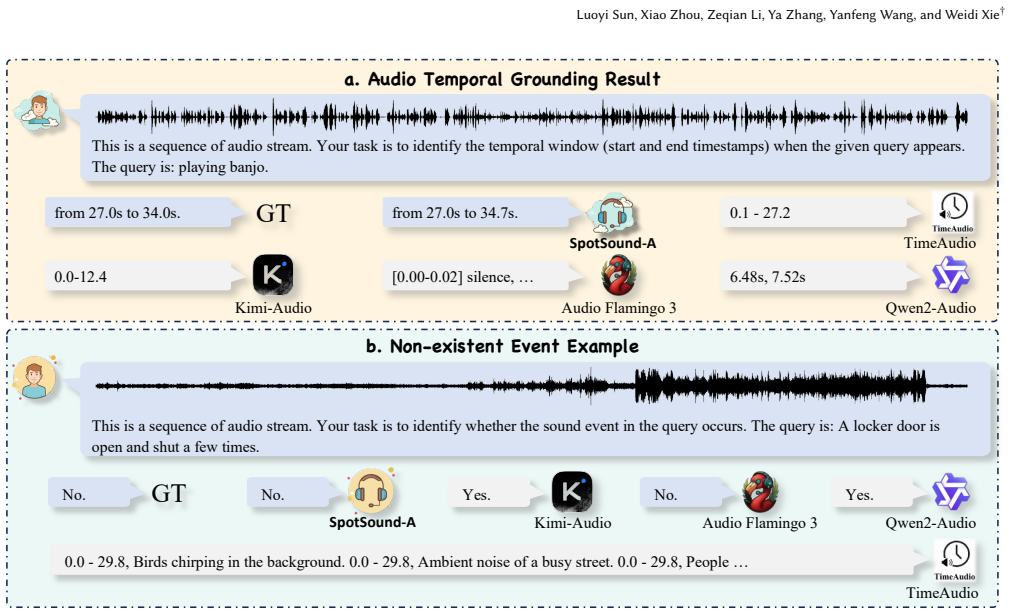
Large Audio-Language Models (ALMs) have recently demonstrated remarkable capabilities in holistic audio understanding, yet they remain unreliable for temporal grounding, i.e., the task of pinpointing exactly when an event occurs within long-form audio. This limitation stems from two factors: training data dominated by clip-level supervision lacking precise timestamps, and benchmarks that fail to simulate real-world scenarios where short events are obscured by dense background sounds. In this paper, we introduce SpotSound, an audio language model designed for grounding audio events. SpotSound incorporates a novel training objective, specifically designed to suppress hallucinated timestamps for events absent from the input. Additionally, we present SpotSound-Bench, a challenging temporal grounding benchmark where target events occupy less than ~10\% of each clip, creating a rigorous `needle-in-a-haystack' evaluation. Experiments demonstrate that SpotSound achieves state-of-the-art results on temporal grounding benchmarks while maintaining robust performance across general downstream audio-language tasks. Code, models and benchmark are released on https://loiesun.github.io/spotsound/
Editorial analysis
A structured set of objections, weighed in public.
Referee Report
Summary. The paper introduces SpotSound, an audio-language model enhanced for fine-grained temporal grounding of events in long-form audio. It proposes a novel training objective to suppress hallucinated timestamps for events absent from the input audio. The authors also release SpotSound-Bench, a new benchmark consisting of clips where target events occupy less than ~10% of the duration to create challenging needle-in-a-haystack evaluations. Experiments are reported to show that SpotSound attains state-of-the-art results on temporal grounding benchmarks while preserving strong performance on general audio-language tasks. Code, models, and the benchmark are made publicly available.
Significance. If the empirical claims hold, the work addresses a practically important limitation in current large audio-language models: their inability to reliably localize events in time within extended audio. The hallucination-suppressing objective and the more realistic SpotSound-Bench could raise the standard for temporal grounding evaluation and training. Public release of artifacts supports reproducibility and community follow-up. The contribution would be most significant if the method generalizes beyond the reported benchmarks and if the benchmark construction avoids unintended biases.
major comments (3)
- [§3 (Method)] §3 (Method): The novel training objective is described as suppressing hallucinated timestamps for absent events, yet the manuscript provides no explicit loss formulation, hyper-parameter settings, or integration details with the base ALM objective. Without these, it is impossible to verify whether the objective is truly parameter-free or how it avoids degrading other capabilities.
- [§4 (Experiments)] §4 (Experiments): The SOTA claim on temporal grounding benchmarks is central but rests on comparisons whose details (exact metrics, IoU thresholds, full list of baselines, number of runs, and statistical significance) are not visible in the abstract-level description. This makes it difficult to assess whether the reported gains are robust or sensitive to evaluation choices.
- [§4.3 (SpotSound-Bench)] §4.3 (SpotSound-Bench): The benchmark is positioned as reflecting real-world difficulty via the <10% event occupancy criterion, but the paper must supply concrete statistics on clip lengths, event duration distributions, background sound selection criteria, and any filtering steps to demonstrate that the construction does not introduce artifacts that inflate or deflate model performance.
minor comments (2)
- [Abstract] The abstract states that SpotSound maintains 'robust performance across general downstream audio-language tasks' but does not name the specific tasks or report the corresponding metrics; adding a concise summary table or sentence would improve clarity.
- [Abstract] Ensure that the project page URL is stable and that the released benchmark includes clear documentation on data licensing and preprocessing scripts.
Simulated Author's Rebuttal
We thank the referee for the constructive feedback. The comments highlight areas where additional details will strengthen the manuscript. We address each point below and will revise the paper to incorporate the requested clarifications and supporting information.
read point-by-point responses
-
Referee: [§3 (Method)] The novel training objective is described as suppressing hallucinated timestamps for absent events, yet the manuscript provides no explicit loss formulation, hyper-parameter settings, or integration details with the base ALM objective. Without these, it is impossible to verify whether the objective is truly parameter-free or how it avoids degrading other capabilities.
Authors: We agree that the current description in Section 3 is insufficient for reproducibility. In the revised manuscript we will add the explicit loss formulation (a contrastive term that penalizes high probability on absent events), the integration as a weighted auxiliary loss with the base ALM objective, and all hyper-parameter values including the weighting coefficient. The objective uses only existing model outputs and introduces no new trainable parameters; we will also add an ablation confirming that general audio-language task performance is not degraded. revision: yes
-
Referee: [§4 (Experiments)] The SOTA claim on temporal grounding benchmarks is central but rests on comparisons whose details (exact metrics, IoU thresholds, full list of baselines, number of runs, and statistical significance) are not visible in the abstract-level description. This makes it difficult to assess whether the reported gains are robust or sensitive to evaluation choices.
Authors: We will expand Section 4 with a dedicated experimental details subsection. It will report the precise metrics (mAP at IoU=0.5 and 0.7), the complete baseline list with citations, the number of runs (three random seeds), and statistical significance (paired t-tests with p-values). These will be presented in tables alongside the existing results to allow full assessment of robustness. revision: yes
-
Referee: [§4.3 (SpotSound-Bench)] The benchmark is positioned as reflecting real-world difficulty via the <10% event occupancy criterion, but the paper must supply concrete statistics on clip lengths, event duration distributions, background sound selection criteria, and any filtering steps to demonstrate that the construction does not introduce artifacts that inflate or deflate model performance.
Authors: We will augment Section 4.3 with the requested statistics: mean and range of clip durations, event duration histograms and occupancy percentages, background selection protocol (diverse non-target clips drawn from AudioSet with manual verification), and all filtering criteria applied during construction. A short discussion of potential biases and mitigation steps will be added to confirm the benchmark's validity. revision: yes
Circularity Check
No significant circularity
full rationale
The paper is an empirical ML contribution focused on a new training objective for temporal grounding in audio-language models and the introduction of SpotSound-Bench. No equations, derivations, or first-principles predictions are present in the abstract or described structure. Claims rest on experimental results, released code/models/benchmark, and standard training rather than any reduction of outputs to self-defined inputs, fitted parameters renamed as predictions, or self-citation chains. The central results are externally falsifiable via the released artifacts and do not exhibit any of the enumerated circularity patterns.
Axiom & Free-Parameter Ledger
Reference graph
Works this paper leans on
-
[1]
Jinze Bai, Shuai Bai, Yunfei Chu, Zeyu Cui, Kai Dang, Xiaodong Deng, Yang Fan, Wenbin Ge, Yu Han, Fei Huang, et al. 2023. Qwen technical report.arXiv preprint arXiv:2309.16609(2023)
work page internal anchor Pith review Pith/arXiv arXiv 2023
- [2]
-
[3]
Nicolas Carion, Francisco Massa, Gabriel Synnaeve, Nicolas Usunier, Alexan- der Kirillov, and Sergey Zagoruyko. 2020. End-to-end object detection with transformers. InEuropean conference on computer vision. Springer, 213–229
2020
-
[4]
Honglie Chen, Weidi Xie, Andrea Vedaldi, and Andrew Zisserman. 2020. Vg- gsound: A large-scale audio-visual dataset. InICASSP 2020-2020 IEEE International Conference on Acoustics, Speech and Signal Processing (ICASSP). IEEE, 721–725
2020
- [5]
-
[6]
Yunfei Chu, Jin Xu, Qian Yang, Haojie Wei, Xipin Wei, Zhifang Guo, Yichong Leng, Yuanjun Lv, Jinzheng He, Junyang Lin, et al. 2024. Qwen2-audio technical report.arXiv preprint arXiv:2407.10759(2024)
work page internal anchor Pith review arXiv 2024
-
[7]
Yunfei Chu, Jin Xu, Xiaohuan Zhou, Qian Yang, Shiliang Zhang, Zhijie Yan, Chang Zhou, and Jingren Zhou. 2023. Qwen-audio: Advancing universal audio understanding via unified large-scale audio-language models.arXiv preprint arXiv:2311.07919(2023)
work page internal anchor Pith review arXiv 2023
-
[8]
Gheorghe Comanici, Eric Bieber, Mike Schaekermann, Ice Pasupat, Noveen Sachdeva, Inderjit Dhillon, Marcel Blistein, Ori Ram, Dan Zhang, Evan Rosen, et al. 2025. Gemini 2.5: Pushing the frontier with advanced reasoning, multi- modality, long context, and next generation agentic capabilities.arXiv preprint arXiv:2507.06261(2025)
work page internal anchor Pith review Pith/arXiv arXiv 2025
-
[9]
Ding Ding, Zeqian Ju, Yichong Leng, Songxiang Liu, Tong Liu, Zeyu Shang, Kai Shen, Wei Song, Xu Tan, Heyi Tang, et al. 2025. Kimi-audio technical report. arXiv preprint arXiv:2504.18425(2025)
work page internal anchor Pith review arXiv 2025
-
[10]
Jort F Gemmeke, Daniel PW Ellis, Dylan Freedman, Aren Jansen, Wade Lawrence, R Channing Moore, Manoj Plakal, and Marvin Ritter. 2017. Audio set: An ontology and human-labeled dataset for audio events. In2017 IEEE international conference on acoustics, speech and signal processing (ICASSP). IEEE, 776–780
2017
-
[11]
Tiantian Geng, Teng Wang, Jinming Duan, Runmin Cong, and Feng Zheng. 2023. Dense-Localizing Audio-Visual Events in Untrimmed Videos: A Large-Scale Benchmark and Baseline. InProceedings of the IEEE/CVF Conference on Computer Vision and Pattern Recognition. 22942–22951
2023
- [12]
-
[13]
Arushi Goel, Sreyan Ghosh, Jaehyeon Kim, Sonal Kumar, Zhifeng Kong, Sang-gil Lee, Chao-Han Huck Yang, Ramani Duraiswami, Dinesh Manocha, Rafael Valle, et al. 2025. Audio flamingo 3: Advancing audio intelligence with fully open large audio language models.arXiv preprint arXiv:2507.08128(2025)
work page internal anchor Pith review arXiv 2025
-
[14]
Aleksandr Gordeev, Vladimir Dokholyan, Irina Tolstykh, and Maksim Kuprashe- vich. 2026. Saliency-guided detr for moment retrieval and highlight detection. InProceedings of the IEEE/CVF Winter Conference on Applications of Computer Vision. 907–916
2026
-
[15]
Yongxin Guo, Jingyu Liu, Mingda Li, Dingxin Cheng, Xiaoying Tang, Dianbo Sui, Qingbin Liu, Xi Chen, and Kevin Zhao. 2025. Vtg-llm: Integrating timestamp knowledge into video llms for enhanced video temporal grounding. InProceedings of the AAAI Conference on Artificial Intelligence, Vol. 39. 3302–3310
2025
-
[16]
Jiachang Hao, Haifeng Sun, Pengfei Ren, Jingyu Wang, Qi Qi, and Jianxin Liao
-
[17]
InEuropean Conference on Computer Vision
Can shuffling video benefit temporal bias problem: A novel training framework for temporal grounding. InEuropean Conference on Computer Vision. Springer, 130–147
-
[18]
Shawn Hershey, Daniel PW Ellis, Eduardo Fonseca, Aren Jansen, Caroline Liu, R Channing Moore, and Manoj Plakal. 2021. The benefit of temporally-strong labels in audio event classification. InICASSP 2021-2021 IEEE International Con- ference on Acoustics, Speech and Signal Processing (ICASSP). IEEE, 366–370
2021
-
[19]
Zhijian Hou, Wanjun Zhong, Lei Ji, Difei Gao, Kun Yan, Wk Chan, Chong-Wah Ngo, Mike Zheng Shou, and Nan Duan. 2023. Cone: An efficient coarse-to-fine alignment framework for long video temporal grounding. InProceedings of the 61st Annual Meeting of the Association for Computational Linguistics (Volume 1: Long Papers). 8013–8028
2023
-
[20]
Edward J Hu, Yelong Shen, Phillip Wallis, Zeyuan Allen-Zhu, Yuanzhi Li, Shean Wang, Lu Wang, Weizhu Chen, et al. 2022. Lora: Low-rank adaptation of large language models.ICLR1, 2 (2022), 3
2022
-
[21]
Bin Huang, Xin Wang, Hong Chen, Zihan Song, and Wenwu Zhu. 2024. Vtimellm: Empower llm to grasp video moments. InProceedings of the IEEE/CVF Conference on Computer Vision and Pattern Recognition. 14271–14280
2024
-
[22]
De-An Huang, Shijia Liao, Subhashree Radhakrishnan, Hongxu Yin, Pavlo Molchanov, Zhiding Yu, and Jan Kautz. 2024. Lita: Language instructed temporal- localization assistant. InEuropean Conference on Computer Vision. Springer, 202–218
2024
- [23]
-
[24]
Xin Lai, Zhuotao Tian, Yukang Chen, Yanwei Li, Yuhui Yuan, Shu Liu, and Jiaya Jia. 2024. Lisa: Reasoning segmentation via large language model. InProceedings of the IEEE/CVF conference on computer vision and pattern recognition. 9579–9589
2024
-
[25]
Jie Lei, Tamara L Berg, and Mohit Bansal. 2021. Detecting moments and highlights in videos via natural language queries.Advances in Neural Information Processing Systems34 (2021), 11846–11858
2021
- [26]
-
[27]
Kevin Qinghong Lin, Pengchuan Zhang, Joya Chen, Shraman Pramanick, Difei Gao, Alex Jinpeng Wang, Rui Yan, and Mike Zheng Shou. 2023. Univtg: Towards unified video-language temporal grounding. InProceedings of the IEEE/CVF International Conference on Computer Vision. 2794–2804
2023
-
[28]
Aixin Liu, Bei Feng, Bing Xue, Bingxuan Wang, Bochao Wu, Chengda Lu, Cheng- gang Zhao, Chengqi Deng, Chenyu Zhang, Chong Ruan, et al. 2024. Deepseek-v3 technical report.arXiv preprint arXiv:2412.19437(2024)
work page internal anchor Pith review Pith/arXiv arXiv 2024
-
[29]
Ye Liu, Siyuan Li, Yang Wu, Chang-Wen Chen, Ying Shan, and Xiaohu Qie. 2022. Umt: Unified multi-modal transformers for joint video moment retrieval and highlight detection. InProceedings of the IEEE/CVF conference on computer vision and pattern recognition. 3042–3051
2022
-
[30]
Yikun Liu, Yajie Zhang, Jiayin Cai, Xiaolong Jiang, Yao Hu, Jiangchao Yao, Yan- feng Wang, and Weidi Xie. 2025. Lamra: Large multimodal model as your advanced retrieval assistant. InProceedings of the Computer Vision and Pattern Recognition Conference. 4015–4025
2025
-
[31]
Ilya Loshchilov and Frank Hutter. 2017. Decoupled weight decay regularization. arXiv preprint arXiv:1711.05101(2017)
work page internal anchor Pith review Pith/arXiv arXiv 2017
-
[32]
Annamaria Mesaros, Toni Heittola, and Tuomas Virtanen. 2016. TUT database for acoustic scene classification and sound event detection. In2016 24th European signal processing conference (EUSIPCO). IEEE, 1128–1132
2016
- [33]
-
[34]
WonJun Moon, Sangeek Hyun, SangUk Park, Dongchan Park, and Jae-Pil Heo
-
[35]
InProceedings of the IEEE/CVF conference on computer vision and pattern recognition
Query-dependent video representation for moment retrieval and highlight detection. InProceedings of the IEEE/CVF conference on computer vision and pattern recognition. 23023–23033
-
[36]
Hokuto Munakata, Taichi Nishimura, Shota Nakada, and Tatsuya Komatsu. 2025. Language-based audio moment retrieval. InICASSP 2025-2025 IEEE International Conference on Acoustics, Speech and Signal Processing (ICASSP). IEEE, 1–5
2025
- [37]
-
[38]
Yulin Pan, Xiangteng He, Biao Gong, Yiliang Lv, Yujun Shen, Yuxin Peng, and Deli Zhao. 2023. Scanning only once: An end-to-end framework for fast temporal grounding in long videos. InProceedings of the IEEE/CVF international conference on computer vision. 13767–13777
2023
-
[39]
Renjie Pi, Jiahui Gao, Shizhe Diao, Rui Pan, Hanze Dong, Jipeng Zhang, Lewei Yao, Jianhua Han, Hang Xu, Lingpeng Kong, et al. 2023. Detgpt: Detect what you need via reasoning. InProceedings of the 2023 Conference on Empirical Methods in Natural Language Processing. 14172–14189
2023
-
[40]
Alec Radford, Jong Wook Kim, Tao Xu, Greg Brockman, Christine McLeavey, and Ilya Sutskever. 2023. Robust speech recognition via large-scale weak supervision. InInternational conference on machine learning. PMLR, 28492–28518
2023
-
[41]
Shuhuai Ren, Linli Yao, Shicheng Li, Xu Sun, and Lu Hou. 2024. Timechat: A time-sensitive multimodal large language model for long video understand- ing. InProceedings of the IEEE/CVF Conference on Computer Vision and Pattern Recognition. 14313–14323
2024
-
[42]
Romain Serizel, Nicolas Turpault, Ankit Shah, and Justin Salamon. 2020. Sound event detection in synthetic domestic environments. InICASSP 2020-2020 IEEE International Conference on Acoustics, Speech and Signal Processing (ICASSP). IEEE, 86–90
2020
-
[43]
Yudi Shi, Shangzhe Di, Qirui Chen, and Weidi Xie. 2025. Enhancing video-llm reasoning via agent-of-thoughts distillation. InProceedings of the Computer Vision and Pattern Recognition Conference. 8523–8533
2025
-
[44]
Arvind Krishna Sridhar, Yinyi Guo, and Erik Visser. 2025. Enhancing temporal understanding in audio question answering for large audio language models. In Proceedings of the 2025 Conference of the Nations of the Americas Chapter of the Association for Computational Linguistics: Human Language Technologies (Volume 3: Industry Track). 1026–1035
2025
-
[45]
Nicolas Turpault, Romain Serizel, Ankit Parag Shah, and Justin Salamon. 2019. Sound event detection in domestic environments with weakly labeled data and soundscape synthesis. InWorkshop on Detection and Classification of Acoustic Scenes and Events. Luoyi Sun, Xiao Zhou, Zeqian Li, Ya Zhang, Yanfeng Wang, and Weidi Xie †
2019
-
[46]
Shashanka Venkataramanan, Mamshad Nayeem Rizve, João Carreira, Yuki Asano, and Yannis Avrithis. 2024. Is ImageNet worth 1 video? Learning strong image encoders from 1 long unlabelled video. InICLR 2024-Twelfth International Con- ference on Learning Representations. 1–21
2024
- [47]
-
[48]
Zeyu Xie, Xuenan Xu, Zhizheng Wu, and Mengyue Wu. 2025. Audiotime: A temporally-aligned audio-text benchmark dataset. InICASSP 2025-2025 IEEE International Conference on Acoustics, Speech and Signal Processing (ICASSP). IEEE, 1–5
2025
-
[49]
Xuenan Xu, Heinrich Dinkel, Mengyue Wu, and Kai Yu. 2021. Text-to-audio grounding: Building correspondence between captions and sound events. In ICASSP 2021-2021 IEEE International Conference on Acoustics, Speech and Signal Processing (ICASSP). IEEE, 606–610
2021
-
[50]
Xuenan Xu, Ziyang Ma, Mengyue Wu, and Kai Yu. 2024. Towards weakly supervised text-to-audio grounding.IEEE Transactions on Multimedia(2024)
2024
-
[51]
An Yang, Baosong Yang, Binyuan Hui, Bo Zheng, Bowen Yu, Chang Zhou, Cheng- peng Li, Chengyuan Li, Dayiheng Liu, Fei Huang, Guanting Dong, Haoran Wei, Huan Lin, Jialong Tang, Jialin Wang, Jian Yang, Jianhong Tu, Jianwei Zhang, Jianxin Ma, Jianxin Yang, Jin Xu, Jingren Zhou, Jinze Bai, Jinzheng He, Junyang Lin, Kai Dang, Keming Lu, Keqin Chen, Kexin Yang, M...
work page internal anchor Pith review arXiv 2024
-
[52]
An Yang, Baosong Yang, Beichen Zhang, Binyuan Hui, Bo Zheng, Bowen Yu, Chengyuan Li, Dayiheng Liu, Fei Huang, Haoran Wei, Huan Lin, Jian Yang, Jianhong Tu, Jianwei Zhang, Jianxin Yang, Jiaxi Yang, Jingren Zhou, Junyang Lin, Kai Dang, Keming Lu, Keqin Bao, Kexin Yang, Le Yu, Mei Li, Mingfeng Xue, Pei Zhang, Qin Zhu, Rui Men, Runji Lin, Tianhao Li, Tianyi T...
work page internal anchor Pith review Pith/arXiv arXiv 2025
-
[53]
Boqiang Zhang, Kehan Li, Zesen Cheng, Zhiqiang Hu, Yuqian Yuan, Guanzheng Chen, Sicong Leng, Yuming Jiang, Hang Zhang, Xin Li, et al. 2025. Videollama 3: Frontier multimodal foundation models for image and video understanding. arXiv preprint arXiv:2501.13106(2025)
work page internal anchor Pith review arXiv 2025
-
[54]
Jun Zhang, Teng Wang, Yuying Ge, Yixiao Ge, Xinhao Li, Ying Shan, and Limin Wang. 2025. Timelens: Rethinking video temporal grounding with multimodal llms.arXiv preprint arXiv:2512.14698(2025). Appendix In the appendix, we provide dataset and benchmark statistics (Appendix A), more experiment results (Appendix B), additional im- plementation details (Appe...
discussion (0)
Sign in with ORCID, Apple, or X to comment. Anyone can read and Pith papers without signing in.