Recognition: unknown
Reminiscences of S. K. Godunov. The Russian Mathematician
Pith reviewed 2026-05-10 16:07 UTC · model grok-4.3
The pith
Personal reminiscences of meetings with Sergey Godunov demonstrate the global reach of his mathematical ideas across science and their lasting effect on careers.
A machine-rendered reading of the paper's core claim, the machinery that carries it, and where it could break.
Core claim
Through these personal reminiscences the author conveys that Godunov's mathematical creativity produced a global impact across multiple branches of science and exerted a lasting influence on the careers of generations of mathematicians working in both academia and industry, as evidenced by the author's own research collaborations and repeated direct meetings with Godunov and his Novosibirsk group.
What carries the argument
The sequence of personal meetings and resulting research collaborations with Godunov and his group, which the author uses as concrete instances to illustrate broader influence.
If this is right
- Godunov's ideas continue to underpin ongoing research in computational mathematics and its applications.
- Personal contacts between Western and Russian mathematicians can lead to sustained international collaborations.
- The influence of a single mathematician's creativity extends beyond academia into industrial practice.
- Documenting such interactions preserves the human context of scientific progress for later generations.
Where Pith is reading between the lines
- Similar reminiscences about other key figures could help map how ideas spread across national research communities.
- The pattern described suggests that direct personal engagement accelerates the adoption of new mathematical techniques in applied fields.
- These accounts imply that the legacy of applied mathematicians is best understood through both their published methods and the networks they built.
Load-bearing premise
The author's personal experiences and observations accurately capture and represent the full scope and nature of Godunov's influence without selection bias or overstatement.
What would settle it
A survey of active researchers in numerical methods and related fields that finds no traceable influence from Godunov's work or no record of the described meetings and collaborations.
Figures


read the original abstract
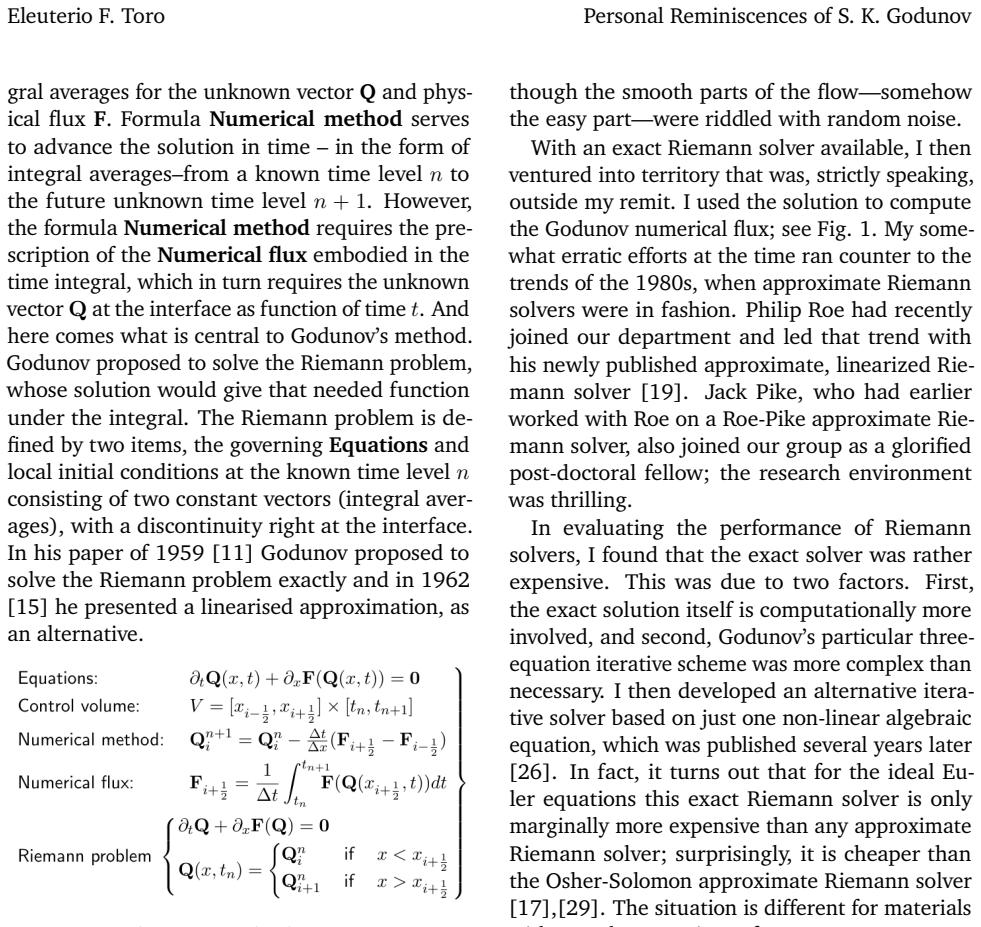
These personal reminiscences of the great Russian mathematician Sergey K. Godunov (1929-2023) arose from a request by his daughter, Ekaterina, to contribute a piece to a book she is writing about her father's life. I was honoured to accept this invitation and to give written form to the rewarding experience of conducting research on themes pioneered by Professor Godunov, interacting with him personally on several memorable occasions, and helping to establish research collaboration with his Novosibirsk group. Our association began at a conference in Lake Tahoe (USA) in 1995 and was followed by a number of subsequent meetings, notably in Novosibirsk, Manchester, Oxford, and Cambridge. Briefer encounters also took place in the Porquerolles Island (France), in Lyon (France), and in St. Petersburg (Russia). These notes bear witness to the global impact of Godunov's mathematical creativity across multiple branches of science, as well as to its lasting influence on the careers of generations of mathematicians in both academia and industry.
Editorial analysis
A structured set of objections, weighed in public.
Referee Report
Summary. The manuscript consists of personal reminiscences by the author detailing his professional interactions with Sergey K. Godunov beginning at a 1995 conference in Lake Tahoe and continuing through meetings in Novosibirsk, Manchester, Oxford, Cambridge, Porquerolles, Lyon, and St. Petersburg. It frames these encounters as evidence of Godunov's mathematical creativity and its influence on subsequent generations of researchers in academia and industry.
Significance. As a firsthand account from a collaborator, the memoir supplies primary-source material for the history of applied mathematics in the post-Soviet period, documenting international exchanges and the transmission of ideas from Godunov's group to Western institutions. Such personal narratives complement archival histories and can illuminate the human context of technical developments in numerical analysis and computational science.
minor comments (2)
- [Abstract] Abstract: the assertion that the notes 'bear witness to the global impact ... across multiple branches of science' is presented without any concrete illustration of those branches or examples of impact; a single sentence naming one or two specific areas (e.g., Godunov's schemes for hyperbolic conservation laws) would anchor the claim for readers.
- [Full text] The narrative moves chronologically but lacks explicit section breaks or subheadings; inserting short titled sections (e.g., 'First Encounter at Lake Tahoe', 'Visits to Novosibirsk') would improve readability and allow readers to locate particular episodes more easily.
Simulated Author's Rebuttal
We thank the referee for the positive assessment of the manuscript and for recognizing its value as primary-source material documenting international exchanges and the transmission of ideas in applied mathematics during the post-Soviet period. The recommendation for minor revision is noted.
Circularity Check
No circularity: personal memoir with no derivations or load-bearing claims
full rationale
The manuscript is a personal reminiscence recounting the author's interactions with Godunov and his group. It contains no equations, no fitted parameters, no predictions, no uniqueness theorems, and no self-citations used to justify technical results. The central statements arise directly from the author's stated experiences and are presented as such, without any attempt to derive conclusions from prior work or to reduce claims to self-referential inputs. This matches the non-technical memoir format and requires no circularity analysis.
Axiom & Free-Parameter Ledger
Reference graph
Works this paper leans on
-
[1]
Busto, M
S. Busto, M. Dumbser, I. Peshkov, and E. Romenski. Thermodynamically compat- ible finite volume schemes for continuum mechanics.J. Sci. Comput., 44(3):A1723– A1751, 2022
2022
-
[2]
Chiocchetti, I
S. Chiocchetti, I. Peshkov, S. Gavrilyuk, and M. Dumbser. High order ADER schemes and GLM curl cleaning for a first order hyper- bolic formulation of compressible flow with surface tension.Journal of Computational Physics, 426:109898, 2021
2021
-
[3]
G. V. Demidenko, E. Romenski, E. Toro, and M. Dumbser (Editors).Continuum Mechan- ics, Applied Mathematics and Scientific Com- puting: Godunov’s Legacy. Springer, 2020
2020
-
[4]
Dumbser, C
M. Dumbser, C. Enaux, and E. F. Toro. Fi- nite Volume Schemes of Very High Order of Accuracy for Stiff Hyperbolic Balance Laws. J. Comput. Phys., 227(8):3971–4001, 2008
2008
-
[5]
Dumbser and C
M. Dumbser and C. D. Munz. ADER Discon- tinuous Galerkin Schemes for Aeroacoustics. Comptes Rendus Mécanique, 333:683–687, 2005
2005
-
[6]
Dumbser, I
M. Dumbser, I. Peshkov, E. Romenski, and O. Zanotti. High order ADER schemes for a unified first order hyperbolic formula- tion of continuum mechanics: viscous heat- conducting fluids and elastic solids.J. Comp. Phys., 314:824–862, 2016
2016
-
[7]
Dumbser, I
M. Dumbser, I. Peshkov, E. Romenski, and O. Zanotti. High order ADER schemes for a unified first order hyperbolic formulation of Newtonian continuum mechanics cou- pled with electro-dynamics.J. Comp. Phys., 348:298–342, 2016
2016
-
[8]
E. F. Toro, V. A. Titarev, M. Dumbser, A. Iske, C. R. Goetz, C. E. Castro, G. I. Montecinos, and R. Dematté. The ADER approach for approximating hyperbolic equations to very high accuracy. InXVIII International Confer- ence on Hyperbolic Problems: Theory, Numer- ics, Applications, volume 1, pages 83–105, Malaga, Spain, 2024. Springer Nature
2024
-
[9]
K. O. Friedrichs and P. Lax. Systems of con- servation equations with a convex extension. Proc. Nat. Acad. Sci. USA, 68(8):1686–1688, 1971
1971
-
[10]
SolutionintheLargeforNonlinear Hyperbolic Systems of Equations.Comm
J.Glimm. SolutionintheLargeforNonlinear Hyperbolic Systems of Equations.Comm. Pure. Appl. Math., 18:697–715, 1965
1965
-
[11]
S. K. Godunov. A Finite Difference Method for the Computation of Discontinuous So- lutions of the Equations of Fluid Dynamics. Mat. Sb., 47:357–393, 1959
1959
-
[12]
S. K. Godunov. Interesting class of quasilin- ear systems.Report of the USSR Academy of Sciences, 139(3):521–523, in J. Comput. Phys. 520 (2025) 113521, 1961. 10 Eleuterio F. Toro Personal Reminiscences of S. K. Godunov
2025
-
[13]
S. K. Godunov. Thermodynamics, Conserva- tion Laws and their Rotations. InGodunov Methods: Theory and Applications. Edited Review, E. F. Toro (Editor), pages 399–410. Kluwer Academic/Plenum Publishers, 2001
2001
-
[14]
S. K. Godunov and E. I. Romenski. Nonsta- tionary equations of nonlinear elasticity the- ory in Eulerian coordinates.J. Appl. Mech. Tech. Phys., 13(6):868–884, 1972
1972
-
[15]
S. K. Godunov, A. V. Zabrodin, and G. P. Prokopov. A computational scheme for two-dimensional non stationary problems of gas dynamics and calculation of the flow from a shock wave approaching a stationary state.USSR J. Comp. Math. and Math. Phys., 1:1187–1219, 1962
1962
-
[16]
P. D. Lax. Weak Solutions of Nonlinear Hyperbolic Equations and Their Numerical Computation.Comm. Pure. Appl. Math., VII:159–193, 1954
1954
-
[17]
Osher and F
S. Osher and F. Solomon. Upwind Difference Schemes for Hyperbolic Conservation Laws. Math. Comp., 38:339–374, 1982
1982
-
[18]
A hy- perbolic model for viscous Newtonian flows
Ilya Peshkov and Evgeniy Romenskiy. A hy- perbolic model for viscous Newtonian flows. Continuum Mechanics and Thermodynamics, 28(1):85–104, 2016
2016
-
[19]
P. L. Roe. Approximate Riemann Solvers, Parameter Vectors, and Difference Schemes. J. Comput. Phys., 43:357–372, 1981
1981
-
[20]
Romenski, E
E. Romenski, E. D. Resnyanski, and E. F. Toro. Conservative Hyperbolic Formulation for Compressible Two–Phase Flow with Dif- ferent Phase Pressures and Temperatures. Quarterly of Applied Mathematics, 65:259– 279, 2007
2007
-
[21]
E. I. Romenski. Thermodynamics and Hy- perbolic Systems of Balance Laws in Con- tinuum Mechanics. InGodunov Methods: Theory and Applications. Edited Review, E. F. Toro (Editor), pages 745–762. Kluwer Aca- demic/Plenum Publishers, 2001
2001
-
[22]
E. I. Romenski and E. F. Toro. Hyperbolic- ity and one-dimensional waves in compress- ible two-phase flow models.Shock Waves, 13(6):473–487, 2004
2004
- [23]
-
[24]
Ruggeri and A
T. Ruggeri and A. Strumia. Main field and convex covariant density for quasi-linear hy- perbolic systems: relativistic fluid dynamics. Annales de l’institut Henri Poincaré, Section A, Physique Théorique, 34(1):65–84, 1981
1981
-
[25]
V. A. Titarev and E. F. Toro. ADER: Arbitrary High Order Godunov Approach.J. Scientific Computing, 17:609–618, 2002
2002
-
[26]
E. F. Toro. A Fast Riemann Solver with Constant Covolume Applied to the Random Choice Method.Int. J. Numer. Meth. Fluids, 9:1145–1164, 1989
1989
-
[27]
E. F. Toro. A Weighted Average Flux Method for Hyperbolic Conservation Laws.Proc. Roy. Soc. London, A423:401–418, 1989
1989
-
[28]
E. F. Toro. Anomalies of Conservative Meth- ods: Analysis and Numerical Evidence.Inter- national J. of Computational Fluid Dynamics, 11(2):128–143, 2002
2002
-
[29]
E. F. Toro.Riemann Solvers and Numerical Methods for Fluid Dynamics: A Practical In- troduction. Springer-Verlag, third edition,
-
[30]
ISBN 978-3-540-25202-3; eISBN 978- 3-540-49834-8 (eBook)
-
[31]
E. F. Toro. The ADER path to high-order Godunov methods. InContinuum mechanics, applied mathematics and scientific comput- ing: Godunov’s legacy- A liber amicorum to Professor Godunov., pages 359–366. Springer Verlag, 2020
2020
-
[32]
E. F. Toro.Computational Algorithms for Shallow Water Equations. Springer- Verlag, second edition, 2024. ISBN 978- 3-031-61394-4; eISBN 978-3-031-61395-1 (eBook)
2024
-
[33]
E. F. Toro.Computational Bodily Fluid Dynamics. Models, Algorithms and Applica- tions. Springer-Nature, first edition, 2025. ISBN 978-3-031-92597-9; eISBN 978-3-031- 92598-6 (eBook)
2025
-
[34]
E. F. Toro, R. C. Millington, and L. A. M. Nejad. Towards Very High–Order Go- dunov Schemes. InGodunov Methods: The- ory and Applications. Edited Review, E. F. 11 Eleuterio F. Toro Personal Reminiscences of S. K. Godunov Toro (Editor), pages 905–937. Kluwer Aca- demic/Plenum Publishers, 2001
2001
-
[35]
E. F. Toro and V. A. Titarev. Solution of the GeneralisedRiemannProblemforAdvection– Reaction Equations.Proc. Roy. Soc. London A, 458:271–281, 2002
2002
-
[36]
E. F. Toro (Editor).Godunov Methods: The- ory and Applications. Edited Review. Kluwer Academic/Plenum Publishers, 2001
2001
-
[37]
OnGodunov’sinterestingclass of systems – The symmetric hyperbolic Eu- ler equations of gas dynamics.Journal of Computational Physics, 522:113588, 2025
G.Warnecke. OnGodunov’sinterestingclass of systems – The symmetric hyperbolic Eu- ler equations of gas dynamics.Journal of Computational Physics, 522:113588, 2025. 12
2025
discussion (0)
Sign in with ORCID, Apple, or X to comment. Anyone can read and Pith papers without signing in.