Recognition: unknown
Long-lived revivals and real-space fragmentation in chains of multispecies Rydberg atoms
Pith reviewed 2026-05-10 13:13 UTC · model grok-4.3
The pith
Competition between repulsion and attraction in dual-species Rydberg chains induces dynamical fragmentation into frozen and oscillatory regions.
A machine-rendered reading of the paper's core claim, the machinery that carries it, and where it could break.
Core claim
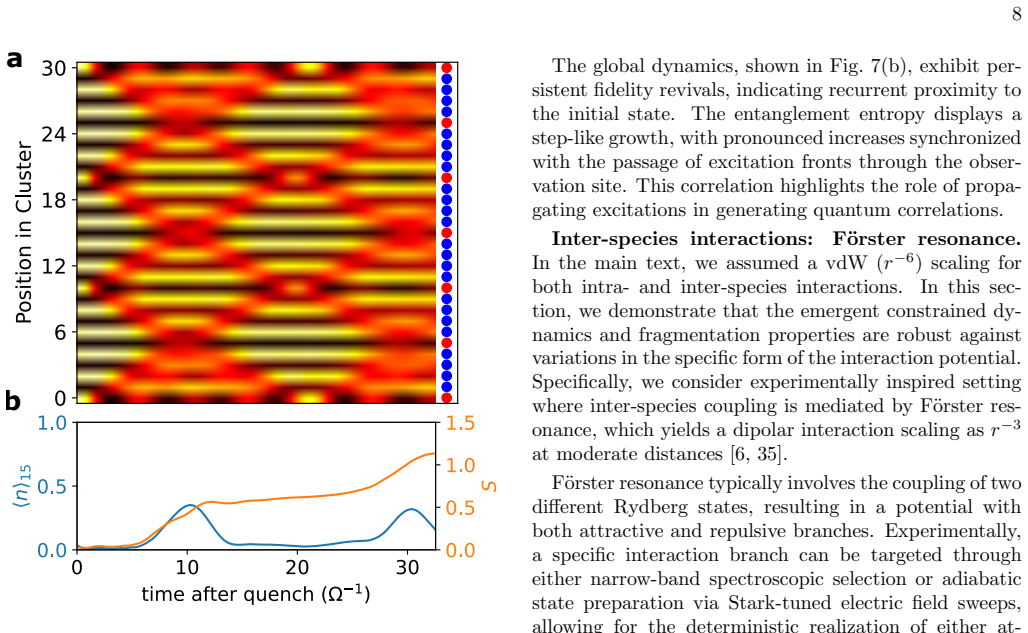
The competition between intra-species repulsion and inter-species attraction induces dynamical fragmentation, marked by the coexistence of extended frozen regions and localized oscillatory sectors. The frozen regions act as emergent barriers that isolate and protect coherent dynamics. In the purely repulsive regime, species-selective quenches drive spontaneous fragmentation, leading to dynamically disconnected regions with irregular revivals. These phenomena are robust across interaction regimes.
What carries the argument
Dynamical fragmentation arising from species-dependent van der Waals interactions, which creates emergent barriers separating coherent oscillatory dynamics from frozen areas.
Load-bearing premise
The model assumes species-dependent van der Waals interactions dominate and that higher-order effects or experimental imperfections do not destroy the fragmentation on the simulated timescales.
What would settle it
A direct experimental observation in a dual-species Rydberg array where frozen regions coexist with localized oscillatory sectors that maintain coherence over long times, contrasted with single-species cases showing ergodic behavior.
Figures




read the original abstract
Arrays of Rydberg atoms provide a powerful platform for exploring constrained quantum dynamics and nonergodic many-body phenomena. While most work has focused on single-species systems, multispecies architectures offer additional interaction channels and enable new forms of dynamical constraints. We study the nonequilibrium dynamics of one-dimensional dual-species Rydberg chains of Cs and Rb atoms with species-dependent van der Waals interactions. Using large-scale matrix product state simulations, we show that the competition between intra-species repulsion and inter-species attraction induces dynamical fragmentation, marked by the coexistence of extended frozen regions and localized oscillatory sectors. The frozen regions act as emergent barriers that isolate and protect coherent dynamics. In the purely repulsive regime, we find that species-selective quenches drive spontaneous fragmentation, leading to dynamically disconnected regions with irregular revivals. These phenomena are robust across interaction regimes, revealing a universal mechanism for fragmentation and establishing multispecies Rydberg arrays as a versatile platform for exploring nonequilibrium quantum dynamics beyond single-species systems.
Editorial analysis
A structured set of objections, weighed in public.
Referee Report
Summary. The manuscript studies nonequilibrium dynamics in one-dimensional dual-species Rydberg chains (Cs and Rb) with species-dependent van der Waals interactions. Large-scale matrix product state simulations show that competition between intra-species repulsion and inter-species attraction produces dynamical fragmentation, with coexisting extended frozen regions and localized oscillatory sectors that act as emergent barriers protecting coherent dynamics. In the purely repulsive regime, species-selective quenches induce spontaneous fragmentation and irregular revivals. The phenomena are presented as robust across interaction regimes and as establishing multispecies Rydberg arrays as a platform for nonequilibrium dynamics beyond single-species systems.
Significance. If the fragmentation mechanism holds under controlled numerics, the work identifies a universal route to real-space dynamical constraints via multispecies interactions, extending single-species Rydberg blockade physics. The large-scale MPS approach is a clear strength, enabling access to system sizes where fragmentation can be directly compared to experiment.
major comments (1)
- [Numerical methods / Results] Numerical methods and results sections: The central claim of robust dynamical fragmentation with frozen and oscillatory sectors rests entirely on MPS data, yet no information is provided on bond-dimension convergence, discarded weight, MPO compression error for the 1/r^6 tails, or finite-size scaling. For long-range van der Waals interactions, truncation or compression artifacts can artificially stabilize frozen regions; without explicit tests or error bars it remains possible that the reported coexistence is a finite-bond or cutoff effect rather than a thermodynamic feature.
minor comments (2)
- [Abstract] Abstract: the phrase 'large-scale matrix product state simulations' is repeated without any accompanying statement of system sizes, bond dimensions, or time scales reached, which would help readers immediately gauge the scope.
- [Introduction / Methods] The manuscript does not cite prior work on long-range MPS techniques for Rydberg systems (e.g., MPO compression or cutoff convergence studies), which would strengthen the numerical methodology section.
Simulated Author's Rebuttal
We thank the referee for the careful reading of our manuscript and the constructive feedback. We address the single major comment below and will revise the manuscript accordingly to strengthen the numerical validation.
read point-by-point responses
-
Referee: [Numerical methods / Results] Numerical methods and results sections: The central claim of robust dynamical fragmentation with frozen and oscillatory sectors rests entirely on MPS data, yet no information is provided on bond-dimension convergence, discarded weight, MPO compression error for the 1/r^6 tails, or finite-size scaling. For long-range van der Waals interactions, truncation or compression artifacts can artificially stabilize frozen regions; without explicit tests or error bars it remains possible that the reported coexistence is a finite-bond or cutoff effect rather than a thermodynamic feature.
Authors: We agree that the original manuscript omitted explicit convergence diagnostics and error analysis, which is particularly important for long-range interactions where truncation effects could influence apparent freezing. In the revised version we will add a dedicated subsection in the Numerical Methods section that reports: bond-dimension sweeps up to D=256 with discarded weights below 10^{-8} for all presented data; the MPO compression protocol for the 1/r^6 tails together with the per-bond truncation error (kept below 10^{-5}); finite-size scaling from L=16 to L=64 showing that the spatial extent of frozen regions and the frequency of oscillatory sectors remain stable; and error bars obtained from independent runs with varied initial conditions. These checks confirm that the reported coexistence of frozen and oscillatory sectors is robust and not an artifact of finite bond dimension or cutoff. The revised figures will include the corresponding convergence plots. revision: yes
Circularity Check
No circularity: results emerge from direct MPS simulation of microscopic Hamiltonian
full rationale
The paper's claims rest on large-scale matrix product state simulations of nonequilibrium dynamics under a Hamiltonian defined by species-dependent van der Waals interactions (intra-species repulsion, inter-species attraction). The reported dynamical fragmentation, frozen regions, and revivals are numerical outputs of time evolution, not algebraic predictions obtained by fitting parameters to the target observables or by self-referential definitions. No equations or steps in the provided text reduce the central results to their inputs by construction, and no load-bearing self-citations or imported uniqueness theorems are invoked to force the conclusions. The derivation chain is therefore self-contained as a computational demonstration.
Axiom & Free-Parameter Ledger
Forward citations
Cited by 1 Pith paper
-
Magnetic-field control of interactions in alkaline-earth Rydberg atoms and applications to {\it XXZ} models
Magnetic fields tune the XXZ anisotropy parameter in alkaline-earth Rydberg pairs, allowing a folded XXZ model in ytterbium without fine-tuning and a mean-field supersolid on the square lattice.
Reference graph
Works this paper leans on
-
[1]
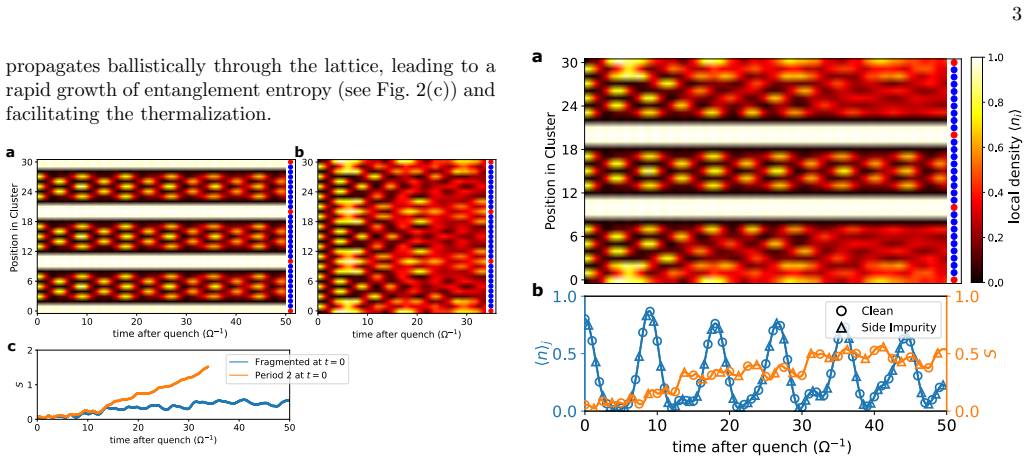
Fully overlapping trajectories demonstrate that the central fragment remains dynamically isolated; the propagating defects are effectively screened by the frozen regions
(blue) and of the bipartite entanglement entropyS(or- ange) for cases without (circles) and with (triangles) external impurities in the initial state. Fully overlapping trajectories demonstrate that the central fragment remains dynamically isolated; the propagating defects are effectively screened by the frozen regions. Emergent fragmentation with species...
-
[2]
Keesling, A
A. Keesling, A. Omran, H. Levine, H. Bernien, H. Pich- ler, S. Choi, R. Samajdar, S. Schwartz, P. Silvi, S. Sachdev,et al., Quantum kibble–zurek mechanism and critical dynamics on a programmable rydberg simulator, Nature568, 207 (2019)
2019
- [3]
-
[4]
Henriet, L
L. Henriet, L. Beguin, A. Signoles, T. Lahaye, A. Browaeys, G.-O. Reymond, and C. Jurczak, Quantum computing with neutral atoms, Quantum4, 327 (2020)
2020
-
[5]
Soto Garcia and N
J. Soto Garcia and N. Chepiga, Resolving chiral transi- tions in one-dimensional rydberg arrays with quantum kibble-zurek mechanism and finite-time scaling, Physical Review B110, 125113 (2024)
2024
-
[6]
M. D. Lukin, M. Fleischhauer, R. Cote, L. Duan, D. Jaksch, J. I. Cirac, and P. Zoller, Dipole blockade and quantum information processing in mesoscopic atomic ensembles, Physical review letters87, 037901 (2001)
2001
-
[7]
Browaeys, D
A. Browaeys, D. Barredo, and T. Lahaye, Experimental investigations of dipole–dipole interactions between a few rydberg atoms, Journal of Physics B: Atomic, Molecular and Optical Physics49, 152001 (2016)
2016
-
[8]
C. J. Turner, A. A. Michailidis, D. A. Abanin, M. Serbyn, and Z. Papi´ c, Weak ergodicity breaking from quantum many-body scars, Nature Physics14, 745 (2018)
2018
-
[9]
Bernien, S
H. Bernien, S. Schwartz, A. Keesling, H. Levine, A. Om- ran, H. Pichler, S. Choi, A. S. Zibrov, M. Endres, M. Greiner,et al., Probing many-body dynamics on a 51-atom quantum simulator, Nature551, 579 (2017)
2017
-
[10]
Serbyn, D
M. Serbyn, D. A. Abanin, and Z. Papi´ c, Quantum many- body scars and weak breaking of ergodicity, Nature Physics17, 675 (2021)
2021
-
[11]
Papi´ c, Weak ergodicity breaking through the lens of quantum entanglement, inEntanglement in Spin Chains: From Theory to Quantum Technology Applica- tions(Springer, 2022) pp
Z. Papi´ c, Weak ergodicity breaking through the lens of quantum entanglement, inEntanglement in Spin Chains: From Theory to Quantum Technology Applica- tions(Springer, 2022) pp. 341–395
2022
-
[12]
W. W. Ho, S. Choi, H. Pichler, and M. D. Lukin, Pe- riodic orbits, entanglement, and quantum many-body scars in constrained models: Matrix product state ap- proach, Physical review letters122, 040603 (2019)
2019
-
[13]
Daniel, A
A. Daniel, A. Hallam, J.-Y. Desaules, A. Hudomal, G.- X. Su, J. C. Halimeh, and Z. Papi´ c, Bridging quantum criticality via many-body scarring, Physical Review B 107, 235108 (2023)
2023
-
[14]
P. Sala, T. Rakovszky, R. Verresen, M. Knap, and F. Poll- mann, Ergodicity breaking arising from hilbert space fragmentation in dipole-conserving hamiltonians, Phys- ical Review X10, 011047 (2020)
2020
-
[15]
Moudgalya, A
S. Moudgalya, A. Prem, R. Nandkishore, N. Regnault, and B. A. Bernevig, Thermalization and its absence within krylov subspaces of a constrained hamiltonian, inMemorial Volume for Shoucheng Zhang(World Sci- entific, 2022) pp. 147–209
2022
-
[16]
F. Yang, H. Yarloo, H.-C. Zhang, K. Mølmer, and A. E. Nielsen, Probing hilbert space fragmentation with strongly interacting rydberg atoms, Physical Review B 111, 144313 (2025)
2025
-
[17]
Y. H. Kwan, P. H. Wilhelm, S. Biswas, and S. Parameswaran, Minimal hubbard models of maxi- mal hilbert space fragmentation, Physical Review Letters 134, 010411 (2025)
2025
-
[18]
H. Zhao, J. Vovrosh, F. Mintert, and J. Knolle, Quan- tum many-body scars in optical lattices, Physical review letters124, 160604 (2020)
2020
-
[19]
W.-L. You, Z. Zhao, J. Ren, G. Sun, L. Li, and A. M. Ole´ s, Quantum many-body scars in spin-1 kitaev chains, Physical Review Research4, 013103 (2022)
2022
-
[20]
Francica and L
G. Francica and L. Dell’Anna, Hilbert space fragmen- tation in a long-range system, Physical Review B108, 045127 (2023)
2023
-
[21]
Fendley, K
P. Fendley, K. Sengupta, and S. Sachdev, Competing density-wave orders in a one-dimensional hard-boson model, Physical Review B69, 075106 (2004)
2004
-
[22]
Lesanovsky and H
I. Lesanovsky and H. Katsura, Interacting fibonacci anyons in a rydberg gas, Physical Review A—Atomic, Molecular, and Optical Physics86, 041601 (2012)
2012
-
[23]
Anand, C
S. Anand, C. E. Bradley, R. White, V. Ramesh, K. Singh, and H. Bernien, A dual-species rydberg array, Nature Physics20, 1744 (2024)
2024
- [24]
-
[25]
C. Fang, J. Miles, J. Goldwin, M. Lichtman, M. Gillette, M. Bergdolt, S. Deshpande, S. A. Norrell, P. Huft, M. A. Kats,et al., Interleaved dual-species arrays of single atoms using a passive optical element and one trapping laser, Science Advances11, eadw4166 (2025)
2025
-
[26]
Dobrzyniecki, P
J. Dobrzyniecki, P. Heim, and M. Tomza, Tunable two- species spin models with rydberg atoms in circular and elliptical states, Physical Review Research7, 013321 (2025)
2025
-
[27]
Schollw¨ ock, The density-matrix renormalization group in the age of matrix product states, Annals of physics 326, 96 (2011)
U. Schollw¨ ock, The density-matrix renormalization group in the age of matrix product states, Annals of physics 326, 96 (2011)
2011
-
[28]
S. R. White, Density matrix formulation for quantum renormalization groups, Physical review letters69, 2863 (1992)
1992
-
[29]
Haegeman, J
J. Haegeman, J. I. Cirac, T. J. Osborne, I. Piˇ zorn, H. Ver- schelde, and F. Verstraete, Time-dependent variational principle for quantum lattices, Physical review letters 6 107, 070601 (2011)
2011
-
[30]
Haegeman, C
J. Haegeman, C. Lubich, I. Oseledets, B. Vandereycken, and F. Verstraete, Unifying time evolution and optimiza- tion with matrix product states, Physical Review B94, 165116 (2016)
2016
-
[31]
Paeckel, T
S. Paeckel, T. K¨ ohler, A. Swoboda, S. R. Manmana, U. Schollw¨ ock, and C. Hubig, Time-evolution methods for matrix-product states, Annals of Physics411, 167998 (2019)
2019
-
[32]
We add another Cs atom at the end of the chain to realize symmetric boundary conditions in an open chain
-
[33]
In experiments this can be done with a light-shift tech- nique
-
[34]
Browaeys and T
A. Browaeys and T. Lahaye, Many-body physics with in- dividually controlled rydberg atoms, Nature Physics16, 132 (2020)
2020
-
[35]
Ebadi, T
S. Ebadi, T. T. Wang, H. Levine, A. Keesling, G. Se- meghini, A. Omran, D. Bluvstein, R. Samajdar, H. Pich- ler, W. W. Ho,et al., Quantum phases of matter on a 256-atom programmable quantum simulator, Nature 595, 227 (2021)
2021
- [36]
-
[37]
Quantum cellular automata on a dual-species rydberg processor,
R. White, V. Ramesh, A. Impertro, S. Anand, F. Cesa, G. Giudici, T. Iadecola, H. Pichler, and H. Bernien, Quantum cellular automata on a dual-species rydberg processor, arXiv preprint arXiv:2601.16257 (2026)
-
[38]
Singh, S
K. Singh, S. Anand, A. Pocklington, J. T. Kemp, and H. Bernien, Dual-element, two-dimensional atom ar- ray with continuous-mode operation, Phys. Rev. X12, 011040 (2022)
2022
-
[39]
Lin and Y
L. Lin and Y. Tong, Low-rank representation of tensor network operators with long-range pairwise interactions, SIAM Journal on Scientific Computing43, A164 (2021)
2021
-
[40]
Beterov and M
I. Beterov and M. Saffman, Rydberg blockade, f¨ orster res- onances, and quantum state measurements with different atomic species, Physical Review A92, 042710 (2015)
2015
-
[41]
Weber, C
S. Weber, C. Tresp, H. Menke, A. Urvoy, O. Firstenberg, H. P. B¨ uchler, and S. Hofferberth, Calculation of ryd- berg interaction potentials, Journal of Physics B: Atomic, Molecular and Optical Physics50, 133001 (2017). 7 END MA TTER T echnical details of the algorithms.Numerical simulations were performed using state-of-the-art density matrix renormaliza...
2017
discussion (0)
Sign in with ORCID, Apple, or X to comment. Anyone can read and Pith papers without signing in.