Recognition: unknown
Magnetic-field control of interactions in alkaline-earth Rydberg atoms and applications to {it XXZ} models
Pith reviewed 2026-05-08 13:18 UTC · model grok-4.3
The pith
Magnetic fields tune XXZ spin interactions in alkaline-earth Rydberg atoms with unusual zero-field behavior in 174Yb.
A machine-rendered reading of the paper's core claim, the machinery that carries it, and where it could break.
Core claim
Considering the pair of Rydberg states |ns 3S1 mJ> and |(n+1)s 3S1 mJ>, the effective Hamiltonian takes the form of an XXZ-type quantum spin model. The anisotropy parameter for 174Yb at zero magnetic field is significantly different from that for other atomic species due to strong spin-orbit coupling in 174Yb. The interaction parameters of the XXZ model can be tuned by the magnetic field. In one-dimensional systems in the large-anisotropy regime the folded XXZ model can be realized in 174Yb systems without fine-tuning of the field. In two-dimensional square-lattice systems a supersolid phase can emerge in the ground state at the mean-field level.
What carries the argument
The effective two-body XXZ Hamiltonian obtained from magnetic-field-dependent interactions between the chosen |ns 3S1 mJ> and |(n+1)s 3S1 mJ> Rydberg states.
Load-bearing premise
The chosen pair of Rydberg states remains isolated from all other states and the derived effective two-body Hamiltonian continues to describe the system accurately when many atoms are present.
What would settle it
A direct measurement showing that the anisotropy parameter of 174Yb Rydberg pairs at zero magnetic field equals the value obtained for 88Sr would falsify the claimed difference arising from spin-orbit coupling.
Figures




read the original abstract
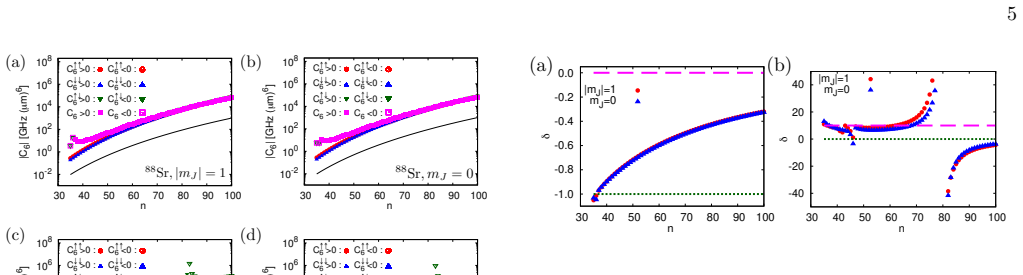
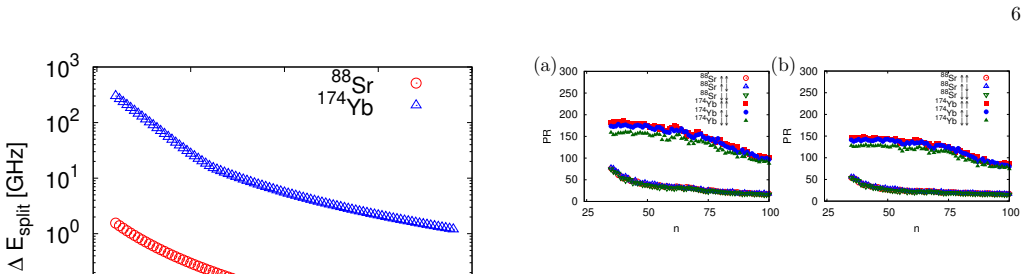
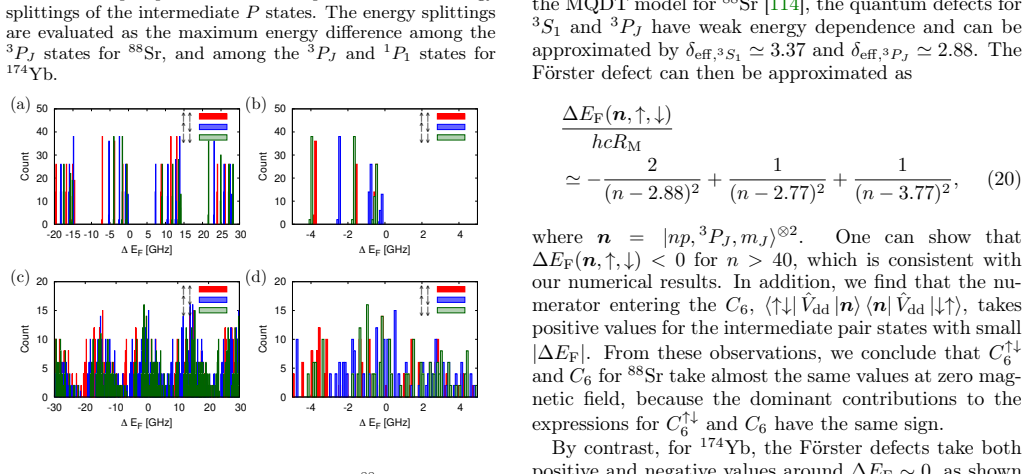
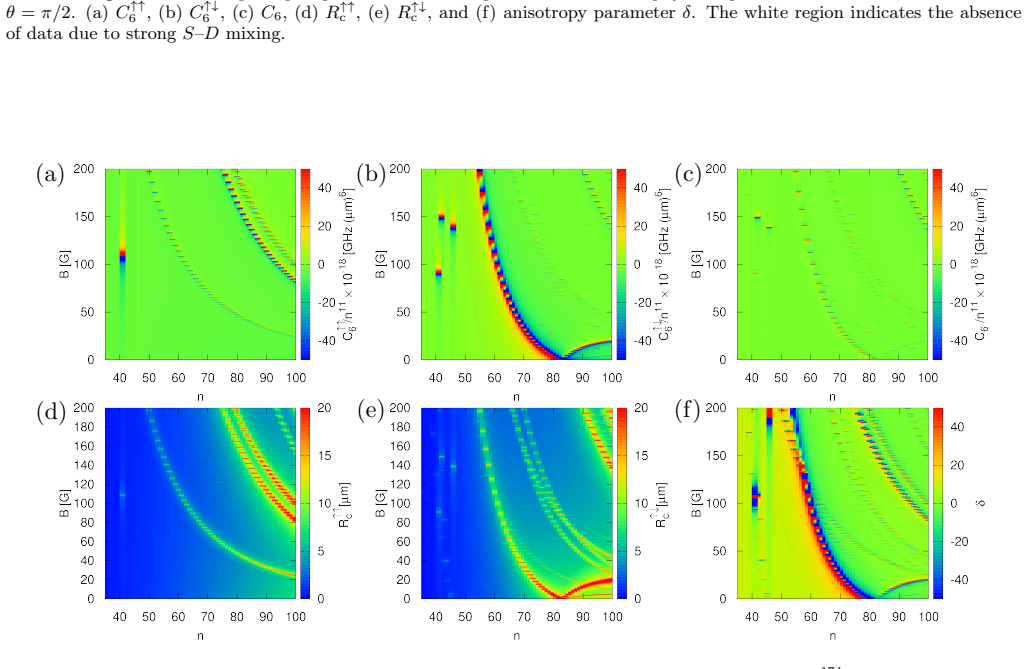
We study the magnetic-field dependence of the interactions between two alkaline-earth(-like) Rydberg atoms, ${}^{88}$Sr and ${}^{174}$Yb. Considering the pair of Rydberg states $|ns,{}^3S_1,m_J\rangle$ and $|(n+1)s,{}^3S_1,m_J\rangle$, we show that the effective Hamiltonian takes the form of an {\it XXZ}-type quantum spin model, as in the alkali-atom case [M. Kunimi and T. Tomita, Phys. Rev. A {\bf 112}, L051301 (2025)]. We find that the behavior of the anisotropy parameter for ${}^{174}$Yb at zero magnetic field is significantly different from that for other atomic species. This behavior originates from the strong spin-orbit coupling in ${}^{174}$Yb. We systematically calculate the interaction parameters of the {\it XXZ} model in the presence of a magnetic field and show that they can be tuned by the field. As applications to quantum many-body problems, we investigate one-dimensional systems in the large-anisotropy regime and show that the folded {\it XXZ} model can be realized in ${}^{174}$Yb systems without fine-tuning of the field. We also investigate two-dimensional square-lattice systems and show that a supersolid phase can emerge in the ground state at the mean-field level.
Editorial analysis
A structured set of objections, weighed in public.
Referee Report
Summary. The manuscript calculates the magnetic-field dependence of the effective two-body interactions between pairs of alkaline-earth Rydberg atoms (88Sr and 174Yb) in the states |ns 3S1 mJ> and |(n+1)s 3S1 mJ>. It demonstrates that the resulting Hamiltonian takes an XXZ form, shows that the zero-field anisotropy parameter for 174Yb differs markedly from other species due to strong spin-orbit coupling, and demonstrates that the XXZ parameters can be tuned by an external magnetic field. Applications are presented to one-dimensional chains (realization of the folded XXZ model in 174Yb without fine-tuning) and to two-dimensional square lattices (emergence of a supersolid phase at the mean-field level).
Significance. If the underlying atomic-physics calculations and the validity of the projected two-body Hamiltonian hold, the work supplies a concrete, field-tunable route to XXZ spin models in alkaline-earth Rydberg gases. The distinctive zero-field anisotropy in 174Yb and the parameter-free realization of the folded XXZ chain constitute potentially useful additions to the Rydberg quantum-simulation toolbox.
major comments (3)
- [§3] §3 (or equivalent section presenting the interaction parameters): the manuscript states that systematic calculations of the XXZ couplings were performed, yet supplies neither basis-set convergence data, error bars on the extracted J and Δ values, nor a quantitative estimate of the leakage rate out of the {|ns 3S1 mJ>, |(n+1)s 3S1 mJ>} subspace induced by the strong SOC of 174Yb once the magnetic field is applied. Because the central claim of field-tunable XXZ parameters and the zero-field anisotropy difference rests on these numbers, the absence of such checks is load-bearing.
- [§4] §4 (one-dimensional applications): the assertion that the folded XXZ model is realized in 174Yb “without fine-tuning of the field” presupposes that the effective two-body Hamiltonian remains accurate when embedded in a many-atom chain. No perturbative bound on higher-order dipole-dipole or SOC-induced couplings that scale with atom number is provided; this directly affects the validity of the folded-XXZ claim.
- [§5] §5 (two-dimensional mean-field analysis): the reported supersolid phase is obtained at the mean-field level only. No comparison against exact diagonalization, DMRG, or quantum Monte Carlo on small clusters is shown, nor is the sensitivity of the supersolid region to the (unquantified) uncertainties in the microscopic J and Δ parameters assessed.
minor comments (2)
- [Introduction] The notation for the Rydberg states is introduced in the abstract but the precise definition of the magnetic quantum number mJ (and whether it is conserved) is not restated at the beginning of the main text; a brief reminder would improve readability.
- [Figure captions] Figure captions for the field-dependence plots should explicitly state the principal quantum number n used in the calculations.
Simulated Author's Rebuttal
We thank the referee for the careful reading and constructive comments on our manuscript. We address each major comment below and have revised the manuscript to strengthen the presentation of the numerical results and to clarify the scope and limitations of the applications.
read point-by-point responses
-
Referee: [§3] §3 (or equivalent section presenting the interaction parameters): the manuscript states that systematic calculations of the XXZ couplings were performed, yet supplies neither basis-set convergence data, error bars on the extracted J and Δ values, nor a quantitative estimate of the leakage rate out of the {|ns 3S1 mJ>, |(n+1)s 3S1 mJ>} subspace induced by the strong SOC of 174Yb once the magnetic field is applied. Because the central claim of field-tunable XXZ parameters and the zero-field anisotropy difference rests on these numbers, the absence of such checks is load-bearing.
Authors: We agree that explicit documentation of the numerical reliability is important. The calculations in the original manuscript employed a standard large-basis expansion for the Rydberg pair states that had been converged in prior related works, but we did not report the tests. In the revised manuscript we have added an appendix containing basis-set convergence data for both 88Sr and 174Yb, demonstrating that J and Δ change by less than 2% upon doubling the basis size. Error bars are now quoted as the standard deviation across the converged bases. For the SOC-induced leakage in 174Yb, we have performed an additional perturbative estimate of the mixing amplitude with nearby fine-structure states under the applied magnetic field; the projected leakage remains below 0.8% for the field strengths used in the applications, which we now state explicitly in §3. revision: yes
-
Referee: [§4] §4 (one-dimensional applications): the assertion that the folded XXZ model is realized in 174Yb “without fine-tuning of the field” presupposes that the effective two-body Hamiltonian remains accurate when embedded in a many-atom chain. No perturbative bound on higher-order dipole-dipole or SOC-induced couplings that scale with atom number is provided; this directly affects the validity of the folded-XXZ claim.
Authors: The effective XXZ Hamiltonian is obtained by projecting the two-body dipole-dipole interaction onto the chosen Rydberg subspace; this projection is independent of atom number. In the parameter regime of the folded-XXZ realization (large anisotropy, moderate magnetic field), the leading corrections arise from virtual population of other Rydberg states, which are suppressed by the same energy denominators already quantified in the two-body leakage estimate. While a rigorous many-body perturbative bound that explicitly scales with chain length is not supplied, such a bound would require a separate many-body calculation outside the scope of the present work. We have added a paragraph in §4 clarifying the regime of validity and noting that the two-body projection error remains the dominant uncertainty, which is already bounded. revision: no
-
Referee: [§5] §5 (two-dimensional mean-field analysis): the reported supersolid phase is obtained at the mean-field level only. No comparison against exact diagonalization, DMRG, or quantum Monte Carlo on small clusters is shown, nor is the sensitivity of the supersolid region to the (unquantified) uncertainties in the microscopic J and Δ parameters assessed.
Authors: We acknowledge that the supersolid is identified within the mean-field (Gutzwiller) approximation. In the revised manuscript we have added a discussion in §5 that places the result in the context of existing literature on XXZ models, where supersolid phases have been confirmed by DMRG in one dimension and by QMC in related two-dimensional geometries. We have also performed a sensitivity analysis showing that the supersolid lobe persists for ±10% variations in Δ/J, which covers the estimated microscopic uncertainties. Full cluster exact diagonalization or DMRG on the square lattice for the relevant system sizes is computationally demanding and lies beyond the present scope; we therefore retain the mean-field result while explicitly stating its approximate nature. revision: partial
- A rigorous atom-number-scaling perturbative bound on higher-order many-body corrections for the 1D folded XXZ realization
- Numerically exact (DMRG or QMC) verification of the 2D supersolid phase on the square lattice
Circularity Check
Minor self-citation to authors' prior alkali work; central claims rest on independent atomic-structure calculations
full rationale
The paper derives the XXZ form and magnetic-field dependence for the chosen Rydberg pair in Sr and Yb from standard dipole-dipole matrix elements, Zeeman shifts, and SOC effects, with explicit numerical results for the anisotropy parameter. The single self-citation to the authors' 2025 alkali-atom Letter supplies only the precedent for the two-state projection; the present work performs fresh calculations for alkaline-earth species, zero-field Yb anomaly, and field tuning. No parameters are fitted to many-body observables, no prediction reduces to a fit by construction, and the 1D folded-XXZ and 2D mean-field supersolid statements follow from the computed Hamiltonian without circular reduction. The isolation assumption for the two-state subspace is an external validity condition, not a definitional loop.
Axiom & Free-Parameter Ledger
axioms (2)
- domain assumption The chosen pair of Rydberg states remains isolated from all other states over the relevant distance and field range.
- domain assumption The two-body interaction can be faithfully represented by an XXZ spin model without higher-order corrections when many atoms interact.
Reference graph
Works this paper leans on
-
[1]
Bloch, J
I. Bloch, J. Dalibard, and W. Zwerger, Many-body physics with ultracold gases, Rev. Mod. Phys.80, 885 (2008)
2008
-
[2]
Gross and I
C. Gross and I. Bloch, Quantum simulations with ultra- cold atoms in optical lattices, Science357, 995 (2017)
2017
-
[3]
Schäfer, T
F. Schäfer, T. Fukuhara, S. Sugawa, Y. Takasu, and Y. Takahashi, Tools for quantum simulation with ultra- cold atoms in optical lattices, Nat. Rev. Phys.2, 411 (2020)
2020
-
[4]
L. D. Carr, D. DeMille, R. V. Krems, and J. Ye, Cold and ultracold molecules: science, technology and appli- cations, New J. Phys.11, 055049 (2009)
2009
-
[5]
S. L. Cornish, M. R. Tarbutt, and K. R. Hazzard, Quan- tum computation and quantum simulation with ultra- cold molecules, Nat. Phys.20, 730 (2024)
2024
-
[6]
Blatt and C
R. Blatt and C. F. Roos, Quantum simulations with trapped ions, Nat. Phys.8, 277 (2012)
2012
-
[7]
Monroe, W
C. Monroe, W. C. Campbell, L.-M. Duan, Z.-X. Gong, A. V. Gorshkov, P. W. Hess, R. Islam, K. Kim, N. M. Linke, G. Pagano, P. Richerme, C. Senko, and N. Y. Yao, Programmable quantum simulations of spin sys- tems with trapped ions, Rev. Mod. Phys.93, 025001 (2021)
2021
-
[8]
Browaeys and T
A. Browaeys and T. Lahaye, Many-body physics with individually controlled Rydberg atoms, Nat. Phys.16, 132 (2020)
2020
-
[9]
Morgado and S
M. Morgado and S. Whitlock, Quantum simulation and computingwithRydberg-interactingqubits,AVSQuan- tum Science3, 023501 (2021)
2021
-
[10]
Wendin, Quantum information processing with su- perconducting circuits: a review, Rep
G. Wendin, Quantum information processing with su- perconducting circuits: a review, Rep. Prog. Phys.80, 106001 (2017)
2017
-
[11]
Kjaergaard, M
M. Kjaergaard, M. E. Schwartz, J. Braumüller, P. Krantz, J. I.-J. Wang, S. Gustavsson, and W. D. Oliver, Superconducting qubits: Current state of play, Annu. Rev. Condens. Matter Phys.11, 369 (2020)
2020
-
[12]
Bernien, S
H. Bernien, S. Schwartz, A. Keesling, H. Levine, A. Om- ran, H. Pichler, S. Choi, A. S. Zibrov, M. Endres, M.Greiner, V.Vuletić,andM.D.Lukin,Probingmany- body dynamics on a 51-atom quantum simulator, Na- ture551, 579 (2017)
2017
-
[13]
De Léséleuc, V
S. De Léséleuc, V. Lienhard, P. Scholl, D. Barredo, S. Weber, N. Lang, H. P. Büchler, T. Lahaye, and A. Browaeys, Observation of a symmetry-protected topological phase of interacting bosons with Rydberg atoms, Science365, 775 (2019)
2019
-
[14]
Semeghini, H
G. Semeghini, H. Levine, A. Keesling, S. Ebadi, T. T. Wang, D. Bluvstein, R. Verresen, H. Pichler, M. Kali- nowski, R. Samajdar, A. Omran, S. Sachdev, A. Vish- wanath, M. Greiner, V. Vuletić, and M. D. Lukin, Prob- ingtopologicalspinliquidsonaprogrammablequantum simulator, Science374, 1242 (2021)
2021
-
[15]
C. Chen, G. Bornet, M. Bintz, G. Emperauger, L.Leclerc, V.S.Liu, P.Scholl, D.Barredo, J.Hauschild, S. Chatterjee, M. Schuler, A. M. Läuchli, M. P. Zaletel, T. Lahaye, N. Y. Yao, and A. Browaeys, Continuous symmetry breaking in a two-dimensional Rydberg ar- ray, Nature616, 691 (2023)
2023
-
[16]
Labuhn, D
H. Labuhn, D. Barredo, S. Ravets, S. De Léséleuc, T. Macrì, T. Lahaye, and A. Browaeys, Tunable two- dimensional arrays of single Rydberg atoms for realizing quantum Ising models, Nature534, 667 (2016)
2016
-
[17]
Zeiher, R
J. Zeiher, R. Van Bijnen, P. Schauß, S. Hild, J.-y. Choi, T. Pohl, I. Bloch, and C. Gross, Many-body interferom- etry of a Rydberg-dressed spin lattice, Nat. Phys.12, 1095 (2016)
2016
-
[18]
Zeiher, J.-y
J. Zeiher, J.-y. Choi, A. Rubio-Abadal, T. Pohl, R. Van Bijnen, I. Bloch, and C. Gross, Coherent many- body spin dynamics in a long-range interacting Ising chain, Phys. Rev. X7, 041063 (2017)
2017
-
[19]
Büchler, T
S.DeLéséleuc, S.Weber, V.Lienhard, D.Barredo, H.P. Büchler, T. Lahaye, and A. Browaeys, Accurate map- ping of multilevel Rydberg atoms on interacting spin- 1/2 particles for the quantum simulation of Ising mod- els, Phys. Rev. Lett.120, 113602 (2018)
2018
-
[20]
Lienhard, S
V. Lienhard, S. de Léséleuc, D. Barredo, T. La- haye, A. Browaeys, M. Schuler, L.-P. Henry, and A. M. Läuchli, Observing the space-and time-dependent growth of correlations in dynamically tuned synthetic Ising models with antiferromagnetic interactions, Phys. Rev. X8, 021070 (2018)
2018
-
[21]
Guardado-Sanchez, P
E. Guardado-Sanchez, P. T. Brown, D. Mitra, T. De- vakul, D. A. Huse, P. Schauß, and W. S. Bakr, Probing the quench dynamics of antiferromagnetic correlations in a 2D quantum Ising spin system, Phys. Rev. X8, 021069 (2018)
2018
-
[22]
Keesling, A
A. Keesling, A. Omran, H. Levine, H. Bernien, H. Pich- ler, S. Choi, R. Samajdar, S. Schwartz, P. Silvi, S.Sachdev, P.Zoller, M.Endres, M.Greiner, V.Vuletić, and M. D. Lukin, Quantum Kibble–Zurek mechanism and critical dynamics on a programmable Rydberg sim- ulator, Nature568, 207 (2019). 19
2019
-
[23]
Tamura, T
H. Tamura, T. Yamakoshi, and K. Nakagawa, Analy- sis of coherent dynamics of a Rydberg-atom quantum simulator, Phys. Rev. A101, 043421 (2020)
2020
-
[24]
M. Kim, Y. Song, J. Kim, and J. Ahn, Quantum Ising Hamiltonian programming in trio, quartet, and sextet qubit systems, PRX Quantum1, 020323 (2020)
2020
-
[25]
Borish, O
V. Borish, O. Marković, J. A. Hines, S. V. Rajagopal, and M. Schleier-Smith, Transverse-field Ising dynamics in a Rydberg-dressed atomic gas, Phys. Rev. Lett.124, 063601 (2020)
2020
-
[26]
Y.Song, M.Kim, H.Hwang, W.Lee,andJ.Ahn,Quan- tum simulation of Cayley-tree Ising Hamiltonians with three-dimensional Rydberg atoms, Phys. Rev. Res.3, 013286 (2021)
2021
-
[27]
Ebadi, T
S. Ebadi, T. T. Wang, H. Levine, A. Keesling, G. Semeghini, A. Omran, D. Bluvstein, R. Samajdar, H. Pichler, W. W. Ho, S. Choi, S. Sachdev, M. Greiner, V. Vuletić, and M. D. Lukin, Quantum phases of mat- ter on a 256-atom programmable quantum simulator, Nature595, 227 (2021)
2021
-
[28]
Bluvstein, A
D. Bluvstein, A. Omran, H. Levine, A. Keesling, G. Se- meghini, S. Ebadi, T. T. Wang, A. A. Michailidis, N. Maskara, W. W. Ho, S. Choi, M. Serbyn, M. Greiner, V. Vuletić, and M. D. Lukin, Controlling quantum many-body dynamics in driven Rydberg atom arrays, Science371, 1355 (2021)
2021
-
[29]
Scholl, M
P. Scholl, M. Schuler, H. J. Williams, A. A. Eberharter, D. Barredo, K.-N. Schymik, V. Lienhard, L.-P. Henry, T. C. Lang, T. Lahaye, A. M. Läuchli, and A. Browaeys, Quantum simulation of 2D antiferromagnets with hun- dreds of Rydberg atoms, Nature595, 233 (2021)
2021
-
[30]
Hollerith, K
S. Hollerith, K. Srakaew, D. Wei, A. Rubio-Abadal, D. Adler, P. Weckesser, A. Kruckenhauser, V. Walther, R. van Bijnen, J. Rui, C. Gross, I. Bloch, and J. Zeiher, Realizing distance-selective interactions in a Rydberg- dressed atom array, Phys. Rev. Lett.128, 113602 (2022)
2022
-
[31]
L. Zhao, M. D. K. Lee, M. M. Aliyu, and H. Loh, Floquet-tailored Rydberg interactions, Nat. Commun. 14, 7128 (2023)
2023
-
[32]
Bharti, S
V. Bharti, S. Sugawa, M. Mizoguchi, M. Kunimi, Y. Zhang, S. De Léséleuc, T. Tomita, T. Franz, M. Wei- demüller, and K. Ohmori, Picosecond-scale ultrafast many-body dynamics in an ultracold Rydberg-excited atomic Mott insulator, Phys. Rev. Lett.131, 123201 (2023)
2023
-
[33]
Franz, S
T. Franz, S. Geier, C. Hainaut, A. Braemer, N. Thaicharoen, M. Hornung, E. Braun, M. Gärt- tner, G. Zürn, and M. Weidemüller, Observation of anisotropy-independent magnetization dynamics in spa- tially disordered Heisenberg spin systems, Phys. Rev. Res.6, 033131 (2024)
2024
-
[34]
Bharti, S
V. Bharti, S. Sugawa, M. Kunimi, V. Chauhan, T. Mahesh, M. Mizoguchi, T. Matsubara, T. Tomita, S. De Léséleuc, and K. Ohmori, Strong spin-motion cou- pling in the ultrafast dynamics of Rydberg atoms, Phys. Rev. Lett.133, 093405 (2024)
2024
-
[35]
K. Kim, F. Yang, K. Mølmer, and J. Ahn, Realization of an extremely anisotropic Heisenberg magnet in Rydberg atom arrays, Phys. Rev. X14, 011025 (2024)
2024
-
[36]
L.Zhao, P.R.Datla, W.Tian, M.M.Aliyu,andH.Loh, Observation of quantum thermalization restricted to Hilbert space fragments andZ 2k scars, Phys. Rev. X 15, 011035 (2025)
2025
-
[37]
Manovitz, S
T. Manovitz, S. H. Li, S. Ebadi, R. Samajdar, A. A. Geim, S. J. Evered, D. Bluvstein, H. Zhou, N. U. Koylu- oglu, J. Feldmeier, P. E. Dolgirev, N. Maskara, M. Kali- nowski, S. Sachdev, D. A. Huse, M. Greiner, V. Vuletić, and M. D. Lukin, Quantum coarsening and collective dynamics on a programmable simulator, Nature638, 86 (2025)
2025
-
[38]
Gonzalez-Cuadra, M
D. Gonzalez-Cuadra, M. Hamdan, T. V. Zache, B. Braverman, M. Kornjača, A. Lukin, S. H. Cantú, F. Liu, S.-T. Wang, A. Keesling, M. D. Lukin, P. Zoller, and A. Bylinskii, Observation of string breaking on a (2+1)D Rydberg quantum simulator, Nature642, 321 (2025)
2025
-
[39]
Zhang, H
T. Zhang, H. Wang, W. Zhang, Y. Wang, A. Du, Z. Li, Y. Wu, C. Li, J. Hu, H. Zhai, and W. Chen, Observation of near-critical Kibble-Zurek scaling in Rydberg atom arrays, Phys. Rev. Lett.135, 093403 (2025)
2025
-
[40]
C. B. Dağ, H. Ma, P. M. Eugenio, F. Fang, and S. F. Yelin, Emergent disorder and sub-ballistic dynamics in quantum simulations of the Ising model using Rydberg atom arrays, Phys. Rev. Lett.135, 250403 (2025)
2025
-
[41]
Zhang, S
J. Zhang, S. H. Cantú, F. Liu, A. Bylinskii, B. Braver- man, F. Huber, J. Amato-Grill, A. Lukin, N. Gemelke, A. Keesling, S.-T. Wang, Y. Meurice, and S.-W. Tsai, Probing quantum floating phases in Rydberg atom ar- rays, Nat. Commun.16, 712 (2025)
2025
-
[42]
P. R. Datla, L. Zhao, W. W. Ho, N. Klco, and H. Loh, Statistical localization of U(1) lattice gauge theory in a Rydberg simulator, Nat. Phys.22, 355 (2026)
2026
-
[43]
A. A. Geim, N. U. Koyluoglu, S. J. Evered, R. Sa- hay, S. H. Li, M. Xu, D. Bluvstein, N. O. Gjonbalaj, N. Maskara, M. Kalinowski, T. Manovitz, R. Verresen, S. F. Yelin, J. Feldmeier, M. Greiner, V. Vuletić, and M. D. Lukin, Engineering quantum criticality and dy- namicsonananalog-digitalsimulator,arXiv:2602.18555 (2026)
-
[44]
One-to-one quantum simulation of a frustrated magnet with 256 qubits
L. Leclerc, S. Julià-Farré, G. S. Freitas, G. Villaret, B. Albrecht, L. Béguin, L. Bourachot, C. Briosne- Frejaville, D. Claveau, A. Cornillot, J. de Hond, D. Di- allo, C. Dupays, R. Dupont, T. Eritzpokhoff, E. Got- tlob, L. Henriet, M. Kaicher, L. Lassablière, A. Lind- berg, Y. Machu, H. Mamann, T. Pansiot, J. Ripoll, E. S. Choi, A. Signoles, J. Vovrosh,...
work page internal anchor Pith review Pith/arXiv arXiv 2026
-
[45]
Ravets, H
S. Ravets, H. Labuhn, D. Barredo, L. Béguin, T. La- haye,andA.Browaeys,Coherentdipole–dipolecoupling between two single Rydberg atoms at an electrically- tuned Förster resonance, Nat. Phys.10, 914 (2014)
2014
-
[46]
Barredo, H
D. Barredo, H. Labuhn, S. Ravets, T. Lahaye, A. Browaeys, and C. S. Adams, Coherent excitation transfer in a spin chain of three Rydberg atoms, Phys. Rev. Lett.114, 113002 (2015)
2015
-
[47]
Ravets, H
S. Ravets, H. Labuhn, D. Barredo, T. Lahaye, and A. Browaeys, Measurement of the angular dependence of the dipole-dipole interaction between two individual Rydberg atoms at a Förster resonance, Phys. Rev. A 92, 020701 (2015)
2015
-
[48]
A. P. Orioli, A. Signoles, H. Wildhagen, G. Günter, J. Berges, S. Whitlock, and M. Weidemüller, Relaxation ofanisolateddipolar-interactingRydbergquantumspin 20 system, Phys. Rev. Lett.120, 063601 (2018)
2018
-
[49]
Lippe, T
C. Lippe, T. Klas, J. Bender, P. Mischke, T. Nieder- prüm, and H. Ott, Experimental realization of a 3D random hopping model, Nat. Commun.12, 6976 (2021)
2021
-
[50]
Y. Chew, T. Tomita, T. P. Mahesh, S. Sugawa, S. de Léséleuc, and K. Ohmori, Ultrafast energy ex- change between two single Rydberg atoms on a nanosec- ond timescale, Nat. Photonics16, 724 (2022)
2022
- [51]
-
[52]
Bornet, G
G. Bornet, G. Emperauger, C. Chen, B. Ye, M. Block, M. Bintz, J. A. Boyd, D. Barredo, T. Comparin, F. Mezzacapo, T. Roscilde, T. Lahaye, N. Y. Yao, and A. Browaeys, Scalable spin squeezing in a dipolar Ryd- berg atom array, Nature621, 728 (2023)
2023
-
[53]
Bornet, G
G. Bornet, G. Emperauger, C. Chen, F. Machado, S. Chern, L. Leclerc, B. Gély, Y. T. Chew, D. Barredo, T. Lahaye, N. Y. Yao, and A. Browaeys, Enhancing a many-body dipolar Rydberg tweezer array with ar- bitrary local controls, Phys. Rev. Lett.132, 263601 (2024)
2024
-
[54]
Emperauger, M
G. Emperauger, M. Qiao, C. Chen, F. Caleca, S. Bocini, M. Bintz, G. Bornet, R. Martin, B. Gély, L. Klein, D. Barredo, S. Chatterjee, N. Y. Yao, F. Mezzacapo, T. Lahaye, T. Roscilde, and A. Browaeys, Tomonaga- Luttinger liquid behavior in a Rydberg-Encoded spin chain, Phys. Rev. X15, 031021 (2025)
2025
-
[55]
Emperauger, M
G. Emperauger, M. Qiao, G. Bornet, C. Chen, R. Mar- tin, Y. T. Chew, B. Gély, L. Klein, D. Barredo, A. Browaeys, and T. Lahaye, Benchmarking direct and indirect dipolar spin-exchange interactions between two Rydberg atoms, Phys. Rev. A111, 062806 (2025)
2025
-
[56]
C. Chen, G. Emperauger, G. Bornet, F. Caleca, B. Gély, M. Bintz, S. Chatterjee, V. Liu, D. Barredo, N. Y. Yao, T. Lahaye, F. Mezzacapo, T. Roscilde, and A. Browaeys, Spectroscopy of elementary excitations from quench dynamics in a dipolar XY Rydberg sim- ulator, Science389, 483 (2025)
2025
-
[57]
Emperauger, M
G. Emperauger, M. Qiao, G. Bornet, Y. T. Chew, R. Martin, B. Gély, L. Klein, D. Barredo, T. La- haye, and A. Browaeys, Probing spin-motion coupling of two Rydberg atoms by a Stern-Gerlach-like experi- ment, Phys. Rev. A112, 053717 (2025)
2025
-
[58]
M. Hornung, E. J. Braun, S. Geier, T. Franz, G. Zürn, and M. Weidemüller, Observation of hysteresis in an isolatedquantumsystemofdisorderedHeisenbergspins, arXiv:2508.18197 (2025)
- [59]
-
[60]
Dirac Spin Liquid Candidate in a Rydberg Quantum Simulator
G. Bornet, M. Bintz, C. Chen, G. Emperauger, D. Barredo, S. Chatterjee, V. S. Liu, T. Lahaye, M. P. Zaletel, N. Y. Yao, and A. Browaeys, Dirac spin liquid candidate in a Rydberg quantum simulator, arXiv:2602.14323 (2026)
work page internal anchor Pith review Pith/arXiv arXiv 2026
-
[61]
Signoles, T
A. Signoles, T. Franz, R. Ferracini Alves, M. Gärttner, S. Whitlock, G. Zürn, and M. Weidemüller, Glassy dy- namicsinadisorderedHeisenbergquantumspinsystem, Phys. Rev. X11, 011011 (2021)
2021
-
[62]
Geier, N
S. Geier, N. Thaicharoen, C. Hainaut, T. Franz, A. Salzinger, A. Tebben, D. Grimshandl, G. Zürn, and M. Weidemüller, Floquet Hamiltonian engineering of an isolated many-body spin system, Science374, 1149 (2021)
2021
-
[63]
Scholl, H
P. Scholl, H. J. Williams, G. Bornet, F. Wallner, D. Barredo, L. Henriet, A. Signoles, C. Hainaut, T. Franz, S. Geier, A. Tebben, A. Salzinger, G. Zürn, T. Lahaye, M. Weidemüller, and A. Browaeys, Mi- crowave engineering of programmable XXZ Hamilto- nians in arrays of Rydberg atoms, PRX Quantum3, 020303 (2022)
2022
-
[64]
Steinert, P
L.-M. Steinert, P. Osterholz, R. Eberhard, L. Festa, N. Lorenz, Z. Chen, A. Trautmann, and C. Gross, Spa- tially tunable spin interactions in neutral atom arrays, Phys. Rev. Lett.130, 243001 (2023)
2023
-
[65]
Mögerle, K
J. Mögerle, K. Brechtelsbauer, A. Gea-Caballero, J. Prior, G. Emperauger, G. Bornet, C. Chen, T. La- haye, A. Browaeys, and H. Büchler, Spin-1 Haldane phase in a chain of Rydberg atoms, PRX Quantum6, 020332 (2025)
2025
-
[66]
M. Qiao, G. Emperauger, C. Chen, L. Homeier, S. Hol- lerith, G. Bornet, R. Martin, B. Gély, L. Klein, D. Barredo, S. Geier, N.-C. Chiu, F. Grusdt, A. Bohrdt, T. Lahaye, and A. Browaeys, Realization of a doped quantum antiferromagnet in a Rydberg tweezer array, Nature644, 889 (2025)
2025
- [67]
- [68]
-
[69]
S. J. Evered, M. Kalinowski, A. A. Geim, T. Manovitz, D. Bluvstein, S. H. Li, N. Maskara, H. Zhou, S. Ebadi, M. Xu, J. Campo, M. Cain, S. Ostermann, S. F. Yelin, S. Sachdev, M. Greiner, V. Vuletić, and M. D. Lukin, ProbingtheKitaevhoneycombmodelonaneutral-atom quantum computer, Nature645, 341 (2025)
2025
-
[70]
Lienhard, P
V. Lienhard, P. Scholl, S. Weber, D. Barredo, S. de Léséleuc, R. Bai, N. Lang, M. Fleischhauer, H. P. Büchler, T. Lahaye, and A. Browaeys, Realization of a density-dependent Peierls phase in a synthetic, spin- orbit coupled Rydberg system, Phys. Rev. X10, 021031 (2020)
2020
-
[71]
S. K. Kanungo, J. D. Whalen, Y. Lu, M. Yuan, S. Das- gupta, F. B. Dunning, K. R. A. Hazzard, and T. C. Killian, Realizing topological edge states with Rydberg- atom synthetic dimensions, Nat. Commun.13, 972 (2022)
2022
-
[72]
X. Wu, F. Yang, S. Yang, K. Mølmer, T. Pohl, M. K. Tey, and L. You, Manipulating synthetic gauge fluxes via multicolor dressing of Rydberg-atom arrays, Phys. Rev. Res.4, L032046 (2022)
2022
-
[73]
Weber, R
S. Weber, R. Bai, N. Makki, J. Mögerle, T. Lahaye, A. Browaeys, M. Daghofer, N. Lang, and H. P. Büchler, Experimentally accessible scheme for a fractional Chern insulator in Rydberg atoms, PRX Quantum3, 030302 (2022)
2022
-
[74]
Yang, B.-Z
T.-H. Yang, B.-Z. Wang, X.-C. Zhou, and X.-J. Liu, 21 Quantum Hall states for Rydberg arrays with laser- assisted dipole-dipole interactions, Phys. Rev. A106, L021101 (2022)
2022
-
[75]
Zhao and X.-F
Y. Zhao and X.-F. Shi, Fractional Chern insulator with Rydberg-dressed neutral atoms, Phys. Rev. A108, 053107 (2023)
2023
-
[76]
Nishad, A
N. Nishad, A. Keselman, T. Lahaye, A. Browaeys, and S. Tsesses, Quantum simulation of generic spin- exchange models in Floquet-engineered Rydberg-atom arrays, Phys. Rev. A108, 053318 (2023)
2023
-
[77]
E. Kuznetsova, S. Mistakidis, S. T. Rittenhouse, S. F. Yelin, and H. Sadeghpour, Engineering chiral spin inter- actions with Rydberg atoms, arXiv:2309.08795 (2023)
-
[78]
Chen, B.-Z
Y.-H. Chen, B.-Z. Wang, T.-F. J. Poon, X.-C. Zhou, Z.-X. Liu, and X.-J. Liu, Proposal for realization and detection of Kitaev quantum spin liquid with Rydberg atoms, Phys. Rev. Res.6, L042054 (2024)
2024
-
[79]
R. J. Valencia-Tortora, N. Pancotti, M. Fleischhauer, H. Bernien, and J. Marino, Rydberg platform for non- ergodic chiral quantum dynamics, Phys. Rev. Lett.132, 223201 (2024)
2024
-
[80]
Kunimi, T
M. Kunimi, T. Tomita, H. Katsura, and Y. Kato, Pro- posal for simulating quantum spin models with the Dzyaloshinskii-Moriya interaction using Rydberg atoms and the construction of asymptotic quantum many- body scar states, Phys. Rev. A110, 043312 (2024)
2024
discussion (0)
Sign in with ORCID, Apple, or X to comment. Anyone can read and Pith papers without signing in.