Recognition: unknown
Haar bases for multi-parameter twisted structures
Pith reviewed 2026-05-10 12:17 UTC · model grok-4.3
The pith
Twisted dyadic filtrations produce complete orthonormal Haar bases on Euclidean space whose union forms a tight frame with bound 3.
A machine-rendered reading of the paper's core claim, the machinery that carries it, and where it could break.
Core claim
Each of the resulting dyadic systems forms a complete orthonormal basis of L^2(R^{2m}), and their union yields a tight frame with frame bound 3. L^p-equivalences hold for the associated discrete twisted Littlewood-Paley square functions. Projecting product fractal tiles from a lifting group produces raw projected shards that reflect the quotient geometry; analytic dyadic shards are then obtained which are exactly rectifiable and uniformly comparable to the raw structure, yielding twisted nilpotent Haar frames on the Shilov boundary group.
What carries the argument
Twisted dyadic shards obtained by projection from a lifting group of Heisenberg products, which remain rectifiable and scale-comparable to the underlying quotient geometry.
Load-bearing premise
The analytic dyadic shards obtained by projection are exactly rectifiable and remain uniformly comparable to the raw quotient structure across the relevant scales.
What would settle it
A concrete function in L^2(R^{2m}) whose expansion in the constructed Haar system fails to converge in norm, or a direct calculation showing the frame operator has bound other than 3.
Figures

read the original abstract
Motivated by the Cauchy--Szeg\H{o} projections on a broad class of Siegel domains and the geometric quotient structures of nilpotent Lie groups observed by Nagel, Ricci, and Stein, we develop a martingale and Haar wavelet framework for twisted multi-parameter geometries. We introduce twisted dyadic filtrations and construct adapted Haar bases on Euclidean spaces $\mathbb{R}^{2m}$. Each of the resulting dyadic systems forms a complete orthonormal basis of $L^2(\mathbb R^{2m})$, and their union yields a tight frame with frame bound $3$. We establish $L^p$-equivalences for the associated discrete twisted Littlewood--Paley square functions. Furthermore, we extend this discrete real-variable theory to the non-abelian setting of a nilpotent Lie group of step two, $\mathscr{N}$, which serves as the Shilov boundary of certain fundamental Siegel domains. By projecting product fractal tiles from a lifting group of Heisenberg products, we define twisted dyadic shards and construct twisted nilpotent Haar frames. More precisely, we first introduce raw projected shards that reflect the quotient geometry, and then pass to analytic dyadic shards which are exactly rectifiable and remain uniformly comparable to the raw quotient structure in the relevant scale regimes. This yields a discrete framework adapted to twisted quotient geometries in both the Euclidean and nilpotent settings, providing a basic dyadic infrastructure for further developments in twisted real-variable theory.
Editorial analysis
A structured set of objections, weighed in public.
Referee Report
Summary. The paper develops a martingale and Haar wavelet framework for twisted multi-parameter geometries, motivated by Cauchy-Szegő projections and nilpotent Lie group quotients. It introduces twisted dyadic filtrations on R^{2m} that each form a complete orthonormal basis of L^2(R^{2m}), with their union yielding a tight frame of bound 3, and establishes L^p equivalences for the associated discrete twisted Littlewood-Paley square functions. The work extends to a nilpotent Lie group N by projecting product fractal tiles to define twisted dyadic shards and construct twisted nilpotent Haar frames, asserting that analytic dyadic shards are exactly rectifiable and uniformly comparable to the raw quotient structure.
Significance. If the constructions and geometric assertions hold, the paper supplies explicit dyadic infrastructure for twisted real-variable theory in both Euclidean and non-abelian settings, with the concrete frame bound of 3 and the extension from lifting groups providing a clear starting point for further harmonic analysis on Siegel domains and nilpotent groups. The explicit constructions of filtrations and shards are strengths that could support reproducible developments in the area.
major comments (2)
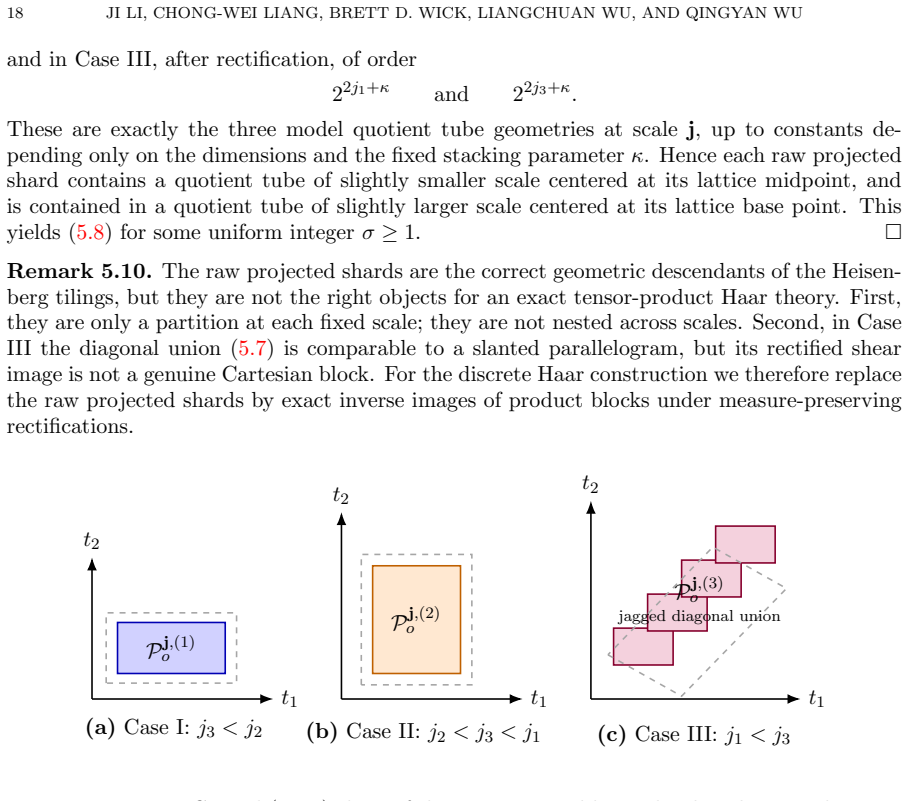
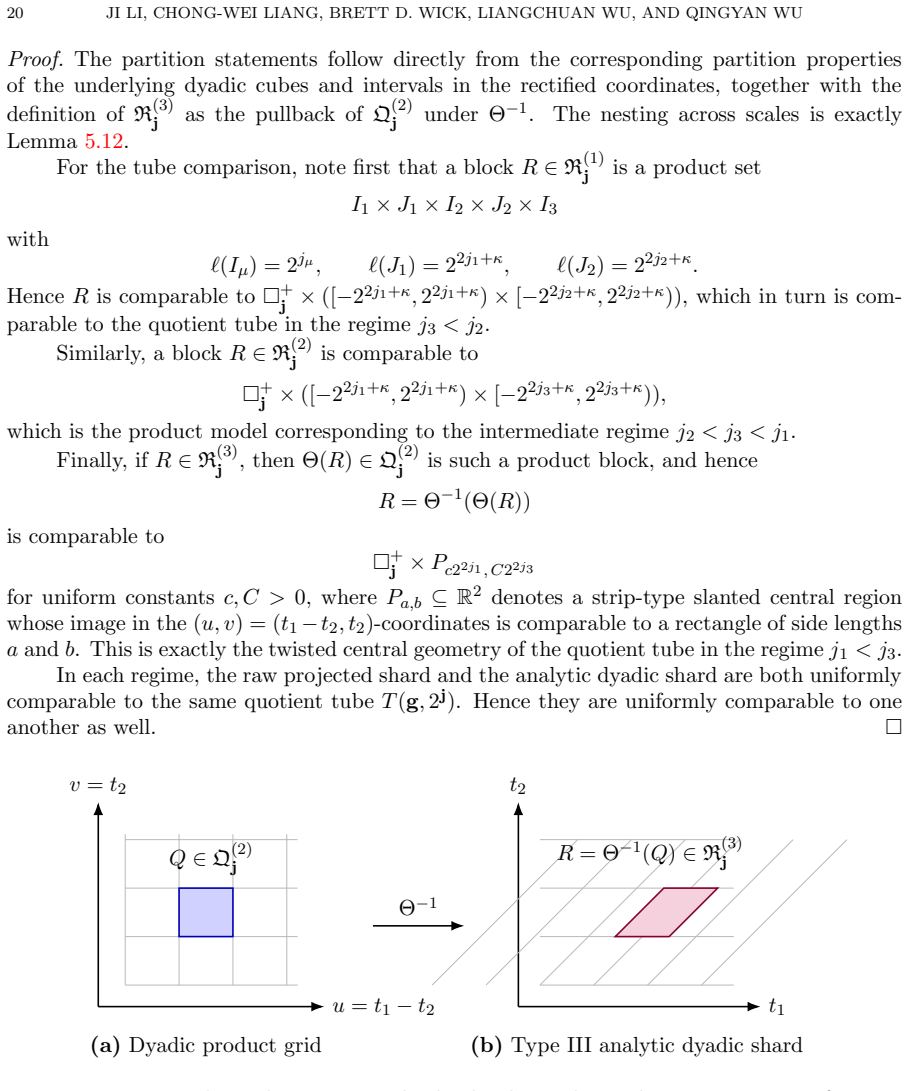
- [final paragraph on twisted dyadic shards] The final paragraph asserts that 'analytic dyadic shards which are exactly rectifiable and remain uniformly comparable to the raw quotient structure in the relevant scale regimes' allow the frames to inherit geometric properties from the lifting group. This comparability and rectifiability claim is load-bearing for the nilpotent Haar frames and the overall extension, yet no explicit estimates, scale regimes, or proof outline are supplied to verify it against the raw projected shards.
- [statements on L^2 bases and tight frame] The claims that each twisted dyadic system forms a complete orthonormal basis of L^2(R^{2m}) and that their union is a tight frame with bound exactly 3 rest on the martingale properties of the filtrations and orthogonality of the Haar functions. Without the specific verification of completeness, orthogonality constants, or how the multi-parameter twisting preserves these in the construction, the frame bound cannot be confirmed as parameter-free or tight.
minor comments (1)
- [Abstract] Several novel terms ('twisted dyadic filtrations', 'raw projected shards', 'analytic dyadic shards', 'twisted nilpotent Haar frames') are introduced without immediate cross-references or brief definitional sentences, which reduces readability in the abstract and early sections.
Simulated Author's Rebuttal
We thank the referee for the careful review and valuable comments on our manuscript. We address each major comment below and indicate the revisions we will make to strengthen the presentation.
read point-by-point responses
-
Referee: [final paragraph on twisted dyadic shards] The final paragraph asserts that 'analytic dyadic shards which are exactly rectifiable and remain uniformly comparable to the raw quotient structure in the relevant scale regimes' allow the frames to inherit geometric properties from the lifting group. This comparability and rectifiability claim is load-bearing for the nilpotent Haar frames and the overall extension, yet no explicit estimates, scale regimes, or proof outline are supplied to verify it against the raw projected shards.
Authors: We agree that the rectifiability and comparability assertions in the final paragraph are central to the extension to the nilpotent group and require more detailed support. The manuscript introduces the raw projected shards reflecting the quotient geometry and then defines the analytic dyadic shards as rectifiable versions. To address this, we will add an appendix or subsection providing explicit estimates for the rectifiability (e.g., bounds on the deviation from flatness) and uniform comparability constants in the dyadic scale regimes. This will include a proof sketch showing how the analytic shards are obtained by rectifying the projections while preserving the measure and geometric properties up to constants independent of the scale. revision: yes
-
Referee: [statements on L^2 bases and tight frame] The claims that each twisted dyadic system forms a complete orthonormal basis of L^2(R^{2m}) and that their union is a tight frame with bound exactly 3 rest on the martingale properties of the filtrations and orthogonality of the Haar functions. Without the specific verification of completeness, orthogonality constants, or how the multi-parameter twisting preserves these in the construction, the frame bound cannot be confirmed as parameter-free or tight.
Authors: The construction of the twisted dyadic filtrations ensures that they are martingales with respect to the twisted multi-parameter structure, and the associated Haar functions are defined to be orthogonal by construction, with the twisting incorporated into the definition of the conditional expectations. Completeness follows from the density of the union of the filtration levels in L^2, analogous to standard dyadic martingales but adapted to the twisted geometry. The frame bound of 3 is obtained because the three twisted systems (corresponding to the different twisting parameters in the multi-parameter setting) cover the space with controlled overlaps, leading to the tight bound independent of the dimension m. However, we recognize that the verification of the exact constants and the preservation under twisting could be made more explicit. In the revised manuscript, we will include a lemma detailing the computation of the inner products of the Haar functions under the twisting and the resulting frame operator being 3 times the identity. revision: partial
Circularity Check
No significant circularity detected
full rationale
The paper's derivation proceeds via explicit constructions: twisted dyadic filtrations on R^{2m} are introduced and adapted Haar bases are built directly from them, with the orthonormal basis and tight-frame properties following as standard consequences of the resulting martingale structure and orthogonality (as asserted in the abstract). The nilpotent extension defines raw projected shards from product fractal tiles on a lifting group, then passes to analytic dyadic shards by asserting rectifiability and uniform comparability; these are presented as definitional steps adapted to the quotient geometry rather than reductions to fitted inputs or prior self-referential results. No self-definitional loops, parameters fitted to a subset and then renamed as predictions, load-bearing self-citations, or uniqueness theorems imported from the authors' own prior work appear in the stated chain. The central claims remain independent of the inputs once the filtrations and projections are fixed, rendering the argument self-contained against external geometric motivations.
Axiom & Free-Parameter Ledger
axioms (2)
- domain assumption Geometric quotient structures of nilpotent Lie groups observed by Nagel, Ricci, and Stein.
- domain assumption Existence of product fractal tiles from a lifting group of Heisenberg products that can be projected while preserving scale comparability.
invented entities (2)
-
twisted dyadic filtrations
no independent evidence
-
twisted nilpotent Haar frames
no independent evidence
Reference graph
Works this paper leans on
-
[1]
S.-Y. A. Chang and R. Fefferman, A continuous version of duality of H^1 with BMO on the bidisc. Ann. of Math. 112 , 1 (1980), 179--201
1980
-
[2]
S.-Y. A. Chang and R. Fefferman, Some recent developments in Fourier analysis and H^p -theory on product domains. Bull. Amer. Math. Soc. 12 , 1 (1985), 1--43
1985
- [3]
-
[4]
Fefferman and E
R. Fefferman and E. M. Stein, Singular integrals on product spaces. Adv. in Math. 45 , 2 (1982), 117--143
1982
- [5]
-
[6]
Y. S. Han, M. Y. Lee, J. Li and B. Wick, Maximal function, Littlewood--Paley theory, Riesz transform and atomic decomposition in the multi-parameter flag setting. Mem. Amer. Math. Soc. 279 , 1373 (2022)
2022
-
[7]
Journ\'e, A covering lemma for product spaces
L. Journ\'e, A covering lemma for product spaces. Proc. Amer. Math. Soc. 96 , 4 (1986), 593--598
1986
-
[8]
Kairema, J
A. Kairema, J. Li, C. Pereyra and L.A. Ward, Haar bases on quasi-metric measure spaces, and dyadic structure theorems for function spaces on product spaces of homogeneous type. J. Funct. Anal. 271 (2016), no. 7, 1793--1843
2016
- [9]
-
[10]
M\"uller, F
D. M\"uller, F. Ricci and E.M. Stein, Marcinkiewicz multipliers and multi-parameter structure on Heisenberg (-type) groups I. Invent. Math. 119 , 1 (1995), 199--233
1995
-
[11]
Nagel, F
A. Nagel, F. Ricci and E. M. Stein, Singular integrals with flag kernels and analysis on quadratic CR manifolds. J. Funct. Anal. 181 , 1 (2001), 29--118
2001
-
[12]
Nagel, F
A. Nagel, F. Ricci, E. M. Stein and S. Wainger, Singular integrals with flag kernels on homogeneous groups: I. Rev. Mat. Iberoam. 28 , 3 (2012), 631--722
2012
-
[13]
Nagel, F
A. Nagel, F. Ricci, E. M. Stein and S. Wainger, Algebras of singular integral operators with kernels controlled by multiple norms. Mem. Amer. Math. Soc. 256 , 1230 (2018)
2018
-
[14]
Pipher, Journ\'e's covering lemma and its extension to higher dimensions
J. Pipher, Journ\'e's covering lemma and its extension to higher dimensions. Duke Math. J. 53 , 3 (1986), 683--690
1986
-
[15]
E. M. Stein, Singular integrals: the roles of Calder\'on and Zygmund. Notices Amer. Math. Soc. 45 , 9 (1998), 1130--1140
1998
-
[16]
Strichartz, Self-similarity on nilpotent Lie groups
R. Strichartz, Self-similarity on nilpotent Lie groups. In Generalized convex bodies and generalized envelopes , Contemp. Math. 140. Amer. Math. Soc., Providence, RI, 1992, pp. 123--157
1992
-
[17]
Tyson, Global conformal Assouad dimension in the Heisenberg group
J. Tyson, Global conformal Assouad dimension in the Heisenberg group. Conf. Geom. Dyn. 12\/ (2008), 32--57
2008
-
[18]
Wang and Q
W. Wang and Q. Y. Wu, Flag-like singular integrals and associated Hardy spaces on a kind of nilpotent Lie groups of step two. J. Geom. Anal. 34\/ (2024), no. 12, Paper No. 373, 51 pp
2024
discussion (0)
Sign in with ORCID, Apple, or X to comment. Anyone can read and Pith papers without signing in.